Our first Australian a visitors arrive today. Doug and Nerida have been friends for over twenty five years and we have done trips down the Volga, up the coast of Norway and through Paris with them but this is the first time we have lived together and travelled. They are flying into Manchester International Airport and we have driven over to collect them. Their arrival is on time and Manchester is much easier to navigate than Heathrow.
After greetings and the short walk to the car, we decide to avoid the motorway on the return journey and by the time we get into Long Eaton it is already dark but their journey through the
villages of the Peaks District gives them a taste of what is to come including unexpected users of the road.

Arriving in Manchester

Delayed getting home

I’m on the footpath
Conscious of the effect of jet lag, we don’t plan much for the next day. Our neighbours John and Pam have told us that Shardlow (a nearby village) has had a glorious history during the great industrial canal era. I don’t need any more than that to make me curious as to what it looks like today.
So I looked on Wikipedia to find the history of the village and it says: “An important late 18th century river port for the trans-shipment of goods to and from the River Trent to the Trent and Mersey Canal, during its heyday from the 1770s to the 1840s it became referred to as “Rural Rotterdam” and “Little Liverpool”. Today Shardlow is considered Britain’s most complete surviving example of a canal village, with over 50 Grade II listed buildings and a large number of surviving public houses within the designated Shardlow Wharf Conservation Area.”
The trip over to Shardlow took little more than 10 minutes and we did not find anything of the past glory. It is cute in some ways but nothing of a “Rural Rotterdam” remains. The most interesting bit was the canal house caught between the canal and the lock

Canal house

View from Long Eaton reach

View of the entry to the Shardlow basin

View to Long Eaton

Over there is the full basin

Tourists!

the Basin today
The next day we showed them around Long Eaton and then a trip was into Nottingham to the caves under the city.
“Nottingham sits upon a soft sandstone ridge which can easily be dug with simple hand tools to create artificial cave dwellings. Indeed Nottingham was once known as Tigguo Cobauc meaning Place of Caves and was referred to as such by the Bishop of Sherborne Asser in The Life of King Alfred (893AD). The caves here are some of the oldest remaining in the city, with pottery finds dating them to 1270-1300, and were inhabited from at least the 17th century until 1845 when the St. Mary’s Inclosure Act banned the renting of cellars and caves as homes for the poor. None of the caves are natural, they were all cut into the sandstone for use as houses, cellars and place of work by the inhabitants of the city.
As of 2014 more than 500 caves in the city have been catalogued, including 100 that were only rediscovered in the last four years. Construction of the Broadmarsh Shopping Centre began in the late 1960s, but the opening up of the caves to vandals and plans to fill them in with concrete caused a public outcry. A detailed study by The Nottingham Historical Arts Society led to the caves being scheduled as an ancient monument and the development plans were subsequently changed to preserve most of the caves. The caves were cleared by volunteers from the 2418 Sherwood Squadron Air Training Corps and Rushcliffe School and opened to public tours by the Friends of Nottingham Museum in 1978.”(source Wikipedia)
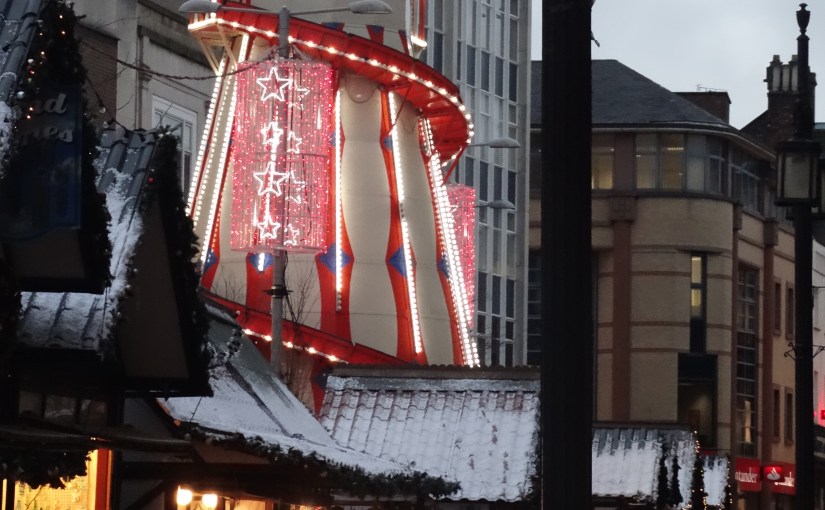
After visiting the caves we took a walk through part of the city and stumbled onto the city square set up as a Christmas wonderland.

Wine bar Nottingham style

Xmas Wonderland
Share this: Feel free to share





 glendon1954