Wollarton Hall Nottingham

August 20, 2014
Wollarton Hall Nottingham
We are both awake early as the electrician is coming this morning, we are joining the rotary meeting at Woolloongabba via google hangout and going to St Mary the Virgin Church to help clean up. The electrician arrived and fitted the new fittings except for one which was for a lamp not a ceiling and provided a solution to the poor lighting in the bathroom – he put in another light which now floods the bathroom so that it is brighter than outside the flat.
In the midst of the electrician’s work we “hang out” with the Rotarians at home. I think that some of them thought it was fanciful that we even try to attend the meeting from 26,000 miles away. Great fun and good to catch up but it feels like we have not left home.
The electrician is still here and we have to give St Mary’s a miss. Finally finished he stands around chatting until 12.00 noon – it was bloody hard to get him here then equally hard to get rid of him.
We decide we will change the lamp shade so into the car (THISTLE) and off to British Home Stores Derby. Oops cannot find the receipt but manage to exchange it anyway at the cost of 2 pounds parking. As we are out and about we decide to visit Wollarton House one of the sights of Nottingham recommended to us by our mates at Nottingham Rotary.
Wollarton Hall is located in the centre of Nottingham (CBD is only 3 miles away) in a very large park by the same name with Europe’s oldest and first cast iron greenhouse, and with herds of red and fallow deer running around. It is an Elizabethan mansion (late 16th century) completed in the same year the Spanish Armada was sunk 1588. (Interesting because this lead to some innovation around sourcing timber for the Prospect Room as the Navy was using every stick for ships). The Willoughby family had been sheep farmers in the county and changed their family name to reflect the wealth they were accumulating (they adopted the locality name). By the time that Sir Francis Willoughby (a Baronet) built this mansion the family were the wealthiest family in Britain next to the Tudors (Elizabeth I). Funny thing is that Sir Francis had a problem with status and wanted to lord it over everyone. So he invited Liz to visit his family home (the one before he built Wollarton Hall) and when Liz did visit her comment was something like – We don’t like the man, nor do we like the wife nor do we like the house. So he built Wollarton – the first place in Britain to have central heating, a bathroom and double glazing but more about that later. Money was no object.
One hundred years later Francis Jnr became a pioneering naturalist so the Hall is filled with stuffed animals and heads on the wall. The practice was continued down the centuries by the family.
As is the fate of these ambitious families someone loses the family fortune and the property falls into disrepair. In this case it was death duties that got them and the house and park has ended up in the hands of the Nottingham City Council and is now a natural history museum the stables are the industrial museum and shops and the park is open to the public (the day we were there it seemed every member of the public).
There was a tour on offer for 5 pounds each and as entry was free we thought what the heck. So as the kids disappeared to see Batman (yes it was a dress up day for the kids) we started our tour in the main hall. Most home for the gentry up to this date were castles or fortified buildings but this was to be a stately manor and they had no template other than a castle or a church so this looks like a castle but is intended to be a house. It is square (the only square manor house in the UK) and has a central court which was entered through stone arches to greet the Lord on his throne. Behind that was the dining room and the kitchens underneath in the basement. I mentioned the Spanish Armada. Well they did not have enough timber to provide the supports to the Prospect Room which is above the centre court. Also they tried to emulate the manner of support of the ceiling with the grotesques at the bottom but instead of support it actually pulled down on the floor. And when the architect could not get the timber he wanted because of the Navy he design a lattice support beam which never did work which meant the Prospect Room which was designed to allow notable guests to view the extent of the Willoughby lands (to the horizon for 360 degrees) all that was safe was a small viewing platform at the top of the stairs 3 storeys above ground. Of course when the Council took it over they put in the correct supports hence the floor today looks unworn although it is over 500 hundred years old.

From the Prospect Room we walked down to traverse a section of the roof (apparently a favoured past time of the Tudor gentry). Here we see the double glazing installed at a time when the government charged a tax on the number of windows but money was no object. The second lord (they climbed their way up to Dukedom also) had installed side doors to the centre court which created a draught and the centre court could not be kept warm so they installed steel pipes behind all fire paces filled with water channelled underground from a cistern installed 3 miles away to carry heat throughout the home (the first heating system) and then later the doubling glazing to contain heat (the first of its kind). On the corners of the house are the bedrooms for the guests starting with the highest ranking having access to the roof.
After viewing the walk we returned into the house and were shown the household safe (a solid steel door) and to protect the inhabitants of the house and the money from the staff at night there were two iron grilled gates and then a heavy wooden door before you got to the staff quarters (prison). Beyond were the Tudor kitchens discovered by the Council when renovating the hall. They are a bright yellow in colour and the Council discovered this was a paint made up of lime wash and pigs urine (the urine acted as a disinfectant). There were three areas to the kitchens and a slaughter room beside the meat salting room.

From the slaughter room we went into an underground tunnel which operated as both a beer cellar wine cellar brandy cellar and the cistern room for collecting the water from that cistern 3 miles away, channelling it through the tunnels to clear the air in the tunnels and ultimately to fill the man-made lake in the park. The tunnels allowed servants to clear the path for the water and to service that cistern and others but they could also call into the “Admiral Rodney “ a pub in the village going to and returning from the cistern.
After existing from the tunnels we viewed the rest of the house in particular the natural history displays and then the stables but they were closed – we had run out of time. After all was said and done a most interesting visit to see a Tudor household as it might have been.


Although I forgot the big camera we are starting to get prepared and I had the small camera in our travel pack and took some pictures and here they are:
• the Hall, its grounds,

  • some of the “heads of the household”
  • the centre court,
  • the Prospect Room
  • the view to the horizon, and
  • the stables (bigger than some other stately homes)
    • The bathroom (between the floors of the Prospect Room and below was the first indoor bathroom in Britain)
    • The kitchens and slaughter room
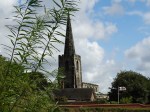
Attenborough, the Cromwell connection and St Mary the Virgin church

Monday August 11

Attenborough, the Cromwell connection and St Mary the Virgin church

Last night we reacquainted ourselves with the Rotarians of the Nottingham Rotary Club. We will do more with the Club and have already volunteered to do some fund raising next week.

The following day we took it pretty easy. I said earlier that I had something about Oliver Cromwell and his connection to Long Eaton. Well his son-in-law Henry Ireton was born at Attenborough in 1611 and the place of his birth (much renovated) still stands there today. Attenborough is the next to Long Eaton between Toton and Chillwell.

Ireton ended up a general in the English Parliamentary Army during the English Civil War and died of fever in Ireland in November 1651. He was baptized at St Mary the Virgin Church (more about the church shortly) graduated BA in 1629 from Trinity College Oxford in 1629 and entered the Middle Temple (one of the exclusive inns of barristers in London). Ireton joined the parliamentary army and engaged in his first battle in 1642 and fought in 5 campaigns until being wounded at the Battle of Naseby whilst commanding the left wing of the attacking force before being freed by Cromwell’s right wing of the force in September 1645 and thereafter entered parliament in October as the member for Appleby and after fighting in the siege of Oxford married Cromwell’s daughter (and step daughter of General Fleetwood) Bridget Fleetwood (who after being widowed from Ireton married her step-father the General).

Unlike Cromwell, Ireton supported the idea of a constitutional Monarchy and conducted lengthy negotiations with the Army and the King (Charles I) to try and achieve this outcome for the Civil War but he became convinced of the hopelessness of dealing with Charles after the King’s flight to the Isle of Wight. He was to later sit on the King’s trial and was one of the commissioners to sign the death warrant for Charles.

He accompanied Cromwell to Ireland for his Irish campaign in August 1649 and was elevated to the rank of Major General and placed in charge of the New Model Army in Ireland when Cromwell returned to England to invade Scotland. He died of fever after the successful siege of Limmerick and was buried at Westminster Abbey under the Arms of the Commonwealth of England Scotland Wales and Ireland (the Kingdom having ceased with the beheading of Charles I). However following the restoration of the King in 1660 Charles II exhumed the corpse from Westminster along with Cromwell and John Bradshaw (all of whom signed the death warrant for Charles I) on January 30 1660 (the anniversary of the beheading of Charles I) and mutilated the corpses.

Now as to St Mary the Virgin church it still stands in Attenborough having stood in one form or another for 1000 years (they have found evidence of a wooden Saxon Church and remnants of a Norman Church in the grounds and todays building). We have volunteered to attend a working bee at the church and are interested in doing further activities for the community through the church.

I have attached the photos showing:

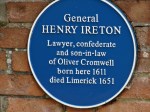
  • The Ireton memorial and todays house
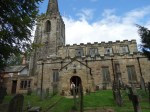
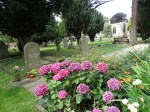
  • The St Mary the Virgin Church and graveyard.

Since I first wrote this article Kerry and I have joined the maintenance crew at the church to do a spot of cleaning up.Kerry trimmed bushes whilst I cleaned storm water drains and mowed amongst the tombstones. Here is the photographic evidence.

First Working Bee
First Working Bee

Go back

Your message has been sent

Warning
Warning
Warning
Warning

Warning.

Sherwood Forest, Thoresby Abbey, Rufford Country Park and Wellsby Abbey


August 13, 2014
Sherwood Forest, Thoresby Abbey, Rufford Abbey Country Park and Wellsby Abbey
It is Wednesday our wedding anniversary so we have planned to catch up with Ingrid and John Pears plus revisit Thoresby Abbey. Ingrid is a world renowned glass blower with her furnace and shop at Thoresby courtyard and past President of the Nottingham Rotary Club. Thoresby is now a Warner Hotel but Warner has restored the Abbey magnificently. It is about 55 minutes north of Long Eaton.
On the way (as usually happens) we were distracted with a sign to Newstead Abbey but the Abbey building is closed during the week. This diversion meant that we approached Thoresby from a different direction and we ran into Rufford Abbey Country Park. Rufford is now a ruin but has an interesting history. The Abbey was founded by Cistercian monks in 1147. Henry VIII closed the Abbey and it ended up in the hands of the 4th Earl of Shrewsbury and converted to a country house. Now remember Bess of Hardwick. One of her husbands was the Earl of Shrewsbury so the Abbey might have ended up in the hands of the Cavendish family except that it passed along the female line and ended up in the hands of the Saville Family until sold to Nottingham County Council in 1952 and became England’s first country park. It is 150 acres in size and regularly frequented by families.
Below you will see photos of the Abbey as is today showing
• The interior ground floor of the monks quarters
• The base of a corbel (support for the upper floor) and its grotesque
• One part of the under croft with displays of abbey furniture and
• The other part showing the lay monks quarters and
• What is now called the Orangeries but started life as a bath house with a swimming pool (in 1740 this was quite unique) and the view from the Orangeries to the grounds.

You can read more at website: http://www.Nottinghamshire.gov.uk/ruffordcp

We then moved on to the only remnant of Sherwood Forest remaining. Mining and logging over the years has decimated the forest and the Brits are desperately trying to hold on to this little bit. It is near the village of Edwinstowe and includes a visitor centre and various walks in the forest. We took the walk to Major Oak said to be the tree Robin Hood and men used as a hiding spot because the trunk has a cavity which can hold 13 men. All of the good oak trees have been cut out leaving the stunted and diseased but even these have grown to enormous proportions over 800 years. In Robin’s time the forest was a Royal Hunting Forest made up of villages open heath woodland sunny glades and farmland. I was surprised to learn that the ecology of the forest is quite unique and includes 200 different species of spider and 1500 species of beetle.
I have given you below photos of
• The entrance to the visitors centre
• Major Oak (11m in circumference and longest limbs being 28m)
• An eagle and a hawk at the visitors centre

• The Robin Hood supply wagon

• and us enjoying a cuppa

You can read more at website: http://www.Nottinghamshire.gov.uk/sherwoodcp

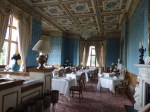
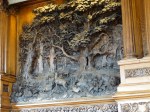
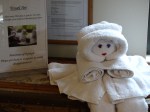
Finally we made our way to Thoresby. Having been there before we went straight to the Courtyard (the former stables turned into a retail centre for the hotel) in the hope of catching up with Ingrid and John. We had heard that Ingrid had been ill so it came as no real surprise that her studio was closed. So we went to the hotel to have lunch but ended up visiting the restored abbey because it is so outstanding. I have attached photos of the:
• the entrance to the courtyard
• the abbey in the distance
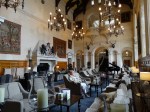
• the grand hall
• the blue room restaurant and the hand-made silk wall paper costing 500 pound per metre
• a carving of “major oak” and
• examples of towel art


You can read more at website: http://www.warnerleisurehotels.co.uk
There is reference in the tourist guides to the “the Dukeries” which is a reference to the 4 great ducal estates in the region south of Worksop. The Duke of Newcastle (Clumber House – no longer there) Duke of Portland (Welbeck Abbey – questionably there) the Duke of Kingston (Thoresby Hall) and the Duke of Norfolk (Worksop Manor). To find out more about the Dukeries and to get some lunch we went to Welbeck Abbey. We were puzzled by the crowds of people visiting this former abbey which is now just a group of shops selling plants to produce. Not worth the visit unfortunately and no photos.

Attenborough Nature Reserve and the Canal

Sunday August 10
Attenborough Nature Reserve and the Canal
There are a lot of places of interest around Long Eaton and in the shires generally. Last Sunday we visited the Attenborough Nature Reserve (not named after Richard Attenborough but named after the community in which it is located between Long Eaton and Nottingham). This area now 250ha in size started as a gravel pit and dumping ground for the fly ash from the nearby power station. It is now Britain’s second largest and second most popular nature reserve with over 50 species of bird living / visiting the water ways created by the extraction of gravel and return of the surface clays to create the ponds. There are long walks through the reserve and a conservation centre with information on the site. We took a free guided tour through part of the reserve and here are some of our photos.
Photo of the centre and our walk.

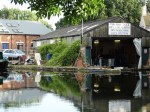
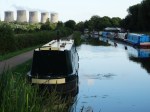
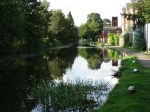
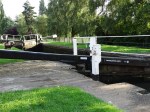
Within 100m of our flat is the Erewash Canal. Built in 1776 by a consortium of local merchants (collieries brick works and engineering workshops) it was the transport for all of the produce of the area until the railway started in 1846. It is approx. 13 miles long and joins the River Trent which flows to the North Sea. The locals chipped in 100 pounds each to cover the cost of 23,000 pounds to build and the cost came in under budget. There are 9 locks along its course raising the height of the canal 109 feet.
After the railways were developed the canals gradually lost commercial value and fell into disrepair. In 1969 the community formed a preservation group to restore the canal for recreational purposes. Today there is a fabulous walk down to the River Trent and there is a variety of wildlife and hedgerows along the way (about one and one half hour round trip flat to the pub [not allowing drinking time] and back). The canal is full of swans with their goslings and many other water fowl. It is also home to a canal boat industry with many variety of boat and industry supporting the boats along the canal. Here is a collage of the scenes I have viewed on my walk.


Go back

Your message has been sent

Warning
Warning
Warning
Warning

Warning.