
Once again the day started brilliantly. Clear skies and truly brilliant sunshine suggested a magnificent day. Our goal was to get to Oban on the west coast travelling down Loch Ness past Urquhart Castle onto Fort Augustus and Loch Oich. From there we wanted to be in Fort William for lunch, visit the Highland Museum and then go onto Oban to sup a dram of their wee fine spirit.
Travelling through Inverness to the Loch took no time at all. The ruins of Urquhart Castle seemed little changed from 1990 except there was now a visitor’s centre and a fee for admission. We had seen enough ruins so we moved on quickly enjoying the scenes across the Loch. Nerida had the desire to drink from the Loch. After some whining from the back seat, I stopped and granted her wish. It was at this time she was certain she saw a large dinosaur looking animal in the water – I told her it was her reflection and beat a hasty retreat to the car. After she had her drink and promised no retribution for the Nessy crack, we moved on to Fort Augustus.


In the aftermath of the Jacobite rising in 1715, General Wade built a fort (taking from 1729 until 1742) which was named after the Duke of Cumberland. The fort was captured by the Jacobites in April 1745, just prior to the Battle of Culloden. In 1867, the fort was sold to the Lovat family, and then passed to the Benedictine order. The monks established Fort Augustus Abbey and later a school. In 1998 the monks abandoned the site, and it reverted to the Lovat family which in turn sold it.
Of principal interest to us was the series of locks in the centre of the village. The Caledonian Canal connects the Scottish east coast at Inverness with the west coast at Corpach near Fort William. It was constructed in the early nineteenth century by engineer Thomas Telford, and at Fort Augustus it has 5 locks giving access into Loch Ness for traffic from the Irish Sea. Intended for commercial traffic it appears now to be principally pleasure craft. Very picturesque.


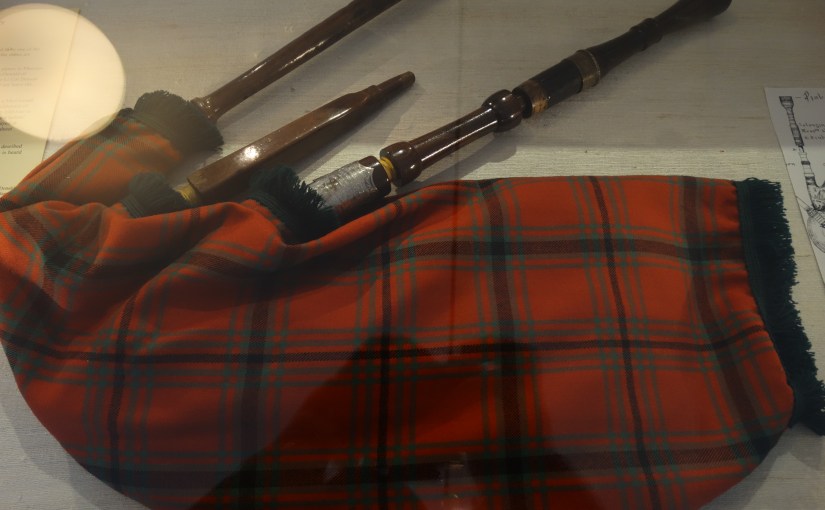
The trip into Fort William was equally pleasant. Sunshine, a fair wind and great scenery made the trip very pleasant. On arriving in Fort William we made our way to the Western Highland Museum on Cameron Square. Although not what I expected it was very interesting. One of the features for me was a set of bag pipes said to have been played in battle in 1344. Who keeps old bag pipes for 670 years?
“The West Highland Museum is one of the oldest museums in the Highlands. It was founded in 1922 by a group of local enthusiasts led by Victor Hodgson, who had neither a collection nor a building to display it in. In 1925, after several temporary exhibitions and the acquisition of significant collections, the Museum launched a fundraising appeal, and in 1926 purchased the present building, a former branch of the British Linen Bank.” See their web page http://www.westhighlandmuseum.org.uk/about/.


Fort William is the 2nd largest settlement in the highlands and a major tourist centre with Ben Nevis nearby. Named firstly after King William (William of Orange) and then renamed only to be named after the Duke of Cumberland it was established firstly during the English Civil War by Oliver Cromwell and reinforced as a fort against the Jacobites and the uprisings during the first part of the 18th century with the present township developing around it. The Caledonian Canal finishes near here with 8 locks.


Neptune’s Staircase at Banavie, near Fort William just north of Loch Linnhe is the longest staircase lock in Britain lifting boats 64 feet (20 m). It consists of eight locks, each 180 feet (55 m) by 40 feet (12 m) and it takes about 90 minutes to pass through the system.


 glendon1954