The Retirees go Abroad – The Osminton White Horse, T. E Lawrence’s house Cloud Hill, Thomas Hardy’s birthplace and Max Gate, Durdle Door, the Jurassic Coast and Jordan Hill Roman Temple.

We started the day looking out the breakfast room window at the rain. As predicted by the BBC weatherman it was raining and quite heavily. Our plans had allowed for this development. In the morning we would visit T. E. Lawrence’s home Cloud Hill, and Thomas Hardy’s birthplace and home with a visit to Durdle Door in the afternoon when it stops raining.

Once behind the wheel of Thistle, Kerry drove east out of Weymouth with me in the co-pilot’s chair. We had been travelling for about 5 minutes when I noticed a large horse drawn on the hill opposite. Just last night Kerry had asked me to find the white horse on the hill and there it was. Well not the one she wanted but it is a horse drawn on a hill. The Osmington White Horse is a hill figure sculpted in 1808 into the hill just north of Weymouth. The figure is of King George III who regularly visited Weymouth and made it the first resort riding on his horse. It is 280 feet long and 323 feet.

We moved on. Kerry really wanted to follow the coast line and it appeared there just is not a coast road. I spotted a road running off toward the coast and Kerry wanted to follow it to see where it went. The road led us to a private road and a sign stating that there was a £5 charge to use the road. One irritating thing we have encountered down here is that you have to pay for parking everywhere. Now having to pay for the use of the road was just the end. So we proceeded in another direction to the top of the hill and a view to Portland and the bay in front of Weymouth.

The rain was once again falling consistently as we approached Cloud Hill. We were quite surprised that the car park was full and the cottage was next door to the Tank Museum and down the road from the Tank training grounds. It turned out that this was Lawrence week commemorating 80 years since his death. There was a special set of lectures on the man and we sat in on one before viewing the cottage. Of course we are talking about Lawrence of Arabia who ended up trying to find obscurity as a private in the tank corps hence he bought Cloud Hill just down the road from the tank training grounds. The cottage was quite eccentric. No toilet and one room lined in aluminium.

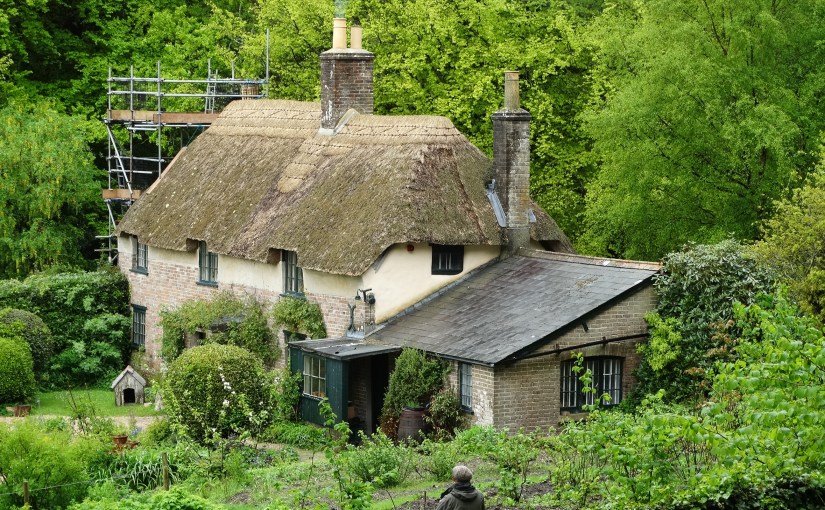
One of his mates was Thomas Hardy author of many books and poems notably “Far from the Madding Crowd”. Hardy was born in a cottage built by his great grandfather on land loaned to him by his master and there the family stayed until the Hardy’s were no more. It is a simple house and was acquired by his sister Kate who donated it and Max Gate to the National Trust. Recently the trust has incorporated a new visitors centre and woodland walk to the house.

Hardy qualified as an architect and worked in that profession until he could become a full time author. He designed Max Gate just outside Dorcester and also designed three extensions. Here he wrote most of his books and poems and his first wife Emma died. He then married his secretary Florence 39 years younger than him but he was preoccupied with the death of Emma for most of his second marriage until he died in 1928. When Florence died twelve years later Kate bought Max Gate at auction and along with the Hardy’s home gifted both to the trust.

The rain had largely stopped and the sun made a tentative appearance. So we headed for the coast and Durdle Door. On arriving it was quite cold with the wind off the English Channel. Kerry made the lunch whilst I made the tea and we sat in the car out of the cold to eat lunch. Following lunch we changed shoes to walk the trek to Durdle Door. Although only 15 minutes walk it is down a very steep and well trodden path which today was very muddy with the rain, covered in puddles and the churned up chalky soil from the traffic of human feet. Stunning coast line. Chalky cliffs lookout to the sea and the more solid stone of Durdle Door braces against the buffering sea. The stumps of a fallen coastline surface above the waves to remind us of the past. As we stood dreaming looking at this coast, I noticed a squall moving from Weymouth towards us so we hightailed it up the hill back to the car. The steepness of the hill meant that we were caught and not only did we drag mud back to the car but we had very damp jackets to dry out.

We then moved on to Lulworth Castle. I had noticed signs about this place and as it was nearby we decided to investigate. Unfortunately time was against us and the castle had closed by the time we drove in the gate. As though knowing that we were turning for home the rain stopped. So we had one more shot at visiting another site – Jordan Hill Roman Temple. We punched in the site into Tommy and headed in the direction of home. The site turned out to be within 5 minutes of our B&B at Weymouth. Not much to look at and as usual with Roman ruins in a curious spot between houses.

Another big day comes to an end.

Go back

Your message has been sent

Warning
Warning
Warning
Warning

Warning.

The Retirees go Abroad – Dorchester, Piddlehinton, Puddletown, Corfe, Corfe Castle and Kingston Lacey

It’s Wednesday, another sparkling day and its market day in Dorchester. After breakfast we bundle into the car and travel the few miles to Dorchester and its markets. Disappointing in that it is more flea market and very little else. Not to worry we stroll the mall in Dorchester.  The author and poet Thomas Hardy based the fictional town of Casterbridge on Dorchester, and his novel The Mayor of Casterbridge is set there.  So is the book Far from the Madding Crowd.

Hardy’s childhood home is to the east of the town, and his town house, Max Gate, is owned by the National Trust and open to the public. Hardy is buried in Westminster Abbey, but his heart was removed and buried in Stinsford one mile east of Dorchester.

As we walked around the town we found in one alley a historic plaque claiming that Hardy was born in that very lane and another plaque claimed the building was the house on which Hardy based the Mayor’s house in Casterbridge. We also found the museum, Judge Jeffries coffee shop and an old arcade claiming by inscription on it facade to be built in 1661.

I was fascinated by some of the town names in the surrounding area and it was all because of a river – the River Piddle. Piddlehinton sits on the river and is a few minutes east of Dorchester. The village has one public house called The Thimble, but no shop or post office. It is quite picturesque. Like many of the surrounding villages it takes its name from the river running through it.

Then we went a few miles to the east and came to Puddletown also on the River Piddle but the wise folk of this village had the good sense to change the name from Piddle to Puddle. Many times larger than Piddlehinton, Puddletown was still very quaint and had many thatched roofed houses. We took a walk around the town, took a photo of the River Piddle flowing through it some of the thatched houses and notable buildings. Thomas hardy used Puddletown as the basis for Weatherby in his book Far from the Madding Crowd.

It was lunch time. We had purchased a small loaf of corn bread at the markets in Dorchester and we were looking for somewhere green and out of the wind to make a sandwich and have a cup of tea. Nothing offering in Puddletown we moved onto Corfe Castle, Dorset’s most recognised ruin. We found a spot off the main road between the visitors centre and the castle and beside a field of sheep with their new black lambs. No lamb chops for lunch – a little too close to the bone.

After lunch we walked the quarter mile to the visitors centre only to be told that we had to produce our pass at the castle village. So we walked back to the car then walked the quarter mile to the village and the National Trust office to be told that we had to produce our card at the castle gate. Fortunately the castle gate was only 50 metres away but the castle was atop a hill – a big hill. A little bit of the history of the castle.

Corfe Castle is a fortification standing above the village of the same name on the Isle of Purbeck in the English county of Dorset. Built by William the Conqueror, the castle dates back to the 11th century and commands a gap in the Purbeck Hills on the route between Wareham and Swanage. The first phase was one of the earliest castles in England to be built using stone when the majority were built with earth and timber. Corfe Castle underwent major structural changes in the 12th and 13th centuries.

In 1572, Corfe Castle left the Crown’s control when Elizabeth I sold it to Sir Christopher Hatton. Sir John Bankes bought the castle in 1635, and was the owner during the English Civil War. His wife, Lady Mary Bankes, led the defence of the castle when it was twice besieged by Parliamentarian forces. The first siege, in 1643, was unsuccessful, but by 1645 Corfe was one of the last remaining royalist strongholds in southern England. In March that year Corfe Castle was demolished on Parliament’s orders. Owned by the National Trust, the castle is open to the public. It is protected as a Grade I listed building and a Scheduled Ancient Monument.

What this short extract does not tell you is that the family built a home at Kingston Lacey when the castle was destroyed on a parcel of land that came with the 8,000 acres purchased from Hatton. Included on the land are villages the castle and farms. On the death of the last Bankes to live in the house, he bequeathed it (the whole 8,0000 acres, house, castle, villages and farms) to the National Trust – the single largest bequest received by the Trust. So after a short trip around the village of Corfe, we ventured off to Kingston Lacey.

Kingston Lacey is an ornate manor home set in wonderful gardens which we did not have time to visit. Inside the house is the original furnishings and art work – nothing sold all just given to the Trust. The artwork includes originals by the Venetian painter Tintoretto.

A snapshot of the history  is as follows. Kingston Lacy is a country house and estate near Wimborne Minster, Dorset, England, now owned by the National Trust. From the 17th to the late 20th centuries it was the family seat of the Bankes family, who had previously resided nearby at Corfe Castle until its destruction in the English Civil War after its incumbent owners, Sir John Bankes and Dame Mary joined the side of Charles I. They owned some 8,000 acres (3,200 ha) of the surrounding Dorset countryside and coastline.

We finished with a cup of coffee in the cafe and then after a tiring day made the trip back to Weymouth.

Go back

Your message has been sent

Warning
Warning
Warning
Warning

Warning.