

Spring is supposed to be just round the corner but someone forgot to tell Mother Nature – it is still cold and wet. You learn that you make do with the weather otherwise you would never leave your flat. So we rug up and then travel south west to Kinver Edge to see the Holy Austin Cave Houses.
Kinver Edge is a high heath and woodland escarpment just west of Kinver, about four miles west of Stourbridge, and four miles north of Kidderminster, and is on the border between Worcestershire and Staffordshire, England. It is now owned by the National Trust. Kinver Edge is home to the last troglodyte dwellings occupied in England, with a set of complete cave-houses excavated into the local sandstone. One of the rocks, “Holy Austin”, was a hermitage until the Reformation. The Holy Austin rock houses were inhabited until the 1950s. They are now owned by the National Trust. The cottage gardens and an orchard are being replanted and restored.
The heathland and woodland on Kinver Edge are inhabited by wildlife, including adder and common lizard present on the heaths, and Common Buzzard, Eurasian Jay, Great Spotted Woodpecker, badger, red fox, and many other bird species present in the woods. The area around the summit is mainly heathland, with birch, oak and sweet chestnut trees in the woods at the northern end.
We had an enjoyable time and shared some of our travel stories with one of the volunteers in the tea rooms. He is an avid mountain climber and walker and gave us some great tips about the Severn Railway – a steam locomotive trip from Blewly to Bridgeford North and the Malvern Hills. We teased him with stories of climbing Mt Kosciusko and the Glass House Mountains.
We went back to the village of Kinver Edge and had lunch at the White Hart pub (very disappointing). The village is very pretty and includes antique and second hand shops and some buildings that look as though they are from Tudor times.


Kinver Edge is south west of Birmingham (very industrial and dirty scenery as we passed around it) and south of Wolverhampton (home of the Wolverhampton Wanders) and whilst a big city seemed more hospitable than Birmingham. So we told tommy we wanted to call in at Mosely Old Hall.
This is what Wikipedia says about the Hall. “Moseley Old Hall is a National Trust property located in Fordhouses, north of Wolverhampton in the United Kingdom. It is famous as one of the resting places of Charles II of England during his escape to France following defeat at the Battle of Worcester in 1651.
Charles II’s father, King Charles I, was executed at Whitehall on 30 January 1649, at the climax of the English Civil War. Cromwell then defeated Charles II at the Battle of Worcester on 3 September 1651, and Charles fled to mainland Europe.
The Hall was built in 1600 and was the home of the Whitgreaves, a local Staffordshire family, mostly Catholics and Royalists. Thomas Whitgreave assisted Charles II when he arrived in the early hours of 8 September after the journey from Boscobel House. Thomas gave the King dry clothes, food, and a proper bed (his first since Worcester on 3 September). The King was hidden in the priest-hole for two days whilst planning the route for his escape. He was accompanied by the family’s Catholic priest John Huddleston who cleaned and bandaged the King’s feet.
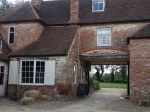
Descendants of the Whitgreave family owned the house until 1925, and during that time made few structural changes, apart from encasing the Hall with brick walls and replacing the Elizabethan windows. After the 1820s, it appears to have been abandoned as the family home, in favour of Moseley Court, a new Regency style house built for George Whitgreave. It was used as a farmhouse until the Second World War but was suffering from neglect when the National Trust took it over in 1962. It is now fully restored, and furnished with generous donations of period furniture. The original four-poster bed used by Charles stands in the King’s room.”
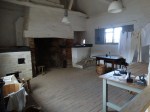
We arrived close to closing time and had missed the last tour so we guided ourselves with the help of some written notes. On entering through the same door as Charles II (the back door) we went into the brew house (kitchen – as you could not drink the water in those days they brewed beer as the common drink, hence the brew house). Here we met one of the guides who gave us a bit of a short run down on a few things.
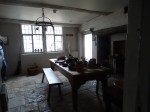
In my pictures below you will see a picture of a kitchen table and on the table you will see some black jugs. These are actually made of leather and coated in pitch to preserve and stiffen it. The small one is a “pitcher” after the coating and the large one is a “bombardier” for God only knows what reason.
You will also see a wooden square plate. This was the servants dish and from this came the phrase “a square meal”. The third thing to note is the straw on the stand. The straw would be coated in animal fat and lit at both ends and were used instead of the more expensive candles. From this comes the saying: “burning the candle at both ends”.
We then went up stairs to the King’s Bed Chamber and checked out the “priest’s hole” where the good king hid from the pursuing army. The house reminded us of the visit to Little Moreton in Cheshire and we were right – it is a timber house over which a brick exterior has been constructed. The attic contained the chapel – quite unusual but I guess it is a hangover form the persecution of Catholics at this time. Although only a short visit (about an hour) it was enough time to take in all we needed to see and know about this famous hall.







 glendon1954