

Between returning from Scotland and leaving for France, we had a window of opportunity which I have called “the Interval”.
During these few days we visited Southwell Minster north east of Nottingham, Haddon Hall north west of Nottingham and London (I presume you know where that is). This blog concerns Southwell (pronounced “Suthull” by Nottinghamites and “South Well” by its residents – work that out). Norwell (pronounced “Norrell”) approximately eight miles northwest may support the notion of there being “south” and “north” wells in the area.
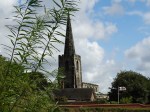
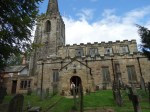
Southwell is a town in Nottinghamshire, best known as the site of Southwell Minster, the seat of the Church of England diocese that covers Nottinghamshire. The town lies on the River Greet, approximately 14 miles (22 km) northeast of Nottingham.
The early history of this Minster as noted by Wikipedia: “Eadwy of England gifted land in Southwell to Oskytel the Archbishop of York, in 956. Eadwy’s charter is the first dated reference to Southwell. Evidence of a tessellated floor and the 11th-century tympanum over a doorway in the north transept are evidence of the construction of the minster after this time. The Domesday Book of 1086 has much detail of an Archbishop’s manor in Southwell. A custom known as the “Gate to Southwell” originated after 1109 when the Archbishop of York, Thomas I wrote to every parish in Nottinghamshire asking for contributions to the construction of a new mother church. Annually at Whitsuntide the contributions known as the “Southwell Pence” were taken to the minster in a procession that set off from Nottingham headed by the mayor followed by clergy and lay people making a pilgrimage to Southwell’s Whitsun Fair. The Southwell Pence was paid at the north porch of the minster to the Chapter Clerk. The name of this custom – the Southwell Gate – derives from the Scandinavian word “gata” meaning street or way to. In its original form it persisted well into the 16th century. In 1981 Dolphin Morrismen revived the tradition.
Geoffrey Plantagenet was ordained as a priest at Southwell in 1189. On 4 April 1194, Richard I and the King of Scots, William I, was in Southwell, having spent Palm Sunday in Clipstone. King John visited Southwell between 1207 and 1213, ostensibly for the hunting in Sherwood Forest, but also en route to an expedition to Wales in 1212. The Saracen’s Head was built in 1463 on land gifted in 1396 by the Archbishop of York, Thomas Arundel, to John and Margaret Fysher. When built, the first floor overhung the roadway in the vernacular of the time.
In 1603, James VI of Scotland passed through Southwell on his way to London to be crowned King James I. During the English Civil War, King Charles I spent his last night as a free man in May 1646 in the Saracen’s Head (then the King’s Head), before surrendering to the Scottish Army stationed at nearby Kelham. The fabric of the town, the minster and Archbishop’s Palace suffered at the hands of Oliver Cromwell’s troops, as they sequestered the palace as stabling for their horses, broke down monuments, and ransacked the graves for lead and other valuables. In 1793, iron rings fastened to the walls to secure the horses were still in situ. The end of the civil war left the Archbishop’s Palace in ruins apart from its Great Hall. It is reputed that Cromwell also stayed in the King’s Head.”


So you can see that this small town (around 7,000 people) has played a big part in bits of history of the UK. The Archbishop’s Palace was home to Cardinal Wolsey who was Henry VIII’s advisor and when unable to secure Henry’s divorce from Rome Wolsey hid out at Southwell until summons by Henry to London but fortunately for Wolsey he died on his trip back to a trial and execution planned by Henry.
The Saracen’s Head is still there. It changed its name from the King’s Head when Charles lost his head. So we visited the Minster and the pub. Whilst at the Pub we picked up this fascinating leaflet on the history of the hotel which told us more of the story of Charles I last meal than the dry facts given by Wikipedia. Remember that in 1642 Charles had raised his standard at Nottingham Castle to signal the beginning of the Civil War. By 1646 the Royalist Army had been all but defeated or surrendered. After the Battle of Naseby Charles realised he needed the Scots to help him defeat the Parliamentarians.
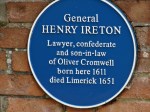
The leaflet told us that Charles escaped from London and went to the Inn disguised as a Clergyman with his clerk to meet with the Scottish commissioners then in Southwell Minster with a regiment of Scottish soldiers. You may recall in earlier blogs I have written about Cromwell’s son in law Henry Ireton and how he was negotiating with Charles around accepting a role as constitutional monarchy. Well the Scots were talking to Charles about supporting him if he accepted Presbyterianism as the religion of England and Ireland amongst other things.
So Charles revealed himself to the Scottish general and started negotiations to have the Scottish forces join his Royalist Army. However he prevaricated so much (as he was doing with Ireton) and refused to sign an agreement that the Scots who left Southwell and marched with Charles as their “prisoner” to Kelham outside Newcastle where they treated with Cromwell’s Parliamentary army and handed over Charles in exchange for 400,000 pounds. And, as they say the rest is history and Charles lost his head at Whitehall on January 30, 1649.
Whilst at the pub and we saw a copy of Charles I death warrant signed by Parliament and in particular Cromwell and Ireton. The leaflet says that as well as Charles I many other notable people stayed at the Inn, namely:
- Lord Byron (who lived close by),
- Cardinal Wolsey of course
- Kings of England, Richard I, Richard II, John, Henry II, Edward I, Edward II, Edward III, and Edward IV
- King of England and Scotland James I
- Charles Dickens – he was a very wide travelled individual as he has popped up as a visitor in many places we have been; and
- The Beatles


So well worth a visit to this village and see the Minster (there are displays of the remains of an old Roman villa under the Minster visible, Saxon “bread” pews and Norman and Gothic architecture), the ruins of the Archbishops Palace and the restored Great Dining Hall and the Saracen’s Head (so named as the sword used to behead Charles was a Saracen sword)





 glendon1954