The Retirees go Abroad – Sherwood Forest and a Bakewell Tart

One of the things on the bucket list for Rod was a visit to Sherwood Forest. There is not much of the original forest remaining but there is a section of the forest containing “Major Oak” a thousand year old oak tree rumoured to be one of Robin’s hiding places in the forest. Without thinking we prepared and took a BBQ for lunch in the forest.

On arriving at the car park we were met with a sign “NO BBQS IN THE FOREST”. Ah well we had come all this way so we walked to Major Oak and completed the circuit to the visitors centre. Having fulfilled the bucket list wish we set off for Clumber Park as we were told it was permitted to BBQ in that park. Clumber is near to Sherwood Forest is a National Trust property and does have a place for BBQs – an open field with no facilities. We had purchased a disposable BBQ from Tesco and some kebabs to cook. The wind was still gusting so we manoeuvred the car to form a wind break, lit the BBQ and waited to cook lunch. A memorable BBQ because of the laughs we had trying to cook in that wind with that BBQ.

A visit to Sherwood Forest is not complete without visiting Thoresby Abbey and Ingrid Pears Glass Works. Ingrid was still there working busy with curious tourists. But our goal was to visit the Abbey show Rod and Kerry the restoration performed by Warner Hotels and to enjoy a hot liquor coffee.

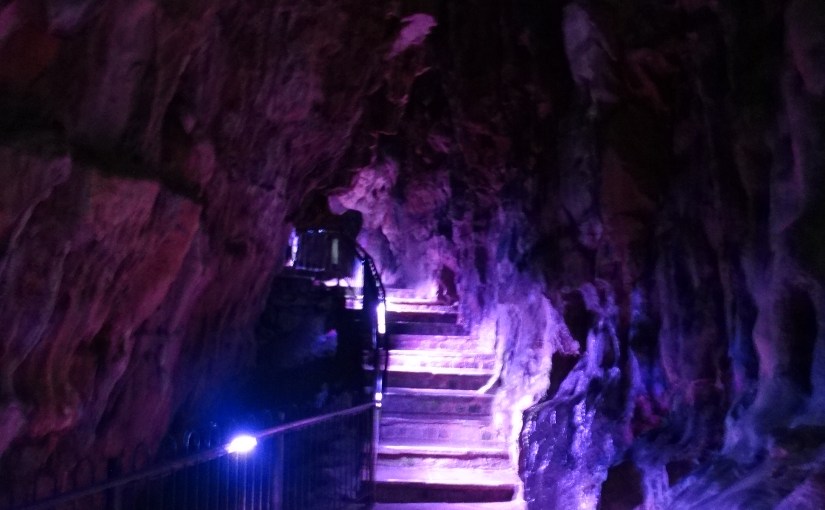
The next day was relax and pack day. But we managed to fit in a trip to Bakewell so that Rod could try a genuine Bakewell Tart and then over to Buxton to visit Poole’s Cavern and see the limestone cavern. To finish off the day we walked some part of the way along Erewash canal to Trent Lock then to the Bulls Head in Breaston for dinner. Early to been this night for tomorrow we drive to Gatwick Airport to farewell Rod and Kerry and collect David and Veronica.


Go back

Your message has been sent

Warning
Warning
Warning
Warning

Warning.

Retirees Go Abroad – Ordinary Lives living in the UK – Poole’s Cavern

One of the things that Kerry misses over here is the grandchildren. But she now has time to knit so all of those having children (Ben and Phadera, Damien and Barbara, Robert and Dana) are the beneficiaries of her cluckiness as she knits shawls for all of these new borns. We purchased the pattern (and the first lot of wool) in Sheringham in Norfolk. Then having pulled her hair out over the difficulty of the square shawl she decided to knit the round pattern, ran out of wool bought more wool in Buxton in Derbyshire only to find it was not the same shade of white and the pattern seemed to be inaccurate and she abandoned the trial. Purchasing more wool she set sail into her second shawl.

Now all this is to tell you how we ended up back in Buxton visiting Poole’s Cavern. She needed more wool for the third shawl.

Poole’s Cavern can be found in Buxton itself. The Cavern has been known about for centuries but only really became a tourist Poole’s Cavern attraction in the 19th century. The cavern has been sculptured by water over the centuries and archaeological finds show it has been used by pre-historic cave dwellers, romans and highway men like Mr Poole who has given the cavern his name. The first explorers would have trekked through forest and climbed through a narrow opening into the cavern where they would have used candle light to climb over the rock strewn floor of the cavern to marvel at the stalactite and stalagmite formations. Then an inventive Victorian opened the cavern entrance and paved a path through the cavern installing the first gas lamps as he went. This work no doubt interfered with the natural environment but it also gave us the access to the cavern we enjoy today.

The cavern is home to various types of bat but they are shy creatures and are rarely seen by visitors. There is a feature of the cavern which has the scientific population in a stir. Certain Stalagmites which are phallic in shape are growing in decades not centuries and there is argument as to how that can happen. Above the cavern is Grin Low hill which over the 18th century was home to Lime burners. One theory is that it is the accumulation of this lime in the soil which activates the fast growth of the stalagmites. Whether true or not it is spectacular to see a forest of penises all with a yellow head poking their heads to the roof of the cavern.

Now once again we had the pleasure of an exclusive tour due to the time of year and the weather. Notwithstanding the weather, the guided tour and the visit to the cavern is well worth the trip.

While we were on tour the guide informed us of some of the dignitaries who visited down the ages and told us they had all stayed in a particular hotel in Buxton – The Old Hall Hotel, claimed to be the oldest surviving accommodation hotel dating back to the 17th century. So we visited the hotel (which backs onto the baths) and at the same time looked over the Opera house. On the way home we stopped at Ashbourne for afternoon tea. Photos of Buxton and Ashbourne follow.

Kerry did get her wool so all orders for a shawl will be fulfilled.

Go back

Your message has been sent

Warning
Warning
Warning
Warning

Warning.