
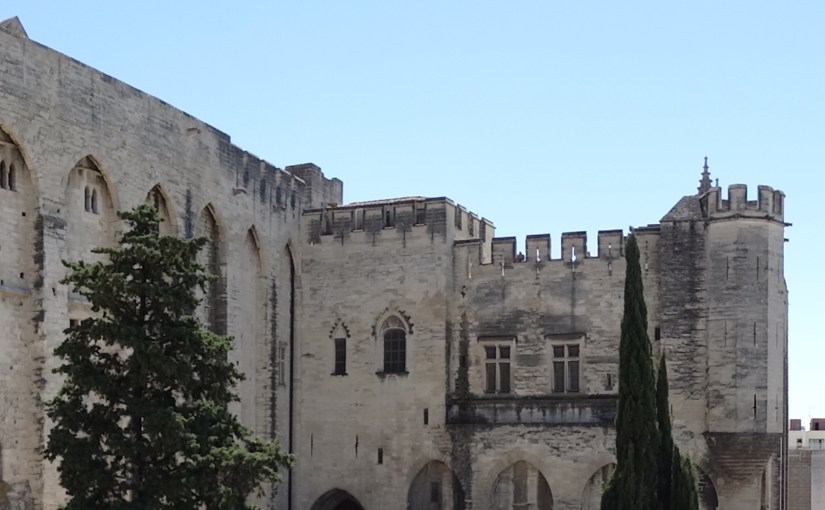
Although windy the previous day, we could feel that the weather had changed significantly and that shorts would be the dress code for the future. I had for a long time between curious about a papal city outside Rome. This trip allowed me to indulge that curiosity.
Here is a short snippet of the intriguing history of the Avignon Popes. In 1309 the city was chosen by Pope Clement V as his residence rather than Rome. Between 1309 and 1377 during the Avignon Papacy, seven successive popes resided in Avignon and in 1348 Pope Clement VI bought the town from Joanna I of Naples. Avignon became the Pontifical residence of Pope Clement V and his successor, John XXII, a former bishop of the diocese, who made it the capital of Christianity and transformed the former episcopal palace into the primary Palace of the Popes. Urban V took the first decision to return to Rome, but the chaotic situation there with different conflicts prevented him from staying there. He died shortly after his return to Avignon and his successor, Gregory XI, also decided to return to Rome and this ended the first period of the Avignon Papacy. When Gregory XI brought the seat of the papacy to Rome in 1377, the city of Avignon was administered by a legate. The early death of Gregory XI caused the Great Schism. Clement VII and Benedict XIII reigned again in Avignon. Papal control persisted until 1791 when, during the French Revolution, it became part of France. The town is now the capital of the Vaucluse department and one of the few French cities to have preserved its ramparts around the whole of the old city. From then on until the French Revolution, Avignon was a papal possession.
We had strolled around the base of the “Palais des Papes” the previous evening after dinner but we wanted to get our plans in order so that we did not waste any of our time. We visited the tourist Info centre and gained some valuable info as well as learning a trick to get discount entry fees to the Palais. The trick is to pick up the brochure for the Avignon explorer’s pass and validate it by visiting one of the cheaper tourist sites pay the full fee and get discounts at all of the others.
This is how we ended up visiting the Archaeology Museum in Rue de Republic. The display was fairly routine except for five gallo-roman masks which seemed to me to be similar to the South American masks I have seen.


We then made our way along Rue de Republic to the Palais. The Popes relied on the defence provide by strong fortifications of their palace, the “Palais des Papes” with walls 17–18 feet thick, and built on a natural spur of rock, rendering it all but impregnable to attack. After its capture following the French Revolution, it was used as a barracks and prison for many years but it is now a museum. The historic centre of Avignon includes the Palais des Papes, the cathedral, and the Pont d’Avignon. Here are some photos of the interior and exterior of the Palais.


This is one of the largest if not the largest Palais of its kind in Europe and its restoration is still on going. In fact they only recently found secret vaults in the treasury for the Papal wealth and documents.
We also visited some other sites of interest including various buildings where the glass had been removed and images on board replaced them, the Hotel de Ville and its odd tower, the opera alongside it the contrasting Mercure Hotel and the mint where the Popes minted their currency. We also visited another small museum down a lane way and obtained two interesting snaps – one of the entrance to the lane and the other being pictures of an early Avignon. We also walked outside the city walls along the banks of the Rhone to catch a ferry ride around parts of the river and the city.


The ferry ride was lacking in information but it was great to be in air conditioning out of the sun. We got to see one of the “Scenic Tours” fleet and to feel the bump of the debris against the hull of the boat. I also got to photograph some kids on jet skis but how they missed the debris I don’t know.




 glendon1954