The Retirees go Abroad – the Iberian Peninsula – Madrid, the Botanic Gardens and Sobrino de Bortin

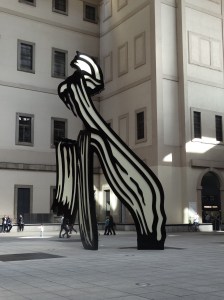
It’s Sunday and we have slept in. There is an anomaly with our watches and our computers but we pay no notice to it. I book an appointment for the sale of the car and then we walk down to the art gallery to see if it is open. It is but we are reluctant to pay 8 euros to see only part of the exhibition. So I take photos instead.

A notice catches our attention – there are gardens and a palace across the road, so off we go to the Botanic Gardens and Jardines del Buen Retiro and Puerta de Hernani. As we enter the park we note there is a book market in full swing and people everywhere walking running riding playing on the equipment all under the watchful eye of the Policia. In the midst of the park is the Cristal Palace – a glass structure which is hosting a display by a Vietnamese artist involving suspended bones and in the midst of this a suspended Christ like figure. As usual in a royal park there is a lake and a palace but this one is closed. The park is lovely full of grass and trees – trees now showing the first signs of winter.

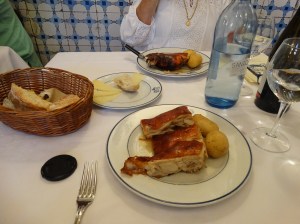
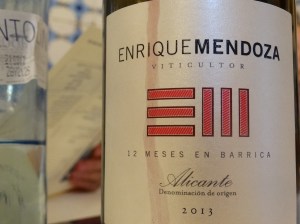
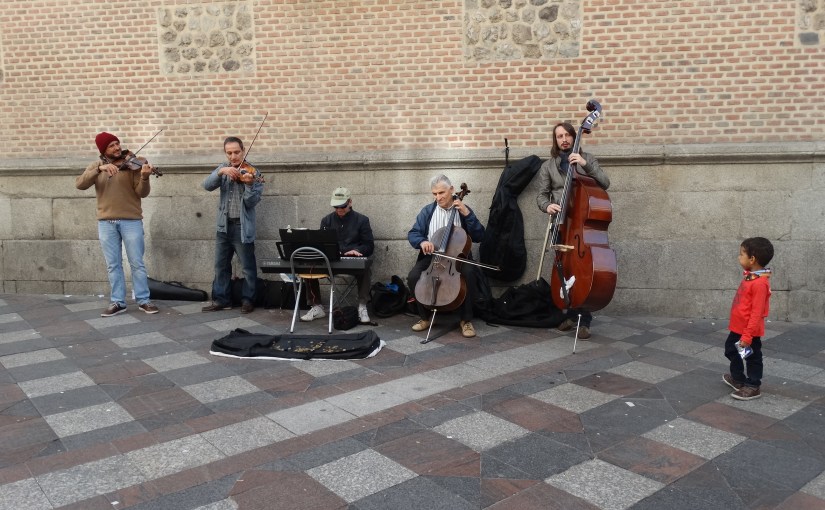
We leave the gardens and find the Spanish Arch de Triumph set on a roundabout. We make our way to the Metro and our lunch appointment at Sobrino de Bortin. We kicked around town for a bit killing time and listened to a street band serenading passers-by including one fascinated little boy.  Our reservation was for 3.15pm and we finally get there 10 minutes early or so we think. Unbeknown to us daylight saving finished in Madrid last night and we are an hour early. No trouble they found us a table beside two Australians from Melbourne. They have been travelling for 6 weeks and return to Australia next week. We ordered a bottle of wine (pinot noir from Alicante region by Enrique Mendoza – quite nice) and the specialty suckling pig. The restaurant was jumping and because of that service was quick – they wanted our table. I am glad we visited but the pork was not as nice as a pork roast with crackling or a pork belly.

Tomorrow we will try to find El Pardo and try another bus trip to the wilds of Spain.

Go back

Your message has been sent

Warning
Warning
Warning
Warning

Warning.

The Retirees go Abroad – the Iberian Peninsula – Madrid and Sergovia

Enrique gave us tips about another restaurant specialising in lamb and tips about flamenco shows, markets, towns to visit and a town famous with Spaniards for game – El Pardo. So the next day we revisited where we had been with Enrique before going out to Sergovia. When retracing our steps Kerry found the shop that had been making espadrilles since 1860 at the same spot – Hernanz Cordeleria and Alpargateria. We spent some considerable time here while Kerry photographed shoes and emailed them to various people taking orders. We also made bookings at Sobrino de Bortin and Posada de la Ville. We had cod fish cakes and jam with a glass of wine and tapas (spanish omelette) at El Modrono and visited San Miguel mercado to see what all the fuss was about.

That afternoon we decided to find our way to Moncloa and catch a bus to Sergovia which is located on the plains of Old Castile, near Valladolid and the Spanish capital, Madrid. Sergovia was first settled by the Celts, captured and occupied by the Romans who built a fort and aqueduct and abandoned after the invasion by the Moors and resettled after Alfonso VI defeated the Moors. It is world heritage listed for its aqueduct and the castle built on the foundations of the Roman fort. The bus trip takes about an hour non-stop and cost 8 euro each return. The bus trip was comfortable and without drama and included a vista of a large cross out in the countryside for no apparent reason.We made the mistake of getting off at the first stop in Sergovia and then walking through the modern village to the old village. When returning to Madrid, we would learn that had we not disembarked at the terminus but stayed on the bus for one more stop that there was a terminus much closer to the old village.  The walk through the new village had some interest. The bonus was that it was all downhill. Along the way we passed a wall mural of early life in the old village. Some might call this graffiti but I was very impressed. The mural gave some feel of ordinary life in the village to visitors. Finally after half an hours walk we arrived at the aqueduct. A quick visit to the information centre and we developed our plan of attack. There are some seriously old buildings still in use in this town.

We took the main road up the hill past the diamond tip house, the Palacio de Cascales, St Martins Church, a tower which had an exhibit of Portuguese aqueducts (go figure), a restaurant with suckling pig, the Cathedral, the Town Hall, and finally the castle.

The views from the castle were awe inspiring particularly the windows of the castle with a sheer drop of hundreds of feet.  The Alcázar of Segovia (literally, Segovia Castle) is a castle rising out on a rocky crag above the confluence of two rivers near the Guadarrama mountains, it is one of the most distinctive castle-palaces in Spain by virtue of its shape – like the bow of a ship. The Alcázar was originally built as a fortress but has served as a royal palace, a state prison, a Royal Artillery College and a military academy since then. It is currently used as a museum and a military archives building. The interior was badly damaged by fire but has been rebuilt and the Hall of the Kings with its frieze of all Spanish Kings is impressive.

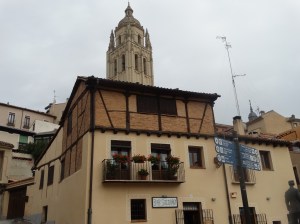
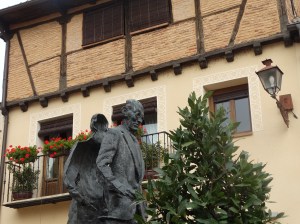
On the return leg we went through the Jewish quarter with its old architecture and some interesting street art. It is below the cathedral indicating an easy existence with the Christian inhabitants.

We left ourselves an hour to walk back to the bus and this proved to be insufficient because we had got off the bus one stop too early. The bus driver on the journey to Sergovia was a rude individual who answered Kerry’s enquiry about where to catch the return bus with a grunt and a wave of his hand. When we made the same enquiry of a know it all tourist information officer he could not believe we had got off the bus anywhere other than the terminus and simply kept saying that we return to the point where we had arrived to catch the return bus. Well we missed the 5.00pm bus but caught the 6.00pm bus now knowing exactly the ins and outs of Sergovia.

Go back

Your message has been sent

Warning
Warning
Warning
Warning

Warning.