The Retirees return to Italy – Umbria – The ruins of Carsulae

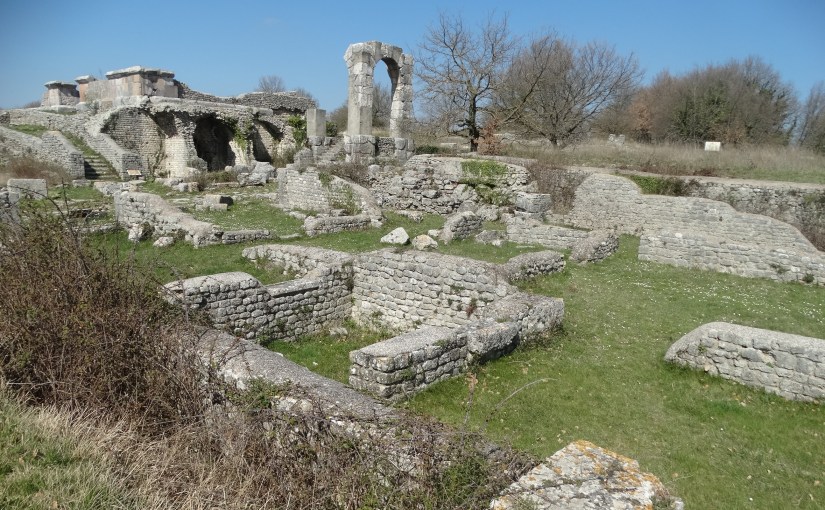
Carsulae is an archaeological site in Umbria, central Italy, now one of the most impressive archaeological ruins in Italy. It is located c. 4 kilometres (2.5 mi) north of San Gemini, a small comune in the province of Terni. Nearby is the comune of Montecastrilli (Montes Carsulis). The bus stops at the car park for the ruins which is on the opposite side of the road and until we stumbled onto the guide map we thought the ruins had been lost. It was like the ruins a ghost town with only one lonely car in it. We walked across the car park under the road and 300 metres later encountered the gatehouse and entrance.

Most historians fix the town’s official founding to about 300 BC. Carsulae’s growth into a major town only took place, however, with the building of the ancient Roman road, the via Flaminia, in 220-219 BC.

When the via Flaminia was built, its western branch proceeded north from Narni, sparking the development not only of Carsulae, but also of Bevagna. This branch of the road courses through a gently rolling upland plain at the foot of the Martani mountain range, an area that had been heavily populated since the middle of the Bronze Age. The eastern branch proceeded from Narni to Terni, north to Spoleto, then past Trevi and finally to Foligno, where it merged with the western branch.

In due course, during the age of Emperor Augustus, Carsulae became a Roman municipium. During his reign a number of major works were initiated, eventually including the amphitheater, most of the forum, and the marble-clad Arch of Trajan (now called the Arco di San Damiano).

During its “golden age” Carsulae, supported by agricultural activity in the surrounding area, was prosperous and wealthy. Its bucolic setting, its large complex of mineralized thermal baths, theatres, temples and other public amenities, attracted wealthy and even middle class “tourists” from Rome.

However, while many of the other mentioned towns and cities on the two branches of the old Roman road continue to exist, nothing but ruins remains of Carsulae, which was abandoned, and once abandoned, never resettled. The only subsequent building that took place occurred in paleo-Christian times, about the 4th or 5th century, at the southerly entrance to Carsulae, where the church of San Damiano, still standing today, was built for a small community of nuns on the foundations of an earlier Roman building.

For centuries after it was deserted, Carsulae was used as a quarry for building materials transported to cities like Spoleto or Cesi, where Roman tombstones may be seen built into the church of S. Andrea (St Andrew), but otherwise, it was left alone. Consequently, archaeologists have been able to map the city with considerable detail.

No one knows the precise reasons why Carsulae was abandoned, but two that seem most plausible are first, that it was almost destroyed and the site made inhospitable by an earthquake, and second that it lost its importance and as a result became increasingly impoverished because most of the important north-south traffic used the faster east branch of the via Flaminia.

Haphazard excavations took place in the 16th century under the direction of Duke Federico Cesi, whose palazzi are in Cesi Acquasparta, and in the 17th century under the direction of Pope Pius VI, but not until 1951 were the ruins subjected to methodical archaeological exploration and documentation. Significant additional work was also done in 1972. There is a current excavation run through Valdosta State University of Georgia.

The modern entrance to the ruins is through a modern gatehouse museum and coffee shop. The museum displays some of the statuary, baths and sarcophagi from the ruins. Speaking of sarcophagi we discovered the ruins of a tomb and sarcophagus on the site.


Go back

Your message has been sent

Warning
Warning
Warning
Warning

Warning.

The Retirees return to Italy – Terni and its origins

This morning before I awoke and we decided we would visit  Piediluco on the Lake via Terni on the way. Its like that here. You wake the weather is fine nothing to do so……

We caught the bus and in true Italian tradition the bus driver drove like a bat out of hell down the hill into Terni. Note the faces of the excited passengers in the picture below. While waiting for the bus we could see from our vantage point overlooking the Terni valley, one of the local marble quarries and the nearby village of St Gemini which we decided we would visit shortly.

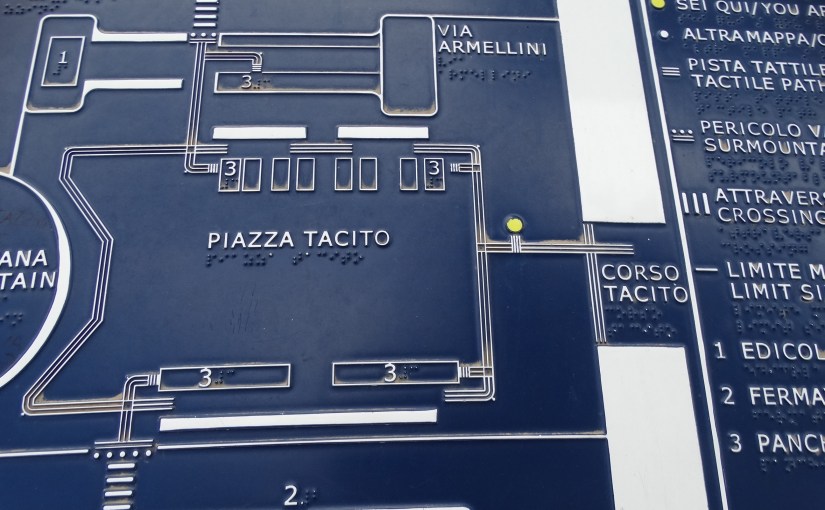
Twenty minutes later once the blood had returned to our knuckles, we left the bus and walked 50 metres to the main Piazza Tacito. It is largely paved for pedestrians but as usual you have to watch out for the cyclists and motor bikes. The hills surround the city and can be seen on all sides as you stroll down the mall. It is only the fact that many of the buildings appear of the modern era that remind you that on August 11, 1943, a massive allied bombardment devastated the city. It was the first of the 108 air strikes that destroyed 80% of Terni’s buildings. Despite this, Terni’s industrial environment increased quickly after the war. Some of the ancient city remains and some of those buildings have had a second life like the former church in the photo below.

Terni is a city in the southern portion of the Region of Umbria in central Italy. The city is the capital of the province of Terni, located in the plain of the Nera river. It is 104 kilometres (65 miles) northeast of Rome. It was founded as an Ancient Roman town.

During the 19th century, steel mills were introduced and led the city to have a role in the second industrial revolution in Italy. Because of its industrial importance, the city was heavily bombed during World War II by the Allies. It still remains an industrial hub, and has been nicknamed “The Steel City” and the “Italian Manchester”.

Terni also advertises itself as a “City of Lovers”, as its patron saint, Saint Valentine, was born and became a bishop here and his remains are preserved in the basilica. The city was founded around the 7th century BC by the Umbrians, in a territory inhabited (as testified by archaeological excavations of several necropolises) as early as the Bronze Age. In the 3rd century BC it was conquered by the Romans and soon became an important municipium lying on the Via Flaminia. The Roman name was Interamna, meaning “in between two rivers”. During the Roman Empire the city was enriched with several buildings, including aqueducts, walls, an amphitheater, a theater, temples and bridges.

After the Lombard conquest in 755 Terni lost prominence when it was reduced to a secondary town in the Duchy of Spoleto. In 1174 it was sacked by Frederick Barbarossa’s general, Archbishop Christian of Mainz. In the following century Terni was one of sites visited frequently by St. Francis to give sermons.

In the 14th century Terni issued its own constitution, and from 1353 the walls were enlarged, and new channels were opened. As with many of the Italian communes of the Late Middle Ages, it was beset by civil unrest between the partisans of the Guelphs and Ghibellines, and later between the Nobili and Banderari. Later it joined the Papal States. In 1580 an ironworks, the Ferriera, was introduced to work the iron ore mined in Monteleone di Spoleto, starting the traditional industrial connotation of the city. In the 17th century, however, the population of Terni declined further due to plagues and famines.

In the 19th century, Terni took advantage of the Industrial Revolution and of plentiful water sources in the area. New industries included a steelworks, a foundry, as well as weapons manufacture, jute and wool processing factories. In 1927 Terni became capital of the province. The presence of important industries made it a target for the Allied bombardments in World War II.

Go back

Your message has been sent

Warning
Warning
Warning
Warning

Warning.


The Retirees return to Italy – Umbria – San Gemini

San Gemini is a commune (municipality) of c. 4,500 inhabitants in the province of Terni in the Italian region Umbria, located about 60 km south of Perugia and about 13 km northwest of Terni. After catching our bus down the hill to Terni, we had time to do some shopping and buy our tickets, get a cup of coffee and still have time to spare. San Gemini is famous in the region for its spa water and its old town. It borders the municipalities of Montecastrilli, Narni and Terni and is a well-preserved medieval burgh with two lines of walls, built over the remains of a small Roman centre along the old Via Flaminia.

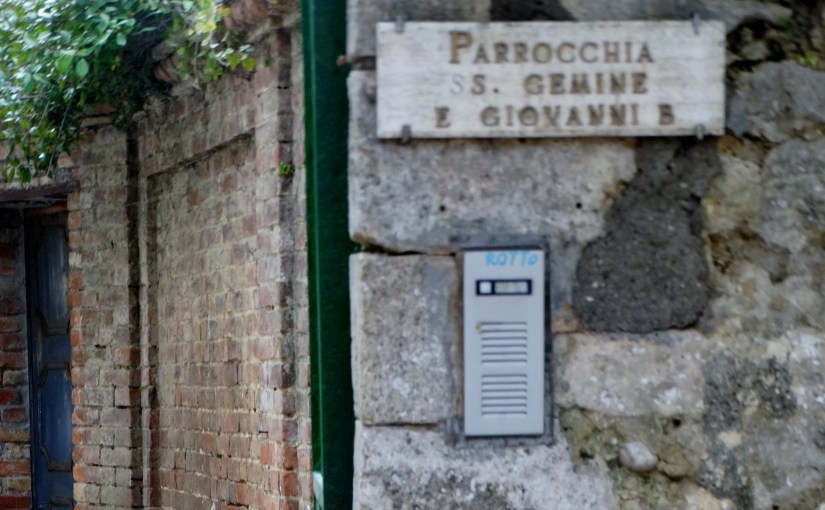
Our bus takes us up the hill and drops us at the old town gate. After entering through the gate and making a quick right turn we encounter San Gemini Cathedral or Duomo – a 12-century church dedicated to the commune’s patron, the locally venerated Saint Gemine, whose relics were recovered in 1775, which was rebuilt in 1817. Brother Gemine was a monk of Syrian origins who died in 815 AD. The burial urn and original stone are conserved in the sacristy; the saint has been reburied under the high altar.

We strolled along the main street Via Roma to Piazza San Francesco and the Franciscan church with 15th-century frescoes. The piazza also has an open aspect with views to Cesi and beside the church is a courtyard with the town well and an old press. We journey on through the next gate to San Nicolò a Romanesque architecture church in the Piazza Palacio Vecchio but it is under restoration. This piazza is much smaller but is the oldest piazza in the village.

We continue to follow Via Casventino to San Giovanni Battista an 11th century church which strangely was semi circular and Taberna del Torchio where we have lunch. Again, we can clearly see Cesi from the old town walls of San Gemini. Lunch is very enjoyable with Roberto rushing off while lunch is prepared to buy some cups he saw before the midday siesta.

With our hunger sated, we complete our walk of the old town returning along Via del Tribunale ending up back at Piazza San Francesco and thereafter we returned to the bus stop along Via Roma.

Our bus returns us to Terni where we do some grocery shopping and collect our parcels from the morning excursion. Roberto gets chatting with the owner and suddenly we have a free ride to Cesi coutesy of Umberto who used to reside in Cesi. He certainly knows his way around taking the short cut up the hill though the olive groves and then taking the back road to the western gate of Cesi and winding through its narrow streets until we are almost at Roberto’s front door. Walking to home Umberto points out the house where his parents lived and ran their hair dressing shop – under 100 metres from Roberto’s home. Umberto is invited in and given the grand tour by a very proud Roberto.

Go back

Your message has been sent

Warning
Warning
Warning
Warning

Warning.