The Retirees Go Abroad – Finding the Pantheon


Kerry has got through the night and her headache has passed. Once again another bright sunny day but our passes have expired. However we have learned the mechanics of the bus and metro and have some idea of the layout of the old city so fearless and undaunted by hot weather we plan to visit the Pantheon, but before doing so to visit the Prison of St Peter and Vittoriano.

However we started the day by visiting a fashion market just off Via Cavour, the name of which I can give but it exact location I have not recorded so unfortunately readers you may have to explore and find this one yourselves. Hidden in a very plain, and for Rome an undistinguished building was Mercato Monti Urban Market, a small alternate studio of individual designers and makers of alternate fashions. One was Eliodoro Benelli (also alternate – batted for the other team) who makes jewellery with fabric. We also spotted some of Rome” Bridges and journeyed to an island in the river Isola Tiberina. One bridge sits behind another destroyed bridge and the other includes a flood warning device; a hole and when the river starts to fill the hole it is time to leave Rome. Exploring the major building on the island we found ourselves in the maternity ward of a local hospital. We just walked in off the street and there we were in the queue for new mothers. We backed out very quickly.

It was a brief visit to Mercato Monti Urban Market fortunately. It seemed very popular based on the number of visitors whilst we were there.

We returned to the task at hand – finding the Prison of St Peter. He is said to have been crucified upside down as he did not wish to try and emulate the crucifixion of his Lord. Carcere Di san Pietro (Mamertino) can be found between the Arch of Septimus Severus and Vittoriano in a minor street marked on my map in size 2 font so it cannot be read (even with a magnifying glass) by the elderly. So once again you may have to do some research to find this but the two landmarks should fix it pretty clearly for you.

Our Omnia card gained us free entry and a tour of the Prison. You may recall that I passed comment in an earlier blog that I thought the Omnia Pass may have been a business project of the Vatican. Well here is where I felt this confirmed. The tour was almost a sales pitch for Christianity and a rededication to the faith. Very little about the building itself, its occupant and the fate of St Peter.

According to tradition, the prison was constructed around 640-616 BC, by Ancus Marcius. It was originally created as a cistern for a spring in the floor of the second lower level. Prisoners were lowered through an opening into the lower dungeon. For more on the history of this prison I suggest you visit http://en.wikipedia.org/wiki/Mamertine_Prison.

It has been a cistern, a place of detention before execution, then a prison, then a church. What a mix. By the way Romans did not have prisons. There was no sentence for custodial terms under Roman law so if you ended up in Mamertine you were going to die.

There was a part of the tour where images of rocks spoke to us about the history but the remainder was far more to do with spiritual matters and whilst I had no objection to this presentation it was not what either of us expected nor wanted.

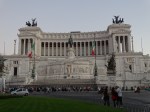
We walked back toward Via Dei Fori Imperiall and found the junction stairs to Vittoriano and its war museum. The Altare della Patria (Altar of the Fatherland) also known as the Monumento Nazionale a Vittorio Emanuele II (National Monument to Victor Emmanuel II) or “Il Vittoriano” is a monument built in honour of Victor Emmanuel, the first king of a unified Italy and contains the tomb of the Unknown Soldier. We were not interested in going through the museum we were interested in the building itself. I suspect the museum would be very interesting historically but there is only so much history to put into a holiday. It was lunch time so we went upstairs to the restaurant on what we thought was the roof only to find another few stories above accessed by an external elevator with a queue. So we grabbed some lunch. It was extremely hot and the Italians thought they had this beat by using a water mist injector on their fans. Maybe it worked we don’t know as we did not get the benefit but one table of tourists found the negative when the water line broke and they got a shower instead of a mist.

So we caught the elevator along with plenty of other sweating tourists and got to the roof viewing platform. We were now on top of Rome. In the photos you will see a hole being dug below the Vittoriano. These excavations can take place anywhere as the whole city sits atop ruins of civilisations going back thousands of years.

We then decided to find the Pantheon. This took us on foot through some more of Rome’s little streets and Piazzas. On the way we encountered another dirty edifice hiding a beautiful church. Clearly one of the bishops this church ended up a Pope as the Papal insignia appears on the face of it and inside is just indescribable from the point of view that this is just one of many and yet it is remarkable. I just cannot understand how so much money could be spent on these monuments to the institution and the man rather than the purpose.

The Pantheon popped up before us unexpectedly. We were so used to being lost that it surprised us to find our target. This is unusual in that is somewhat plain. The Pantheon, commissioned by Marcus Agrippa during the reign of Augustus (27 BC – 14 AD) and rebuilt by the emperor Hadrian about 126 AD is circular with a portico of large granite Corinthian columns (eight in the first rank and two groups of four behind) under a pediment. A rectangular vestibule links the porch to the rotunda, which is under a coffered concrete dome, with a central opening (oculus) to the sky. Almost two thousand years after it was built, the Pantheon’s dome is still the world’s largest unreinforced concrete dome. The height to the oculus and the diameter of the interior circle are the same, 43.3 metres (142 ft.). It is one of the best-preserved of all Ancient Roman buildings. It has been in continuous use throughout its history, and since the 7th century, the Pantheon has been used as a Roman Catholic Church dedicated to “St. Mary and the Martyrs” but informally known as “Santa Maria Rotonda”. The square in front of the Pantheon is called Piazza della Rotonda. To read more visit http://en.wikipedia.org/wiki/Pantheon,_Rome.the Piazza was alive with tourists so finding somewhere to sit in the shade and rest the feet was quite a challenge.Litter lay everywhere and weeds grew through cracks in the fence and paving. Entry was free and it was quite chaotic with tourists bumping and clicking all around.

In this building is the tomb of that famous Renaissance artist Raphael.

Fatigue set in and we made our way to the Metro and then to the Jolly Pizza for a warm meal a bottle of water and then to sleep.

Go back

Your message has been sent

Warning
Warning
Warning
Warning

Warning.

The Retirees Go Abroad – the Colosseum and Palatine Hill


Our goal that day had been to visit the Colosseum and Palatine Hill so after some uncertainty about where to catch the “yellow bus” and brushing off numerous street vendors, we found our way to what I think is seen as the embodiment of Rome, the Colosseum. Colosseo to the Romans this enormous stone structure can be found between Via Claudia, Via S Gregorio, Via Labicana, and Via Fori Imperiall. This was an extremely hot day and in the low season so we were not prepared for a queue 200 metres long (once you get inside to buy your tickets the queue breaks from two into 8 and is another 100 metres long). This is where you appreciates the queue jumping ability given to Omnia pass holders. Even so by the time you get inside you want to pee and there is a queue into the portable dunnies which have a smell as long as the queues. Fellas it’s like the football you have to fight off the women to get to sit on the pot because they all want to use our pans.

Once you have finished the call of nature you go to get your audio guide. Don’t bother! The audio guide spots are poorly marked on your guide map and once you do find them on your stroll around you usually have gone the wrong way because there is no guidance as to the direction to follow. Anyway this does not detract from the breathtaking engineering used by the Romans at a time before hydraulic cranes and computer design. Unfortunately the Popes saw fit to raid this monument for stone to build their own monuments so the southern wall is a mixture of building materials and all the wooden seats have long since disappeared but even the ruin is remarkable.

“The Colosseum is situated just east of the Roman Forum. Construction began under the emperor Vespasian in 70 AD, and was completed in 80 AD under his successor and heir Titus. Further modifications were made during the reign of Domitian (81–96). These three emperors are known as the Flavian dynasty, and the amphitheatre was named in Latin for its association with their family name (Flavius).” (Wikipedia)

The construction was financed by booty from the invasion of Judea. The structure is 50 metres tall and capable of holding 75,000 people. I had seen an article on the plane from Brisbane and had quite a lot of knowledge about the way the arena operated (National Geographic) and some of the controversy about the sails that were operated by a garrison of sailors to provide shade over the patrons. So seeing the myriad of corridors underneath the floor of the arena only brought questions as to the truth of how the staging operated. Whatever is the truth, either story is miraculous for 2,000 year old technology. By the way, the arena was covered in sand and the latin for sand is arena. The Online Etymology Dictionary says “from Latin harena “place of combat,” originally “sand, sandy place,” perhaps from Etruscan”.

We found a place in the shade and pulled out the bits from the breakfast table to substitute for lunch.

We then moved across to the Roman Forum and the Palatine Hill. Here are the ruins of Rome from the times of Vespasian and Flavius.

The Palatine Hill is one of the Seven Hills of Rome and is one of the most ancient parts of the city. According to Roman mythology, the Palatine Hill was the location of the cave, where Romulus and Remus were found by the she-wolf that kept them alive. Later they killed their great-uncle (who had seized the throne from their grandfather), and they both decided to build a new city of their own on the banks of the River Tiber. However, they had a violent argument with each other and in the end Romulus killed his twin brother Remus. This is how “Rome” got its name – from Romulus.

You get some great views from the Colosseum particularly of the triumphal arch which formed part of the Roman road to the forum. Your Omnia pass gets you in here ahead of the queues also. Once inside the first thing you encounter is the arch of Titus a 1st-century honorific arch. It was constructed in c. 82 AD by the Roman Emperor Domitian shortly after the death of his older brother Titus to commemorate Titus’ victories, including the Siege of Jerusalem in 70 AD. You can imagine the cohorts of Legionnaires marching through these arches to the raucous applause of the citizens of Rome.

You then follow a bit of a rough trail down to the Forum passing the Basilica of Maxentius, the Temple of Romulus, the Temple of Antoninus and Faustina and the ancient cemetery, another basilica and another temple until you reach the forum. There is not a lot to see and you need to exercise your imagination to envisage a community meeting place that changed regularly with changes in Rome itself. At this point the sun, the rough path underfoot and the fact we were largely looking at piles of stones took its toll on Kerry. From here on I was travelling solo.

I continued along the path shown as the “visitor’s route” to the Curia and the Arch of Septimius Severus. The white marble Arch at the northwest end of the Roman Forum is a triumphal arch dedicated in AD 203 to commemorate victories of Emperor Septimius Severus and his two sons, in the two campaigns against the Parthians of 194/195 and 197-199. These arches have weathered time very well. Moving around the visitor’s route I then passed the ruins of the Temple of Saturn and the Capitoline Hill. Behind these ruins were further ruins of Temples from different eras. One of the largest footprints was the Basilica of Julia initially dedicated in 46 BC by Julius Caesar, with building costs paid from the spoils of the Gallic War, and was completed by Augustus, who named the building after his adoptive father.

Standing in the distance I could see three columns with everything around them in rubble. These are the remnants of the Temple of Vesta (vestal virgins) and behind that the gardens of the House of Vestals.

I caught up with Kerry and we moved back to the Arch of Titus and climbed Palatine Hill to Domus Flavia, also known as The Flavian Palace. This is a part of the vast residential complex of the Roman Emperors on the Palatine Hill in Rome. It was completed in 92 AD in the reign of Titus Flavius Domitianus, more commonly known as the Emperor Domitian. The Flavian Palace was more commonly used for purposes of state, while the Domus Augustana, an enormous, lavishly ornamented palace south of the Flavian Palace, was the Emperor’s primary residence. Vast is an understatement. This residence once covered the entire hill top. The site is so big that any photo would only give you a small view of ruins making up the whole.

The sun had beaten both of us so we called it quits to head home on the yellow bus. It was after 6.00pm so the yellow bus was not operating. We set off on foot to find our Metro home. In doing so we crossed paths with an unknown church but we were struck by the size of it. It must have once been a significant part of the community but its condition shows what being just one of many churches leads to. Then we passed Vittoriano, a monument to the Unknown Soldier. It is very Roman in its design. It also serves as a museum. We put this on our list to revisit.

That night Kerry was stricken with a violent headache – probably sunstroke – went to bed as soon as we got home. Here is my photo record of the Colosseum.


Go back

Your message has been sent

Warning
Warning
Warning
Warning

Warning.