Remembrance Day

It is the 11th hour on the 11th day 100 years after the Armistice.

The strength of support for Remembrance is tremendous. The similarity with ANZAC Day in Australia is phenomenal and the pride of the nation for its fallen servicemen is tangible. Everywhere there is silence as we remember those soldiers, sailors, and airmen sacrificed for the security and stability that British people enjoy today.

We feel we have been part of this remembrance and glad that we have involved ourselves. Our involvement started with assisting the British Legion with its Poppy Day fund raising through the Rotary Club of Nottingham. For two hours we sold Poppy Day mementos at Broadmarsh Shopping Centre in Nottingham. Our shift, 4.00pm to 6.00pm meant that we saw people of Nottinghamshire coming home from work (the rail station is accessed through the shopping centre) all stopping to donate or buy a poppy, badge or wrist band. One of the styles of poppies on sale was a knitted poppy. We had not seen these before. All individual but based on a standard pattern. We learned that these had been created by members of the public following a request by one of the local radio stations that 11,000 be knitted for the 11,000 Nottinghamshire soldiers lost in WW1.

Kerry delighted in relaying this story to the many women who picked through these poppies looking for the right one. I am not sure if they were interested in the poppies or just wanted to hear the Australian talking. We were visited by one surprised Aussie who heard the accent and had to ask what the hell we were doing raising money for the British Legion.

We were visited by Val Lievers, a past District Governor for this Rotary District. Val is one of the originators of the project and she continues with organisation for the British Legion and has cemented the relationship between the organisations. Busy and bubbly, Val was surprised to have a couple of Aussies on the stand. Below are the snaps of us on the stand courtesy of Val. According to Val tens of thousands of pounds will be raised through this effort by the Legion and Rotary.


Val also told us that the response from the public to supply the knitted poppies was overwhelming with more than 100,000 poppies being donated from Nottingham.

We also had present servicemen visit and donate. One in particular stopped with his wife and family to talk to me as we shared a common interest – it is probable that he encountered our son Adam serving with the Australian Defence Force in Afghanistan. This fellow is currently in his 30th year in the service, having started as a Private and risen in the ranks to Major and having served a number of times in Afghanistan, Iraq and Falklands.

Our next encounter was when we went to the Tower of London to see our Poppy. For those of you who are not aware the British Legion has arranged the sale of hundreds of thousands of ceramic poppies (almost 900,000 in fact, designed and made right here in Derbyshire) to represent the British soldiers, sailors and airmen lost in the WW1. The poppies have been planted in the moat of the Tower. These poppies are about 4 feet tall and cost 25 pound. We hope to receive ours in January 2015 as the display will be dismantled after today. The vision of these poppies is spectacular and has been visited by over 4 million people according to press reports. A picture is worth a thousand words or so the saying goes. I agree in this case and here are my photos.


Here in Britain they remember on Remembrance Sunday. This is the Sunday before the anniversary of Armistice Day and they have two minutes silence at 11.00am on the 11th as well. I was not aware of this and by accident came across the Long Eaton Memorial parade and service returning from Tescos. On returning to the flat, I told Kerry and both of us hurried back to the Memorial. Marketplace Rd and Tamworth Rd were closed and now filled with people. We had missed the parade but the formal service and wreath laying was taking place. There were dignitaries on the official dais beside the Memorial in the centre of town. It was hard to see what was happening from the back of the crowd but the audio was crystal clear. I don’t know who everyone on the dais was but there was clearly a priest who conducted the service and probably the Mayor for the borough in mayoral regalia. There were representative units from the Army, Navy, Air force and Commandos, and other community organisations laying wreaths.

The priest gave a moving and interesting address about the first two minutes silence. Someone, and I cannot remember who, put the idea to King George V shortly before the first anniversary of the armistice. The King approved of the idea and through the Times requested that on the 11th hour of the 11th day that everyone stop their daily activities for two minutes silence in remembrance of the fallen. Even with the short notice, the country came to a standstill. Traffic stopped. Trains delayed their departure. Pedestrians stood still in the streets. And every year thereafter this ritual of remembrance was performed until Remembrance Sunday was announced for the remembrance of those lost in war, as well as the two minutes silence on the anniversary. With the completion of the ceremony the parade reformed and marched out down Tamworth Rd. I have captured some of it for you.


Lest we forget.

Go back

Your message has been sent

Warning
Warning
Warning
Warning

Warning.


The Retirees Go Abroad – Amazing Pompeii and the Opera


We had decided that we would visit the ruins of Pompeii rather than the nearby Ostia Antica (which we were assured was just as impressive as Pompeii) even though it was some 3 hours by bus to get to Pompeii. Pompeii is something of legend. A Roman town destroyed by a volcano in 79AD leaving an intact record of life at that time for all generations to see.

This was a full day and we had to be at our rendezvous Enjoy Rome by 7.30am. We had on a previous day searched out the offices of Enjoy Rome and it was a good thing we did. It was located in a house near Terminii Rail station but due to a large tree the sign identifying it was obscured. It took us an hour to locate it and then identify the easiest route for our Wednesday trip. So through good planning we arrived a Terminii for breakfast and were able to make our rendezvous with 15 minutes to spare. There were 17 of us on the bus plus guide and driver. The bus trip took 3 hours broken by a stop at Monte Cassino a spot that should have been well known to the Americans with us because of the battles with the Germans during WW2 to liberate Italy and the bombing of the Abbey of Monte Cassino.

Our guide was an Ecuadorian immigrant who basically marshalled us and introduced us to our Pompeiian guide Andrew (anglicised version of his name I guess). We were equipped with radio and given strict instructions on when to return for the bus and then set free.

“The eruption of Vesuvius killed the city’s inhabitants and buried it under tons of ash. Evidence for the destruction originally came from a surviving letter by Pliny the Younger, who saw the eruption from a distance and described the death of his uncle Pliny the Elder, an admiral of the Roman fleet, who tried to rescue citizens. The site was lost for about 1,500 years until its initial rediscovery in 1599 and broader rediscovery almost 150 years later by Spanish engineer Rocque Joaquin de Alcubierre in 1748.” (Wikipedia – http://en.wikipedia.org/wiki/Pompeii)

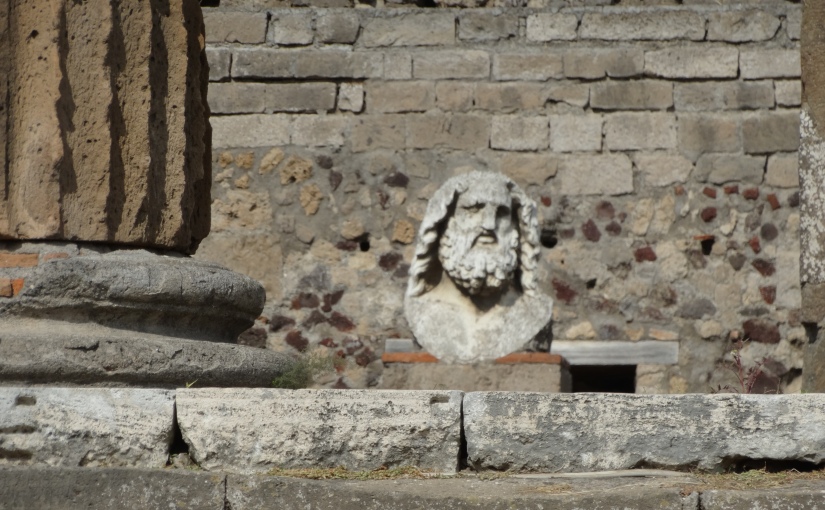
Our tour started with a short history lesson as we walked along a modern path past some of the ruins to the entry through the Gladiator Barracks (which looks more like a college square with the barracks along one side and a portico along another. Andrew was of the view that it is unlikely that Gladiators lived and trained here and that it was more likely an assembly area for the theatre and the “barracks” storerooms/prop rooms for the theatre. From here we moved into the large theatre which was remarkable as it demonstrated the transition from an auditorium with a pit to an auditorium with a pit and stage.


We exited onto an area that looked like the sort of exercise track we have today only used by Fred Flintstone (everything in stone) – running track etc. beside the ruins of a Greek (yes Greek) church. Now I may not get this exactly correct but by my reckoning this was the Temple of Isis and from there we moved onto one of the minor roads in the city to visit a “modern brothel” (modern in the sense that language was no barrier – you pointed to a picture on the wall displaying the type of transaction you wished to conduct and believe me they were all portrayed, a bit faded with time but legible). Now the sex industry must have been a big business as there were quite a few buildings dedicated to this purpose and they seemed to be landmarked by large phalluses and scrotums in stone in the footpath and walls of buildings. I was tempted to suggest Biggus Dickus was one of the proprietors, but resisted. (Since visiting Pompeii I have seen a BBC documentary on Pompeii and they put a different interpretation on the graphics on the brothel walls and the numerous phalluses around the city)

Throughout the ruins were water fountains. Our Bus guide warned us about drinking the water from these fountains but as though he knew the challenge had been made Andrew made a point of drinking form a fountain and inviting us to do likewise.

We made our way into the Forum. Andrew pointed out that this was not only the political hub of the city but the community hub as well with a temple to Zeus, a fish market, granary and store. Here we also saw the first of the human casts made by the volcanic ash. It was here that we became aware that there were 5 Aussies out of the 17 member tour and two were from Mt Gravatt.

We visited the central baths, the House of the Vettii, and the house of the Faun with Andrew. He pointed out that small business existed even then showing us a BBQ with residence attached where the proprietor would sell BBQ products (the start of the “lamb sandwich”) and the family live in one or two rooms behind. He pointed out the difference between commercial and domestic dwellings and the “green” credentials of the houses each with their own cistern for catching rain water. The House of the Faun is the largest of the homes in Pompeii, built during the 2 nd. century BC, and most impressive private residences in Pompeii. It is one of the most luxurious aristocratic houses from the Roman republic, and reflects this period better than most archaeological evidence found even in Rome itself The House of the Faun was named for the bronze statue of the dancing faun located, on a basin for catching rainwater. It also has many features such as floor murals and decorations to establish its opulence. (The BBC programme challenged this also showing an even grander ruin)

The baths were also fascinating as they showed just how ingenious these people were at finding solutions to providing services much the same as we enjoy today. They also had an understanding of “feng shui” with how they designed their living spaces. For instance in one house the largest room was a type of family room which encompassed dining and relaxation whilst the bedrooms were functional – just for sleeping. There were centre courts for light breeze and catching rain for the water cistern. (The BBC presenter made the point that there were no drains in the baths and that the water, although hot, was probably rancid with piss and sweat)

Although this tour was for two and one half hours, time passed very quickly and we found ourselves outside a renovated building (probably the only one) turned into a modern café and rest room. Andrew gave instructions to those hearty individuals who wanted to explore more on their own and bid us adieu.

Although the roads were paved time had made them fairly rough. The uneven roads, the heat of the day and the tedium of looking at piles of stone meant we did not seek to go beyond where tourists go but rather to look in more detail at things we had seen with Andrew. We went back to the forum and made our own way through the Temples of Jupiter, Apollo, and Venus down to Marina Gate. Here we ended our tour of the ruins and made our way to the Hotel Vittoria for a cup of coffee and a chat with our Australian comrades.

With the return of the bus we boarded for the return journey. Again we stopped at Monte Cassino and our bus tour guide relayed the story about the bombing of the Abbey. This was the site of 4 major battles both to liberate Italy but also to tie up German resources for the D Day landings. There were Americans, British, Ghurkha, New Zealand, Free French and Moroccan troops involved and the bombing of the Abbey turned out to be a complete blunder. The allies thought the Germans were using the Abbey for spotting when in fact they were not. The Allies sent over 140 planes to bomb the crap out of the Abbey which they did and then the German’s occupied the bombed site. There were 4 battles to push Hitler’s Tenth Army back to Rome.

After this stop we settled in for the journey home during which Kerry spotted some interesting buildings and monuments snapping pictures on the way.

Finally home around 9.00pm and the lights of the Jolly Pizza were still burning. Another enjoyable repast and off to bed. I have the early signs of a cold and we know that tomorrow we go to the opera returning home around 11.00 o’clock and having to get up at 5.00 am for an early start to the airport.

Next day was spent relaxing in our hotel room until late in the afternoon when we travelled into Terminii to visit Museo Nazionale Romano – Palazzo Massimo (closed Mondays). After having visited Pompeii this was dramatic with statuary, jewellery, frescos and architecture from that time. Well worth the visit and it closes later in the evening so no excuses for not going. If you cannot visit then visit the web site: http://archeoroma.beniculturali.it/en/museums/national-roman-museum-palazzo-massimo-alle-terme.

After the museum we went to the Teatro Dell’Opera Di Roma. Now I am not a fan of the opera but I do enjoy certain arias sung well. This was a performance of Rigoletto by some of the current best in Italy and was best quality. I was not feeling like being at the Opera but the performance was certainly worthwhile. I suggest that before visiting any opera that you research the story otherwise you will be lost in all the theatrics.

So ends the tale of our visit to Rome. We arrived home safely and the journey by bus was quite tolerable – better than 4 times the cost by taxi; we are pensioners now.

Go back

Your message has been sent

Warning
Warning
Warning
Warning

Warning.

The Retirees Go Abroad – Finding the Pantheon


Kerry has got through the night and her headache has passed. Once again another bright sunny day but our passes have expired. However we have learned the mechanics of the bus and metro and have some idea of the layout of the old city so fearless and undaunted by hot weather we plan to visit the Pantheon, but before doing so to visit the Prison of St Peter and Vittoriano.

However we started the day by visiting a fashion market just off Via Cavour, the name of which I can give but it exact location I have not recorded so unfortunately readers you may have to explore and find this one yourselves. Hidden in a very plain, and for Rome an undistinguished building was Mercato Monti Urban Market, a small alternate studio of individual designers and makers of alternate fashions. One was Eliodoro Benelli (also alternate – batted for the other team) who makes jewellery with fabric. We also spotted some of Rome” Bridges and journeyed to an island in the river Isola Tiberina. One bridge sits behind another destroyed bridge and the other includes a flood warning device; a hole and when the river starts to fill the hole it is time to leave Rome. Exploring the major building on the island we found ourselves in the maternity ward of a local hospital. We just walked in off the street and there we were in the queue for new mothers. We backed out very quickly.

It was a brief visit to Mercato Monti Urban Market fortunately. It seemed very popular based on the number of visitors whilst we were there.

We returned to the task at hand – finding the Prison of St Peter. He is said to have been crucified upside down as he did not wish to try and emulate the crucifixion of his Lord. Carcere Di san Pietro (Mamertino) can be found between the Arch of Septimus Severus and Vittoriano in a minor street marked on my map in size 2 font so it cannot be read (even with a magnifying glass) by the elderly. So once again you may have to do some research to find this but the two landmarks should fix it pretty clearly for you.

Our Omnia card gained us free entry and a tour of the Prison. You may recall that I passed comment in an earlier blog that I thought the Omnia Pass may have been a business project of the Vatican. Well here is where I felt this confirmed. The tour was almost a sales pitch for Christianity and a rededication to the faith. Very little about the building itself, its occupant and the fate of St Peter.

According to tradition, the prison was constructed around 640-616 BC, by Ancus Marcius. It was originally created as a cistern for a spring in the floor of the second lower level. Prisoners were lowered through an opening into the lower dungeon. For more on the history of this prison I suggest you visit http://en.wikipedia.org/wiki/Mamertine_Prison.

It has been a cistern, a place of detention before execution, then a prison, then a church. What a mix. By the way Romans did not have prisons. There was no sentence for custodial terms under Roman law so if you ended up in Mamertine you were going to die.

There was a part of the tour where images of rocks spoke to us about the history but the remainder was far more to do with spiritual matters and whilst I had no objection to this presentation it was not what either of us expected nor wanted.

We walked back toward Via Dei Fori Imperiall and found the junction stairs to Vittoriano and its war museum. The Altare della Patria (Altar of the Fatherland) also known as the Monumento Nazionale a Vittorio Emanuele II (National Monument to Victor Emmanuel II) or “Il Vittoriano” is a monument built in honour of Victor Emmanuel, the first king of a unified Italy and contains the tomb of the Unknown Soldier. We were not interested in going through the museum we were interested in the building itself. I suspect the museum would be very interesting historically but there is only so much history to put into a holiday. It was lunch time so we went upstairs to the restaurant on what we thought was the roof only to find another few stories above accessed by an external elevator with a queue. So we grabbed some lunch. It was extremely hot and the Italians thought they had this beat by using a water mist injector on their fans. Maybe it worked we don’t know as we did not get the benefit but one table of tourists found the negative when the water line broke and they got a shower instead of a mist.

So we caught the elevator along with plenty of other sweating tourists and got to the roof viewing platform. We were now on top of Rome. In the photos you will see a hole being dug below the Vittoriano. These excavations can take place anywhere as the whole city sits atop ruins of civilisations going back thousands of years.

We then decided to find the Pantheon. This took us on foot through some more of Rome’s little streets and Piazzas. On the way we encountered another dirty edifice hiding a beautiful church. Clearly one of the bishops this church ended up a Pope as the Papal insignia appears on the face of it and inside is just indescribable from the point of view that this is just one of many and yet it is remarkable. I just cannot understand how so much money could be spent on these monuments to the institution and the man rather than the purpose.

The Pantheon popped up before us unexpectedly. We were so used to being lost that it surprised us to find our target. This is unusual in that is somewhat plain. The Pantheon, commissioned by Marcus Agrippa during the reign of Augustus (27 BC – 14 AD) and rebuilt by the emperor Hadrian about 126 AD is circular with a portico of large granite Corinthian columns (eight in the first rank and two groups of four behind) under a pediment. A rectangular vestibule links the porch to the rotunda, which is under a coffered concrete dome, with a central opening (oculus) to the sky. Almost two thousand years after it was built, the Pantheon’s dome is still the world’s largest unreinforced concrete dome. The height to the oculus and the diameter of the interior circle are the same, 43.3 metres (142 ft.). It is one of the best-preserved of all Ancient Roman buildings. It has been in continuous use throughout its history, and since the 7th century, the Pantheon has been used as a Roman Catholic Church dedicated to “St. Mary and the Martyrs” but informally known as “Santa Maria Rotonda”. The square in front of the Pantheon is called Piazza della Rotonda. To read more visit http://en.wikipedia.org/wiki/Pantheon,_Rome.the Piazza was alive with tourists so finding somewhere to sit in the shade and rest the feet was quite a challenge.Litter lay everywhere and weeds grew through cracks in the fence and paving. Entry was free and it was quite chaotic with tourists bumping and clicking all around.

In this building is the tomb of that famous Renaissance artist Raphael.

Fatigue set in and we made our way to the Metro and then to the Jolly Pizza for a warm meal a bottle of water and then to sleep.

Go back

Your message has been sent

Warning
Warning
Warning
Warning

Warning.

The Retirees Go Abroad – Closed Mondays


We have been really blessed with the weather. Overnight it has been very gusty with storms in some places but the wind has cleared the clouds leaving an azure blue sky and a throbbing Sun promising another warm day.

Breakfast has been the same all week – cereal (corn flakes or corn flakes), juice, sugary pastries, bread and ham, bread and condiments, a toast type biscuit, coffee (or at least it was advertised as such) and tea. Not a lot to choose from but we are travelling on a budget and we will make up for choice during the day. Even so the biscuits pack easily into your back pack and are tasty to fill in during the day. So each day we have grabbed some packets of these biscuits and a bottle of water (don’t forget the water fountains in Rome).

Our plan today was to visit two museums at Repubblica; Museo Nazionale Romano – Palazzo Massimo and Museo Nazionale Romano Terme Di Dioclezino. The National Roman Museum is a museum, with several branches in separate buildings throughout the city of Rome, Italy. We were looking to visit the two at Repubblica – The Baths of Diocletian, which currently houses the Epigraphic and the Proto-historic sections of the modern Museum, while the main collection of Ancient Art which is currently housed in the nearby Palazzo Massimo alle Terme. For more on the National Museums of Roman a visit to http://en.wikipedia.org/wiki/National_Roman_Museum will be helpful.

We caught the bus and metro as usual alighting at Repubblica (the next stop from Terminii). Once again directions by street sign was hopeless. The most obvious entrance to one of the Museums appeared to be a church. How did I know it was a church – it had a bloody great big cross and a beggar out front (the beggar was the giveaway). The Basilica of St. Mary of the Angels and the Martyrs (Bascilica Santa Maria degli Angeli e dei Martiri) is a church built inside the Baths of Diocletian in the Piazza della Repubblica. When we entered the first thing I saw was this sign “Shorts not permitted”. Well of course I was in shorts, so Kerry ventured on.

As I stood beside the front door a tour group came through the door and some of the men were in shorts like me. One fellow immediately engaged the tour guide in conversation and from the gestures it concerned the shorts he was wearing and the sign greeting them as they entered. The tour guide was trying to explain presumably why she did not warn them when a girl probably in her early twenties wearing a pair of shorts that rode up her arse, exposing the cheeks of her bum entered the church. The tour guide pointed her out and although I don’t understand German/Dutch (which ever), she seemed to be identifying that the sign referred to those types of shorts. With that she called to this young woman who when turning displayed the pockets of her shorts hanging below the leg of the shorts and a very large “camel toe” in the crotch of her shorts. She was oriental and did not understand German/Dutch/Italian or English and continued to walk into the church oblivious of the sign and probably quite proud to display her arse and camel toe. It always happens when you have not got the camera ready.

By the time I had witnessed this short pantomime, Kerry had returned speaking about the glory of the church. I asked her if she had observed the “shelia with the camel toe” but she had no idea what I was talking about so we moved on to find the museums.

We decided on the direction to walk based on our tourist map (they are all sooo vague) and ended walking around the block (in sight of the Terminii station – I reckon I could throw a ball from one to the other station) to find the gate to Museo Nazionale Romano Terme Di Dioclezino (the Baths of Diocletian) closed on Mondays. So we moved on to stumble across Museo Nazionale Romano – Palasso Massimo just across the road – closed on Mondays. Aargh!

What do we do now? Consult the map! Map in hand we moved along Via Nazionale to be harassed by a street vendor selling tickets to an Opera. We took the leaflet with plans to visit the theatre presenting the show to see if we wanted to book tickets – only 30 euros each. We consult the map. Change of plan let’s find the main Opera theatre for Rome. We are standing on the corner of Via Nazionale and Via Firenze when we come to this momentous decision and where is the Opera – the intersection of Via Torino, Via Del Viminali and Via Firenze walking distance from Terminii and in the path to Museo Nazionale Romano – Palasso Massimo. So we walk around to Teatro Dell’Opera Di Roma and Rigoletto is opening on October 21, the night before we fly out of Rome. Perfect so we enquire about the tickets at the ticket office. Sure thing we can have tickets starting price up in the nose bleeds is 85 euros, to 150 euros in the boxes. We settle for 2 seats in the right wing on the floor of the theatre. All I can think is that my Dad (a great fan of opera) would be so jealous.

Stumped as to what else I want to do that day Kerry slips in the “shopping expedition”. She has found a shopping tour to a designer outlet. I will give you the web site but here is what it says:

“At Castel Romano Designer Outlet, you can find your favourite designer brands at up to 70% off, all year round. Our beautiful setting, cafes and restaurants, children’s play area, parking and more than 140 boutiques, we offer something for everyone. We have a wide range of stores, ranging from iconic fashion brands like Valentino, Roberto Cavalli, Lacoste and Michael Kors to athletic labels, like Nike and Adidas, and casual favourites, like Guess and Diesel.”

“Castel Romano Designer Outlet, is located just 25 km from the centre of Rome, in the heart of Agro Pontino. It is close to the Tyrrhenian coastline, making it the perfect destination in summer for a day of sun, sea and shopping. The Castel Romano roundtrip shuttle bus service runs every day from the city centre of Rome. ” And it is just 13 euros. As I said I will share the web site so here it is: http://www.mcarthurglen.com/it/castel-romano-designer-outlet/en/

Well the trip takes about an hour and if you have tired feet and a bountiful wallet (or in my case a tight fist on the wallet) then for 13 euros each it provides an interesting trip through the Rome that does not excite tourists – the commercial districts. We arrived and it felt like we had gone to a shopping village on the Gold Coast except they spoke Italian. Even the developer seemed un-Italian – McArthur Glen. It certainly has everything to cure you of a shopping itch and some nice eateries as well. So we idled away the afternoon and I got some interesting shots of some of the street furniture.

On the trip home Kerry was determined to get a photo of a building with a heliport on it as it also appeared to have a huge solar panel beside the heliport. I got the giggles and she got her photo.


She also scratched her itch.

Go back

Your message has been sent

Warning
Warning
Warning
Warning

Warning.

The Retirees Go Abroad – the Mother Church

We awoke to another bright and hot day. The weather had been unusually warm but each morning had started with a chill in the air with the day becoming warm by 10.00 am and hot by 2.00 pm. As we were planning a day out doors we packed our water bottle and our hats grabbed our Omnia tickets (yellow for the sight-seeing bus and red for the monuments and public transport). The back pack Kerry had bought in Bakewell (a village in Derbyshire) served us well holding all our needs including provisions from the breakfast table to provide snacks throughout the day. Biscuit and honey!
As usual we caught the bus to Anangina car-parking and bus/metro station. It is hard to describe this place and to take photos as everyone rushes past makes you feel like such an obvious tourist and dick. So I can only offer two snaps one showing the bus stops and buses of one section and part of the everyday market (clothing mainly) at Anangina.
After the ride on the Metro to San Giovanni we walked around to the Mother Church. This is St John’s Lateran. The first home to the Pope of Roma. Before the Vatican and before Avignon and the Holy See, the Pope lived and preached here. Emperor Constantine established the first Christian church on this site hence the Romans consider this the Mother Church the seat of the popes as bishops of Rome from which all other Christian churches have developed. As the cathedral of the Bishop of Rome, it ranks above all other churches in the Catholic Church, including St. Peter’s Basilica. For that reason, unlike all other Roman Basilicas, it holds the title of Arch basilica.
“The arch basilica stands over the remains of the Castra Nova equitum singularium, the ‘new fort’ of the imperial cavalry bodyguard. The fort was established by Septimius Severus in AD 193. Following the victory of Constantine I over Maxentius (for whom the Equites singulares augusti had fought) at the Battle of the Milvian Bridge. …………The Lateran Palace fell into the hands of the emperor when Constantine I married his second wife Fausta, sister of Maxentius. Known by that time as the “Domus Faustae”, the Lateran Palace was eventually given to the Bishop of Rome by Constantine. The actual date of the gift is unknown but scholars believe it had to have been during the pontificate of Pope Miltiades, in time to host a synod of bishops in 313AD.
The arch basilica is located outside of the boundaries of Vatican City proper, although within the city of Rome. However, it enjoys extraterritorial status as one of the properties of the Holy See. This is also the case with several other buildings, following the resolution of the Roman Question with the signing of the Lateran Treaty.” (Source Wikipedia)
The front doors are the original doors to the roman “Domus Faustae” and they are huge. In the portico or patio to the church is a statue of Constantine which comes from the original Domus Faustae. Inside the church is opulent without being garish like St Peter’s. The graceful baldacchino over the high altar, which looks out of place in its present surroundings, dates from 1369 and contains the statues of St. Peter and Saint Paul, now in the cloisters from the original palace. Throughout the church are many confessionals each marked with the language spoken by the priest taking the confession. In one I was able to capture the priest and an unknown person having an aside outside the confessional. I like to think the priest has stopped to give his bets to his bookie.
The throne in the Church can only be sat upon by the Pope.
On the square in front of the Lateran Palace is the largest standing obelisk in the world, known as the Lateran Obelisk (weight estimated at 455 tons). It was commissioned by pharaoh Thutmose III and erected by Thutmose IV before the great Karnak temple of Thebes, Egypt. Intended by Constantine I to be shipped to Constantinople, the very preoccupied Constantius II had it shipped instead to Rome, where it was re-erected in the Circus Maximus in 357. At some time it broke and was buried under the Circus. In the 16th century it was located and dug up, and Sixtus V had it re-erected on a new pedestal on August 3, 1588 on its present site.
Whilst viewing the church we spoke to an arch deacon of the church who encouraged us to visit two lesser known churches one dedicated to St Lazlo and the other St Alphonsus. As it turned out the latter was just up the road (about 30 minutes walk). The Church of Alphonsus on the Esquiline contains an icon (strange indeed – icons are a creature of the eastern orthodox church and prevalent in Russia). The icon was stolen from a church in Crete in the 15th century and brought to Rome where it has been known as “The Virgin of Perpetual Help”.
Just up the road, Via Merulana, is The Basilica di Santa Maria Maggiore. It is the largest Catholic Marian church in Rome. There are 25 other churches in Rome dedicated to Mary, but the greater size of the Basilica of Saint Mary Major justifies the adjective by which it is distinguished from the other 25. According to the 1929 Lateran Treaty, the basilica located in Italian territory is owned by the Holy See and enjoys extraterritorial status similar to that of foreign embassies.
Our goal had been to visit the Colosseum and Palatine Hill. Our short visit to the Lateran Palace had taken up the whole morning. Such is the depth of history in this town.


Go back

Your message has been sent

Warning
Warning
Warning
Warning

Warning.

The Retirees Go Abroad – the Colosseum and Palatine Hill


Our goal that day had been to visit the Colosseum and Palatine Hill so after some uncertainty about where to catch the “yellow bus” and brushing off numerous street vendors, we found our way to what I think is seen as the embodiment of Rome, the Colosseum. Colosseo to the Romans this enormous stone structure can be found between Via Claudia, Via S Gregorio, Via Labicana, and Via Fori Imperiall. This was an extremely hot day and in the low season so we were not prepared for a queue 200 metres long (once you get inside to buy your tickets the queue breaks from two into 8 and is another 100 metres long). This is where you appreciates the queue jumping ability given to Omnia pass holders. Even so by the time you get inside you want to pee and there is a queue into the portable dunnies which have a smell as long as the queues. Fellas it’s like the football you have to fight off the women to get to sit on the pot because they all want to use our pans.

Once you have finished the call of nature you go to get your audio guide. Don’t bother! The audio guide spots are poorly marked on your guide map and once you do find them on your stroll around you usually have gone the wrong way because there is no guidance as to the direction to follow. Anyway this does not detract from the breathtaking engineering used by the Romans at a time before hydraulic cranes and computer design. Unfortunately the Popes saw fit to raid this monument for stone to build their own monuments so the southern wall is a mixture of building materials and all the wooden seats have long since disappeared but even the ruin is remarkable.

“The Colosseum is situated just east of the Roman Forum. Construction began under the emperor Vespasian in 70 AD, and was completed in 80 AD under his successor and heir Titus. Further modifications were made during the reign of Domitian (81–96). These three emperors are known as the Flavian dynasty, and the amphitheatre was named in Latin for its association with their family name (Flavius).” (Wikipedia)

The construction was financed by booty from the invasion of Judea. The structure is 50 metres tall and capable of holding 75,000 people. I had seen an article on the plane from Brisbane and had quite a lot of knowledge about the way the arena operated (National Geographic) and some of the controversy about the sails that were operated by a garrison of sailors to provide shade over the patrons. So seeing the myriad of corridors underneath the floor of the arena only brought questions as to the truth of how the staging operated. Whatever is the truth, either story is miraculous for 2,000 year old technology. By the way, the arena was covered in sand and the latin for sand is arena. The Online Etymology Dictionary says “from Latin harena “place of combat,” originally “sand, sandy place,” perhaps from Etruscan”.

We found a place in the shade and pulled out the bits from the breakfast table to substitute for lunch.

We then moved across to the Roman Forum and the Palatine Hill. Here are the ruins of Rome from the times of Vespasian and Flavius.

The Palatine Hill is one of the Seven Hills of Rome and is one of the most ancient parts of the city. According to Roman mythology, the Palatine Hill was the location of the cave, where Romulus and Remus were found by the she-wolf that kept them alive. Later they killed their great-uncle (who had seized the throne from their grandfather), and they both decided to build a new city of their own on the banks of the River Tiber. However, they had a violent argument with each other and in the end Romulus killed his twin brother Remus. This is how “Rome” got its name – from Romulus.

You get some great views from the Colosseum particularly of the triumphal arch which formed part of the Roman road to the forum. Your Omnia pass gets you in here ahead of the queues also. Once inside the first thing you encounter is the arch of Titus a 1st-century honorific arch. It was constructed in c. 82 AD by the Roman Emperor Domitian shortly after the death of his older brother Titus to commemorate Titus’ victories, including the Siege of Jerusalem in 70 AD. You can imagine the cohorts of Legionnaires marching through these arches to the raucous applause of the citizens of Rome.

You then follow a bit of a rough trail down to the Forum passing the Basilica of Maxentius, the Temple of Romulus, the Temple of Antoninus and Faustina and the ancient cemetery, another basilica and another temple until you reach the forum. There is not a lot to see and you need to exercise your imagination to envisage a community meeting place that changed regularly with changes in Rome itself. At this point the sun, the rough path underfoot and the fact we were largely looking at piles of stones took its toll on Kerry. From here on I was travelling solo.

I continued along the path shown as the “visitor’s route” to the Curia and the Arch of Septimius Severus. The white marble Arch at the northwest end of the Roman Forum is a triumphal arch dedicated in AD 203 to commemorate victories of Emperor Septimius Severus and his two sons, in the two campaigns against the Parthians of 194/195 and 197-199. These arches have weathered time very well. Moving around the visitor’s route I then passed the ruins of the Temple of Saturn and the Capitoline Hill. Behind these ruins were further ruins of Temples from different eras. One of the largest footprints was the Basilica of Julia initially dedicated in 46 BC by Julius Caesar, with building costs paid from the spoils of the Gallic War, and was completed by Augustus, who named the building after his adoptive father.

Standing in the distance I could see three columns with everything around them in rubble. These are the remnants of the Temple of Vesta (vestal virgins) and behind that the gardens of the House of Vestals.

I caught up with Kerry and we moved back to the Arch of Titus and climbed Palatine Hill to Domus Flavia, also known as The Flavian Palace. This is a part of the vast residential complex of the Roman Emperors on the Palatine Hill in Rome. It was completed in 92 AD in the reign of Titus Flavius Domitianus, more commonly known as the Emperor Domitian. The Flavian Palace was more commonly used for purposes of state, while the Domus Augustana, an enormous, lavishly ornamented palace south of the Flavian Palace, was the Emperor’s primary residence. Vast is an understatement. This residence once covered the entire hill top. The site is so big that any photo would only give you a small view of ruins making up the whole.

The sun had beaten both of us so we called it quits to head home on the yellow bus. It was after 6.00pm so the yellow bus was not operating. We set off on foot to find our Metro home. In doing so we crossed paths with an unknown church but we were struck by the size of it. It must have once been a significant part of the community but its condition shows what being just one of many churches leads to. Then we passed Vittoriano, a monument to the Unknown Soldier. It is very Roman in its design. It also serves as a museum. We put this on our list to revisit.

That night Kerry was stricken with a violent headache – probably sunstroke – went to bed as soon as we got home. Here is my photo record of the Colosseum.


Go back

Your message has been sent

Warning
Warning
Warning
Warning

Warning.