Bishops Visit – A Roman’s Life – Housesteads Fort and Hadrians Wall


When asked about Britain I am invariably asked about Hadrian’s Wall and have I been there. Well until today, my answer was I plan to visit one day.Today I changed that answer to “yes I have and I visited Housestead Fort, the best preserved Roman fort along the remnants of the wall”.

As days go the weather was pretty ordinary. We left Hexham and its Abbey headed for Housesteads said to be “just round the corner”.


Grey and misty to start with sun trying to break through. Then we got onto the B6318 from Wall and the mist descended as we followed a swaggering hay truck obviously overloaded and sneaking along this back road. Then there was a sudden lifting of the mist and the visitor’s centre appeared suddenly before us.

Inside the centre we learned two things, one, that the fort and museum were some distance from the road and the centre and, two that part of the road we had just driven on once formed part of the wall. As this was winter and we were the only visitors at the time we were given the privilege of driving into the museum car park. It meant we had to pass through a cattle gate and drive a meandering road up to the museum and the fort.

DSC01765

The museum is small but includes a video presentation of the fort and diagrammatic reconstructions of fort as well as a short history of its use and decline. Following the video we walked up to what was formerly the South Gate an into the foundations of the fort, its barracks granary and other buildings. From the North Gate I could view the wall running east and west and view the undulating landscape watched over by centurions 1900 years ago from my same position. The fort must have seemed a real barrier and threat to the tribes of the north.


There is not a lot to see unless you can imagine the buildings that once sat upon the foundations. But equally there is a lot to activate your imagination. After walking around I made my way to the south east corner and lowest point of the fort to view the roman latrines. Placed at the lowest point to gain downward flow (old saying “Shit flows down hill”) of water and waste the latrines were impressive in the mastery of the design to move the waste with gravity and running water.


Time was against us doing further exploration as we were due in Inverness that evening – some 5 to 6 hours driving and the weather had turned decidedly against us.

Bishops Visit – The Best of Barnard Castle.


We set sail today in the most brilliant sunshine, clear blue sky and moderate temperature such that I could have mistaken it for a spring morning. High spirits abound as we travel north making good time and arriving in Barnard Castle about 10.30am. Barnard Castle is a market town in Teesdale, county Durham with an unusual market rotunda in the centre of town called the Butter Market. It has been a court, a goal and a market over the years. The town grew up around the castle of the same name and is home to Bowes Museum.


The Bowes Museum, housed in a chateau-like building, was founded by John Bowes and his wife Josephine, and is of national status. It contains an El Greco, paintings by Goya, Canaletto, Boucher, Fragonard and a collection of decorative art. A great attraction is the 18th century silver swan automaton, which periodically preens itself, looks round and appears to catch and swallow a fish.


DSC01728

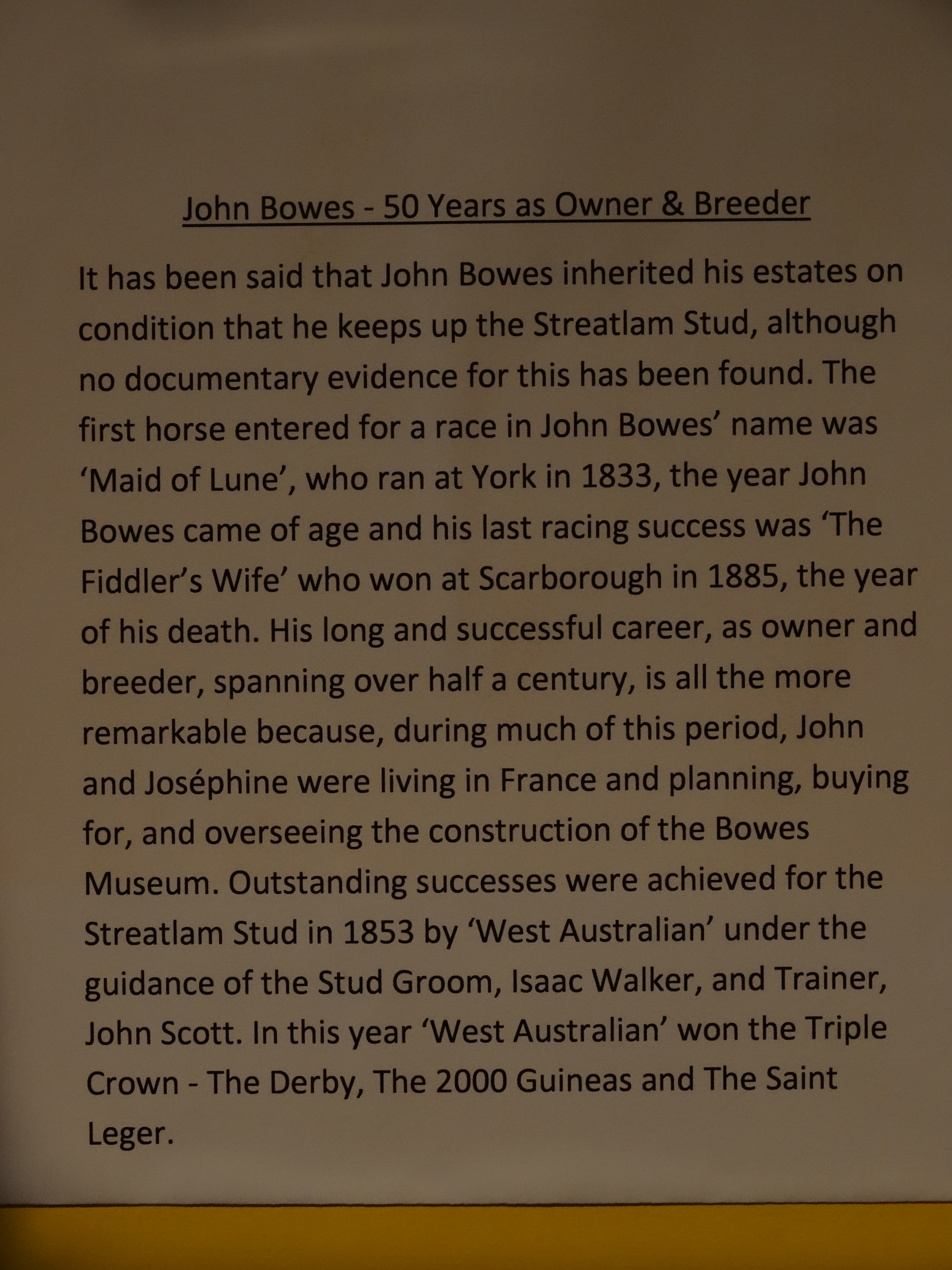
John Bowes lived at nearby Streatlam Castle (now demolished). By reason of his father’s late marriage in England to his mother John did not receive the hereditary Scottish title which passed to his Uncle. His Streatlam stud never had more than ten breeding mares at one time, but produced no fewer than four Derby winners in twenty years. The last of these, “West Australian”, was the first racehorse to win the Triple Crown (1853).


Bowes Lyon lineage
Bowes Lyon lineage

Born into the wealthy coal mining descendants of George Bowes, he was the child of John Lyon-Bowes, 10th Earl of Strathmore and Kinghorne (1769–1820) and his mistress or common-law wife Mary Milner. His uncle’s line ultimately produced the Queen mother Elizabeth Bowes Lyon.

The museum had a very interesting interior decorating section showing the interior designs from Tudor to today and along side this was a fashion exhibit and a most interesting visual art display. In the photos I have taken you will see what appears to be three different portraits but in fact it is the one portrait which changes expression. Also there is a second portrait in which the earrings in the picture move.

Bowes is a very different and interesting museum but well off the beaten track. Nevertheless it is well patronised by those who discover this oasis. We overnighted at the Hadrians Hotel in Wall, a village outside of Hexham. Before visiting the wall we called into Hexham and found an interesting old town with a fabulous mall Abbey and history. These photos are included.

Go back

Your message has been sent

Warning
Warning
Warning
Warning

Warning.