The Retirees go Abroad – All aboard The Chocolate Train

The weather has been kind. Wednesday after an exciting day on the glacier we were treated to a lovely sunset over Lake Geneva. The promise of a fine day for tomorrow.

We enjoy the vineyard and know we will miss this place when it is time to go.

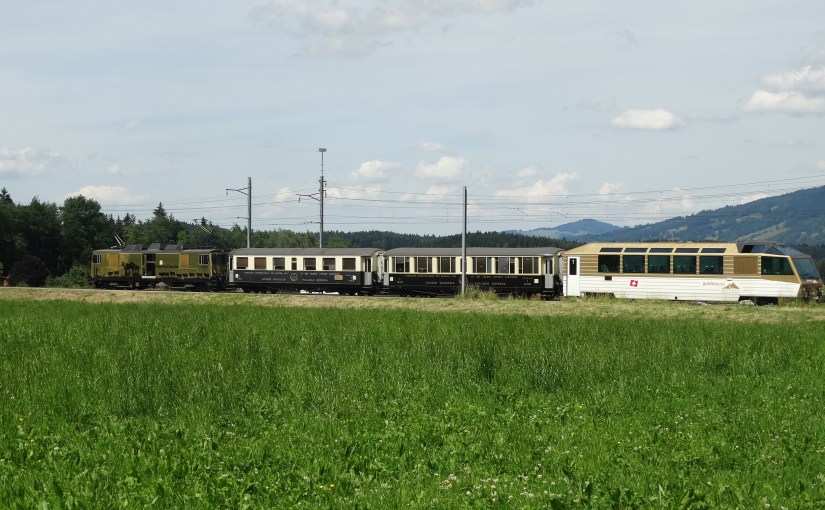
It’s an early start to shower have breakfast and get prepared to be in Montreux by 8.30 am even though Montreux is only 4 minutes by train from Villeneuve. We make the station ahead of time but this allows us to double check that we get the correct train. At Montruex we find the office of Golden Pass and collect our tickets. All aboard. The rain snakes its way out of Montreux giving spectacular views of the town and its lake.

As we travel along the countryside surprises us with its beauty and ruggedness. Photography is difficult because of the reflections in the windows.

Finally we reach Cailler. Cailler is a Swiss chocolate brand. It was founded by François-Louis Cailler in 1819 and bought by Nestlé in 1929 when the company fell on hard times during the Depression. The tour of the factory tells the story of cocoa how it was found by the Aztecs stolen by Cortez and introduced to Spain and then Europe. The Dominican order opposed it as sinful whilst the Franciscans approved of it for consumption even during Lent. By 1819 Louis Cailler had developed the chocolate block we know today and he made a fortune and a factory at Broc (where the tour is conducted) but he never exported. It was Nestle that had the international contacts hence the buyout in 1929. You won’t find Cailler in Australia which is a damned shame as it is beautiful chocolate.

After the history you go to a tasting room where through an audio guide you hear about the Nestle programme for helping indigenous women in Africa become self-sufficient and secure the resource (Coca beans) for Nestle. You hear about the nut growers and the Dairymen who are all part of the Cailler team and you get to taste the nuts and the chocolates – as much as you can eat provided you don’t try to leave with any uneaten.

After the gift shop we needed a cup of coffee/tea to wash away the taste of the chocolate. But the allure of the gift shop was hard to resist so we bought 3 bars of milk chocolate – we are pensioners and have to watch the pennies.

The tour finished and our taste for chocolate slaked we board a bus and travel to the villages of Gruyere. The village is most famous to us as the name of a type of cheese principally associated with fondue dining. But it started as the name of the village that was given to the local cheese. Dominated by its chateau the village is a reminder of the violent times of the past when it was necessary to have a fortified place to live and work. There are many remnants of this history apparent in the village. Apart from the modern entry there are a number of fortified gates around the village and two walls an outer and an inner wall before reaching the chateau.

The village church is remarkably large and well maintained but it also is surrounded by earlier fortifications

There are two museums in the village; a Tibetan museum and the HR Giger Museum. The Giger museum is a strange futuristic fantasy art museum and there is an adjoining café which takes its theme from the movie “Alien”. We had lunch there and even that was alien so far as Kerry was concerned

However the tour allowed us three hours at the village where two was plenty. After the village we returned to the bus and travelled literally down the hill to the cheese factory. Well after the Cailler tour the cheese factory was never in the hunt. We got the story of how cheese was made and stored and its different vintages plus the obligatory samples and gift shop but not as interesting or tasty as Cailler. Perhaps the most interesting was the cheese turning robot that spends its life going up and down the aisles of cheese rounds turning them over at the assigned time.

The tour has ended and it is time to board the train and head back to Montreux. Not a very vigorous day but tiring eating all that chocolate.

Go back

Your message has been sent

Warning
Warning
Warning
Warning

Warning.

The Retirees go Abroad – Glacier 3000 at Mont Scex Rouge Switzerland

We awoke early to arrive at Col du Pillion for the first cable car at 9.00 am. The agent at the local tourism Office had suggested that Wednesday would be fine weather but this was outstanding – not a cloud in the sky and a predicted 26C.

Everything went to plan and we arrived just in time to share the first car with a tour bus of Indian or Pakistani tourists, a cross country skier and some grocery deliveries for the cafeteria on the mountain. We bought our tickets which was a bit of a shock as the cost was about 128€. And yes the car for the trip from Col du Pillion to the first base was big enough to hold more than a bus load and travel 1500m in 53 seconds.

So before we could get scared about the height of the climb or the sheer rock faces we were passing, we had arrived to take the second cable car another 1300m to the top of Mont Scex Rouge. Up there the hot spring day was forgotten and a below zero temperature was keeping the ice solid and the snow thick. We learned later that it had snowed over night with very strong winds. We could see the mountains opposite and the avalanche protection in the form of fences across the face of the mountains, we could see the suspension bridge and snow-capped peaks. Below we could see the verdant green valleys.

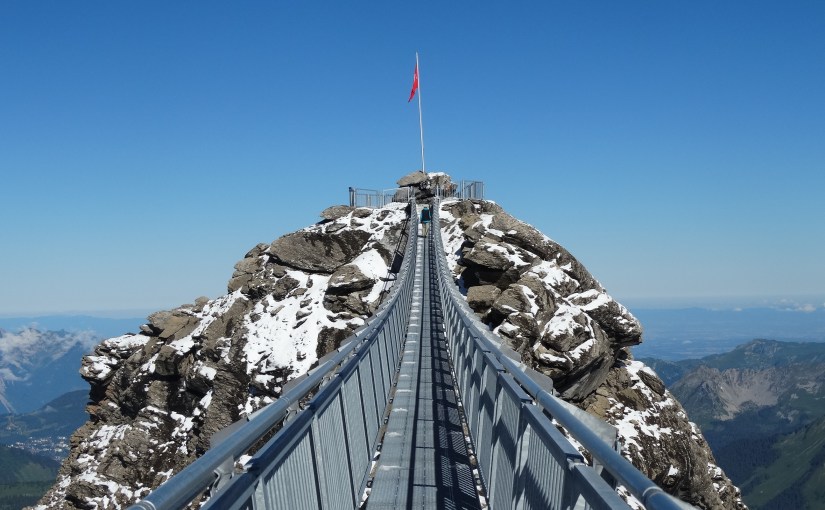
Gingerly we headed to the suspension bridge another 100 or so metres above us, A few more steps to climb but this time iced over with pools of melted ice water gathering in the morning sun. The bridge is made of metal suspended on four ropes and connecting with the adjacent peak roughly 180 metres away. At the end of the bridge is a large Tissot watch giving you the correct time but also the altitude. There is a viewing platform there covered in ice and snow but the view is spectacular including what I think is an old volcanic caldera now a lake surrounded by mountains.

After catching our breath and the views we gingerly crossed to the ski chair lift to descend to the glacier. The glacier is about an hour long at this point so we set off to walk to the Tour St. Martin and the café on the precipice. Buses ply the route for those not willing to walk and the snow dozers are preparing the snow for the weekend skiers – Yes we are coming into summer. About an hour into the walk we found it too hot to continue with jackets on. The Cable car station is now just a strange blimp on a white carpet stretching into the horizon. There are only two colours white and blue.

The tower appears close enough to touch but is still some 15 minutes away. We are starting to struggle in the fresh snow so it is with relief and excitement that we reach Tour St Martin and the end of the glacial ice. Here a café has been erected on the precipice looking almost 3000m straight down to the valley below. We stop at the café for barley soup and a hot chocolate and to soak up the atmosphere. We encounter a Swiss couple enjoying a wine which may have come from their vineyard in the valley below and chatter on not really knowing what we are talking about but loving it just the same. There are some Dutch and Korean couples and we all just embraced this special place. It was the waitress that told us about yesterday’s terrible weather and that the cloud was so low you could not see the Tour let alone Mont Blanc or the Matterhorn. She also explained that the hut is lined externally with metal to protect it against the wind blown debris which has left pock marks in the metal cladding.

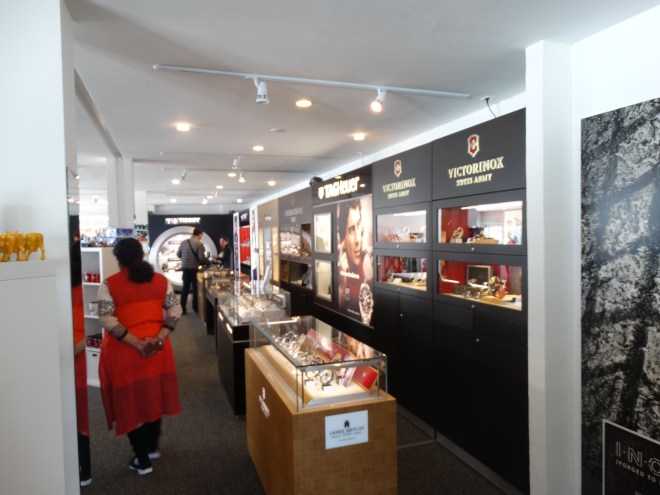
We decide to head back and our return journey is much quicker. We also encounter our friend the cross country skier who passes and repasses us two or three times as we journey back to the Cable car base. As you would expect there is a gift shop and it includes a Tissot watch shop. Our friend at the Tourism office tells us that it is quite the fashion to buy your new watch at 3000m. We journey home and flop into bed exhausted by the walking and the sun. At about 7.30 pm we rise to get some dinner and have a glass or two watching the sun go down about 9.30 pm.

Go back

Your message has been sent

Warning
Warning
Warning
Warning

Warning.

The Retirees go Abroad – Villeneuve Switzerland

The weather has improved but we are expecting rain tonight so we have put off going to the Glacier at Mont Scex Rouge to Wednesday and chosen to visit the La Vaux region and its vineyards this afternoon. A visit to Chantal at the tourist information office on Monday gave us all the information we needed about taking it easy enjoying our villa and seeing the important bits around the place.

We drove over to Chexbres a small village in the hills of the La Vaux region. We tracked along the lake through Montreux until climbing into the hills. On Friday we will walk back to Montreux to its casino with its Freddie Mercury Museum and past the Chateau de Chillon. Chexbres presented as a pleasant hilltop village with loads of charm but it was not in the vines so we moved onto Cully to catch the La Vaux Express through the vines. I am quite intrigued by the fountains appearing in all the villages particularly as we have filled up a number of times. Oh and I found some more lavender for Ron.

On the way to Cully we saw a number of interesting things about vineyards in the La Vaux: the steepness of the farms, the presence of the lake, and the way in which every space is used for vines and the various ways the farmers travel amongst the vines.

Cully is another village steeped in charm and it also benefits from the pier at which the Montreux paddle wheeler stops on its tour around the lake. It also celebrates liberation from Bern at the hands of Major Davel with everything from streets to Hotels named after him. Whilst we were there awaiting the Express we saw the Montreux docking.

Our tour on the Express started about 3.00pm. Our train took us on a journey through the streets of the villages and the vineyards that surround them.

By the time we returned to Cully we took the time to look more closely on the village, the fishermen on the pier, and the mermaid in the lake. On the way back to Villeneuve I was fascinated by the yellow awnings on the hotel at Montreux.

Go back

Your message has been sent

Warning
Warning
Warning
Warning

Warning.

The Retirees go Abroad – Bregenz Austria to Villeneuve Switzerland

After leaving Bregenz we anxiously watched “Tommy” to pick up our trail in Switzerland as we had the maps for Switzerland. After some backward and forwards and after buying our Swiss vignette (the road tax sticker) we made it into Switzerland.

It is very much like Austria or Austria is very much like Switzerland I don’t know which. Even down to the onion domes on some of the churches. We decided we would break our trip and call into Lucerne to see a bridge. Kerry had read about ten famous walking bridges in the world to see (and no the Goodwill Bridge was not one of them) and amongst the bridges was Kapellbrucke in Lucerne.

The Kapellbrücke (literally, Chapel Bridge) is a covered wooden footbridge spanning diagonally across the Reuss River. The bridge is unique since it contains a number of interior paintings dating back to the 17th century, although many of them were destroyed along with most of the centuries-old bridge in a 1993 fire. Subsequently restored, the Kapellbrücke is the oldest wooden covered bridge in Europe, as well as the world’s oldest surviving truss bridge.

After a hot beverage in the form of a hot chocolate, we left Lucerne for Lausanne or at least a village outside of Lausanne or so we thought. When we arrived in Villeneuve we were struggling with where the hell was our accommodation. We seemed to be going into the vineyards and then low and behold we ended up at a Cave for Domaine du Scex du Chatelard. Is it possible that we were staying in a vineyard – YES! We were a little early so we went back to the village to poke around.

Christine met us at 3.00pm as arranged and we took possession of the villa – a studio really with a kitchen dining room overlooking our Greek themed patio under the peach tree looking at the vines and a bedroom/lounge room. Both rooms have large windows looking over the village. Then there is the bathroom. Obviously an afterthought, there is part of the rock wall behind the villa extruding into the bathroom. Perfect in every way. We even had our own Grotte. We are staying at Domaine du Scex du Chatelard. Our photos of the vines show what a delightful place it is.

We very quickly noticed that sky diving is an important past time in Villeneuve with multiple sky divers drifting towards earth at different times during the afternoon. They were so frequent we even forgot about them.

We walked down to the village to buy some groceries and found that not much was open. So we ended up at the Hotel du Soleil for dinner. The incumbents are of the oriental persuasion so it was soup and dim sims for dinner. Not much chop for the price.

Go back

Your message has been sent

Warning
Warning
Warning
Warning

Warning.

The Retirees go Abroad –Salzburg through Germany to Bregenz Austria

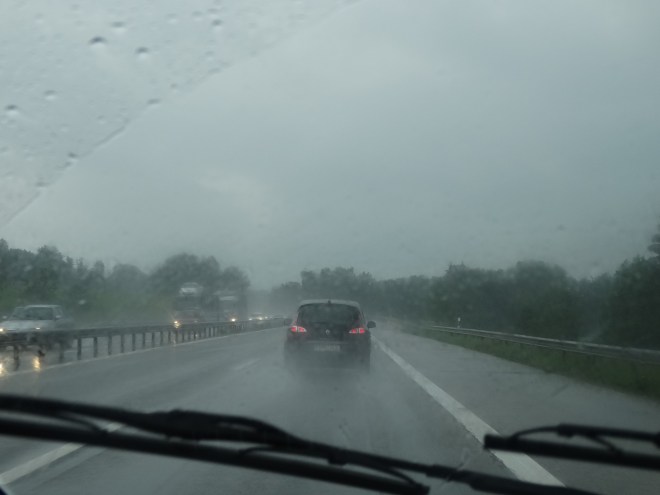
Whilst it had been raining on and off during our stay in Salzburg it really turned it on the day we left. Pouring rain followed us all the way to Bregenz. Bregenz is the capital of Vorarlberg, the westernmost federal state of Austria. The city is located on the eastern shores of Lake Constance, the third-largest freshwater lake in Central Europe, between Switzerland in the west and Germany in the northwest. The city is situated on the junction of the arterial roads from the Rhine valley to the German Alpine foothills. It is especially famous for the annual summer music festival Bregenzer Festspiele.

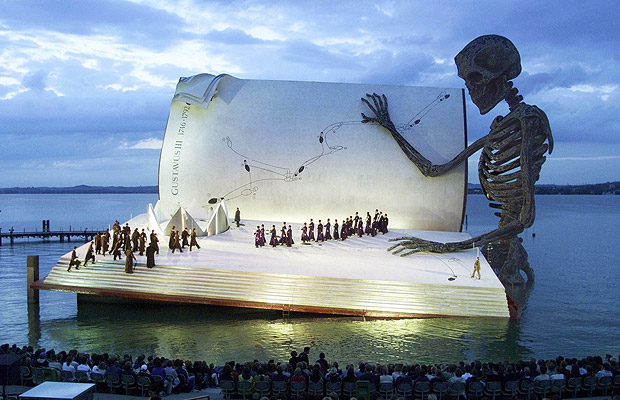
The day was grey the atmosphere damp and cold and the traffic was difficult at times. Finding our Ibis Hotel was not made easier by the IPhone but we got there. After checking in, Kerry wanted to check out an outdoor amphitheatre over the Lake with a floating stage and the Casino. We thought the weather had broken and that we would not need an umbrella. So we walked from our hotel only 100m or so and we found ourselves crossing over the rail line to the casino and the theatre. Some interesting graffiti appeared on a wall along the way.

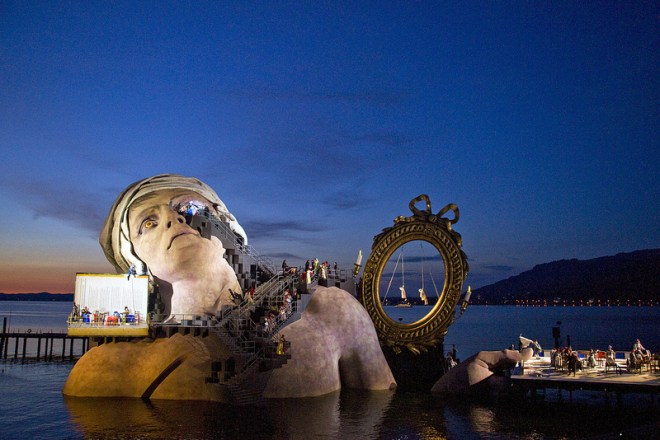
Well you cannot call it a theatre. In fact I don’t know what to call it other than fantastic. They were preparing for a presentation of Puccini’s Turandot in a Chinese setting with the clay soldiers rising from the water and the great wall crossing the stage. The whole building was remarkable and a landmark.

I have copied pictures of two previous presentations to give you the idea of the surreal atmosphere this stage presents.

We also went to the Casino. Reasonably swish and pleasant. We lost about 15€ on the pokies and for Sharna at Easts they used the card system and it was quite successful. We then decided to take in the air and walk along the lake edge until it started to rain and we scurried into the old town to buy some croissants for breakfast. There was a fabulous bandstand on a pier on the lake and quaint colourful buildings in the old town (including tractors in the main street). And of course some lavender for Ron. We had dinner on the Lake and it was bloody cold and wet but better than a pizza in the room.

Next morning it was still raining for our trip to Villeneuve.

Go back

Your message has been sent

Warning
Warning
Warning
Warning

Warning.

The Retirees go Abroad – Last Day in Salzburg Austria

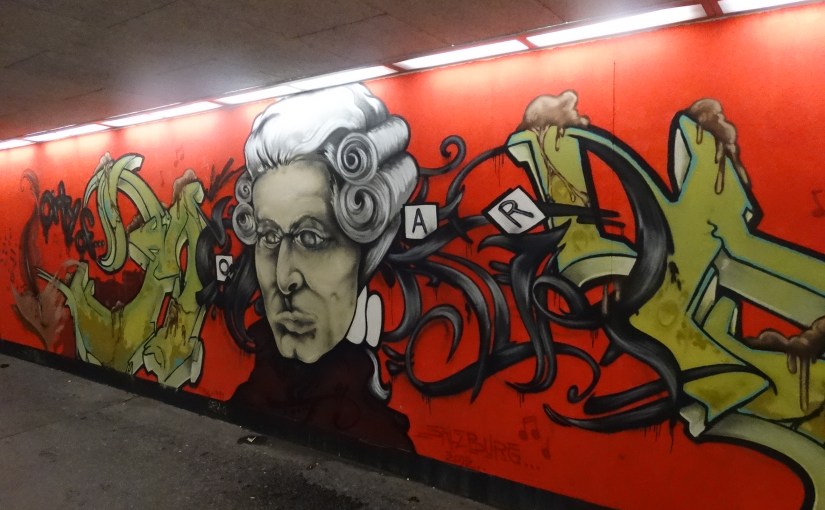
It is our last day for tripping around. We have to get some domestic things done like washing ironing and some car repairs. However we have the use of our Salzburg cards until 10.00 am so we jump the bus and go into the old City and visit Mozart’s birth place. On the way we pass some interesting graffiti. Mozart’s birth place is far more interesting and informative. We learn that Mozart had a sister and 5 other siblings who died at birth or shortly thereafter. His father Leopold was a distinguished musician and held positions at court. Because of Leopold’s talent he recognised Wolfgang’s brilliance and moved mountains to have it recognised. Mozart’s sister was brilliant also but not quite genius. Wolfgang had two sons one who was as brilliant as his father but lived in his father’s shadow and the second also musically talented but who chose to work in the civil service. The family line died out with Wolfgang’s sons. As usual with brilliant people the musicians were eccentric and it was Wolfgang’s mother who was the family stabiliser. Wolfgang’s wife was quite a business woman and although Wolfgang died at an early age his widow made his name and music live on. If in Salzburg this is a must to visit.

Kerry had high hopes of a shopping spree after our last museum but the weather had been overcast and rainy the last few days and today it was constantly raining – raining on her shopping spree. So home to domestic duties and car repairs.

We had lost power to the auxiliary power points in the car and it needed some oil. I knew it was the fuse but I could not find the fuse in question. I spoke to Petra our host about a service station and she immediately volunteered her father (who happened to be visiting her that night) to help. Arrangements were made to go to her uncle’s garage outside of Salzburg on Friday – today. At 2.00pm we followed Petra to this garage and after everyone got over a right hand drive car it took 5 minutes for the professional to find the fuses behind the change box in the dash. Fuse changed and oil topped up we returned to our domestic duties to prepare for travel and to prepare for the concert at Schloss Mirabell tonight.

Go back

Your message has been sent

Warning
Warning
Warning
Warning

Warning.

The Retirees go Abroad – Concert at Schloss Mirabell Salzburg Austria

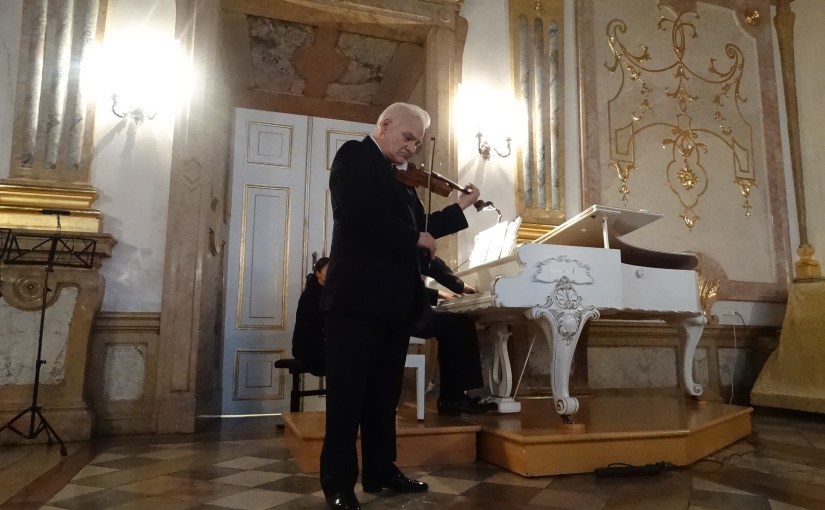
Schloss Mirabell’s breathtaking Marble Hall is the venue for classical concerts every Friday night in Salzburg. Dripping with old-world Austrian glamour, the hall’s interior matches the elegance of the music played inside it, making it the place to watch a concert in Salzburg. Access to the inside of Schloss Mirabell is only possible by booking a concert such as the one we attended tonight. So we did it and discovered the palace’s Baroque beauty while listening to chamber music from a trio of master musicians (piano, violin and viola) playing the music of the likes of Mozart and Beethoven.

The performance stated with a pianist from Siberia who played a set of three pieces by Mozart. Then the “First Violin” joined him for another set of three pieces followed by a break. Then came the surprise. The Violinist had forgotten the sheet music for the trio – the first time in 30 years so the pianist filled in with an ad lib piece until the sheet music was brought to the Palace.

The evening finished with the trio playing three pieces by Mozart to a standing ovation. The viola player was almost demonic in her determined thrusting with her bow.

So we walked to the bus stop to catch the number 5 home but the last bus was at 8.00pm and our concert finished at ten. So a cab home and into bed ready for a big drive to Bregenz in Austria tomorrow.

Go back

Your message has been sent

Warning
Warning
Warning
Warning

Warning.

The Retirees go Abroad – Ice Caves near Werfen Austria

This was to prove to be a very special day in many ways. We started early with the goal of doing the ice caves, Berchtesgaden salt mines and the Eagles Nest. I am glad we decided to do the ice caves first. The drive to the caves was exhilarating. We climbed to an enormous height way above Hohenwerfen castle which itself stood on a hill above the town, then after paying for our entry we walked up what must have been a 25 degree slope for 10 minutes then through a tunnel in the mountain for another 5 minutes then climbed again on a steep twisting trail for another 10 minutes to reach the cable car which took us up to 1500m. There we climbed again for another ½ hour on a twisting trail partly sheltered by concrete to protect against rock slides before we got to the mouth of the cave.

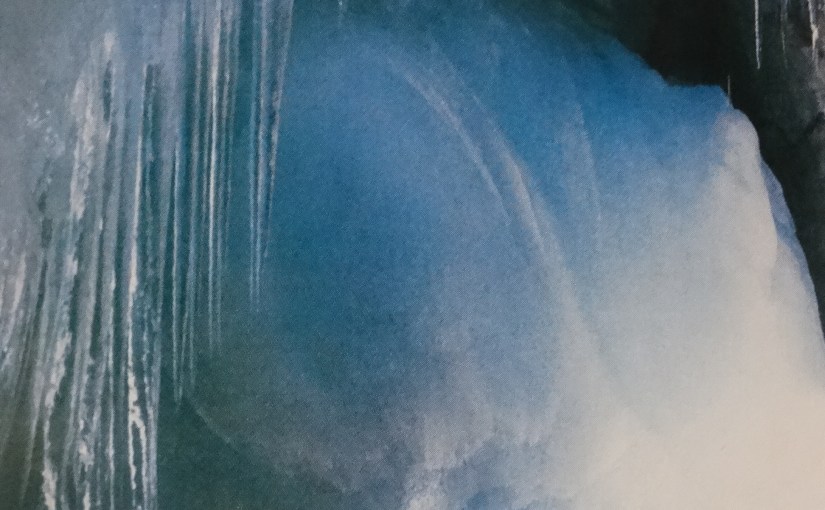
There were groups of school children as well as tourists so we had about a ½ hour wait (to catch our breath) before we were given our kerosene miners lamp and entered the cave with a mixed group of German and English speakers and our guide. No photos allowed inside so I have cheated bought a series of post cards photographed them and they appear below. However the thing you need to know is that the cave is cold – below freezing obviously and the trail is for the first ¾ of an hour made up of ladders climbing 700 steps up or the equivalent of 145m up through the caverns. After the climb to get there this can be quite a strain. Then of course you have to come down and walk back to your car. We thought we had earned a hot chocolate which we consumed before taking the cable car down to the last stage of our walk back to the car.

A breath taking experience!

The Retirees go Abroad – Salt Mines Berchtesgaden Austria

We lunched on Austrian baguettes (a bit tougher than the French ones) after climbing down from the Ice Caves looking at Hohenwerfen Castle and then travelled to Berchtesgaden. Kerry’s IPhone must have been playing a joke on us as we took the most circuitous route through villages to end up on a main road beside the tour buses at our destination, the salt mines. I was very surprised that we were standing in front of a glass and steel building with a train line poking out of it.

We encountered another Aussie Bea out for the day with her Austrian friend of 40 years. They joined us and we dressed in our overalls along with a tour bus of Chinese to head off on a tour in German with audio guides for those of us who did not understand German. No photos permitted of course but this did not stop the Chinese so I got a bit of the action half way through. The museum is an old salt mine and the tour went through its history and the mining process. The mine is still in use today and is likely to continue for many years yet and the stores of it are immense.

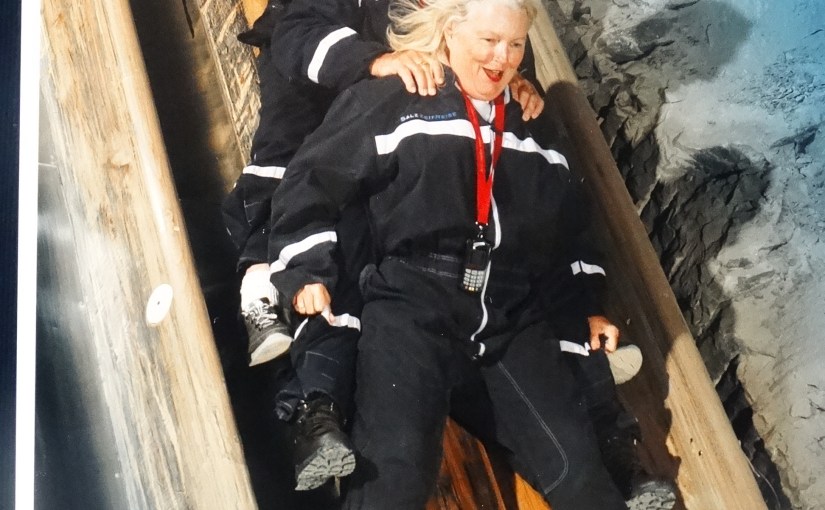
One of the photos shows Kerry me and Bea on one of the slides. I cannot tell a lie this was the highlight shushing down the slides. The tour included a boat ride on one of the lakes formed underground by the mining process of dissolving the salt and pumping it out and some of the photos are of the light show you watch from the boat. The picture of the church is just random – we saw this as we followed Tommy’s directions to the salt mines.

We had planned to visit the Eagles Nest. This is the resort built for Hitler on top of a mountain above Berchtesgaden which today is a restaurant and visited by many tourists but not us today as we are too late. Ah well we have done some amazing things today so I cannot be disappointed.

Go back

Your message has been sent

Warning
Warning
Warning
Warning

Warning.

The Retirees go Abroad – Old Town Salzburg Austria

You may remember a little movie called “the Sound of Music” and that most of the movie is set in Salzburg and that most of it was shot in Salzburg. Well even though there is no organised tour you can visit some of the sights where famous scenes were shot. Like the pavilion at Schloss Hellbrun, the fountain in Residenz Square, the cemetery at St Peters and a few other sights. Well I can give you the fountain and the Duomo of Salzburg, the cemetery at St Peters but not the Pavilion as we were too tired and wet for reasons I will explain. I have also included a shot of a large ball with a figure on top for which I can give no explanation.

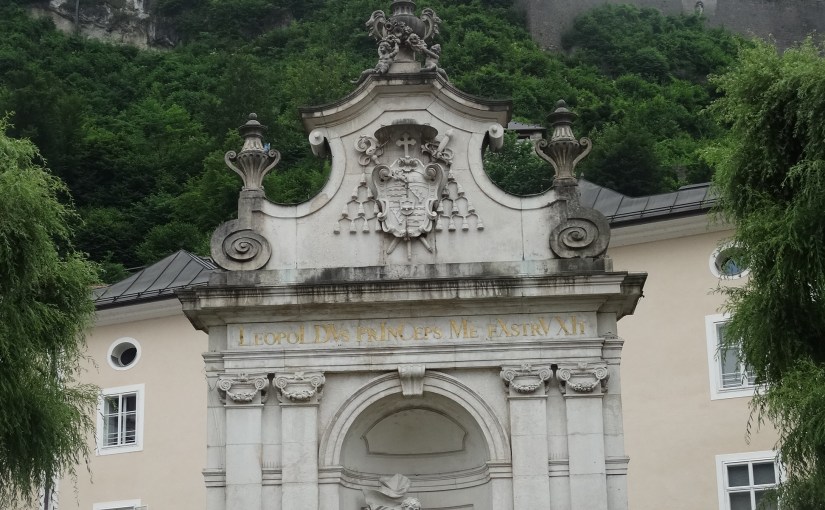
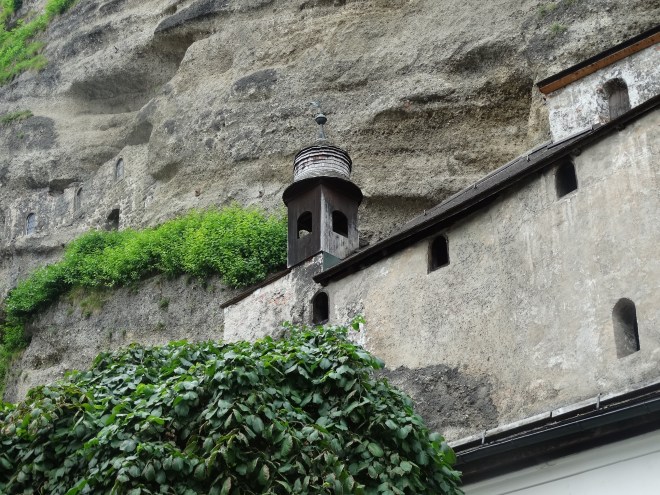
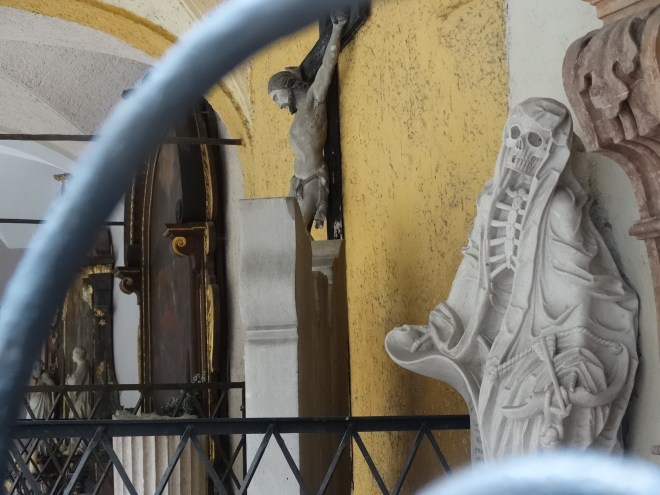
St Peter’s Cemetery is where the Von Trapp family hid from the Brown Shirts after their performance. It is a beautiful cemetery with some unusual aspects like its gated tombs to the chapel built into the rock wall and the gardens in the graves themselves.

Hohensalzburg Castle sits directly above the city and was the place of power and protection for the Prince Bishops of Salzburg. Although it has the oldest working funicular (originally powered by horses) it is now used for delivery of goods whilst a modern funicular give visitors access to the castle.

After arriving in the castle grounds, we made our way to the courtyard via one of the well heads and via the keep passing a marionette theatre which included the Von Trapps.  The keep was made up of a square tower not much like the fortified keeps of English castles. In the courtyard was a quaint church and a display on the changes to the castle over time. We also saw the old funicular as it is today still used to cart goods in and out of the castle.

In the state rooms we did not see much of the life of the bishops but rather a military museum. However the doors and door jambs were remarkable with the jambs made in marble. There were a number of tiled stoves (apparently Salzburg was a leader in these when they were popular) and one section of wall where during recent remodelling they found that a much earlier wall had been bricked in and they have left it open for visitors to see the earlier construction.

Other displays included medieval weapons and armour, a chapel, a kitchen and musical instruments. The kitchen had a quaint exhaust system for fouled water. A purpose built hole in the wall.

We were also able to get a view of the monastery we had visited previously or at least a little part of the walls and watch towers.After the castle we visited the Bendictine Monastery where Mother Superior sang “Climb Every Mountain” but photo opportunities were limited.

Then off to catch the bus (that bus pass came in very handy) to Schloss Hellbrun and the Folk Museum. This is a palace without a bedroom. The Bishop for whom it was built only wanted a day residence and he wanted to have fun so it is filled with water traps for his guests and todays visitors. If you visit don’t expect to stay dry. There are many little water operated dioramas including one that ends with a fountain on its audience.

Our visit to the folk museum was a bit of an afterthought – after we had walked in the opposite direction. It turned out to be a short version of the trek to the Ice Caves without a cable car and perhaps not worth the effort. Here are the photos for you to decide.

As we were leaving Schloss Hellbrun I noticed this lovely line of flowers with the colours lined to create a dazzling display. After leaving the palace of trick fountains and long walks, we finished the day by visiting the Mozart Steg – the final place of residence for Mozart in Salzburg. Well talk about disappointing. There seemed to be more about things that were not Mozart and we found out when we visited Mozart’s home where he grew up that all the good stuff was over there. Anyway this is what the front door to his last home in Salzburg looks like.

Go back

Your message has been sent

Warning
Warning
Warning
Warning

Warning.