The Retirees visit Anzio

We had enough of the dead so the following day we decided to visit Anzio. Again, we turned to the train to deliver us safely to this quiet fishing village south of Rome. Terminii is a large modern station with restaurants and bars on the first floor overlooking the trains parked and picking up passengers pulling in and departing across 28 plus lines. We had breakfast and watched the trains until our train was due to depart.

The train station at Anzio is approximately 500 metres from the water front. The downhill stroll was relatively easy however the same cannot be said for the return trip. Anzio has been established since ancient times.

Anzio occupies a part of the ancient Antium territory. In ancient times, Antium was the capital of the Volsci people until it was conquered by the Romans. Leading Romans built magnificent seaside villas there and when Cicero returned from exile, it was at Antium that he reassembled the battered remains of his libraries, where the scrolls would be secure. Remains of Roman villas are conspicuous all along the shore, both to the east and to the north-west of the town. Many ancient masterpieces of sculpture have been found there: the Fanciulla d’Anzio, the Borghese Gladiator (in the Louvre) and the Apollo Belvedere (in the Vatican) were all discovered in the ruins of villas at Antium.

Of the villas, the most famous was the imperial villa, known as the Villa of Nero, which was used by each Emperor in turn, up to the Severans and which extended some 800 metres (2,600 ft) along the seafront of the Capo d’Anzio. Augustus received a delegation from Rome there to acclaim him Pater patriae (“Father of his Country”). The Julian and Claudian emperors frequently visited it; both Emperor Caligula and Nero were born in Antium. Nero razed the villa on the site to rebuild it on a more massive and imperial scale including a theatre. Nero also founded a colony of veterans and built a new harbour, the projecting moles of which still exist.

In the Middle Ages Antium was deserted in favour of Nettuno, which maintained the legacy of the ancient city. Pope Pius IX founded the modern municipality of Anzio, with the boundaries of Nettuno being redrawn to accommodate the new town.

Anzio and Nettuno are also notable as sites of an Allied forces landing and the ensuing Battle of Anzio during World War II. The Commonwealth Anzio War Cemetery and Beach Head War Cemetery are located here.

Strolling down from the station we entered the village at the edge of the market square. The square was bustling all the way to the waterfront where you can still see evidence of the refurbishment of the harbour ordered by Emperor Nero. We walked through the square and along the water front past a Jewish synagogue with middle eastern architecture past beaches lined with umbrellas the colours indicating the different business owners of the beach, a lighthouse standing over caverns in the sea wall delineated as though they were once part of the harbour which lead us up to the ridge running along the sea shore. Scores of ruins lay around between beaches and across the ridge.

A fence prevented us from walking amongst the ruins. We walked about 1000 metres and came upon a visitor centre where we watched a video explaining the ancient ruins all around. We then followed the path taking us on a journey through time and the ruins. We were standing where Emperors like Caligula and Nero had once stood in their holiday villas.

It was hot and the walking was taking a toll. We still had to get back to the train station and we had come such a long way out of the old village. We made our way back attempting a short cut, but it was now the middle of the afternoon and the ocean breeze was not helping much. Mixed in with this was we had only a light lunch and the expectation that we would pick something up before the train proved illusory. Back on the train we journeyed to Terminii and our apartment for the last time. Tomorrow we would catch the train/underground to Leonardo da Vinci – Fumucino airport and home to Brissie.

As I am writing this 6 months after the events (not my usual practice but time did not permit) I cannot be sure that the next event happened on the way to Fumicino or another day we caught the lift at Terminii. Waiting for passengers to alight for the lift carriage two women came from behind me pushing me forward rather than waiting for the passengers in the lift to leave. Then I felt a hand in my pocket so I turned and using my forearm against the throat of the culprit I pushed her back against the wall with her feet off the ground. I screamed at her to remove her hand. She quickly got her hand out of my pocket and so I removed my forearm and then backed into the lift carriage.

Quite a bit of excitement but it reaffirmed for me that you cannot let your guard down in Rome particularly the underground. Kerry who had no idea what was going on, was quite shocked that I would attack this woman and accused me of being impatient and losing my temper.

Very interesting – what the witness saw – not a pickpocket at work but an impatient angry man attacking an innocent woman. Fortunately she accepted that the woman was a pick pocket and did not hand me over to the Carabinieri.

Go back

Your message has been sent

Warning
Warning
Warning
Warning

Warning.

The Retirees and the Capuchins – the Catacombs of Rome

Two more days of our Roman Holiday. After our visit to Castel Gandolfo we seemed to hit a dead spot but not for long. We took a tour of the catacombs and to pick up the tour we decided to walk which proved to be somewhat futile as we turned right when we should have turned left and ended back where we started which was not the intention. Even so we passed many interesting statues and buildings. We passed what appeared to be a monument to a mythical sea god, a building without corners and Trevi Foundation which is what we were looking for. Having visited the fountain by night on our Segway tour we thought we needed to see it with fewer people and get some day time shots.

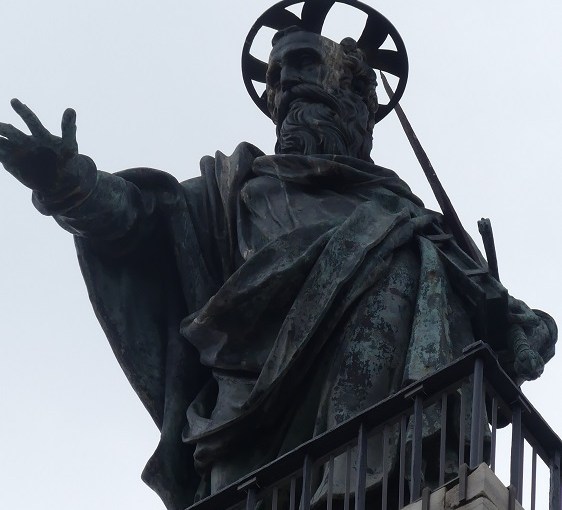
Some of these ancient buildings are not actually so ancient but shopping centres made to resemble the ancient. We also passed through a square we had visited on the Segway tour where we were able to obtain photos of the pillar with an avenging angel on top at least I think it is an angel or is an apostle – it gets confusing. We finally made it to the square where we were to meet our guide along with a whole lot of other people. The group was divided into at least 4 smaller groups of 12 – 16 people bundled into buses and whisked away. In our case it was to visit the Capuchin Convent – Cimitero dei Cappuccini: The Capuchin Crypt.

The Capuchin Order arose in 1525 when Matteo da Bascio, an Observant Franciscan friar said he had been inspired by God with the idea that the manner of life led by the friars of his day was not the one which their founder, St. Francis of Assisi, had envisaged. He sought to return to the primitive way of life of solitude and penance, as practiced by the founder of their Order.

Matteo and his companions were formed into a separate province, called the Hermit Friars Minor, as a branch of the Conventual Franciscans, but with a Vicar Provincial of their own, subject to the jurisdiction of the Minister General of the Conventuals. The Observants, the other branch of the Franciscan Order at that time, continued to oppose the movement.

The crypt is located just under the Church of Santa Maria della Concezione in Rome. Cardinal Antonio Barberini, who was of the Capuchin Order, in 1631 ordered the remains of thousands of Capuchin friars exhumed and transferred from the friary on the Via dei Lucchesi to the crypt. The bones were arranged along the walls in varied designs, and the friars began to bury their own dead here, as well as the bodies of poor Romans, whose tomb was under the floor of the present Mass chapel. Here the Capuchins would come to pray and reflect each evening before retiring for the night.

The crypt, or ossuary, now contains the remains of 4,000 friars buried between 1500–1870, during which time the Roman Catholic Church permitted burial in and under churches. The underground crypt is divided into five chapels, lit only by dim natural light seeping in through cracks, and small fluorescent lamps. The crypt walls are decorated extensively with the remains, depicting various religious themes. Some of the skeletons are intact and draped with Franciscan habits, but for the most part, individual bones are used to create the elaborate ornamental designs.

Unfortunately no photos allowed.

I must say it was quite strange, but everything came back to reality when we entered the gift shop for the crypt – I kid you not!

Our next visit was to what I considered the real catacombs The Catacombs of Domitilla

They are situated over 16 metres underground, about 2 kilometers from the south of Appia Antica (Appian Way) and spans 15 kilometers in distance. They were actively used as a cemetery from around first through fifth centuries CE and were rediscovered in 1593 by Antonio Bosio, an archaeologist. They include more than 26,000 tombs. Inside the Catacombs of Domitilla are images, some of which were revealed by the restoration, reflecting the life of bakers, grape vines, Jesus with the apostles, Noah’s ark, and Daniel with the lions. No pictures allowed but rather spooky in parts. No bones that we could see but apparently there are still remains somewhere in there. This was underneath a church and the church had a gift shop of sorts but no where near as weird as the Capuchins.

Go back

Your message has been sent

Warning
Warning
Warning
Warning

Warning.

The Retirees visit the Pope’s holiday home – Castel Gandolfo

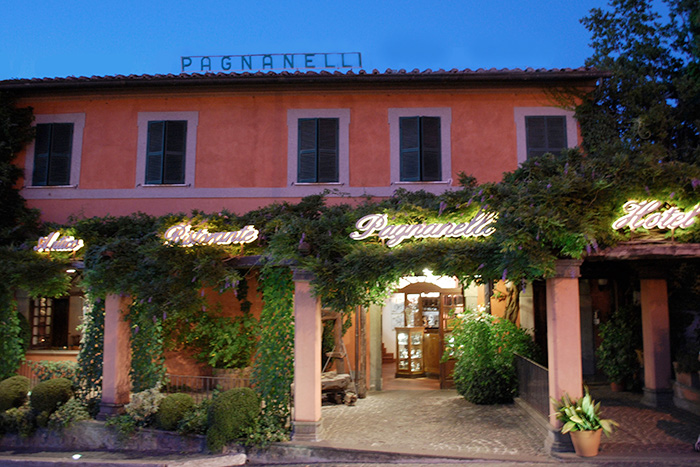
The highlight of our trip occurred on the 13th August when we visited the Pope’s summer palace at Castel Gandolfo. Coincidentally it was also the anniversary of our wedding. We had decided to celebrate with lunch at Antico Ristorante Paginanelli which is outside of Castel Gandolfo.

Castel Gandolfo is a town located 25 kilometres southeast of Rome. It is situated on Largo (Lake) Albano which to me looks like an old caldera filled with water as the village and castle of Castel Gandolfo is over 600m up the side of the lake.

To get to Castel Gandolfo we decided on the train but we had no idea what we would encounter nor how we would get up the hill from the station to the Restaurant and Pope’s residence. Fortunately for us just a few train stations short of the castle stop in Albano, the train line was under repair and for the last leg of our trip we were bussed to the town high above Lake Albano and not the rail terminus.

Occupying the top of the Alban Hills overlooking Lake Albano, Castel Gandolfo has a population of approximately 8,900 residents and is considered one of Italy’s most scenic towns.  The resort community includes almost the whole coastline of Largo (Lake) Albano which is surrounded by many summer residences, villas, and cottages built during the 17th century. It houses the Stadio Olimpico that staged the rowing events during the Rome Olympics. Castel Gandolfo has several places of archaeological interest including the Emissario del Lago Albano and the remains of the Villa of Domitian.

The bus dropped us off and we were left wondering where to from there, but a little investigation uncovered Antico Ristorante Pagnanelli, our ultimate destination. Nearby we noticed a road way climbing along the face of the valley with dramatic views of the lake.

At the end of the road is Castel Gandolfo (the village) and at the end of the village square – the Palace. Within the town’s boundaries lies the Apostolic Palace of Castel Gandolfo which served as a summer residence and vacation retreat for the Pope. Although the palace is located within the borders of Castel Gandolfo, it has extraterritorial status as one of the properties of the Holy See and is not under Italian jurisdiction. It is now open as a museum. The day we visited a group of nuns was also visiting which seemed a little odd that they were tourists and not part of the palace or a least the church.

We entered through a side entrance and looked back to the square of the village. Inside the palace courtyard is part of the Pope’s motor vehicle stable. Above us the Pope would stand and address the villagers and conduct Mass. Our online enquiries about tickets to visit the Palace suggested that we could only visit as part of a tour at a cost of 250 euros each but for 19 euros we got tickets to explore the palace/museum.

The oldest parts of the castle date back to the 13th century. It was acquired by the Vatican in 1596 when the Savelli family, who owned it, were unable to pay a debt to the Papacy. The gardens occupy the site of a residence of the Roman Emperor Domitian. The palace was built for Pope Urban VIII. Popes have used the properties as a summer residence and vacation retreat, except for the years between 1870 and 1929 when the Popes, were in dispute with Italy over territorial claims, and did not leave Vatican City. Pope Pius XI had the facilities modernised and began using the retreat again in 1934. In accordance with the Lateran Treaty of 1929, the palace and the adjoining Villa Barberini added to the complex by Pope Pius XI are extraterritorial properties of the Holy See.  The palace has been a museum since 2016. The first floor holds many of the vestments of past Popes and displays of ceremonies of the Church. In addition portraits of every Pope from the time of the Savelli family (one of the Savellis had held the office of Pope) was displayed along with the official Vatican history of the Pope. Not all of them were saints in my view. The Savelli crest has been absorbed into the Palace crest which appear on the ceiling and pottery (chamber pot in this instance). Of course there are priceless pieces of art and sculpture throughout but the statue of Don Quixote caught my eye as it stared at the timeless stunning scenery out the window. As we passed through the Papal bedroom I was amused that the Papal bed was a single bed but on reflection that is all he needed – probably the only thing that did not suggest excess and opulence.

We exited onto the village square and we wandered through to return to the road that would take us back along the ridge to Antico Ristorante Pagnanelli.

Opened by Giovanni Pagnanelli in 1882 the restaurant has been in the ownership of the same family for 4 generations. When we arrived we were greeted by a very Australian nona who it turned out is the wife of the current owner (met her husband on the beaches of Largo Albano married had 3 children and a restaurant). We positioned ourselves on the Terrace over looking the lake and settled in to a most enjoyable lunch with a bottle of Pol Roger (yummy – aged and honey over tones very dry)

The menu was individual and we slowly grazed through 3 course and our bottle of Pol Roger. The whole experience was very memorable topped off by a visit to the cellar. As we were departing Kerry asked if we could see the cellar. Sure no problem. We were shown the stair case and told to hold the rope as we went down. That was it we had been given the keys to the most extensive cellar I have seen. The photos follow and some of the wines would have to be decades old. As we descended we passed displays of all sorts of instruments for opening wine or harvesting grapes then row upon row of ancient bottles some even signed by past visitors – Keneau Reeves being one.

After lunch we waited for the next bus which took us only as far as the train station back to Terminii and a long walk to Via Natizonali.

How do we match that day? A memorable 30th anniversary leaving me to wonder how we improve for the next milestone.

Go back

Your message has been sent

Warning
Warning
Warning
Warning

Warning.