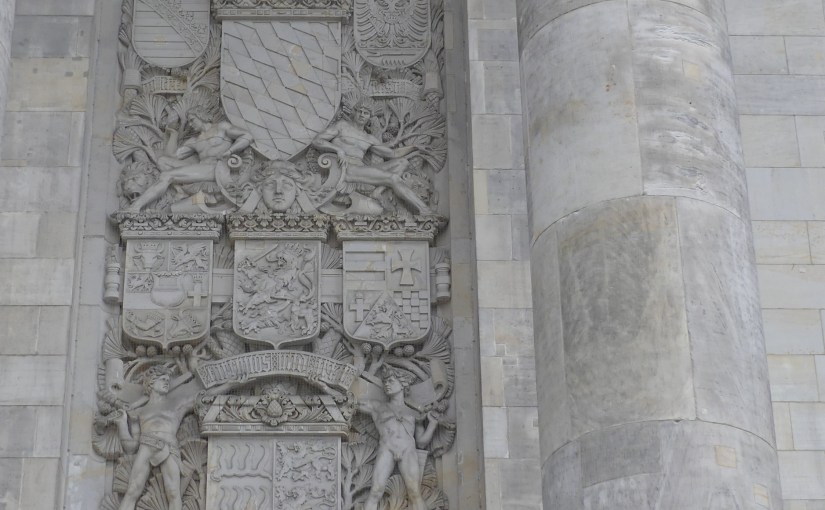
The Reichstag is a historic edifice constructed to house the Imperial Diet (German: Reichstag) of the German Empire. It was opened in 1894 and housed the Diet until 1933, when it was severely damaged after being set on fire. After World War II, the building fell into disuse; the parliament of the German Democratic Republic (the Volkskammer) met in the Palast der Republik in East Berlin, while the parliament of the Federal Republic of Germany (the Bundestag) met in the Bundeshaus in Bonn.
The ruined building was made safe against the elements and partially refurbished in the 1960s, but no attempt at full restoration was made until after German reunification on 3 October 1990, when it underwent a reconstruction led by English architect Norman Foster. After its completion in 1999, it once again became the meeting place of the German parliament: the modern Bundestag. In today’s usage, the word Reichstag (Imperial Diet Building) refers mainly to the building, while Bundestag (Federal Diet) refers to the institution.
It must have been galling to have an English architect restore the Reichstag but he has done a damn fine job. Whilst we did not visit the Bundestag, we were able to dine on the roof top and visit the central dome of the building. Travelling up in the lift was rather eerie with the mirrored walls reflecting our images like the entomb warriors of China.
On the rooftop we had fabulous views of Berlin, the Teirgarten Brandenburg Gate and Alexanderplatz radio tower. I was even able to photograph the Carillon (bell tower) or in German Glockenspiel that I had spotted from the Monkey Bar. Lunch was delightful and the ambience very comfortable.
Day: September 8, 2019
The Retirees go Abroad – Berlin by bus to Pergamon and the Dom
I was keen to visit the Pergamon Museum. My book “the Ghost Empire” had whetted my appetite for more on the middle east and that’s what I got. The Pergamon Museum houses monumental buildings such as the Pergamon Altar, the Ishtar Gate of Babylon, the Market Gate of Miletus reconstructed from the ruins found in Anatolia, as well as the Mshatta Facade. The museum is subdivided into the antiquity collection, the Middle East museum, and the museum of Islamic art. I was bowled over by the Ishtar Gate of Babylon. The following photos include all of the main exhibits. The museum of Islamic art felt somewhat overwhelmed by the displays below it and really deserves its own preserve. I found myself just unable to compare it fairly. For me the most interesting of the museum of Islamic Art was the rug making and the development of the designs and the ages of some of the earlier pieces.
Outside of the gate were some standing stones called “steles”. These had been excavated from Ashur in ancient Mesopotamia which were but a few of the 140 excavated and the purpose of the steles is unknown. They were found in two rows one row being for Assuryian Kings and queens and the other for lesser nobles dating from 1350 BC to 650 BC. Steles were a common structure in Mesopotamian times and were more often used to record major events like victories over other civilisations. From there we saw the archeological finds of many civilsations with many of the exhibits being conserved but in a way that you could see what was original. Paintings of archeological diggings and minatures of camp sites all making intriguing viewing. Before going upstairs to the Museum of Islamic Art we saw more from Ishtar.
From Ishtar we moved to the Art of Islam through the ages. As commented above I did not see it as being as impressive as the Assuryian history but still impressive for other reasons. The Mshatta Facade was one example which was very impressive. The Mshatta Facade is the decorated part of the facade of the 8th century Umayyad residential palace of Qasr Mshatta, one of the Desert Castles of Jordan, which is now installed in the south wing of the Pergamon. It is part of the permanent exhibition of the Pergamon Museum of Islamic Art dedicated to Islamic art from the 8th to the 19th centuries. There was a section dedicated to carpets and the skills of Persian carpet makers – one example being dated from the 15 century and one other being the remnant of a burnt carpet.
After the Pergamon we visited the Dom (Berlin Cathedral), the cathedral that is not a cathedral. It has all the grandeur but has never been the seat of a bishop and is in fact a protestant church. I am not sure how the church justifies this departure from the austere plain houses of worship typical of the protestant religions. We attempted to climb to the top of the dome. When about 100 steps from our final goal the staircase narrowed to a one-way track and passage became almost impossible. We abandoned the quest and returned to ground to meet Rod and Kerry as we were off to the Reichstag.
