Our Fabulous Travels – 2016 ANZAC Day Parade Brisbane

We started the day by watching the Dawn Service at the Australian War Memorial and the address by Brendan Nelson Director of the AWM. Nelson was as good as I have seen at delivering a heartfelt message of remembrance for all Australians who have served their country in theatres of war and elsewhere. He made me feel proud about my heritage, my father’s service in the Middle East 1940 -1942 and my son’s service currently.

Following breakfast, we put on our walking shoes and stepped it out to the City via the Goodwill Bridge QUT and the Botanic Gardens. A most enjoyable stroll in early morning sunshine with the promise of a pleasant warm day. We made our way up Albert St., then into Charlotte St., and finally onto George St. (the wind tunnel of Brisbane) where the various units were assembling. The marchers were in George St. headed north, the bands in Elizabeth St. headed east and the vehicles containing digger too old or disabled to march in Elizabeth St headed west. They would combine at the intersection of George and Elizabeth to form the parade.

We proceeded onto the stairs of the Toshiba Building at the corner of George St., and Adelaide St. took up a comfortable position – Kerry sitting on a wall and me standing camera in hand. People were milling awaiting the whistle for the parade to commence. Organisers in red polo shirts buzzed everywhere clip boards at the ready and the wind started to build whipping up George St like a gale in Bass Strait.

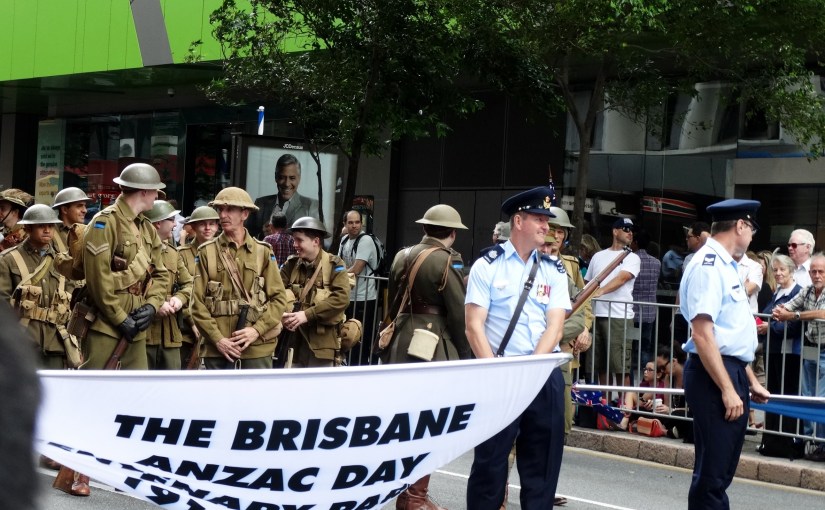
The it started run on 9.30 am with a group re-enacting the appearance of Queensland soldiers from the Boer war for we were not a nation then.

There was a squad of old taxis carrying the old and disabled diggers followed by the Air Force who presented in their sky blue shirts followed by the Navy and then the Army – 150 units in all. Various volunteers, police men and officials spent a lot of time rounding up hats blown off the marchers. The parade continued well past 11.30 am when we decided it was time to walk home as rain was now threatening as well. Nevertheless, a grand parade to remember all the servicemen and women throughout our short history as a nation.

The Retirees at Binna Burra Australia

After arranging to meet with Carly and her family at Binna Burra we arrived and were enjoying a cup of hot chocolate to find out Carly is on another mountain at O’Reilly’s – one and a half hours down and up another mountain. We decided that with the weather turned cool with a gusting wind that we would enjoy our cup of hot chocolate and read Sunday’s newspaper in the warm of Binna Burra Tea Rooms.

After finishing our chocolate and the newspapers, we ventured outside and the weather was decidedly improved. After checking the trails that were open we decided to take the Forest circuit and divert onto the Loop track – 2.1 klms in all.

Binna Burra is a parcel of private land and mountain lodge surrounded by Lamington National Park. It is also the name of a locality in the same area hemce the confusion about where we were to meet Carly. The lodge lies in the north-eastern corner of the Lamington Plateau, 75 km south of Brisbane. According to Wikipedia, Binna Burra means “where the Antarctic Beech trees grow” in a local Aboriginal language. You can visit the remaining Antartic Beech Forest on the way to Natural Arch.

Our walk commeced by passing through the gate to the Park where we encounter one of the locals – a small black snake sunning itself on the path. At only 1 foot long it did not present any danger.

The walk through the forest was cool due to the cloud and the light rain but the incline meant that we would work up a sweat.

The forest is filled with Satinash trees which seem to be very vulnerable to the Strangler Fig which grows up and around the trees eventually crushing it but creating this spectacular twisted natural sculpture. The wind had brought down some of the dead tress that are scattered through the forest.

High up in the trees are the crows nest ferns but thanks to high winds the ferns find their way to the forest floor .

Also on the floor of the forest are some amazing fungi.

The rain eventually built up to the point where we decided to return to the car and make our way home. Travelling down the mountain we stopped at one of the well known jumping off points for the para-gliders. It was far too windy today but you can still experience some fabulous views.

Travelling down the mountain we tried to get a view of the Hinze Dam which flooded Advancetown and the Upper Coomera Valley to provide water to the Gold Coast. We were unable to get a picture showing the whole of the dam but some parts of it and the views to the Gold Coast.


The Retirees Home in Brisbane –Roma to Brisbane

The next day we wanted to get away early and have a look at some features around Roma. Roma has a new airport so we stopped by to take a look. Judging by the cars in the car park there are still a lot of FIFO (fly in fly out) workers on the gas fields.

Then over to the cattle yards – the biggest in Queensland. The first thing we saw was a triple on the wash stand and behind it the cattle yards spread for acres. We climbed into the yards and walked around the viewing area. If you have ever been to a cattle sale and seen the frightened faces on the cattle, then these yards would be enough to cause a stampede – huge.

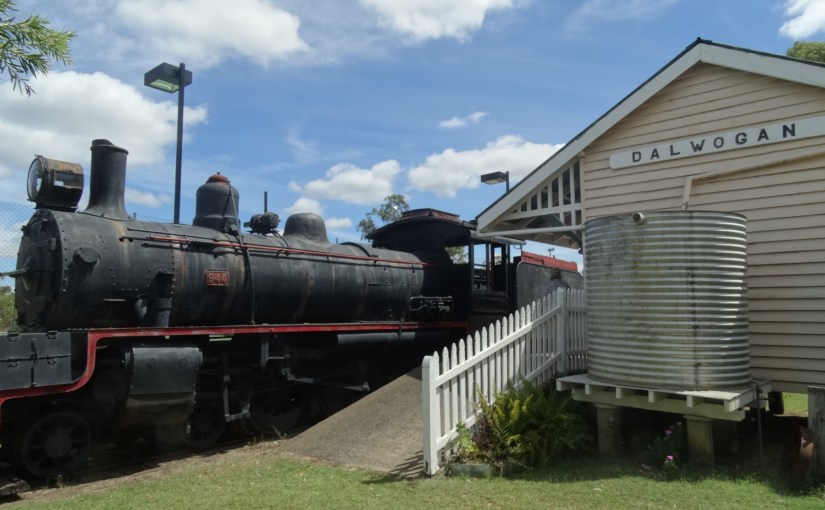
We then headed for Brisbane stopping in at the Miles Heritage Centre. This is a collection of memorabilia from all over the District including an old rail steam engine, an old shops and buildings of yesteryear. One of the building was a hospital with the operating theatre out the back like the dunny.

From there we drove to Toowoomba via Highfields where we caught up with our Lakes District companions Joe and Sue. Finally, home around 6.00pm and exhausted from the travel and the heat of the day.

The Retirees Home in Brisbane – Saturday in Roma

Breakfast was a Rotary BBQ held in the grounds of the Big Rig a museum on the Gas and Petroleum Exploration Industry. It was basic but a good way to start the conference. At the breakfast there was an old slab hut (Slab Hut Museum) giving us the chance for a group (minus 1). Leroy’s Hut built in 1893 by Thomas Keegan for his family of wife and 9 children was moved to Roma for preservation.

Originally home to the Mandandanji Aboriginal people and visited twice by explorer Ludwig Leichhardt, Roma was settled after Sir Thomas Mitchell reported glowingly on the country in 1846. Looking down from nearby Mount Abundance, Mitchell wrote, “I … beheld the finest country I had ever seen in a primeval state – a champaign (meaning ‘undulating country’ in archaic French dialect) region, spotted with wood, stretching as far as human vision or even the telescope would reach.”

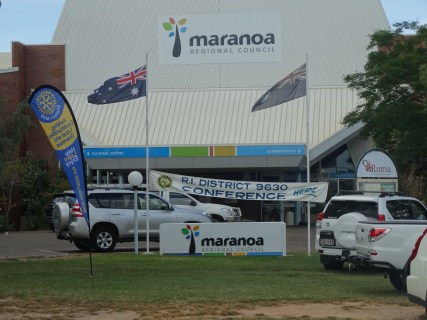
The Conference was being held in the Maranoa Shire Council Chambers which includes a Community Hall. Walking there I found the foundation stone from the foundation of the Commonwealth of Australia in 1901. It had been buried for a number of years and the development of the Shire chambers had unearthed it. Members of the Mandandanji performed the traditional smoke ceremony so we had to pass through the eucalypt and sandalwood smoke to leave the bad spirits outside. Inside the conference commenced with the Mandandanji welcome to the land performed by the local indigenous representative.

Of course Shane arrived just in time.

DSC09622

Our Master of Ceremonies Murray Hartin was an able MC. Coming from Moree he knew the west well and threw in a mixture of his poems which were both humorous and moving. The RI President’s Representative PDG Allan Jagger (OBE) comes from the Rotary Club of Elland West Yorkshire and was a refreshing speaker. We introduced ourselves to Allan and gave him greetings from President Shane at Woolloongabba and President John Bendall at our other Club in Nottingham. After Allan we toured through the booths for Rotary activities before taking lunch.

After lunch there were 4 further speakers all of whom delivered interesting presentations. Jeremy Scott was particularly interesting having toured 52,000 klms over 2 ½ years (London to Auckland) alone without support team. The Saturday session closed and we head for the showers. The Conference dinner was held at the Racecourse with the meals cooked in camp stoves (lots of them) – not a real success in my view. Watered and fed we headed for bed.

The Retirees Home in Brisbane – Roma


We are staying at the Starlight Motor Inn a group of 15 or so motel rooms a short walk from McDowell St the Main Street of Roma. The conference is being held over at the Maranoa Region Town Hall where we register and pick up the conference bag and our tickets for breakfast and the conference dinner on Saturday night.

DSC09593

Kerry has some child hood memories of Roma and tracks down one of her relations on whom we spring a surprise visit. After our visit we walk to the Maranoa Regional Council Chambers where we register and then we take a walk through McDowell St and see some of the historic buildings of Roma. The Western Star building, The School of Arts former hotel, The Commonwealth Hotel to name a few.

After a bit of a kip we join Ros and Julie for drinks then a walk to the nearest pub for dinner. Early to bed as we have a big day tomorrow.

I start the day at 5.30 am with a walk around the town for an hour. I walk past the Commonwealth Hotel around to the Courthouse and two interesting old houses, down the main street and check out the biggest bottle tree in Roma (9m around its girth). From there I walked down to the park by the Big Rig and spotted the Roma Rotarians setting up for breakfast in the grounds of the Big Rig. I also encountered a flock of Red Rumped Parrots, a flock of Apostle birds and a Crested Pidgeon. By the time I got back to our motel the Sun was well and truly risen and the atmosphere was heating up.

Breakfast was a Rotary BBQ held in the grounds of the Big Rig a museum on the Gas and Petroleum Exploration Industry. It was basic but a good way to start the conference. At the breakfast there was an old slab hut (Slab Hut Museum) giving us the chance for a group photo (minus 1). Lenroy’s Hut built in 1893 by Thomas Keegan for his family of wife and 9 children was moved to Roma for preservation.

The Retirees Home in Brisbane – Brisbane to Roma and the points in Between


We have been home now for 4 and a bit months. After some unexpected health issues for Kerry our plans have been thrown into disarray. But come March we are committed to attend the District 9630 Rotary conference in Roma.

For those of my readers who do not know, Roma is the main town in the Maranoa Region of South West Queensland some 515 klms (320 miles) west north west of Brisbane. It is a rich agricultural and grazing area and enjoying the economic benefits of coal seam gas mining presently. Famous for its Bottle trees and Romavilla winery, it was founded in 1867 and named after Lady Diamantina Bowen (née Roma) wife of the Governor of Queensland at the time. the rotary district 9630 incorporates the south east and south west portions of the state of Queensland. So this year we are going to the country. It is not part of the “Outback” per se but west of Roma is accepted to be where the Outback commences.

Romavilla Winery looks very derelict and closed. So I searched on the internet and it has closed but not forever. See http://www.westernstarnews.com.au/news/romas-historical-romavilla-winery-gets-makeover/1841054/

Our journey starts at 7.00 am Friday morning. It will take at least 6 hours driving to reach Roma and we plan 1 or two stops on the way. The first stop is at the top of the Great Dividing Range and the capital of the Darling Downs – Toowoomba. Located 125 klm (78 miles) from Brisbane Toowoomba is the largest inland city after our capital Canberra. Known as the Garden City because of its beautiful public gardens and parks. It is perched on top of the range 700 metres (2,700 ft) above sea level and enjoys milder weather than Brisbane. Our stop involves meeting Kerry’s relation Liz at the Parkhouse Cafe in Margaret St across the road from one of the city’s famous parks for breakfast. I can recommend the cafe for its tasty breakfasts and beautiful surrounds.

Liz can talk so we don’t get away until 10.00 am. Fortunately we had allowed for the delay but soon found ourselves out on the highway travelling through grassy plains and chasing trucks. Even though this area is at a higher altitude it can still get quite warm and today it has claimed to 34 degrees C and the heat haze hangs over the plains. The barley is ripe and ready to harvest. The next main town is Dalby.


Dalby is 208 klms (128 miles) west of Brisbane and the administrative centre of the Western Downs with approx. 13,000 inhabitants. The main Highway – the Warrego Hwy – skirts past the main town and we moved quickly onto Macalister which is mainly made up of silos over the rail line. This is grain country and broad acres and large silos are with us for the next couple of hours. then follows Warra, Brigalow, Boongarra and then Chinchilla 300 klms west of Brisbane. Chinchilla is the melon capital of Queensland and road side melon stall shot the road side. Although its residents only number in the order of 5,500 people it is a powerhouse of agriculture, beef and pork production. Kogan Creek Coal Mine has brought a diversity of wealth to the area. Just outside of Chinchilla we spot the SW Qld version of the Tour Eiffel in the form of a modern micro wave tower.

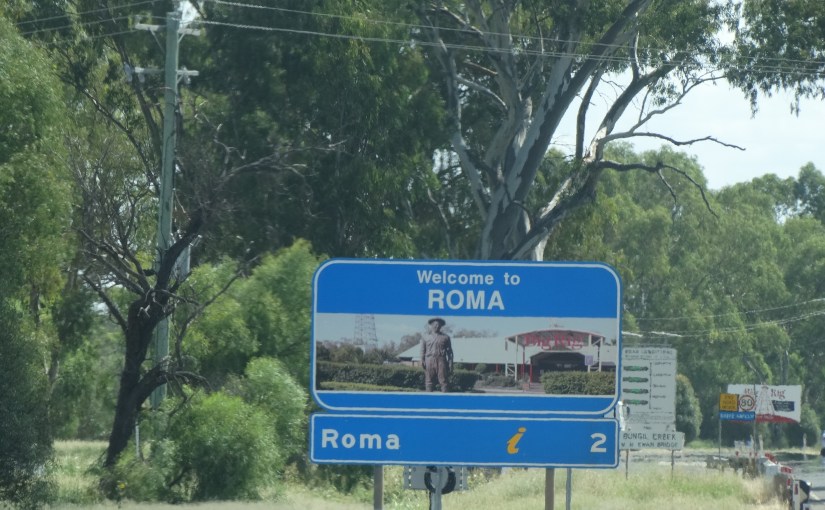
After a milkshake and a break we resume driving west through Goombi, Columboola, and onto Miles 340 klm west of Brisbane. Formerly known as Dogwood Crossing it was renamed in honour of the Queensland Colonial Secretary William Miles and is home to just under 2,000 people. It has a great example of a historic village well worth a visit. Our journey continued through Drillham, Dulacca, Jackson, Yuleba, and Wallumbilla. Jackson is the remains of what was thought to be Queensland big oil industry but now it is 7 houses and “Roo” box (where Kangaroo shooters hang the Roo carcasses awaiting collection) and it is somewhat of a ghost town. We are getting close now to our final destination – Roma. we pass through Blythedale and shortly enter Roma at 2.30 pm just 7 and a half hours driving.


The Retirees go Abroad – France, Norway, UK and Ireland – Post Script

Kerry has brought the following events omitted from my manuscript of our seven weeks in France, Norway UK and Ireland to my attention.

Toll Booth outside Amboise

On arriving at in France we picked up our hire car. At this stage we had Euros 20 in cash. We stopped at a motorway services for our first hot chocolate and then we had Euros 12 in cash. But we had our UK debit card our Amex cash card and our Australian Visa card to cover any tolls. Of course there was a toll and as the town of Amboise is a small rural town the toll station was also small and the toll was euros 19. We pulled into the toll station none of our cards worked and the intercom help line was manned by two people who spoke little English. After two cars and an eighteen wheeler semi had to back out of our lane while we sorted out our problem, the toll booth help line assistants finally printed an invoice for us to pay by cheque within 8 days. Of course we did not have a French cheque account but my cousin Terri did and she wrote the cheque which we then posted. Moral of the story – there are tolls on the highways and you can demand an invoice if you don’t have sufficient money to pay there and then.

Catacombs Paris/Luxembourg Gardens and Palace

The queue for the catacombs was extraordinarily long and it was at least a 2 hour wait before we would get in. I wanted to see the Luxembourg Gardens and Palace which as fate would have it was just around the corner (about a 20 minute walk each way or so I thought) I headed off leaving Kerry to hold our place in the queue. 20 minutes later I hit the edge of the gardens and another 10 minutes later I got to the Palace. Time for a nature stop. Just 50 cents but the toilet orderly thought I was most ungrateful when I wanted change from 1 euro.

DSC03291

The gardens were magnificent even though all the trees had lost their leaves. Hundreds of Parisians were out in the sunshine to get some colour (it was 10 degrees C). Back to the queue and Kerry was close to the entrance. I had a 10 minute wait before we got to go inside.

Kells Bay Beach Ireland. We drove the Ring of Kerry. One thing I did not mention was our visit to Kells Bay Beach. After leaving the main road we drove for what seemed an eternity to get to the beach. The road was narrow and overgrown (I mean really narrow). After probably 5 minutes we arrived at what was once Kells Beach. The storm events in January had washed away the beach. We drove on intending to exit back onto the main road and passed this little hand written sign saying “cul de sac” and it was pointing to an obvious dead end. We drove for 20 minutes along a road which got narrower and rougher until we got to an obvious dead end. Kerry confirmed with a local farmer that there was no exit onto the main road so we had to retrace our path. Again we passed the little sign now aware it meant the whole place was a dead end.

← Back

Thank you for your response. ✨

The Retirees go Abroad – France, Norway, UK and Ireland – Galway to Dublin

Our second day in Galway but this tells me the end is near.

We have booked a tour to the Aran Islands – just Inismor actually – with Michael Faherty tours (Micheal at the wheel). He is an Aranian and lives on Inismor still. The bus ride to the ferry terminal at Rossaveal takes an hour but Micheal gave us a commentary about features on the way making the trip feel shorter. When we arrive there are hundreds boarding the vessel. Fortunately there were only 14 of us on the tour which started with a drive to Fort Dun Aonghusa (a stone fort built by the Vikings on the edge of 300 foot high cliffs some where between 2,000 and 3,000 years ago).

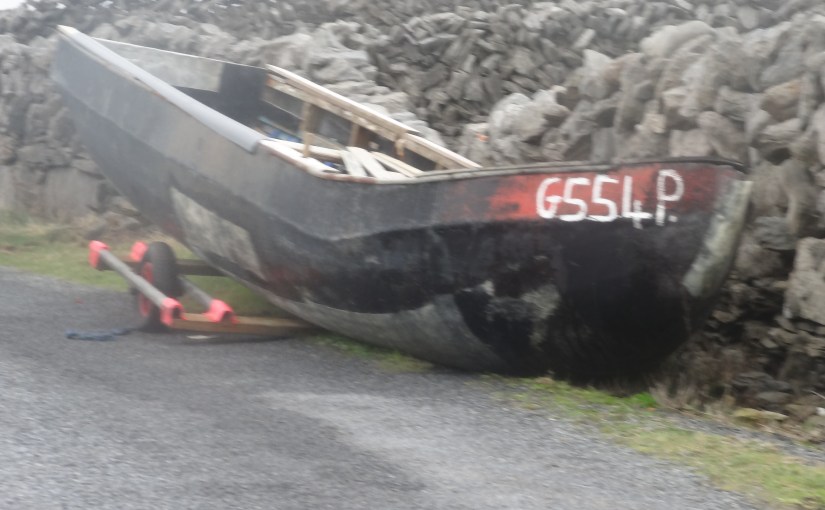
Along the way Michael spoke about life on the isle and the stony landscape. There is over 7,000 klms of dry stonewalls on the island and still there is a lot of loose and sheet stone. The walls were erected to hold the sand and sea weed the Islanders carried up to make a top soil to grow vegetables and grass for sheep cattle and goats. Fishing is the other principal industry.

Of course there was the Aran wool and knitwear to view and buy. The fort is immense covering 14 hectares from the precipice and is a kilometre from the nearest village – uphill of course. It was overcast misty and sprinkling with wind gusts – just the place to put a fort. Climbing to the fort we walked across stone with veins of poor grass so it was very slippery.

We also visited the ruins of seven churches from the 7th and 8th centuries AD, saw the damage caused by January’s cyclone and spotted a seal who was interested in what we were doing standing in the rain watching him. It may not sound like much of a tour but we came away with a real feel for how tough life is on Inismor.

Micheal dropped us off in Salt Hill and we had dinner and a stroll home to plan our next travels.

← Back

Thank you for your response. ✨


The Retirees go Abroad – France, Norway, UK and Ireland – Ring of Kerry, Glenbeigh and Blarney Castle

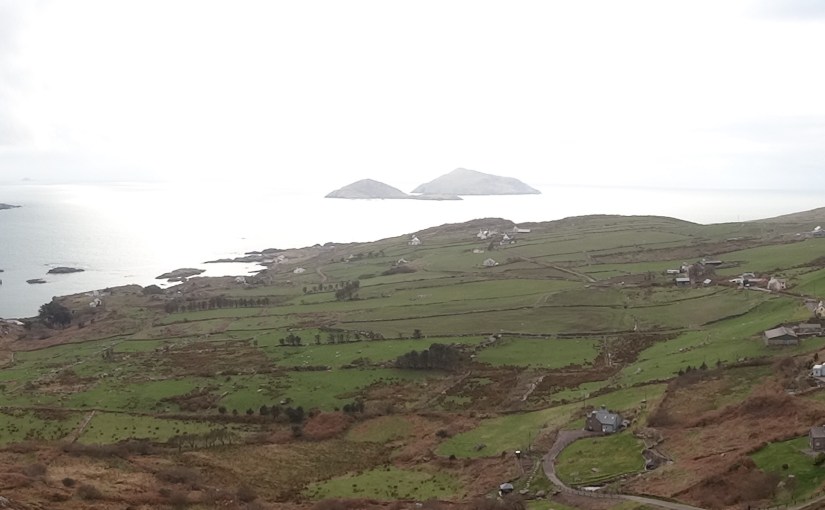
Farewell to Galway on St Paddy’s day we set sail for the Ring of Kerry – a circuit around the Iveragh Peninsular said to be one of the most beautiful areas in Ireland – well having done it I can say there are some parts that rate as beautiful but an awful lot that is just the same as anywhere in Ireland.


One good thing though was we arrived in Glenbeigh just in time for their Paddy’s day parade. We made up most of the crowd and the rest of the town was in the parade. They had a lot of fun and we were part of it. Then came the traffic jam. There is one street and the parade was in it.

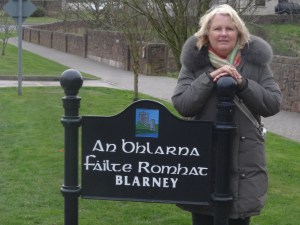
We arrived in Blarney just before 6.00 pm – lovely B&B (the White House). The pubs were still full of Irish celebrating (probably St Patrick’s day or it could have been winning the six nations rugby who knows) so we had dinner at the Chinese (the Red Lantern) with an Irish version of Chinese food.

Visited Blarney Castle and kissed the blarney stone. Tough task without help. Tough way to live as well.

Kerry found the Blarney woollen mills whilst I was viewing the castle. Not so much a mill but a large store of everything Irish and woollen. Set sail for Dublin. The gps “Tommy” was told to take the shortest route which was a country road behind three semi trailers in single file doing under 60kph. We got to enjoy the country side.

Once we got onto the motorway we decided to stop off at Cashel to view the Rock of Cashel. When we arrived the Rock (a medieval monastery) was covered in scaffolding and was at the top of a hill over looking the town. We needed some cash so we went to the town and found we were down to the end of our holiday cash – it had to happen (meanwhile a labourer in Britain had a premonition about winning the lottery and in response to a comment by a female co worker about his laziness he told her of his premonition which she ridiculed but lo and behold he won the lottery 108 million sterling – have a guess who wishes she had shut up when she had nothing good to say).

So after draining our travel card and changing our sterling to euros we headed back to the Rock but got way laid at the Cashel Historical Village. We entered to be met by the local historian who guided us through the village. Unfortunately it was very dilapidated but his passion for Irish political history made up for it.he said that his family had been guardians/caretakers at the rock for 4 generations but he had chosen to start this historical village but his cousin was still chief guide at the Rock. One of the things he showed us was the last “tinkers” wagon used in Cashel. It was dated from 1890 when it was built and was still in use by the Delaney family (they had14 kids in this wagon – Kerry checked the size of the parents bed which was no wider than a single bed which explains a lot) in 1990. He also had extensive memorabilia on each and every Irish rebellion, there must be something about us as when we came to pay he was only going to charge the seniors rate which we rejected.

Our stop at the village meant we ran out of time to see the monastery on the Rock and have lunch so we chose lunch then could not find a place open. So we got back onto the motorway until Kerry spotted the Horse and Jockey where we bought two coffees a loaf of bread and a jacket for me. I juggled the bread on my knee making Vegemite sandwiches as Kerry raced down the motorway.

Our hotel proved a strange one. After arriving at the airport precinct we took a distinctly country road for 2 klms before arriving at the back door of this 500 room hotel out in the paddocks. We returned our hire car after booking in and settled down to prepare for the trip home (3 days and 4 different aeroplanes.)

There you have it. Our seven weeks. Lots of fun adventures and experiences. Until next time goodbye.

← Back

Thank you for your response. ✨

The Retirees go Abroad – France, Norway, UK and Ireland – Day Two in Galway

Day two and we decide to explore to the north west and around the lakes just north of Galway. Rugged but beautiful at the same time.

We visited two or three villages in the Connaught but I cannot remember their names. One village had a remarkable cemetery perched on the edge of one of the lakes so that everyone of its residents got a lakeside view from their graves.

We returned to Galway to visit the Latin Quarter. Across the Liffey once more, this is the oldest part of town with buildings dating back to 1652 and the days of Ireton and Cromwell. It abounds with restaurants and eating houses and I met Oscar Wilde and his lifelong companion seated on a park bench but made the mistake of coming between them.


← Back

Thank you for your response. ✨