We have been lying low and recovering from our trip to the Lakes District but now look forward to our 7 days in Croatia. As we fly out on Wednesday morning from Heathrow at 8.00am, we have booked into a hotel at Hayes outside of London near Uxbridge. On the way down to London, we called into Oxford to reminisce about our visit to Oxford with Rod and Kerry Hayes and to see some more of the exhibits at the Ashmolean Museum. This is Britain’s first dedicated museum and it is fascinating. Certain things really caught my eye this time. One exhibit on the making of violins and stringed instruments down the centuries was so absorbing once again I ran out of time.
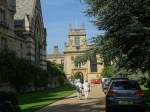
After a bite of lunch we walked down to Christ Church College through the garden and around to Merton and Corpus Christi up Magpie Lane over to the Bodleian Library and Brasenose College then into Broad St past Baliol College and to bus stop 2 to go back to Pear Tree Park and Ride then on to Heathrow.
We stayed overnight at the Mercure Hotel at Hayes near terminal 5 at Heathrow. This gives us the ability to be at the terminal for our 8.10am departure. However even an early flight from Heathrow can be delayed and we don’t get away till 9.00am meaning we arrived at Zagreb in Croatia at 11.00am.
Rod and Kerry were up early to catch a flight to Spain out of Stansted while we snored away but they were kind enough to sound their horn to inform us of their successful departure. We rose leisurely and got ready to vacate the room. The day was fine and for some reason Kerry wanted to go to the beach. The feeling passed and went to breakfast in a small café in the village (I’m sorry this is a town not a village). But it really does feel like an old rural village, untouched by the industrial revolution and reminiscent of earlier times. We finished breakfast and the need to go to the beach returned. So out came the National Trust Handbook and we found Blickling Estate at Aylsham in Norfolk.
The National Trust Handbook says of Blickling
“Nobody ever forgets their first sight of Blickling. The breath-taking red-brick mansion and ancient yew hedges sit at the heart of a magnificent garden and historic park in the beautiful Bure meadows.” It is true. This is a stunning house in equally stunning gardens.
The Hand book goes on to say “Explore the house, with its nationally important book collection, and hear the real voices of the servants who once worked ‘downstairs’. Blickling’s owners have used the estate as a place of quiet refuge, while playing their part on the world’s political stage. From ambassadors and airmen, to kings’ mistresses, its complex and sometimes tragic family history has been tainted by debt and social ambition.”
The Estate played a key role in the 2nd World War. RAF Oulton was a bomber base created on the Blickling Estate in 1939. The station was instrumental in winning the war, as documented by the Luftwaffe themselves. You can visit the museum and see artefacts from that period.
The manor of Blickling is recorded in the Domesday Book. Its owners have included Sir John Fastolf and Geoffrey Boleyn, grandfather of Anne Boleyn, the ill-fated wife of Henry VIII. The present red-brick mansion was built 1616-24 by Robert Lyminge (the architect of Hatfield) for Sir Henry Hobart, 1st Baronet, Lord Chief Justice to James I.
A tour of the house includes “upstairs” and “downstairs” but the house is best known for its library the finest library held by the National Trust. It is made up of 12,000 books collected mainly between 1720 and 1730 in the great book sales that took place in England and Europe at that time. It is held in the Long Gallery, a 123 foot long gallery built by Sir Henry Hobart in 1629 for exercise during bad weather. The Long Gallery is outstanding for its elaborately intricate Jacobean plasterwork ceiling. The bulk of the large library was collected in the 18th century by Sir Richard Ellys of Nocton. The Fist Earl of Buckinghamshire who had inherited the library from his distant relative had the bookcases installed to hold the library in or about 1745 relegating the full length portraits he had commissioned for the gallery in 1729 to the rest of the house. There is plenty more to know about this house and estate and you can read this at http://www.nationaltrust.org.uk/blickling-estate/.
Lord Lothian Ambassador to the USA at the time of WWII was the last private owner of the house. He was instrumental in persuading President Roosevelt to enter the war against Germany and the Axis Powers. On his death the house and the estate were bequeathed to the National Trust.
We took a walk through the gardens. It was very serene. The gardens have been set up with formal paths and interesting informal paths and each sector although containing the same mixtures of trees and bushes seemed to have its own identity. I’ll give you a tip – the secret garden is no secret any longer – it is sign posted. I will let you enjoy the photos.
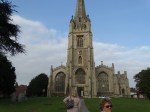
Saffron Waldron’s Church
Pretty impressive
the Vicarage beside the church
the Town Well and Town Hall
Blickling House
the house and gardens
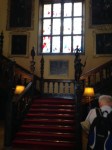
the Entry staircase
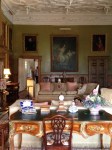
Sitting room
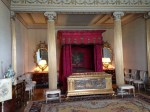
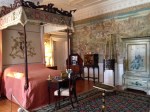
One of the bedrooms
Bedroom 2
Dining Room
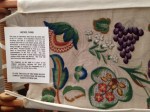
Embroidery on dislaly at Blickling
RAF museum and memorial
the Beach at Shearingham
Aylsham is close enough to the East Anglian coast to justify Kerry saying “Let’s stay at the beach!” We got some local knowledge from one of the assistants at Blickling and headed to Cromer, a typical English beachside resort town with a pier. We drove into the town around 4.00pm as we had been told that it would be no trouble to pick up cheap accommodation as the summer break had finished. Well I don’t know on what facts that advice was based but it was far from true. We drove around Cromer twice without any luck (except for one place that wanted 169 quid for the room for the night). I even tried phoning the proprietor of one B&B who had left a message on the front door that he was away for the moment and to telephone him. Two days later he called back – he had been away on holidays!
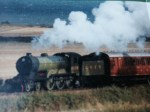
Anyway, we drove along the coast to Sheringham, a pretty seaside village with no pier but it did have accommodation and views of the sea. So we dropped anchor and took a walk around the beach defences (all concrete rocks and pebble beach with timber breakwaters/groins) into the village. Kerry restrained herself until we had walked all through the village to return to the penny arcade where we spent a fortune (well a lot of time) feeding tuppenny coins into the machines. She got so carried away nearly all the cafes and restaurants had closed so we went to the Lobster Hotel where they did not have any Lobster, but we got fed and watered. The next morning after another walk along the sea front and booking out we walked up to the rail station for the North Norfolk Steam Railway. The website http://www.nnrailway.co.uk/ will give you the story but here is what it says about the railway;
“The North Norfolk Railway offers far more than just a train ride, experience yesterday tomorrow with a day out travelling through some of Norfolk’s stunning coastal countryside.
The railway operates both steam and diesel trains, see the timetable for dates and times, and make a day of it with our great value rover ticket!
They have 10 steam locos, 9 of which are in service. If you get excited about steam engines then have a look on the website. We bought a return ticket to Holt and jumped aboard the train. The restored station included all the usual baggage and paraphernalia you would expect a café, gift shop and history room. The rolling stock was impeccable and the locos restored to within an inch of their lives. The journey was enjoyable and brought back memories of the journey through the Yorkshire moors from Whitby to Pickering (Heartbeat country) http://www.visityorkshire.com/attractions/north-york-moors-steam-railway-pickering-north-yorkshire.
When the train ride finished we had a 4 hour trip back to Long Eaton. If there is one thing to know about the East country (Lincolnshire and Norfolk) there are no motorways which makes travel times longer but the scenery is grander.
Our second day in Oxford. The B&B was comfortable (The Conifers) and the breakfast was good. The sun was shining and Oxford was waiting for us. We parked our cars at the Peach Tree Park and Ride and caught the bus into town. One pound for 24 hours parking and our 24 hour ticket from yesterday could be used until 12 noon today. The public transport is truly easily accessible.
The Oxford Visitors Information Office provides (for One pound 50p) a visitor’s guide which is a good investment. Inside is the information on the main colleges and a self – guided walking tour. With the benefit of our knowledge gained the previous day we elected to follow the self – guided tour. But before that we visited England’s first public museum the Ashmolean Museum of Art and Archaeology, cnr. Beaumont and St Giles St opposite that old Morse drinking hole the Randolph Hotel.
Founded in 1683, there is no entrance fee to a museum of wonders. Sure there is the usual Greek and Roman antiquities sprawling across the gallery on the ground floor (many of which were donated by Lord Arundel a person who may have some special interest to me but I may say more about that in the future if research supports myth), but the museum has created a path for you to explore the different civilisations with examples of life for ordinary people as well as the Rulers/Gods. We set ourselves a time limit and I had not got off the ground floor within the time set and there are 4 floors. The most dramatic was an image of a boy mummy from one of the Egyptian periods created from a CT scan and laid on 133 glass sheets so that when you looked at the glass sheets you saw the mummified remains in full and side on all you saw was the edge of the glass panels. My photo did not do it justice but I have included others I found interesting. Kerry meanwhile visited the English Embroideries Trail. Before photography there was embroidery. Just as the Bayeux Tapestry recorded the events leading up to and William’s victory over Harold, there are tapestries of both religious romantic ideas and other works on display. Kerry also ran out of time.
We reconvened at the coffee shop after which we started our walking tour in Cornmarket St where we found Oxford’s oldest surviving building a stone Saxon Tower being part of St Michael’s Church. It was part of city walls and is over 1,000 years old. You can climb to the top of the tower for a fee and on the way up you can see the old door to the goal which imprisoned some religious heretics (Queen Mary trying to restore Catholicism to England had these three gentlemen burnt at the stake in Broad St) and the bells of the tower. On the roof you get very good views over the city – there are no high rise in Oxford.
Unlike yesterday we then continued down Cornmarket into St Aldates and passed Christ Church College entrance on the way to Christ Church Meadow and the Broad Walk to the river. We were supposed to find the shop where Alice Liddell (Alice in Wonderland) bought her sweets but all I could find was a Curry shop. How things change. I wonder if Lewis Carroll would have had Alice drop in for a curry.
We strolled down the meadow lane passed the visitors entrance to Christs Church (7 pounds 50p entrance fee). Across the fields we could see Corpus Christi and Merton Colleges until we reached the river (the Cherwell I presume). We emerged in front of Magdalen College decorated in some unique grotesques and saw that there was a punt ride available under the bridge across the river. We chose a chauffeured half hour cruise for twenty five pound and glided quietly (well we were quiet but the kids at play in the school yards adjoining the river were not) along the river. Our chauffeur was a female student from Brighton having just completed her degree in anthropology and working part time during the term break until she could pick up a job in her chosen profession – event management would you believe!
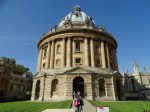
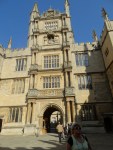
We left the river to walk along the High St past St Edmund College and into Queens Lane and into New College Lane past Edmund Halley’s house (you know Halley’s comet), under the Bridge of Sighs and into Catte St. Here we diverged from the walk and passed All Souls College, around Radcliffe Camera, to the door of Brasenose College (and this time I got a photo of the nose) and into the Bodleian then back to St Mary the Virgin and down that passage across the High Street into Alfred St and down to the Bear for a well – earned drink. There was another reason to lead Rod and Kerry to this pub and that is the quirk for which it is famous or infamous. The walls and ceiling of the hotel are bedecked with the ends of gentlemen’s ties. A former publican collected different ends of ties by shearing the end of the ties of his customers off and displaying it on the hotel walls.
Time was getting away and we needed to be in Cambridge (or more precisely Saffron Waldron just outside of Cambridge and closer to Stansted Airport). So after a pint and a Pimms we set sail for Cambridge. By the way they made the Pimms identically to the Turf. That and the fact that the name of the same hotel group was on the wall confirmed that the dispute about the oldest pub was in the hands of the same owner.
We had a long standing arrangement to meet our good friends and erstwhile neighbours Rod and Kerry at Oxford. They were touring in Somerset and on the way to Spain we agreed to meet half way (well sort of half way). We had planned to meet in Oxford and travel together to Cambridge where Rod and Kerry would catch their flight to Madrid from Stansted Airport. We in turn planned to arrive in Oxford a day earlier to make the most of our visit.
Packed on the Sunday ready to travel on Monday September 8, we rose early and were on the road by 8.30am. Tommy was slow to wake up and we were half way to the M1 when he clicked in. Suddenly I was in a panic. My wallet was not in my pocket and I had left it at home. So instead of exiting at the first exit we upset Tommy by going all the way around the roundabout and home again. As we did so Kerry remembered we had forgotten our accommodation vouchers.
It is now approaching 9.00 am – school drop off time – and travel back to the flat was slow. I collected all the forgotten items (not quite later on I was to realise I had not picked the spare battery for the camera) returned to the car and we tried again. I had planned that we would go to the White Horse Hill south of Oxford and join our Morse and Lewis foot tour at 1.30 pm. Not to be unfortunately. The forgotten essentials and traffic jams at road works in Northamptonshire meant we travelled directly to our B&B in Oxford.
On arriving in Oxford I was surprised to find the city was ringed with Park and Ride facilities. We had been advised against driving in the city itself and I would wholly endorse this. We found the bus service efficient and cheap both from our B&B and later from the Park and Ride. Our accommodation was well located and near a bus stop which meant we arrived into the city well in time before the walking tour. There seemed to be some controversy around the tours offered by the Information Centre with other guides promoting their free tours (the Information Centre charge 10 pound per person for their official tour) directly outside the Centre. I don’t know the quality of the free tour but it would bear investigating and don’t be in a rush to use the services of the Information centre which charged for every service (including the basic street map of the city).
Our guide arrived a little after the appointed time (she had just finished the Harry Potter tour) and she seemed somewhat disorganised when she stepped in front of a bus. Fortunately no one was hurt but she had forgotten that there was a Fair in town and buses were diverted up Broad St (we were standing in the middle of that very street as the Information Centre is located on the old city side of the street.).
We are both interested viewers of Morse and Lewis (both programmes are on English TV continuously) but I was astounded at how seriously others on the tour took the show (mainly Americans). So this was about seeing some of the sites of the city with a slant towards those parts of the city where the programme had been filmed.
Firstly I will get the big question answered. Where is Oxford University? Answer – everywhere!
The University is made up of 38 Colleges which are scattered among the streets of the old city and the extended old city (outside the walls). Many of the shows are set in the forecourts and buildings of the colleges and pubs of Oxford and this tour was going to show us these special places.
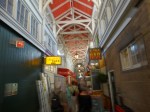
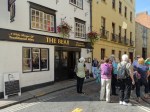
Broad St represents one of the boundaries of the old city. The street is broad because that is where Oxfordians threw their rubbish. Oxford gets its name from the ford across the Cherwell and the Thames at this point. Many of the colleges were founded by religious orders and it is believed the Augustinians were the first to do so in the 12th century. By the 13th century many friars of most of the prominent orders of the day were studying in Oxford. Our first look at the front gate of one of these colleges was Balliol College (founded 1263 was for many years reserved for the poorer scholars) a regular set for Morse episodes (apparently) but we did not get past the front door. Beside Balliol is Trinity College with its’ tell – tale blue gates. From there we proceeded down Turl St and turned into Market St and the city markets (apparently there have been a few chase scenes through these markets) then across the High St into Alfred St and the intersection with Blue Boar St where we find one of Morse’s drinking holes (and the oldest pub in Oxford), the Bear. A small two level pub with crooked windows tiny rooms and narrow staircases it claims establishment from 1249 (not as old as Ye Olde Trip to Jerusalem in Nottingham 1141). We return to the scene of this crime later on.
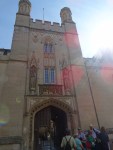
We walk down Blue Boar St and into Oriel St and the front door of Oriel College, where again we see inside the door but entry is not allowed. Again some misadventure had taken place here in one of the series but the best was yet to come. Into Merton St and we arrive at Corpus Christi College. Our guide has a quiet word with the porter (all the gate keepers are called porters) and we are in despite the “No entry to Public” signs. I think there may have been some graft and corruption here as most colleges will for the right fee allow entry and I think our guide has a deal which she has been unable to swing with the other colleges.
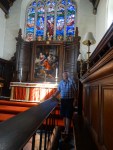
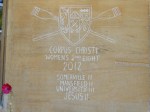
The fore court of the college is very interesting. Unlike the others there is no grass and in the centre of the court is a sundial (handy when there is sun). Graffiti adorns the walls but this is to do with successful rowing teams crowing about their victories. We are taken to the chapel and told more “secrets” from the shows. The chapel is typical but probably the smallest as this is the smallest college with accommodation for only 300 students. Typically there are 20,000 students per year shared among 38 colleges, 8 of which is for graduates and one only All Souls for Fellows (no it is not sexist – these are senior academics). We walked through the garden to see all that remains of one of the Saxon walls that enclosed Oxford, spied on the students using Merton field and viewed the spires of Christ’s College before making our way out to look at the front door of Merton College the third oldest in Oxford (1264 – University College 1249 being the oldest). Once again bloody cobbled streets. Merton St is the only remaining cobbled street and therefore distinguishable in any Morse or Lewis episode.
We then back tracked to Magpie Lane, once again crossing High St, and into Catte St passed St Mary the Virgin Church(interesting how many churches are dedicated to St. Mary the Virgin) and the precinct of the Bodleian Library and the Radcliffe Camera (this is connected to the library through underground tunnels). This is an enormous Library with miles of underground tunnels (although it is only three storeys high it has 8 floors underground) housing tens of thousands of books. It is a copyright library and therefore entitled to receive a copy of every book published in Britain. We could not get inside as it is a working library but tours are available and even tours which include the tunnels (if you know what to ask for and where to look).
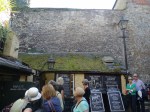
From there we moved into New College Lane (the New College was founded in the 13th century) under the Oxford imitation of the Bridge of Sighs as seen in Venice (actually it is nothing like it – the genuine bridge in Venice connects part of the old palace to the goal cells and when a prisoner passed over that bridge he sighed with resignation over his fate). Then we turned suddenly left into a small lane distinguished by a sign saying “To the Turf”. Following the lane the guide shows us the other remaining section of the original Saxon wall and the entrance to Oxford oldest pub (Yes this one also claims that title and I think the dispute has been settled by the one person buying both hotels and sharing the claim). This pub is squeezed in between other buildings and you have the distinct feeling of being underneath. We visit the scene of this crime a little later on also.
There is another exit out to Hollywell St where we pass another pub this time part of the Young’s Chain and into Broad St once again. We duck back into the Bodleian to view the door through which every student who matriculates passes on their way to the Sheldonian Theatre (a Christopher Wren building) to receive the awarding of their degree. Across the road from the Sheldonian is Blackwell’s bookshop which often features in the Morse and Lewis episodes. Reportedly the bookshop has 2.5 miles of shelving. Alongside is another Morse favourite the White Horse Pub.
There our tour finished. I felt that our guide just ran out of enthusiasm and her audience the same. Whilst I enjoyed it thoroughly I don’t think it was well organised or as well presented as the opportunities to do it better seem endless to me.
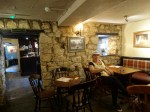
In need of something to wet the whistle Kerry and I returned to the Turf to soak up the atmosphere and an ale or two. The building is clearly old with bits and pieces everywhere very low ceilings small rooms and higgledy piggledy patios all of which gave it an intimate atmosphere. Here they made the best Pimms – not just cucumber or lemon or lime but all of those plus strawberry and apple.
We ended our day and caught the bus back to the B&B where we found that Rod and Kerry had arrived. After settling in we returned to the Turf where we did in a couple of burgers, and a bottle of wine. My photos follow.
Trinity College
Chasing through the Markets
Lincoln College
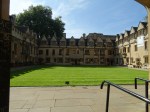
View of part of the court at Lincoln College
Oriel College
View of part of the court at Oriel College
Courtyard of Corpus Christi College
The Chapel – Corpus Christi College
Peeking at Christ’s Church College
The Bear
Graffiti at Corpus Christi
Merton College
Radcliffe Camera
St Mary the Virgin Church
Brasenose College
Part of the Bodleian
Remaining Saxon wall and the Turf Pub
Youngs “Kings Arms Hotel”
Matriculation doorway from the Divinity College in the Bodleian


















 glendon1954