
Retirees Go Abroad – Oxford and Cambridge
An Education at Cambridge
Our trip to Cambridge was somewhat harrowing. Kerry took a wrong turn on the roundabout to the service station at Peach Tree Park and Ride and was told by Tommy to “turn around when possible”. Rod and Kerry aware that Kerry had taken a wrong turn took a different wrong turn on the roundabout and found themselves heading toward Cambridge via Buckingham (due east). To remedy Kerry’s error we had to turn around and the queue onto the roundabout extended for about 2 miles. So we were half an hour behind Rod and Kerry.
We remained in contact via mobile phones. Tommy set us a course south onto the dreaded M25 and then due north before Maidenhead. About an hour into the trip Rod and Kerry hit road works and were delayed 50 mins whilst we made excellent progress. When we learned that Rod and Kerry were free of the road works we encountered “long delays” on the M25. These delays were similar to those encountered on our arrival into the UK. NOTE TO ALL TRAVELLERS – AVOID THE BLOODY M25!
In the end Rod and Kerry arrived at Saffron Waldron 5 mins ahead of us but due to the one way streets in the town we actually drove out of the town to turn around to get a car park. We registered and got the keys to our rooms. This is an old market town and the hotel is a renovation of a renovation. Our room was quite acceptable but Rod and Kerry drew the short straw and there was some considerable upset and debate about the accommodation. Once that was resolved we pulled out the cheese wine and beer and drowned our sorrows.
Next morning I was up early to move our car to the public parking as parking in the High Street was forbidden after 8.00am. We took breakfast in our room (Rod and Kerry had accumulated packets of cereal and bits and pieces). After breakfast we moved down stairs as we intended to use Rod and Kerry’s hire car to drive into Cambridge. I noticed the meeting room down stairs had been set up for a Rotary meeting so I went in and immediately noticed a Woolloongabba Rotary banner then a Stones Corner banner followed by South Brisbane and Brisbane banners. Kerry and I would call on the meeting later that evening.
Without the aid of Tommy but using Kerry’s IPhone we looked to park at the Trumpington St Park and Ride but nary a sign to direct us. So we ended up in the Grand Arcade extremely well placed for a visit to Cambridge. The only difference is the cost. Ultimately it cost us twenty pound for parking for four hours but the location in the heart of the city made up for it.
According to Oxford, “In 1209 a local woman was killed by a scholar. Seeking revenge the townsfolk hanged two of the scholar’s colleagues leading others to flee in fear. Some went to Cambridge where they founded another university” (Oxford Visitor’s Guide, Edition 5 2014).
According to Cambridge, “People had been living there for over 2,000 years. The Romans were there in AD 43 and the Saxons built a bridge across the River Cam in the 8th century followed by the Vikings who established a thriving river trade. 1209 saw the arrival of a rebel group of scholars who had been forced to leave after violent quarrels with residents of Oxford. These were the early founders of what is now the University” (Cambridge Official Map and Mini Guide).
In 1284 the foundations of Cambridge’s oldest college Peterhouse were laid and more colleges followed.
We started our exploration at a coffee shop before going onto the Information centre and purchasing the mini guide for the directions for the self – guided walking tour. The Information Centre is in Wheeler St and from there we proceeded to St Bene’t’s church, the county’s oldest surviving building with a clear Saxon influence (the bell tower was very much like the tower in Oxford). We then proceeded down Free School Lane passed the old Cavendish Laboratory where DNA was first unravelled and the atom split.
From there we found Pembroke College (many of the colleges share the same names as appear in Oxford). Cambridge seems to take a more open and non – commercial approach with there being no entry fee or barriers here. Pembroke was founded in 1347 by the widow of the Earl of Pembroke Mary de St Pol. In 1662 Bishop Matthew Wren kept his promise made whilst a prisoner in the Tower of London to build a new chapel for his old college and he roped in his cousin Christopher Wren to help. He, Matthew not Christopher, is buried in the crypt of the Chapel.
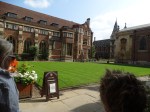
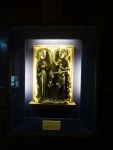
It has a luxurious court of grass surrounded by the ancient buildings forming the college. Here we were allowed into the chapel without restrictions (other than to respect the premises). The chapel is constructed with seats facing each other in “collegiate style” as was the case in all monasteries and followed by the colleges. In the ante chapel there is a beautiful 15th century alabaster depicting Virgin Mary and Archangel Michael with Mary giving judgment on a soul.
Outside the Chapel is a memorial to the past members of the college who died in the First World War. We were also allowed to walk in the gardens viewing the changing architecture over the years.
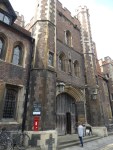
Across Trumpington St and down the way a few hundred yards is Peterhouse College. Access here was also readily offered. The chapel bore its age well but was clearly from an earlier time than the other buildings. We also were allowed to view the dining hall even though there was a lunch being held in there.
We then walked down Mill Lane to the river and had our first encounter with Cambridge Punt Tour sales people. This is the jump off point for the tours and they were not pushy at all.
We were now making up the tour as we went. We made our way to Queens Lane and into Queens College. Here we had to pay a fee of 3 pounds each but it was worth it. The college was founded by two Queens (Stephen Fry may have been a member but he was not one of the founding queens). The wives of Henry VI and Edward IV Margaret of Anjou and Elizabeth Woodville respectively founded this college commencing in 1448. The buildings were very elegant and the dining hall exceptional but who ever allowed the 1970’s architecture of one of the newer buildings into the college needs to be called to account. While we were there a new building sympathetic to the old style used elsewhere in the college was being constructed so there seems no explanation for this incongruous architecture being introduced. Walnut Tree Court especially caught my attention with a large walnut tree and pretty bulbs flowering underneath it
Onto Kings Parade and the impressive and iconic Kings College. Built over 100 years and presided over by 5 kings including Henry VI, VII, and VIII this building is one of the finest examples of gothic architecture in Britain. It is also 7 pounds to enter and lunch is more important at the moment. This is where the Canal tour spruikers gather in numbers and are as annoying as bush flies from road kill on a hot summer’s day. Now the canal tour does look to be superior to Oxford and better value but we had to chase these bastards away – some were very persistent and annoying and would not take “No” for an answer.
We moved on to the square “Market Place” and true to its name there were markets selling all the usual wares. Unusually there were two bike repair shops set up in the pavilions and doing very brisk business. Lunch was a couple of pasties at 2.30 pm sitting in the sunshine which had decided to visit that afternoon but only for a short time. Lunch over, Rod and I prowled the market and found fresh figs the size of cricket balls. That is one thing very noticeable is the preference for seasonal produce. By 3.30 pm we were thinking about getting home not sure about the traffic and what the parking would cost us. Of course as we drove out of Cambridge all the Park and Ride signs jumped out at us. For some reason they all faced the driver leaving the city. Very strange!





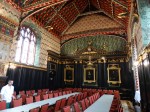


We made it back to Saffron Walden and called into the hotel dropped our gear off and proceeded to look around the town. This is an old market town in Essex. It retains its rural appearance and contains buildings dating from medieval period onwards. There is evidence of settlement since the Neolithic period with a Romano British settlement followed by a monastery and after the Norman invasion a settlement the de Mandeville family (Earl of Essex) built a castle in the town. The castle was “slighted” by King Stephen in 1157 but the town remained within the confines of the old castle bailey battle ditches were dug further south and the town developed to the south and Market Square and in 1295 the Tuesday Markets were moved from Newbury and have been conducted at Saffron Walden ever since. The town claims it has the largest parish church in Essex and it certainly is large. St Mary’s the Virgin Church is dated from the end of the 15th century. The old buildings and jumble of shops makes the streets of the town very pleasant to stroll around.
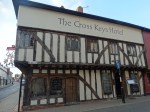
We had dinner at Cross Keys a Tudor hotel and I suspect a more pleasant place to stay than our chosen hotel. The proprietor of the hotel has a relationship with D’Arenberg Wines from MacLaren Vale so good Australian wines are on the menu. The town is worth visiting and there are a number of other features I have not mentioned. If you want to check out Cross Keys visit www.theoldcrosskeys.co.uk. The town has had different names and gained “Saffron” when the growing of saffron brought fame and fortune to the community.
Arriving back at our hotel “Hotel Saffron”, we remembered the Rotary meeting and dressed in shorts and smelling of the dust of the road, we were dragged into the meeting and warmly welcomed by all. The story about the banners was that one of their members had visited relatives in Brisbane and had gone to meetings at each of the Clubs. So we were able to pass on greetings from Woolloongabba and Nottingham.
Here is the photographic proof.




 glendon1954