The Retirees Invade China – Day Seven – Suzhou to Hangzhou

After seeing the silk embroidery, I was looking forward to visiting the silk factory the following day. It hardly looked like a factory and it was not. It was a tourist stop with some minor demonstrations on the life cycle of the mulberry caterpillar, the moth and then the pupae in the cocoon, the treatment of the cocoon and finally the sales room. We started with an explanation of the life cycle and the importance of double cocoons as opposed to single cocoons (about 1200m of silk filament from a single and 1800 – 2000m from a double plus the guarantee of a male and female moth to reproduce). We were then told of the benefit of silk fabrics and shown silk doona, mattress protector and duvet. We were then shown how they loosened the filament to make the thread and how tough the silk can be. They also boil the cocoon to kill the pupae before they eat their way out and of course the pupae are eaten by the Chinese. The cocoon after boiling can be stretched over a metal implement from which they draw off the filaments. We were sold on the idea of a silk doona and purchased the mattress protector, and two light weight doonas for about the same price as a synthetic doona here in Australia. In addition, we made some other purchases before enjoying lunch in the 2nd floor restaurant. No not really a factory.

We then set off for Hangzhou and a visit to West Lake which is  freshwater. It is divided into five sections by three causeways. West Lake has influenced the Chinese for its natural beauty and historic relics, and it has also been among the most important sources of inspiration for Chinese garden designers. It was made a UNESCO Heritage Site in 2011, described as having influenced garden design in the rest of China as well as Japan and Korea over the centuries.

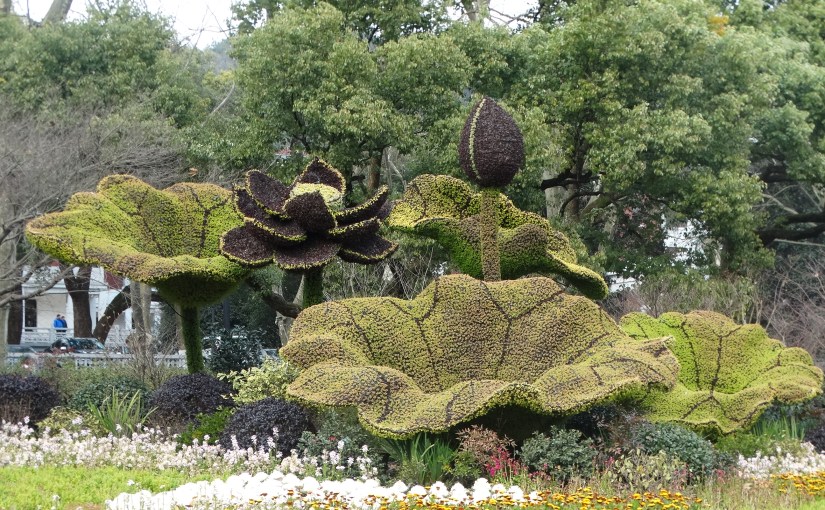
We picked up our local guide Jack and drove straight to the park containing West Lake. Again, we boarded a Chinese ferry to slowly drift around the lake, admiring the countryside the gardens the Pagoda the view of the city and the wild life. Not very exciting except for Jack who worked hard to find something interesting to say about this body of grey coloured water. However, there were some highlights like the floral arrangements on the walk to the ferry, the quaint little car used by the Tourist Police, the floral arrangements of a lotus near the ferry wharf and the ferry itself. We were joined on board by another tour group from Malaysia and Jack was given the floor to find the interesting things to say about what we were seeing.

A highlight for us was finding a shop selling ice creams. As we sat on the causeway park we notice the wind was rising – tomorrow will be cold. An early dinner meant we did not get to our hotel until after dark. As with Suzhou, the buildings were lit up. Unfortunately, I had to take the pictures from the moving bus, until we arrived at our 5 star Jimna hotel.

Go back

Your message has been sent

Warning
Warning
Warning
Warning

Warning.

The Retirees Invade China – Day Six – Wuxi to Suzhou

Up early and on the road to Suzhou and the Lingering Garden. It is a renowned classical Chinese garden located in Suzhou, Jiangsu province, China. It is recognized with other classical Suzhou gardens as a UNESCO World Heritage Site. It was commissioned by Xu Taishi an official in 1593 and it was initially called The East Garden.

The garden was reconstructed in 1876, and the garden was renamed to Liu Yuan. It was abandoned in 1911 and it fell into disrepair. After establishment of the People’s Republic of China, Suzhou government took over and renovated the garden. It was reopened to the public in 1954. In 2001 the garden was added to the UNESCO Word Heritage list, and remains a major tourist destination.

We parked in the adjoining car and bus park where I spotted a flowering magnolia – my first for Spring. Inside the entrance was a variegated azalea – very beautiful. As we moved through the garden it was clear the designer had used simple arrangements against a white wall to give a serenity to each setting. The central feature is a lake with the four seasons able to be viewed from various vantage points. The pavilions were designed to take advantage of all aspects of the garden which used bonsai plants extensively. The big feature is the rocks and the placement of these rocks which are brought in from Lake Tai. The dining pavilion is decorated with hand painted silk panels over 500 years old and the men’s and women’s lounge rooms are each fitted out with mahogany furniture. Such a small space for so many different faces – truly magnificent. Then there was the bonzai garden – turly unbelieveable what trees they have grown in a shallow bonzai dish.

Suzhou, is a major city located in south eastern Jiangsu Province of East China, about 100 km northwest of Shanghai. It is a major economic centre and focal point of trade and commerce, and the second largest city in the province after the capital Nanjing. The city is situated on the lower reaches of the Yangtze River and the shores of Lake Tai and belongs to the Yangtze River Delta region. Suzhou is a prefecture-level city with a population of 4.33 million in its city proper, and a total resident population of 10.58 million in its administrative area.

Founded in 514 BC, Suzhou has over 2,500 years of history, with an abundant display of relics and sites of historical interest. The city’s canals, stone bridges, pagodas, and meticulously designed gardens have contributed to its status as one of the top tourist attractions in China. Suzhou is often dubbed the “Venice of the East” or “Venice of China”.

Part of our tour included a ferry ride along the Grand Canal. This was a step back in time to see a different China which will soon be all gone. It started with boarding the ferry – not what I pictured. Then off along the canal, passed temples house and most of all houses perched on the canal and looking rather shabby. Our guide told us that they had all the mod cons inside – TV, kitchen appliances toilet and shower. Many small bridges led to even smaller canals. And it was busy with many other ferries. Once we reached the basin where the canal joined the old city wall moat it was time to turn around. Suzhou is famous for maintaining the old moat even though the city wall and imperial buildings have long since gone.

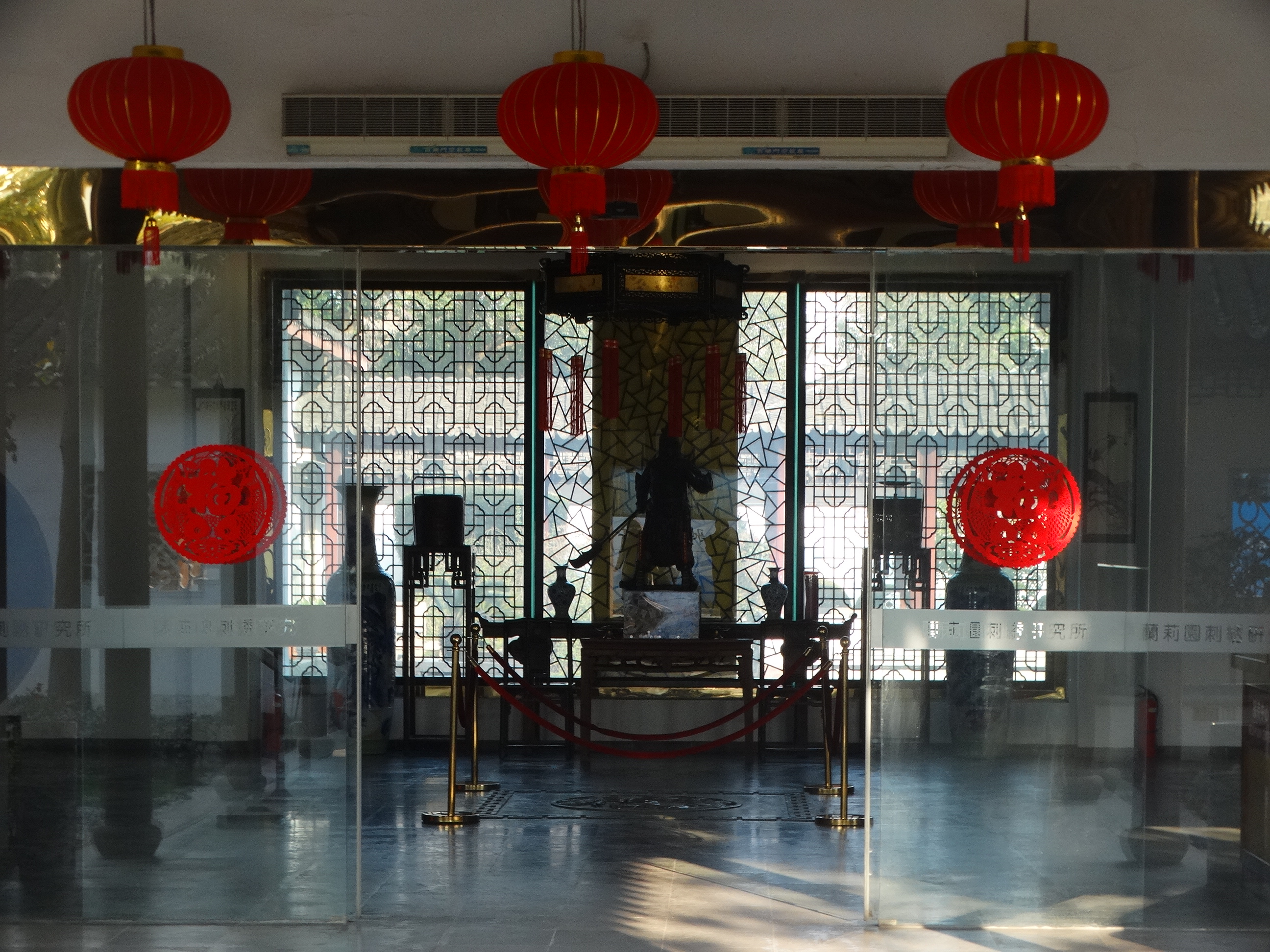
The next day on our way to Hangzhou we stopped at a silk embroidery factory which was created after the unification of China in 1949 bringing together all the talents of many villages and towns in this ancient skill. I had never given this much thought and had dismissed it as an old woman’s hobby. Not so. To see the embroidery is amazing – no photos were allowed as they consider their skills protected intellectual property and when you see silk screens that have been embroidered on both sides in different colours and different patterns done at the same time you gain an understanding of the skill of the masters. Chinese room screens to art to hang on your wall – it is truly remarkable. I can only show you a photo of the front door.

After a busy day, we retired to our hotel which seemed more than ever to be out in the boonies but there were some surprises in store – like the bath tub in the room not the bathroom and the toilet having a button for every conceivable function as well as being on show to the bedroom and a glorious light show on the adjacent buildings. Unfortunately, the innovation was not matched by attention to detail and it was damned difficult to work out how to turn on the lights. The buffet dinner was very average except for the ice cream for dessert.

Go back

Your message has been sent

Warning
Warning
Warning
Warning

Warning.

The Retirees Invade China – Days Four and Five – Shanghai to Wuxi

Day 4 we spent on a bus a plane and another bus to reach the southern centre of Wuxi (meaning “no tin”). We arose early to travel to the airport and unexpectedly we got there an hour and a half early. Good thing too as they cancelled our flight after we had booked in, dropped off our bags and passed through security. This meant we had to exit the departure lounge, collect our bags from the arrivals carousel and rebook in redeliver our bags and pass through security for a second time. None of the Chinese officials even blinked about this odd procedure. So we caught our new flight without incident to meet Maggie (this is her English name – her Chinese name being Tai Meow – like a cat) at Shanghai Airport board a bus and travel for two and half hours to Wuxi. In that time, we passed a spaghetti jungle of roads and overpasses, large farms under shade houses, some odd motor vehicles and an unbelievable number of apartment blocks in the middle of nowhere apparently. In one case I counted 16 towers under construction at the same time each with their own crane/I apologise the photos are taken from the moving bus.

Nestled on the northern shore of Tai Lake, China’s third-largest body of fresh water, Wuxi lies on the southern border of Jiangsu Province, about 128 kilometres northwest of Shanghai. It borders Suzhou to the east, Zhejiang Province to the south and Changzhou to the west. With a total population of 4.578 million, Wuxi is a city richly endowed by nature owing to its pleasantly warm and moist climate. Relying on the near-by Yangtze River and ancient Grand Canal, it had been a port city with the busiest rice and cloth market in China before 19th century. In modern times, with its rapidly developing industry, Wuxi became one of China’s top 50 cities with broad strength and is thus called the ‘Little Shanghai’ for its prosperous economy.

With a splendid history of over three thousand years, Wuxi claims to be ‘the Pearl of Tai Lake’. Besides being a rich cultural repository, Wuxi is blessed with charming natural beauty. Our first stop was Nanchang Street. Nanchang Street is a famous ancient street in Wuxi which has now been renovated to be elegant, unique and integrated with various elements.

Once again, the bus dropped us and ran and we had a significant walk to the memorial marking the start of Nanchang St. Our guide then told us that this was part of the canal system known as the Grand Canal which linked Wuxi with Suzhou, Hangzhou Shanghai and Beijing. We had 40 minutes to have a look around and by the way the oldest stone bridge was just up the canal. Qingming Bridge, the oldest and largest single-opening stone arch bridge over the Grand Canal in the city, connects Nanchang Street with Nanxiatang area. We walked along the street which was full of people, scooters, bikes ,wheelchairs and the like making it to the Qingming Bridge and back again in the allotted time. The lights on the bridge had an interesting arrangement whereby each light would throw a different pattern on the path across the bridge.

I suspect the night and the bright lights covered a few issues. One of the interesting but not open nor illuminated buildings was the house of a former linen menrchant now a museum.  As we returned Kerry stopped to photo the Chinese version of “toad in the hole”.

We overnighted at Deacon House Hotel on the 32nd floor and had an early start to get to Tai Lake and the Ray Pearl factory. Lake Tai is a large freshwater lake in the Yangtze Delta plain. The lake’s southern shore forms the border with Zhejiang. With an area of 2,250 square kilometres and an average depth of 2 meters, it is the third-largest freshwater lake in China. The lake houses about 90 islands, ranging in size from a few square meters to several square kilometres. Lake Tai is linked to the renowned Grand Canal however in recent years, Lake Tai has been plagued by pollution as the surrounding region experienced rapid industrial development. The lake is renowned for its unique limestone formations at the foot of the adjacent Dongting Mountain. These “scholar’s rocks” or “Taihu stones” are often prized as a decorating material for traditional Chinese gardens, as exemplified by those preserved as museums in nearby Suzhou.

Next, we visited Ray Pearl. Wuxi is famous for its quality fresh water pearls and the use of crushed pearl as a health tonic and in a skin cream. We watched as our host cut open one of the younger triangular shaped oysters and laying bare the beginnings of pearls in the shell. Unlike here in Australia where we use shell grit to seed the oyster, in Wuxi they use other oyster meat and seed the oyster multiple times. This poor oyster will become fish bait and the shell will have the immature pearls removed for crushing and mixing to form the tonic. There is always a retail purpose attached and so we were shown into the awaiting arms of the sales team to sell us some pearl products.

As we left we met some of the local traders selling nuts and fruits at good prices. Two days later I finished off the bag of roasted almonds whilst typing this blog.

Go back

Your message has been sent

Warning
Warning
Warning
Warning

Warning.