The Retirees return to Italy – Villa Contessa, Cesi

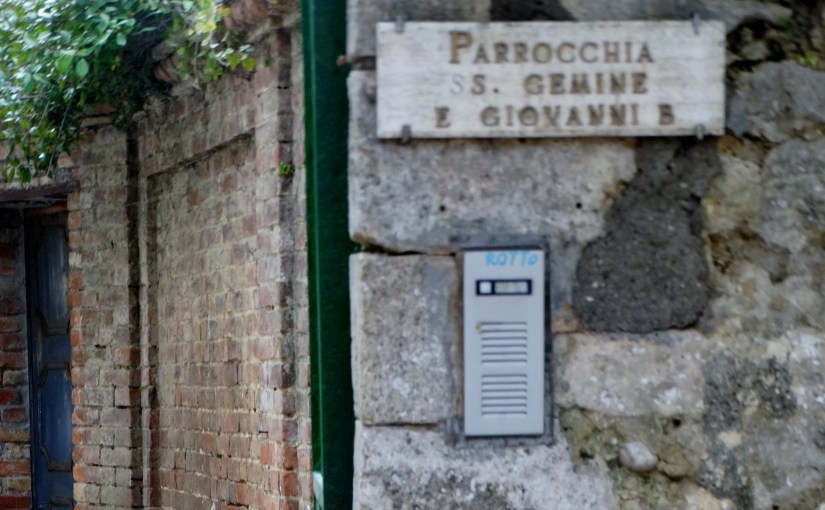
Roberto is extremely proud of his Villa and has every right to be so. He has taken a centuries old residence and breathed new life into it. To attest to its age one is greeted by a mural on the wall of the virgin painted in the 17th century and treasured by the village. After climbing the stairs in Via Carlo Stocchi, and entering on the ground floor, a semi circular staircase takes you to a three bedroom apartment with all the modern conveniences.

The Villa is on the western end of the village below the old convent and Church of St. Michael the Archangel, sharing a wall with the church. There are two neighbours below the Villa, one of whom shares the entrance to the Villa. The village has a small convenience store, a pharmacy that opens when the doctor visits (no one knows exactly when the doctor visits) and a bar on the outskirts of the village near the bypass road to Terni. The village is serviced by a bus which travels from Terni terminus to the village with some services going on to Portaria, the Roman ruins of Carsulae, and Acquasparta. The bus takes the circuitous route winding down through the olive groves whilst the general traffic comes up a narrow lane (the bus won’t fit) exiting beside the bar (you need a drink).

On the Sunday morning after we arrived, I took a walk around the village passing the entrance to the grotto, the present parish church of S’Onofrio through the town gate on its eastern end and ended up above the village and found among the brush the remnant of what appeared to be the city wall.

The village celebrates the Feast of St Joseph (St Guiseppi) this time each year at the former church of St Andrew. Of course we went to the feast. The former church is now a community hall but the former use is present in the frescoes on the wall. The fact that this was a religious feast was born out by a raffle for an icon of St Joseph and child (Jesus) displayed at the front of the hall. The burial cairns from Carsulae tombs are incorporated on the facade of the church beside a doorway. The purpose of doing this was explained to us in Italian by the local historian and of course we did not understand a word.

Inside the hall is a plaque in remembrance of a visit by the famous Italian baritone Titta Ruffo who sang in that hall in 1916. Titta was a contemporary of Caruso and one recording of a duet between them remains. The feast had been prepared by the local citizens and included an antipasto, followed by a dish of lasagna, followed by the first course then two desserts and all washed down with a local wine. Good value for 15 euros.

I was all set for a lazy afternoon when it was decided we would visit the ruins of St Eraszmus Church which are slowly being restored. The ruins are a 15 minute climb at the back of the village and provide astounding views across the Terni plain. Our walk took us past the track up the mountain which plays a part in a later episode (the signs point out all other directions but up the mountain which is the only track that was open – go figure?). When I said the renovation was proceeding slowly, I meant very very slowly.

← Back

Thank you for your response. ✨

The Retirees return to Italy – Umbria – San Gemini

San Gemini is a commune (municipality) of c. 4,500 inhabitants in the province of Terni in the Italian region Umbria, located about 60 km south of Perugia and about 13 km northwest of Terni. After catching our bus down the hill to Terni, we had time to do some shopping and buy our tickets, get a cup of coffee and still have time to spare. San Gemini is famous in the region for its spa water and its old town. It borders the municipalities of Montecastrilli, Narni and Terni and is a well-preserved medieval burgh with two lines of walls, built over the remains of a small Roman centre along the old Via Flaminia.

Our bus takes us up the hill and drops us at the old town gate. After entering through the gate and making a quick right turn we encounter San Gemini Cathedral or Duomo – a 12-century church dedicated to the commune’s patron, the locally venerated Saint Gemine, whose relics were recovered in 1775, which was rebuilt in 1817. Brother Gemine was a monk of Syrian origins who died in 815 AD. The burial urn and original stone are conserved in the sacristy; the saint has been reburied under the high altar.

We strolled along the main street Via Roma to Piazza San Francesco and the Franciscan church with 15th-century frescoes. The piazza also has an open aspect with views to Cesi and beside the church is a courtyard with the town well and an old press. We journey on through the next gate to San Nicolò a Romanesque architecture church in the Piazza Palacio Vecchio but it is under restoration. This piazza is much smaller but is the oldest piazza in the village.

We continue to follow Via Casventino to San Giovanni Battista an 11th century church which strangely was semi circular and Taberna del Torchio where we have lunch. Again, we can clearly see Cesi from the old town walls of San Gemini. Lunch is very enjoyable with Roberto rushing off while lunch is prepared to buy some cups he saw before the midday siesta.

With our hunger sated, we complete our walk of the old town returning along Via del Tribunale ending up back at Piazza San Francesco and thereafter we returned to the bus stop along Via Roma.

Our bus returns us to Terni where we do some grocery shopping and collect our parcels from the morning excursion. Roberto gets chatting with the owner and suddenly we have a free ride to Cesi coutesy of Umberto who used to reside in Cesi. He certainly knows his way around taking the short cut up the hill though the olive groves and then taking the back road to the western gate of Cesi and winding through its narrow streets until we are almost at Roberto’s front door. Walking to home Umberto points out the house where his parents lived and ran their hair dressing shop – under 100 metres from Roberto’s home. Umberto is invited in and given the grand tour by a very proud Roberto.

← Back

Thank you for your response. ✨

The Retirees in Umbria – return to Italy – Cesi and its origins

The probable origins of Cesi are testified by the remains of walls that lie just below the current position. Not far away, the remains of polygonal walls enclose what was probably the Roman city of Clusiolum. In the Middle Ages, Cesi was a fief of Arnolfi ( Arnulf the Lombard lord that arrived there before 1000 AD). The village name comes from the Latin Caesa , meaning a deforested place. The country is the birthplace of the eponymous dynasty Cesi, who acquired the title of Duke of Acquasparta. From this noble family descended five cardinals and Federico Cesi , founder of ‘ Accademia Nazionale dei Lincei .

Within Cesi there are said (by Roberto and the network of femmes that surround him) to be 15 churches. According to Wikipedia the relevant important historical structures are;

Church of St. Michael the Archangel ( 1080 ), early Christian style Romanesque , also used for conferences and concerts for music;

Contelori Palace, former seat of the ancient Municipality of Cesi (now defunct), restored in the XVII century;

St. Andrew’s Church, with burial cairns from Carsulae places on the facade.

Parish church of S. Maria Assunta (XVI- XVIII century ). Inside is an altarpiece of Cesi Master ;

Palazzo Cittadini-Cesi (XVI century);

Medieval wall, rising up to 790 m of the plateau of St. Erasmus, accompanied by a system of watchtowers;

Arce umbra (V-VI century BC), with polygonal walls;

Church of St. Erasmus ( XII century ), founded by the Benedictines and built in Romanesque style;

Palazzo Stocchi, from which you can enter the so-called Eolia grotto;

Palazzo Eustachi;

Church of Sant ‘Onofrio in sharp decline

Going up to the summit of Monte Torre Maggiore (1,121 m), you encounter the remains of a religious complex dating from the sixth century BC, which came to light with an excavation.

I have tried to capture the charm of this village in the following photos.


← Back

Thank you for your response. ✨

The Retirees in Umbria – return to Italy – Rome to Cesi

Terminii is a huge station with 28+ platforms. With the station, so close we were able to wait in our room until half an hour before departure but then we ended up standing for half an hour under the departures board scanning it for the platform number for our train. One of the few things we had been told when buying the tickets was that the platform number would be notified on the board 20 mins before the train’s departure. Waiting and watching the platform number finally appeared as “1 EST”. This was confusing as we could not see that platform listed anywhere until a kindly attendant directed us to the end of platform 1. Interestingly notice of the platform was late allowing about 18 minutes for us to get to the platform and as it is the furthest from the station it took probably 16 minutes to get there followed by other passengers running and out of breath.

We had made it. But we had a surprise to come. After passing through the first stop, the conductress asked for my ticket which I produce and she then told me in Italian that I had not validated the ticket at Termini and that incurred a €50.00 on the spot fine. Kerry came out to find out what the problem was (I was caring for the luggage in the vestibule of the train)  and she copped a fine as well. Of course, we made a protest and the conductress pointed out the notice in fine print on the back of ticket underneath notices in three other languages that you must validate your ticket. We were not the only ones – a young lady with a cold, an Italian accent and the ability to speak the language also coped the fine. So, unless you want to pay €57 for a €7 fare, you must validate your ticket before travel – something no one had thought to mention. As it turned out we probably had no time to do that due to the distance of the platform from the station. Knowledge is a wonderful thing. We were to catch this train several times and being the experienced train traveler we knew to go straight to 1 EST – the train never left from any other platform.

Finally, we arrived in Terni to be greeted by Roberto. We agreed to share a cab to Cesi as we had had quite enough of trains. In fact the train to Cesi stopped at the bottom of the hill another 400 metres vertically up the hill before you get to Cesi.

Cesi is a fraction of the town of Terni, in the region of Umbria. The small village lies at an altitude of 437 metres on the slopes of Mount Aeolus, one of the last foothills of the mountains Martani south. It is about 10 km from Terni , in the northern suburbs to Carsulae . Its position offers an ideal panorama of the entire Terni basin. According to Istat data of 2001 , 682 residents live there.

← Back

Thank you for your response. ✨

The Retirees in Umbria – return to Italy.

After 10 hectic days at home we boarded a plane for Italy. Our friend Roberto (formerly Robert) has made his home in Italy and desperately wanted to show off his renovated Villa Contessa in Cesi. What kind of friends would we be if we disappointed him?

Our flight with Qantas (an Emirates code share) was trouble free but lasted 23 hours with a three hour stopover in Dubai. Wisely we had decided to overnight it in Rome and get a good night rest before training it to Cesi. After landing we were talked into taking a minicab ride to our hotel. It turned out to be a good idea even though our hotel is directly across the road from Termini – Rome’s city terminus for the train. Our cab brought us into Rome through Trastevere across the Tiber past the Colosseum and through Piazza Vitorio past the ruins of the Forum (there were two other couples to be dropped off hence the circuitous route) and finally to Termini where we were greeted by a large green door and a small card on the intercom system telling us our “hotel” Dream Station Hotel was on the 4th piano (floor).

No one had said it was behind a large green door down a lane through a heavily barred gate on the 4th floor and we had 4 suitcases and hand luggage. Fortunately, there was a lift. It looked like a refrigerator and was about the same size internally saving us the difficulty of getting a refund and finding a new hotel. Once we had taken the suitcases up in the elevator two x two due to its carrying capacity, we discovered a quaint set of bedrooms (three for sure and may be three more across the landing) fitted out with a share kitchen and comfortable rooms with private bathroom. Good value at €65.00 per night.

We were settled in by 2.00pm. So here we are in Rome – what to do? Firstly, we went to Termini to book our tickets to Cesi and work out the train system. We visited the tourism information office and then the Trenatalia office to book the tickets. This is important to understand/question what happened later. Having finished the necessary, we wandered through the back streets of the area some five blocks southwest of Stazione Termini encountering The Basilica di Santa Maria Maggiore.

It is a Papal major basilica (presently undergoing renovation) and the largest Catholic Marian church in Rome, from which size it receives the appellation “major”. The ancient basilica enshrines the venerated image of Salus Populi Romani, depicting the Blessed Virgin Mary as the health and protectress of the Roman people. Pursuant to the Lateran Treaty of 1929 between the Holy See and Italy, the Basilica is within Italian territory.

From there we found our way to an architects’ conference in a recently renovated building and in the grounds of course ruins of some previous use and one of the inhabitants of Rome still making use of it (picture below). Jet lag and the cold of the Roman evening started to take its toll, so we had an earlier dinner and retired to our hotel. Big day tomorrow training it to Terni and then up to Cesi.

Breakfast finished we walked around to Piazza della Republica and The Basilica of St. Mary of the Angels and the Martyrs. The building was created by the rearrangement in 1562, of the work of Michelangelo Buonarroti, and the central hall of the Baths of Diocletian, by order of Pope Pius IV at the request of the priest Sicilian Antonio Duke, uncle of the faithful disciple of Michelangelo, Jacopo del Duca. We had been here previously so we moved through the Basilica itself and went to the Sacristy and into a small courtyard where we spotted a statue of Galileo (donated by the PRC – Peoples Republic of China) and another religious scene before existing the building through the tradesman’s entrance onto Via Cernaia.

Our journey then took us past Domus  Australia in Via Cernaia bearing the Australian flag and the Vatican flag (I suspect the lodgings of Cardinal Pell whilst in Rome based on the protest notices affixed the bars on the windows), past the British embassy, past a memorial to the soldiers lost in 3 wars in the first 2 decades of the twentieth century, and the Magistrates Court.

These are a few things to see around Terminii whilst waiting for a trian.

← Back

Thank you for your response. ✨

The Retirees Invade China – Day Nine – Shanghai to Brisbane

The tour has finished and we are packing to return home well at least I am as Kerry has come down with a crushing headache. I leave her to take a walk around the hotel until Kerry has a chance to rest and throw the headache. So, I walk outside and down the road and discover Shanghai as it was before the economic boom. People living in ramshackle houses made up of a variety of building products using the streets for recreation the footpath for their businesses and their laundry. This is China as I have seen it. The new China does not look that different to home only supersized. This China shows the poverty that exists beside the economic prosperity of modern China.

After returning to the hotel, Kerry has settled and it is time to catch the bus to the airport. Our flight home is uneventful but tiring however I am debating at an International Women’s Day brunch so a quick change and I am off to battle for the oppressed men of my community. So, that is it for China. Till next time.

← Back

Thank you for your response. ✨

The Retirees Invade China – Day Eight – Hangzhou to Shanghai

Hangzhou is surrounded by hills and these have been put to very good use by the Dragon Well Tea Company. We visited one of their plantations and the tourist centre to see what makes a good green tea. As we entered the small valley we had row upon row of tea bushes (a variety of camellia) climbing the hills on each side. At the end of the valley is the tourist centre, itself surrounded by tea bushes. In or about April the tea pickers pick the tiny green tips from the bushes and deliver them to the drying process. Some tea oil is placed in the bowls and men swish the clippings through the bowls which are electrically heated until the tips are dry. 72,000 tips are needed to make 1 kilo of tea.

Of course, there is a tea room where we sampled the tea and learned of its medicinal properties. We learned of the Buddhist monk (his statue stands in the courtyard) who first used the green tea for everyday drinking rather than just a medicine. One of its properties is to absorb oils in the human system and this is demonstrated with some rice in a glass to which is added iodized salt which turned the rice black and by the addition of the tea the rice was cleaned.

Persuaded by the demonstration we were first to buy some tea and received an extra can which we sold to one of our fellow tourists. After collecting our tea, I noticed two pieces of calligraphy hanging on the walls reminding me of home.

After escaping the gift shop trap, our bus headed for Shanghai two and one half hours away. The highway was lined with settlements of high rise apartments, and as we got further into the country some country homes with the fast train rattling past them. Today we had lunch on the run eating sandwiches a packet of chips a snickers bar and a banana. Nice change. An hour outside Shanghai we pulled into the roadside stopover for a relief/comfort stop and a break. There was an enormous market with all sorts of things but we were still full from lunch.

Driving into Shanghai we were stunned by the enormity of the freeway system and the apartments reaching to the edge of the freeway. We passed a disused amusement park on our way to the viewing platform on the 88th level of the Jinma Tower, which stands between two other higher towers. We passed them by, barely visible from the bus window due to the dirty air of a fine day. Then we are standing on the footpath looking up to the heavens.

We then ride the elevator to the viewing platform and look out in amazement at a city that has grown to its present size in the last 35 years.

After the viewing platform, we drive to a showroom for what is described as an art gallery but it turns out to be a jewellery sales pitch for a company related to our tour company – not happy Jan. On the way, we pass Shanghai’s only roundabout and the largest sundial. The featured image is a photo of the sundial. The next day we get the chance to ride on the world’s fastest train – the Mag-Lev from Longyang Rd Station to Pudong International Airport. Thirty – one kilometres in 7 minutes reaching a top speed of 431kph and back again. The train rides on a magnetic track and levitates hence the name Mag-Lev. Really exhilarating.

We then had the misfortune to end up at the markets under the Shanghai Science and Technology Park. Well it was the worst experience you have in China being harangued by shop assistants to buy knock watches and handbags and in my case, being physically restrained to buy some further hand bags. Fortunately, Geoff and Jennifer had found a good coffee shop and we took a time out there before venturing outside to see what we could see. On getting back to the surface we found the science and technology centre and a quiet park nearby which led us back to what appeared in the first instance to be Shanghai’s only roundabout only to find out it is a signalised intersection that is round rather than cross shaped. Crossing with us is one of the hangovers from China’s past – the pedal powered transporter of everything. These bikes have one forward gear and we have seen everything stacked on them from refrigerators to waste paper. Across the road looking like 4 enormous rice bowls is Shanghai’s Art Centre.

Lunch time. Not that we felt we needed lunch but it was part of the tour and we had paid for it. So, we traipsed to old Shanghai or at least a remake in the architecture of 19th century Shanghai and the inevitable markets. No sooner had we walked towards the centre than we were met by street vendors and the flavour of the month is strap on skates – convert your shoes to skates. We rebuffed them time and time again but they still kept coming until some of us were able to shelter in the relative peace of the dumpling restaurant for lunch. But the respite was short lived as we had at least a further hour to endure. We strolled through the market place which was far cleaner than the original would ever had been and encountered a pair of elderly women begging. Earlier in the day we had encountered an elderly man playing a whistle in the park at the Science and Technology building and donated all our change probably $1 in Australian money so these beggars missed out.

We are filling in time now as the bus takes us to the Bund – a walk along the Wampu River (a tributary of the Yangtze River) looking at the buildings. We had not done much walking in the last two days so it was good to stretch our legs but the inevitable consequence of eating large meals 3 times a day meant we had calls of nature at a time when only public toilets were available. Now these have proven to be very clean and reasonable with both squat and European toilets available but not so this time probably due to the heavy traffic using them. There was a strong Police presence in this area using mini pursuit cars – chasing pedestrians.

Five o’clock and we are off to dinner – the farewell dinner. Not the great celebration we had expected. Oh well we had a nice time with our new friends. Some of us then proceeded to the harbour for a night cruise whilst others with an early departure tomorrow returned to the hotel. The harbour cruise was extraordinary – the city lights up with a display like I have not seen before. It is still the end of winter so our choice of the open – air deck to get the best view and photos was a brave one. Here are the photos to speak for themselves.

← Back

Thank you for your response. ✨

The Retirees Invade China – Day Seven – Suzhou to Hangzhou

After seeing the silk embroidery, I was looking forward to visiting the silk factory the following day. It hardly looked like a factory and it was not. It was a tourist stop with some minor demonstrations on the life cycle of the mulberry caterpillar, the moth and then the pupae in the cocoon, the treatment of the cocoon and finally the sales room. We started with an explanation of the life cycle and the importance of double cocoons as opposed to single cocoons (about 1200m of silk filament from a single and 1800 – 2000m from a double plus the guarantee of a male and female moth to reproduce). We were then told of the benefit of silk fabrics and shown silk doona, mattress protector and duvet. We were then shown how they loosened the filament to make the thread and how tough the silk can be. They also boil the cocoon to kill the pupae before they eat their way out and of course the pupae are eaten by the Chinese. The cocoon after boiling can be stretched over a metal implement from which they draw off the filaments. We were sold on the idea of a silk doona and purchased the mattress protector, and two light weight doonas for about the same price as a synthetic doona here in Australia. In addition, we made some other purchases before enjoying lunch in the 2nd floor restaurant. No not really a factory.

We then set off for Hangzhou and a visit to West Lake which is  freshwater. It is divided into five sections by three causeways. West Lake has influenced the Chinese for its natural beauty and historic relics, and it has also been among the most important sources of inspiration for Chinese garden designers. It was made a UNESCO Heritage Site in 2011, described as having influenced garden design in the rest of China as well as Japan and Korea over the centuries.

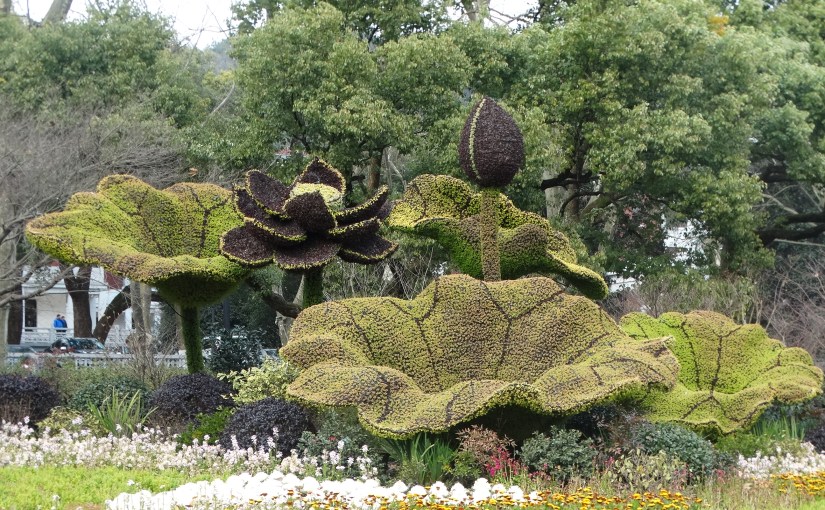
We picked up our local guide Jack and drove straight to the park containing West Lake. Again, we boarded a Chinese ferry to slowly drift around the lake, admiring the countryside the gardens the Pagoda the view of the city and the wild life. Not very exciting except for Jack who worked hard to find something interesting to say about this body of grey coloured water. However, there were some highlights like the floral arrangements on the walk to the ferry, the quaint little car used by the Tourist Police, the floral arrangements of a lotus near the ferry wharf and the ferry itself. We were joined on board by another tour group from Malaysia and Jack was given the floor to find the interesting things to say about what we were seeing.

A highlight for us was finding a shop selling ice creams. As we sat on the causeway park we notice the wind was rising – tomorrow will be cold. An early dinner meant we did not get to our hotel until after dark. As with Suzhou, the buildings were lit up. Unfortunately, I had to take the pictures from the moving bus, until we arrived at our 5 star Jimna hotel.

← Back

Thank you for your response. ✨

The Retirees Invade China – Day Six – Wuxi to Suzhou

Up early and on the road to Suzhou and the Lingering Garden. It is a renowned classical Chinese garden located in Suzhou, Jiangsu province, China. It is recognized with other classical Suzhou gardens as a UNESCO World Heritage Site. It was commissioned by Xu Taishi an official in 1593 and it was initially called The East Garden.

The garden was reconstructed in 1876, and the garden was renamed to Liu Yuan. It was abandoned in 1911 and it fell into disrepair. After establishment of the People’s Republic of China, Suzhou government took over and renovated the garden. It was reopened to the public in 1954. In 2001 the garden was added to the UNESCO Word Heritage list, and remains a major tourist destination.

We parked in the adjoining car and bus park where I spotted a flowering magnolia – my first for Spring. Inside the entrance was a variegated azalea – very beautiful. As we moved through the garden it was clear the designer had used simple arrangements against a white wall to give a serenity to each setting. The central feature is a lake with the four seasons able to be viewed from various vantage points. The pavilions were designed to take advantage of all aspects of the garden which used bonsai plants extensively. The big feature is the rocks and the placement of these rocks which are brought in from Lake Tai. The dining pavilion is decorated with hand painted silk panels over 500 years old and the men’s and women’s lounge rooms are each fitted out with mahogany furniture. Such a small space for so many different faces – truly magnificent. Then there was the bonzai garden – turly unbelieveable what trees they have grown in a shallow bonzai dish.

Suzhou, is a major city located in south eastern Jiangsu Province of East China, about 100 km northwest of Shanghai. It is a major economic centre and focal point of trade and commerce, and the second largest city in the province after the capital Nanjing. The city is situated on the lower reaches of the Yangtze River and the shores of Lake Tai and belongs to the Yangtze River Delta region. Suzhou is a prefecture-level city with a population of 4.33 million in its city proper, and a total resident population of 10.58 million in its administrative area.

Founded in 514 BC, Suzhou has over 2,500 years of history, with an abundant display of relics and sites of historical interest. The city’s canals, stone bridges, pagodas, and meticulously designed gardens have contributed to its status as one of the top tourist attractions in China. Suzhou is often dubbed the “Venice of the East” or “Venice of China”.

Part of our tour included a ferry ride along the Grand Canal. This was a step back in time to see a different China which will soon be all gone. It started with boarding the ferry – not what I pictured. Then off along the canal, passed temples house and most of all houses perched on the canal and looking rather shabby. Our guide told us that they had all the mod cons inside – TV, kitchen appliances toilet and shower. Many small bridges led to even smaller canals. And it was busy with many other ferries. Once we reached the basin where the canal joined the old city wall moat it was time to turn around. Suzhou is famous for maintaining the old moat even though the city wall and imperial buildings have long since gone.

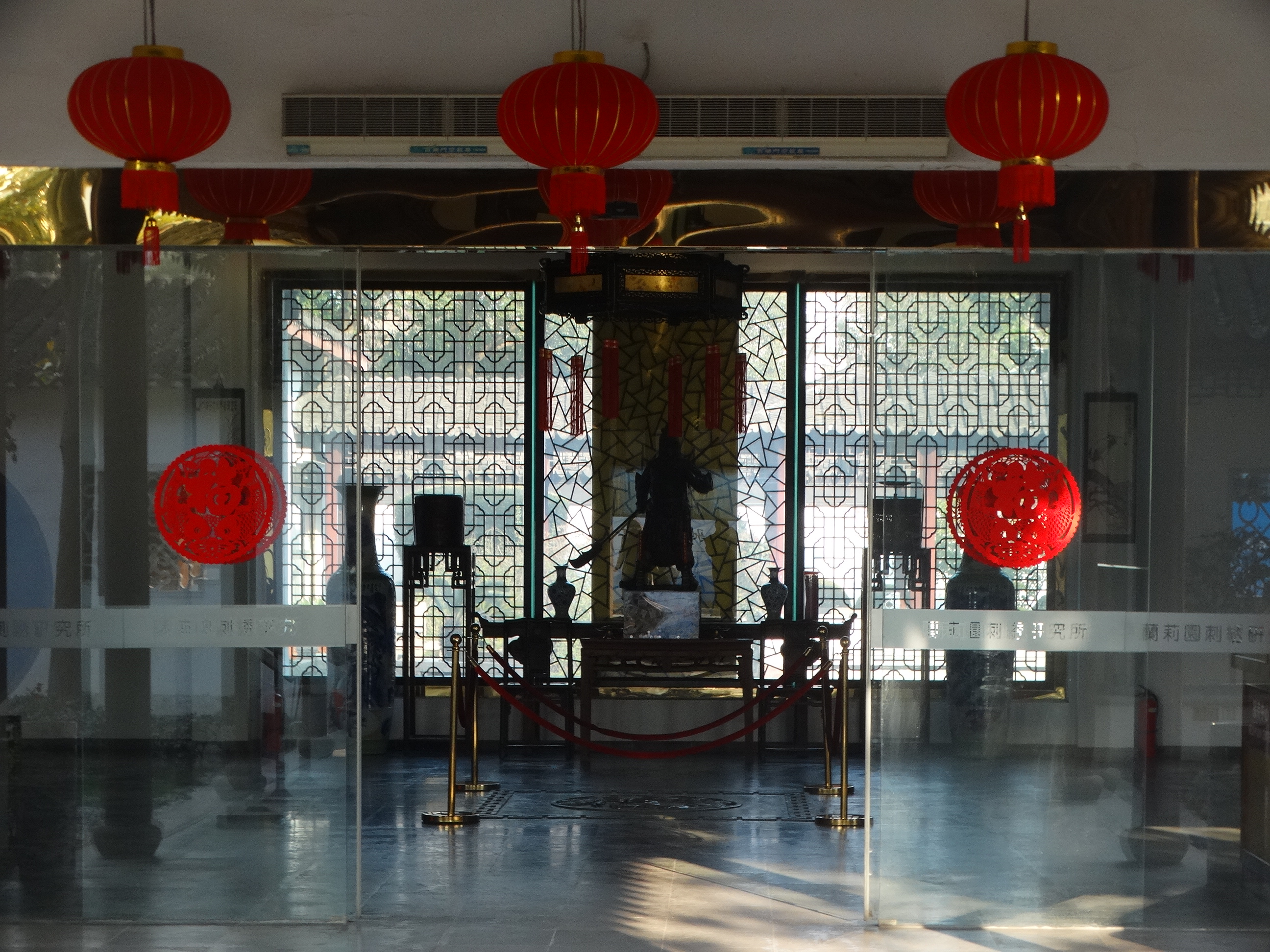
The next day on our way to Hangzhou we stopped at a silk embroidery factory which was created after the unification of China in 1949 bringing together all the talents of many villages and towns in this ancient skill. I had never given this much thought and had dismissed it as an old woman’s hobby. Not so. To see the embroidery is amazing – no photos were allowed as they consider their skills protected intellectual property and when you see silk screens that have been embroidered on both sides in different colours and different patterns done at the same time you gain an understanding of the skill of the masters. Chinese room screens to art to hang on your wall – it is truly remarkable. I can only show you a photo of the front door.

After a busy day, we retired to our hotel which seemed more than ever to be out in the boonies but there were some surprises in store – like the bath tub in the room not the bathroom and the toilet having a button for every conceivable function as well as being on show to the bedroom and a glorious light show on the adjacent buildings. Unfortunately, the innovation was not matched by attention to detail and it was damned difficult to work out how to turn on the lights. The buffet dinner was very average except for the ice cream for dessert.

← Back

Thank you for your response. ✨

The Retirees Invade China – Days Four and Five – Shanghai to Wuxi

Day 4 we spent on a bus a plane and another bus to reach the southern centre of Wuxi (meaning “no tin”). We arose early to travel to the airport and unexpectedly we got there an hour and a half early. Good thing too as they cancelled our flight after we had booked in, dropped off our bags and passed through security. This meant we had to exit the departure lounge, collect our bags from the arrivals carousel and rebook in redeliver our bags and pass through security for a second time. None of the Chinese officials even blinked about this odd procedure. So we caught our new flight without incident to meet Maggie (this is her English name – her Chinese name being Tai Meow – like a cat) at Shanghai Airport board a bus and travel for two and half hours to Wuxi. In that time, we passed a spaghetti jungle of roads and overpasses, large farms under shade houses, some odd motor vehicles and an unbelievable number of apartment blocks in the middle of nowhere apparently. In one case I counted 16 towers under construction at the same time each with their own crane/I apologise the photos are taken from the moving bus.

Nestled on the northern shore of Tai Lake, China’s third-largest body of fresh water, Wuxi lies on the southern border of Jiangsu Province, about 128 kilometres northwest of Shanghai. It borders Suzhou to the east, Zhejiang Province to the south and Changzhou to the west. With a total population of 4.578 million, Wuxi is a city richly endowed by nature owing to its pleasantly warm and moist climate. Relying on the near-by Yangtze River and ancient Grand Canal, it had been a port city with the busiest rice and cloth market in China before 19th century. In modern times, with its rapidly developing industry, Wuxi became one of China’s top 50 cities with broad strength and is thus called the ‘Little Shanghai’ for its prosperous economy.

With a splendid history of over three thousand years, Wuxi claims to be ‘the Pearl of Tai Lake’. Besides being a rich cultural repository, Wuxi is blessed with charming natural beauty. Our first stop was Nanchang Street. Nanchang Street is a famous ancient street in Wuxi which has now been renovated to be elegant, unique and integrated with various elements.

Once again, the bus dropped us and ran and we had a significant walk to the memorial marking the start of Nanchang St. Our guide then told us that this was part of the canal system known as the Grand Canal which linked Wuxi with Suzhou, Hangzhou Shanghai and Beijing. We had 40 minutes to have a look around and by the way the oldest stone bridge was just up the canal. Qingming Bridge, the oldest and largest single-opening stone arch bridge over the Grand Canal in the city, connects Nanchang Street with Nanxiatang area. We walked along the street which was full of people, scooters, bikes ,wheelchairs and the like making it to the Qingming Bridge and back again in the allotted time. The lights on the bridge had an interesting arrangement whereby each light would throw a different pattern on the path across the bridge.

I suspect the night and the bright lights covered a few issues. One of the interesting but not open nor illuminated buildings was the house of a former linen menrchant now a museum.  As we returned Kerry stopped to photo the Chinese version of “toad in the hole”.

We overnighted at Deacon House Hotel on the 32nd floor and had an early start to get to Tai Lake and the Ray Pearl factory. Lake Tai is a large freshwater lake in the Yangtze Delta plain. The lake’s southern shore forms the border with Zhejiang. With an area of 2,250 square kilometres and an average depth of 2 meters, it is the third-largest freshwater lake in China. The lake houses about 90 islands, ranging in size from a few square meters to several square kilometres. Lake Tai is linked to the renowned Grand Canal however in recent years, Lake Tai has been plagued by pollution as the surrounding region experienced rapid industrial development. The lake is renowned for its unique limestone formations at the foot of the adjacent Dongting Mountain. These “scholar’s rocks” or “Taihu stones” are often prized as a decorating material for traditional Chinese gardens, as exemplified by those preserved as museums in nearby Suzhou.

Next, we visited Ray Pearl. Wuxi is famous for its quality fresh water pearls and the use of crushed pearl as a health tonic and in a skin cream. We watched as our host cut open one of the younger triangular shaped oysters and laying bare the beginnings of pearls in the shell. Unlike here in Australia where we use shell grit to seed the oyster, in Wuxi they use other oyster meat and seed the oyster multiple times. This poor oyster will become fish bait and the shell will have the immature pearls removed for crushing and mixing to form the tonic. There is always a retail purpose attached and so we were shown into the awaiting arms of the sales team to sell us some pearl products.

As we left we met some of the local traders selling nuts and fruits at good prices. Two days later I finished off the bag of roasted almonds whilst typing this blog.

← Back

Thank you for your response. ✨