The Retirees Escape to Auckland – Part 1

Thanks to our travel in 2014 and 2015, we had earned loyalty points with EVA Air which we utilised to visit Auckland through the Star Alliance partnership with Air New Zealand. Auckland is presently 3 hours ahead of Brisbane so leaving Brisbane at 6.00 pm meant that we arrived at Auckland International Airport at midnight. We could have planned that better. Taxi fare to our apartment at Metro Apartments Courthouse Lane NZ$69.00. At 1.00 am in the morning we did not much care about anything but finding our bed.

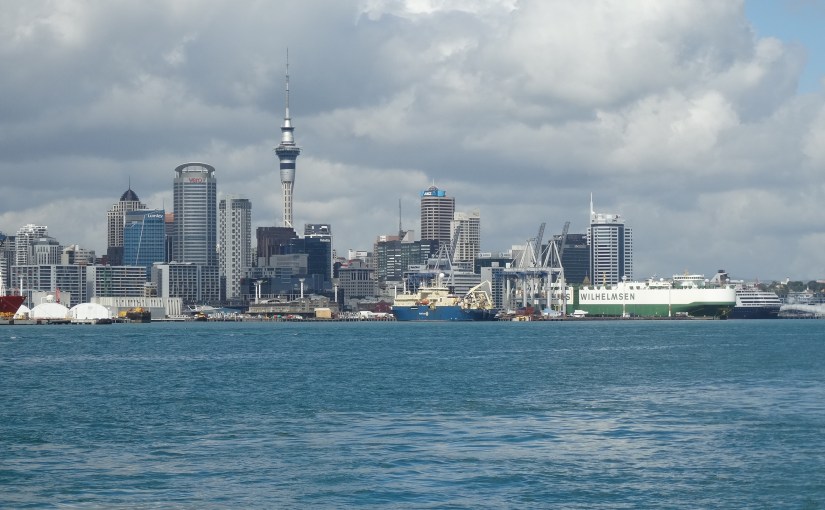
Booking in was a bit different. Whilst I stood guard over the luggage Kerry walked around to Kitchener St and the entrance to the Metro Building where our pass key had been left for collection. We learned later that the two building are joined internally. To my surprise our apartment was on the 29th floor. Again to my surprise it was modern with great views and a big bed. After catching up on sleep we awoke to a sunny but cool day and we were greeted by this view.

Breakfast called and we had a little trouble finding a suitable cafe. Lesson 1 – cafes are in High St not Queen St. Anyway we find a place and after breakfast we walked to the Sky Tower passing some interest improvisation with containers. Everywhere we look there is some thing different done with shipping containers of all sizes. On this occasion it was street vendors.


Principally we headed to the Tower as we were told this was the closest tourist information centre. Auckland has a number of volcanic plugs within it and they are steep. The tower is atop one so after a steady climb we arrived gained the info we wanted and decided that we had better have a look at this icon of Auckland. We rode the elevator to level 51 viewing platform. the elevator has a glass panel in the floor so that you can watch the ground drop away at some speed and then as you rise there are gaps in the building where you feel as though you are going to be flung out into the air. Interesting! At the top magnificent views with glass floor panels so that you can have the feeling of insecurity looking 51 floors to the ground, but wait there is more – up in a second elevator to the 60th floor for breathtaking views and the opportunity to watch the brave souls who have chosen to take the walk on the exterior of the Tower (obviously chained to the building).

After our “walk on the high side” we returned to our Apartment loaded with the groceries for a week. In the afternoon we decided to orientate our selves for later adventures so we walked down to the harbour and followed the harbour edge to Wynyard Quarter where we experienced another opening bridge. At first we wondered who’s car alarm was going off until we realised that the bridge was closing to allow a vessel to pass under into the docks. As we waited I noticed two locals sharing a yarn after swimming. The Wynyard quarter is a redeveloped area of the old waterfront and includes modern restaurants and modern designed buildings as well as more exotic uses of shipping containers (eg) this bus shelter.

We slowly wound our way back to the Apartment where there is a Pizza Restaurant called Amore. It is reminiscent of our Pizza Restaurant in Rome – we dined there just about every night. And we were not disappointed – our waiter and one of the owners clearly was Italian born and told us he came from Milan area and spent some time in Rome sold Moretti beer and made a great pizza. Perfect.

Friday morning and we caught the ferry to Devonport, a harbour side village accessible by ferry or by road the difference being 7 mins by ferry or one and a half hour drive by road. We purchased the Devonport tour which included the return ferry ride and whilst there is not a lot to see at Devonport what is there is a laid back residential life with a maritime background and Maori heritage. We left the dock at 10.00 am and were surprised that people travelling from Devonport we just as numerous as those travelling to it. We got a great view of the harbour from the ferry. As we departed we saw the Ferry House as the early sailors would have seen it, the cruise liner at its terminal, the container terminal with the War Museum on the hill in the background and part of the NZ Navy.

As we got nearer our destination we saw a lovely home on a headland and saw the iconic view of Auckland.


Our tour started on our arrival and we were joined by two other travellers both from Wollongong. We journeyed through the street of the village with our driver a retired sailor from the Naval base telling us the Maori heritage of North Head and maritime history of Flagstaff renamed Devonport when the semaphore purposes of Flagstaff Hill (now called Mt Victoria) changed. The Maori were removed from North Head and other headlands so the British could develop fortifications to protect the colony from other nations particularly the Russians.  The forts they developed never fired a shot in anger and the land is to be returned to the Maori but presently is public open space.

Note the unique disappearing 8″ gun mounted on a pneumatic arm using the recoil to push it out of view.

We then moved on to the next Fort Takapuna. Much the same as North Head. Then onto Mount Victoria (Flagstaff Hill) which the Maori are talking about closing to the public. But not yet so we might be one of the last non Maori to go up the hill. Anyway we looked back to North Head and across to the docks at Auckland. We also looked at Rangitoto a volcanic island formed around 600 years ago and the latest addition to the NZ Navy built for them in Melbourne an urgent response ship.

After a relaxing morning we went home and Kerry visited a doctor regarding extreme stomach pain which she had been coping with for a few days. The GP was uncertain and with the weekend upon us she rang the Registrar at the Auckland Hospital and off we went to No 14 on the top ten favourite tourist spots in Auckland – Auckland Hospital


The Retirees at GOMA (Gallery of Modern Art) Brisbane

Wake up and out of bed, clean my teeth, brush my hair and pull on my pants for today we are going to GOMA with the grandkids. For those who don’t know GOMA has great interactive projects for children as well as some serious Art. The kids love a visit as it engages their minds – well for a period any way. Today they have an interactive display with mirrors and artificial hair and a display on three sisters of Mornington Is. An Icelandic artist has the view that self image is important and that vanity can be a positive not a negative so she has created this experience for children. We arrive and much to my surprise there are two giant slides in the main foyer of GOMA – there is only a lower limit on age but it does not open till next week.

Still there is a lot to do. We go through the foyer and the hairy doorway into the Mirror room.

We then explored the world of Bennickt Island and the artist expression of 3 aboriginal sisters remembering their ancestral home. The big kids enjoyed it as much as the little kids.

In no time it is time for lunch and we go to the cafe in GOMA beside the river and observe the superb location of the building, some of its crazy art and the brazen water dragons feeding on hand outs from cafe patrons.

The Retirees go to Melbourne – Kinky Boots

Whilst in the UK we heard or saw the story of a 3rd generation family owned boot company which was struggling and at risk of going under. So, when Kerry saw that “Kinky Boots” was coming to Melbourne we were keen to go and see the musical. Secondly the music for the story was written by Cyndi Lauper – one of Kerry’s favourite singers.

We flew down on the Thursday morning with the view of having the weekend in Melbourne to finally catch up with pseudo son Damian, Barbara and their daughter Chloe and Kerry’s niece Aimee and her partner Joel. Thursday night we went to the show at the Her Majestys Theatre in Exhibition St. The performance was great. Kerry was disappointed with the seats but that might be the result of allowing an agency to do the booking for you – lesson for next time.

We had no plans for Friday. Melbourne has a tourist circuit bus which gives you a hop on hop off facility for two days for the grand price of $10 per person. Stop 4 is in Exhibition St where we were staying at the Mantra Apartment Hotel. So, we travelled on the bus getting off at Victoria Markets to browse through the extensive offering of everything. We reboarded the bus and travelled down to Docklands for a bit of shopping and to see the changes.

Docklands has some unusual street art which is all very different. Like the squatting red figures and the “termite mounds”. You also have some dramatic views of the Melbourne CBD skyline. We walked through Docklands to the Old Woolshed Pub for a bite of lunch. Great use of former warehouses but later in the day we saw on the news that just after we left the pub and caught the bus again the Woolshed Pub was destroyed by fire. Just a coincidence! Anyway, our journey ended at the base of the Eureka Tower to visit the viewing platform on the 88 floor and Kerry saw this;

The Trike journey started in the office and then for 2 to 3 hours we travelled around Albert Park (the track, the swans and their signets, and the skyline) following the F1 track and then down to St Kilda, Brighton Beach (for an ice cream and view the beach huts and the Melbourne skyline) and Black Rock (the Melbourne skyline). Kerry loved the acceleration as Clive our driver and guide manoeuvred through Friday evening Melbourne traffic. With the ride finished we returned to our apartment to plan our Saturday.

The morning started with a visit to some of Melbourne’s famous lanes and then lunch with Damian and Chloe at a new hotel in Collingwood. Chloe very quickly lost her shyness and interacted with us as old friends. Later Damian (who owns and runs a music agency) informed Kerry that he could get tickets for us to see Goldie Hawn on Monday evening and before I knew it the deal was done (mucking up some engagements I had arranged for Tuesday but…). That evening we visited Melbourne’s Comic Lounge in Errol St North Melbourne. Dinner and show for $55 per head was good value and the show was great. Five acts with each comedian bringing a different flavour to the evening.

Sunday and we met Aimee and Joel and travelled to the Bellarine Peninsula outside of Geelong – new territory for us. It took about an hour which gave us plenty of time to catch up. As we drove towards Basil’s Farm we saw the signs to Scotchmans Hill. No question – we had to go to the cellar door.

After tasting for an hour and purchasing some for Ron (later on), we moved on to Basil’s Farm for lunch. The menu included many of the fruits and vegetables grown on the farm. The bouillabaisse included Tasmanian seafood and the cheese platter that followed was all local product. We could not miss the cellar door and spent 40 to 50 minutes there taking some samples for later. Lovely way to spend a Sunday.

Monday morning, we returned to the lanes of Melbourne. As we had to check out of the hotel, visit Suzie and move to Aimee’s place we returned to the hotel checked out and then took a cab to Middle Park. Suzie, an old friend was babysitting for her daughter and had noticed we were in Melbourne from Facebook postings. Morning tea and lunch with Suzie and both her daughters who turned up for various reasons and we arranged travelling to Aimee’s place.

Tuesday we caught the tram back to the city ending up at the National Gallery of Victoria. Located in Federation Square, the gallery displays some of the most important pieces of Australian early art – artists like Roberts, Conder McCubbin and Boyd. We spent a few hours here only able to see the early Australian collection and the collection of some of the donors to the gallery. Hours more too see. We returned to our temporary home to prepare for the show at the Regent Theatre. Damian surprised us at the theatre and we went to dinner before viewing Peter Hellier and Goldie Hawn having a chat on a couch for an hour or so. It was interesting but we had seen Billy Crystal in the same format in Brissie and I preferred that.

So, that ended our Melbourne trip. The next morning, we returned to Brisbane. Our next tour will be to Auckland in a few weeks.

The Retirees on the Move Again – Tasmania in Ten – Last Day in Tassie

The next day Saturday and Paul and Emily were not working and the kids were not at school. So we went to Salamanca Markets. Emily has the best parking spot for the markets even on busy days.

A stroll around the markets, a visit to Princes Park (Paul works for the council caring for this park and others), then to the Signal House (the park once housed canon to protect the Harbour) and back to the markets.

Lunch was followed by a trip to the other side of the harbour for scones and coffee with Emily’s parents. The Sydney Swans were playing North Melbourne at Bellerive Oval and that is where they live at Howrah so a little bit of excitement there. Paul wanted to show us the matching gun emplacement on this side of the harbour before we fell upon the scones and coffee.

Like all good things our trip came to an end and we returned to much warmer weather to prepare for the working week.

The Retirees on the Move Again – Tasmania in Ten – South Hobart Mt Wellington and Mt Pleasant

The journey into south Hobart was almost as winding as the trip to Queenstown. We followed a new moon into Hobart. Night made it difficult to spot the house but a vigorously waving Emily caught our attention. After a happy reunion we dine on impromptu pizzas with a bottle of red – very nice indeed.

Paul is our youngest son and Emily is his wife. They have two daughters Finney and Lola and live in a three – bedroom house almost at the pinnacle of Mt Wellington. As they live under Mt Wellington our first visit the next day Friday was to the summit of the mountain where we were whipped by very strong winds. Of course this is where I received a call on my mobile from a solicitor enquiring on one of my files. The wind was so strong and the reception terrible I had to confess to being on top of Mt Wellington. As I explored the old shelter Kerry was being blown away on the walkway below the new lookout shelter. We enjoyed a cup of coffee whilst watching everyone else sheltering from the wind. The drive back down was quite hairy.

Next we went to lunch at Frogmore Creek Winery. A friend of our daughter Carly, Shelly is managing the restaurant and cellar. Carly had strongly recommended we make time to visit and she was not wrong. Beautiful food, presented in an innovative way and not expensive with a view 2nd to none. We were looking at Mt Pleasant and the two radio telescope dishes operated by the University of Tasmania. It is home to three radio astronomy antennas and the Grote Reber Museum.

Frogmore wineries is made up of the Cambridge Vineyard and the Campania Vineyard. The Cambridge vineyard is situated on the base of the foothills at the end of the Coal River Valley, planted around Frogmore Creek Wines’ Cellar Door and the Restaurant overlooking the picturesque Barilla Bay. The Cambridge vineyard was first established between 1998-1999 and is the differentiated by a smaller diurnal variation than more inland vineyards (milder days and nights) – the moderating effect is from the proximity to the sea (Barilla Bay). We were impressed with the wines and joined their wine Club.

We ordered lunch and my curiosity made me google the Observatory to see if they did tours. They did but not today but I turned on my charm (??) and organised that after our first two courses we would do the tour and then come back for dessert. Which is what we did.

Grote Reber was the father of radio astronomy, being the first person to build a “big dish” antenna for the purpose of mapping the sky at radio frequencies. He discovered many discrete radio sources, and he mapped the band of bright radio emission from our Galaxy, the Milky Way.

Reber came to Tasmania in the late 1950s because of its unique location at high magnetic latitude in the southern hemisphere. He spent 40 years studying low frequency emissions with telescopes he built himself, first in partnership with the University of Tasmania School of Physics, and later on his own at Bothwell. His accomplishments are remarkable, not only in radio astronomy but also in electrical powered transport, in carbon dating of aboriginal settlements, and in the patterns made by growing bean plants. The museum has exhibits that show Reber’s telescopes, his life’s work, and his many other interests. A unique feature is Reber’s original radio shack, the control building for the radio telescope array at Bothwell, which is installed at the Museum with Reber’s original radio equipment in place.

The museum also shows the radio frequency spectrum with graphic illustrations and physical demonstrations of electromagnetic waves. The radio sky is shown, with matching illustrations of galaxies as seen in the radio and optical spectrum data acquired by the Hubble Space Telescope. A feature of the Museum is a Virtual Reality Theatre, provided by the Swinburne University of Technology. The museum will show entertaining and educational movies and demonstrations in three dimensions.

A feature for us was to visit the control room and see the atomic clock and learn of the impending visit by NASA in respect of the smaller of the two telescopes.

We then returned to desserts that were out of this world (very fitting I thought). After lunch we tried the wines at the wine tasting to finish off a most remarkable day.


Dinner that night at the Shipwrights Arms was not as wonderful as Frogmore but it was with the family and we all enjoyed it.

← Back

Thank you for your response. ✨

The Retirees on the Move Again – Tasmania in Ten – West Coast Wilderness Railway

Watered and fed we returned to our caravan park, slept as best we could then showered in the freezing cold of the ablutions block the following morning, before boarding the Mt Lyell No 3 steam engine for a ride from Queenstown to Dubbil Barril. The West Coast Wilderness Railway is a reconstruction of the Mount Lyell Mining and Railway Company railway in Tasmania between Queenstown and Regatta Point, Strahan. The railway is significant because of its Abt system to conquer the mountainous terrain through rainforest, with original locomotives still operating on the railway today. Now operating as a tourist experience with a focus on sharing the history of the Tasmania’s West Coast, the original railway began operations in 1897 as the only link between Queenstown and the port of Strahan. The railway utilised the Abt rack and pinion system for steep sections and the gauge is 3 ft 6 in. The Abt system was devised by Roman Abt, a Swiss locomotive engineer.

A rack railway (also rack-and-pinion railway, cog railway) is a steep grade railway with a toothed rack rail, usually between the running rails. The trains are fitted with one or more cog wheels or pinions that mesh with this rack rail. This allows the trains to operate on steep grades above around 7 to 10%, which is the maximum for friction-based rail.

We stopped at various stations (now abandoned except for the tourists attending the trip), panned for gold at Lynchford, walked through a cold weather rain forest, and saw trestle bridges built by hand from forest timber, witnessed a hand operated turntable at Dubbil Barril and were feed every step of the way. The “guard” Thomas told us the story of the two Irish miners Crotty and Bowes Kelly (and co-opted two passengers into playing the parts) along the journey making some of the more boring parts entertaining.

We started with sparkling wine and salmon canapes before arriving at the gold town of Lynchford where we panned for a tiny speck of gold. Yes only one tiny speck was found. Here we saw the F O Henry sign above the shop door reminding us of the demount-able store we saw in a picture in the Hall at Lake Margaret and F O Henry went on to become one of Tasmania’s wealthiest men.

After panning for gold we had scones jam and cream before our next stop to take on water for the boiler after our engine had got to the top of the mountain. We got to see the rack and pinion system in operation.

After this stop we cruised down the mountain through the gorge amazed at the rugged country through which the railway had been built by manual labour and into Dubbil Barril where we strolled through a forest walk whilst the engineers turned the engine around for the trip back to Queenstown. The turntable is manual and lots of steam is expelled during the process and not just from the engine. On our return journey we snacked on salad wraps and hot chocolate. Thomas finished his tale of the rivalry between the Irish miners and how that determined the death of some towns and the survival of Queenstown.

After a very enjoyable journey we went home to the van and commenced our journey to Hobart, still full from all the food on the train. It is one of the longer legs of our journey and we encountered a full moon on the way finally arriving at Paul and Emily’s house in South Hobart around 6.30pm.

← Back

Thank you for your response. ✨

The Retirees on the Move Again – Tasmania in Ten – Queenstown

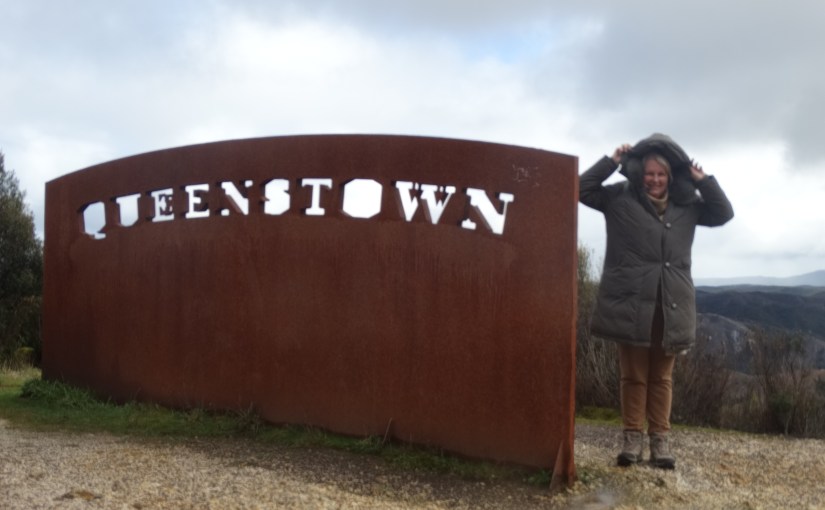
We said farewell to Strahan the following day heading towards Queenstown in the rough and rugged mountains of the West Coast. Queenstown’s history has long been tied to the mining industry. First explored in 1862, alluvial gold was discovered at Mount Lyell in 1880 but when the gold petered out in 1892, an Irish miner by the name of Crotty began searching for copper. In the 1900s, Queenstown was the centre of the Mount Lyell mining district and had numerous smelting works, brick-works, and sawmills. The town in its heyday had the world’s biggest copper mine and had a collection of hotels, churches and schools that have all significantly reduced since the reduction of mining.

Owing to a combination of tree removal for use in the smelters and the smelter fumes (for about 40 years), and the heavy annual rainfall (about 3 metres per year), the erosion of the shallow horizon topsoil back to the harder rock profile contributed to the stark state of the mountains for many decades. There was a brief boom in prosperity in the 1980s, with the building of several nearby dams by the Hydro. The Darwin and Crotty dams that comprise Lake Burbury were built during this period. But hydro power had been introduced to the area much earlier at Lake Margaret.

After driving along some of the most twisting roads in Tasmania, we finally arrived in Queenstown greeted by the Galley Museum (formerly the Imperial Hotel) in view of the Queenstown Railway which would be the highlight of our stay in Queenstown. After locating our caravan park, we returned to the Galley Museum and for the grand sum of $5 each we were able to look through the relics of the mining industry and community that grew up in that rugged and remote place. It is a tremendous community resource displaying photos and memorabilia of the town from foundation through the turbulent and prosperous years of the gold rush and the copper boom into the more mellow years of tourism. Each of the rooms of the hotel was brim full of the memorabilia, including a room dedicated the Royal Order of the Antediluvian Buffaloes.

As we left the museum we were fare welled by one of its stalwart inhabitants.

We had learnt about the Iron Blow, Mount Lyell Mining company and North Mount Lyell Mining company and some of the rivalry between two Irish miners Crotty and Bowes Kelly and were to learn more about them on our railway adventure tomorrow.

On the way to the Iron blow we passed a waterfall but the walk way was out of action due to a rock fall and travelling back down we got a good idea of the size and scope of Queenstown. Returning to the township we stopped at the Skopa which is a hill overlooking part of the town and it is decorated with a canon left over from a re – enactment of a Boer war battle.

Kerry had booked a tour of the Lake Margaret Hydro Power Station and due to the time of the year we found ourselves the only persons on the tour. In 1911 the Mount Lyell Mining and Railway Company decided to make more extensive use of electricity in its smelting operations. It selected Lake Margaret, a small lake high up on Mount Sedgwick, to the north-west of the town, as its catchment area. The water was originally conveyed from the dam via a 2.2 kilometres (1.4 mi) wood stave pipeline. The Australian Woodpipe Company was consulted and employed to construct the wooden pipeline. The Mount Lyell Mining & Railway Company determined that not only was a wooden pipeline cheaper to construct, but it was also more efficient and durable than iron or steel. The local native Tasmanian timber King Billy Pine was studied but it was decided not to be suitable. The wood stave pipeline was subsequently constructed from Oregon Pine (Douglas Fir), which was imported from Canada. The timber was shipped to the west coast town of Strahan and was transported to the Lake Margaret precinct via the ABT Railway (more about this tomorrow). This pipeline rapidly deteriorated and in 1938 was replaced by a King Billy Pine wood stave pipeline, with the timber sourced locally. This pipeline was still in service until the 30 June 2006 closure of the Lake Margaret Power Scheme.

In June 2008 a decision was made to return the Lake Margaret Power Station back to operational capacity. Lake Margaret system was reopened in 2009. The refurbishment included rebuilding the 2.2 kilometres (1.4 mi) wood stave penstock for the Upper Power Station. The upper power station was reopened on 12 November 2009, and the lower power station on 23 July 2010. We toured the site visiting the former workers’ cottages and their Hall, the Upper power station and the weir with views of the wooden portions of the pipeline. When visiting the workers’ cottages, we saw the description of the vegetables grown by the workers spelt out in stones by those workers who revisited the township on a “Back to Lake Margaret Reunion”.

After the tour we returned to town and our caravan park. We decided we would go to the empire Hotel for dinner. Another of the 14 hotels established during the boom times, it boasts a staircase made out of local blackwood which was sent to England for manufacture and returned to the hotel for installation. The meals were quite reasonable and the poker machines gave up their bounty to Kerry.

← Back

Thank you for your response. ✨

The Retirees on the Move Again – Tasmania in Ten – Macquarie Harbour and Sarah Island

Next morning, we excitedly awaken to a fine day and the hope of fair seas for we are sailing to Hells Gates, Bonnet Island, Sarah Island, the Petuna Fish Farm and the Gordon River. After a false start (forgot our boarding passes) we boarded the Ocean Spirit setting sail at 9.00 am. We had the opportunity to look at Strahan as we awaited casting off.

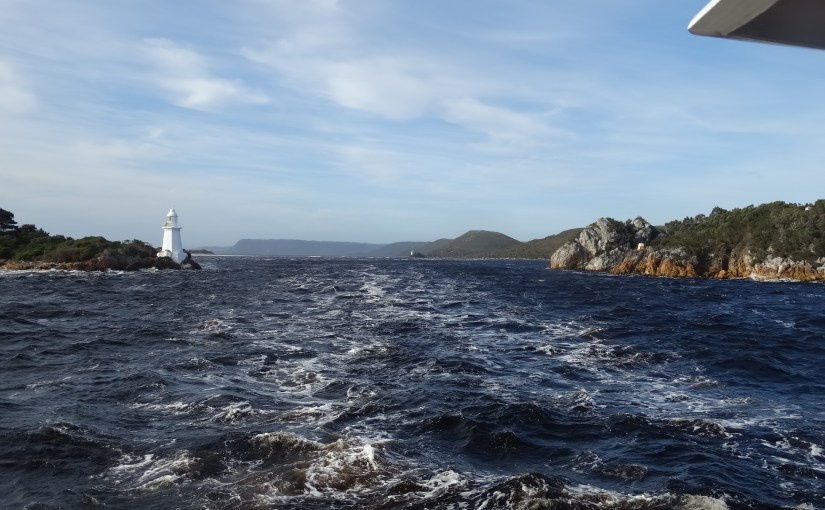
Firstly we sailed to Hells Gates (so called by the convicts sent to Sarah Island between 1822 and 1834 as it was hell on earth) the sea entrance to Macquarie Harbour and the location of Bonnet Island and its lighthouse. As we approached the Gates and passed the penguin colony on Bonnett Island, the wind blew hard and the cold grew immensely. The boat seemed to be struggling against the wind and tide. We passed the lighthouse at Hells Gate turned around and returned from whence we had come. Once we had our back to the wind the lake returned to a table top and the boat now moved easily across the water. We made our way to Petuna Fisheries sea farm where they raise Ocean Trout. We watched as an attendant hosed the pellets into the farm pen and the water rippled with a thousand fins.

From there we went to Sarah Island. The Macquarie Harbour Penal Station, established on Sarah Island, operated between 1822 and 1834. The settlement housed mainly male convicts, with a small number of women. During its 12 years of operation, the penal colony achieved a reputation as one of the harshest penal settlements in the Australian colonies. The penal station was established as a place of banishment within the Australian colonies. It took the worst convicts and those who had escaped from other settlements. The isolated land is ideally suited for its purpose. It was separated from the mainland by treacherous seas, surrounded by a mountainous wilderness and was hundreds of miles away from the colony’s other settled areas. The only seaward access is through the treacherous narrow channel Hells Gates.

Despite its isolated location, a considerable number of convicts attempted to escape from the island. Bushranger Matthew Brady was among a party that successfully escaped to Hobart in 1824 after tying up their overseer and seizing a boat. James Goodwin was pardoned after his 1828 escape and was subsequently employed to make official surveys of the wilderness he had passed through. Sarah Island’s most infamous escapee was Alexander Pearce who managed to get away twice. On both occasions, he cannibalized his fellow escapees. For a short period, it was the largest shipbuilding operation in the Australian colonies. Chained convicts had the task of cutting down Huon pine trees in the Gordon River valley and rafting the logs down the river to the Island. Eventually the heavily forested island was cleared by the convicts.

It was finally closed in 1834. Most of the remaining convicts were then relocated to Port Arthur. However, 10 stole the last ship built on the Island “the Frederick” and sailed her to Chile to escape. The ruins of the settlement remain today as the Sarah Island Historic Site. The Parks and Wildlife Service website reports the following about HMS Frederick;

“Perhaps the most remarkable escape attempt occurred after the official closure of the penal settlement. Twelve convicts, under the supervision of several soldiers and Master Shipwright David Hoy, remained behind to complete the fitting out of the brig, Frederick. Despite the fact that specific orders concerning the completion of vessels in the yards had mysteriously been mislaid, the men dutifully carried out their tasks with ‘great propriety, executing Mr. Hoys’ orders with promptitude and alacrity’.

After the launch of the Frederick in January 1834, ten of the convicts seized the ship. They landed their overseers on the beach, leaving with them half of their supplies. The convicts then sailed the Frederick south of New Zealand and onto the distant coast of South America. Six weeks later they abandoned the Frederick off the coast of Chile and rowed the ship’s whaleboat the remaining 80 km to shore.

Passing themselves off as wrecked sailors, the men were welcomed into the community and several soon assumed positions as shipwrights and respected members of the community. Several married local women, while six of the men made a further escape to America and Jamaica.

Ultimately, the long arm of British law caught up with the four remaining men, bringing them back to face the Hobart gallows in 1837. At their trial, two of the escapees, William Shires and James Porter argued that they were guilty only of stealing a ‘floating bundle of wood and other materials’. As the Frederick had never been registered, there was some doubt in the Chief Justice’s mind as to what legally constituted a ship. Further, the ship had been seized in enclosed waters and not on the high sea — a requisite for charges of Piracy. It was these legal technicalities which saved the men from the gallows. Nonetheless, the men were transported to Norfolk Island for life.”

From there we sailed to the Gordon River entrance into Macquarie Harbour. Prisoners from sarah Island were sent up here to log Huon pine for ship building and of course it was the centre of controversy in respect of a Hydro dam proposed to built on the river. The skipper moved from the wheel house (where there is no wheel but only a joy stick) to his external controls and moored the vessel carefully against a decaying jetty. We disembarked and walked through temperate rain forest where huon pine is want to grow – very slowly. To demonstrate how slow it grows there is a display of a log showing 650 years worth of growth and on the ground below us is a tree three times that size, albeit it has fallen over but it continues to grow and host some other trees as well. It is a short walk but you get the idea that inside one of these forests is a formidable jungle, cold bleak and not very hospitable.

After returning to the boat we enjoyed a documentary on the area whilst returning to Strahan. A great day. That night it was a burger for me and pizza slices for Kerry from the “greasy spoon’ next door to the caravan park. We had some respite from the camper by renting a cabin for these two nights. Luxury.

← Back

Thank you for your response. ✨

The Retirees on the Move Again – Tasmania in Ten – Dove Lake, Tullah and Strahan

The following morning, we awoke to another cold day with grey skies and spotting rain. Nevertheless, we decided to visit Dove Lake and view the Cradle Mountain. The first shuttle was at 9.10 am and we were on it – apart from the driver the only ones on it. After 20 mins driving through the park we arrived at a car park with snow topped mountains in the background. On the far side of the car park was a sign board with all the walks available and Kerry selected the walk to the old boat shed. We walked past a couple getting out of their car with backpacks and bush walking sticks looking the very image of prepared experienced walkers. We walked along the edge of the lake, passing buttongrass and other alpine flora not realising we were walking in the shadow of Cradle Mountain. That couple from the car park passed us as we neared the boat shed. We started talking with them and learned they were walking to the summit of Cradle Mountain which was immediately behind us. After bidding them fair weather for their climb and taking a few snaps of the boat shed (I don’t know how long it has stood in that cold water but it seemed in good nick given the environment) we returned to that car park and caught the shuttle back to the caravan park and set sail for Strahan.

There is no mobile phone service on Cradle Mountain or its surrounds, so we blissfully thought the world had forgotten us until we reached Tullah (pronounced Tu-lah in Strahan and Tull -a in Queenstown) and we regained service and the urgent messages. Whilst Kerry rang home, I made a cup of coffee. Coffee cup in hand I walked through the mining memorial beside the highway. It had provided a convenient place to pull in and it also told an interesting story about the mining of galena (silver sulphide – the usual form of lead in its natural state) at Mt Farrell in the 19th century and later after the Depression a second strike was made saving the town till 1974.

Kerry finished her phone call and we moved onto Strahan. We had hopes of visiting Bonnet Island but the weather is against sailing through Hells Gates (or so we were told) so it is an afternoon of knitting and writing this blog.

That evening we visited Hamers Hotel for dinner. Not bad but a limited menu and a noisy woman who continuously laughed like a hyena.

← Back

Thank you for your response. ✨

The Retirees on the Move Again – Tasmania in Ten – Cataract Gorge and Cradle Mountain

We slept in this morning till 6.45 am. Too bloody cold to get out of bed but I finally bit the bullet and went for my ablutions. Lovely hot shower followed by the cold atmosphere of the amenities block while I did my teeth and had a shave. On the return to the caravan, I turn on the gas and start breakfast of yoghurt with banana and porridge. We needed to get away so that we could visit the Cataract Gorge park before heading to our destination Cradle Mountain National Park. Following the directions given by our host we soon ended up in the parking area of the Gorge Basin. From there we walked across the suspension bridge, along the gorge wall and into city centre where a short distance away is the Penny Royal Amusement Park and then back again. We had a short stop at the kiosk for scones and coffee of course. Just after the Kiosk (or before if you are walking in the opposite direction are two trees both of enormous girth and height with each having a girth 4 times me. The rapids in the Cataract were deafening as against the smooth water fighting with tide below the basin. Then there was the rock that seemed to have hair – grass growing out of the rock.  The gorge is marked by towering granite columns and to my surprise sitting on top of the ridge is a residence. It must have magnificent views of the gorge and basin.

We returned to the motor home about 11.30 am and punched in our next destination – Lake St Clare Caravan Park. Our GPS provides an overview of your chosen route and we suddenly realised that it was nowhere near our next adventure at Cradle Mountain. So we punched in “Cradle Mountain”. Not quite so easy. There is no address in our GPS for Cradle Mountain. Telephoned our caravan park and they confirmed we were at least 2 hours away from where we wanted to be. So ignoring our reservation at Lake St Clare we headed for Mole Creek that being the nearest spot to our destination on the only map we had. All ends well. Mole Creek is the gateway to Cradle Mountain National Park but we were side tracked by a helpful but not well informed tourist information officer at Mole Creek. We went to King Solomon’s Caves to fill in time going to Cradle Mountain only to find that we were an hour early for the next tour.

We arrived on the mountain around 3.00 pm and sorted out our evening tour, our accommodation, our evening meal and our national parks pass by 4.00 pm. Whilst checking on our booking for the Devils we encountered a wombat grazing quietly on the grass in the car park to the Devils Sanctuary. Returning to the caravan park, we rested until it was time to get dressed for the evening chill. We were booked to see the Devils after Dark show at the Tasmanian Devils breeding sanctuary but it was raining windy and below 6 degrees so some preparation was necessary. Dressed in everything we owned off we went to watch a short video on devils and Quolls then experience them being fed whilst our guide droned on and on (15 mins should have done it but he managed 2 hours) The devils the Eastern Quolls and the Spotted Quolls are all related and now are only found in the wild in Tasmania. And they all have a taste for possum.

So back to camp and our frozen dinners – you’ve done it again Mc Cain!

← Back

Thank you for your response. ✨