Bishops Visit – They don’t Just Distill Whisky

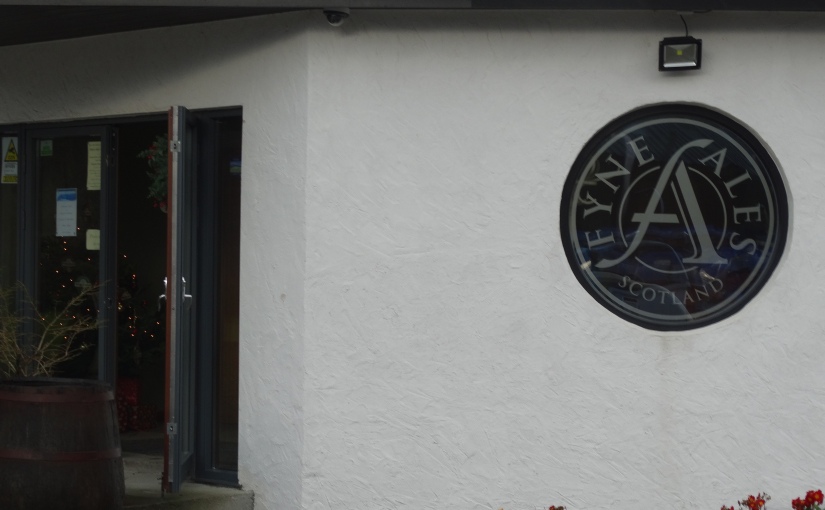
Travelling back to the Stage coach Inn, we notice a sign to Fyne Ales Brewery. The rain is slowing.  A left turn onto a farm road, and we pass slopes with grazing Highland Cattle and then Black Angus then some large farm sheds then a large”Titan”, some barrels and finally the visitors centre for Fyne Ales Brewery. Its exterior is deceiving. Inside is a warm bar and show room of all their ales and beers and they serve some interesting food made on site. Lunch, a warm lounge room and a pint of ale – what more could a soul want?


The Tallest Tree in Britain

Whilst the temptation was to stay at Fyne Ales, we finally moved on. The rain clouds were breaking up and the rain had ceased but the wind had lifted and the temperature had dropped. Still there was the gardens at Ardkinglas and Britain’s tallest tree to visit.

Our hotel is on a side road and we find that it is on the road to Ardkinglas estate the seat of the Laird of Clan Campbell. We learn this by visiting a small kirk on the way to the gardens. The church is in the Scottish church style of a circular nave and a steeple at the entrance. We stepped inside to be greeted by Mr Callander – a member of the Campbell/Erskine/Callander clan. He is decorating a small Christmas tree and stops to chat with us about the clan and the church. On the wall is a plaque giving some of the clan history and then there is the gravestones in the church yard. The church has been recently renovated and they have an Australian benefactor who has donated money over the years to maintain the church.


We left Mr Callander to finish the tree and went to find our own tree – Britain’s tallest tree.

Within 100 metres of the church we enter the Arkinglas estate and are greeted or should I say not greeted by an empty reception box. There is an antibacterial wash for your shoes and literature for the taking but no sign of our quarry. The wind is now cold and chilling, the gardens are dark as the sun struggles weakly to warm the world, and we feel more like a hot chocolate and a fireside seat to tramping through a colourless forest looking for the tallest tree. So we call it quits for the day and 200 metres back down the road pull into the hotel.

Although it is only 4.00pm it is now dark the rain has returned and soon it will be pitch black. The days can be very short. In the lounge the Inn Keeper has started the fire and the room is aglow with its warmth. The girls settle in with their knitting and a Khalua whilst I have a wee dram of Glengoyne single malt and pull out the IPad for some more blogging. Before settling in a browse the various paintings and bric a brac on the walls. Lo and behold, Queen Victoria has visited Cairnow and saw the Campbell children playing, John Keats got lost somewhere near here and Dorothy Wordsworth visited twice. Who cares! It is beautifully isolated and that is its charm.


We leave for Islay tomorrow. This will be an early start so we arrange a picnic basket and settle our bill for a running start tomorrow.

Go back

Your message has been sent

Warning
Warning
Warning
Warning

Warning.

Bishops Visit – Cairnow, Inveraray and the Stagecoach Inn

We left Oban at 4.30pm to travel to Cairnow on Loch Fynes but the weather had turned against us and the sun was now hidden behind a bruised sky. Our next hotel was over 90 minutes away and the conditions for driving got worse the more we travelled. The west coast is deeply indented with fjord type waterways called Firths and sometimes called Lochs (I don’t know why, it is too technical I am told). So I went to Wikipedia to find out and it says:

“Firth is a Lowland Scots word for a large sea bay or sometimes a strait whereas a Loch is an Irish and Scottish gaelic word for a lake or sea inlet.”

To get to Cairnow we had to travel around Loch Fyne so we encountered rain mist and dense darkness with very few villages to give the driver a break from the darkness. However our arrival at the Stagecoach Inn was a pleasant surprise. Like our hotel at Wall this is an old style hotel full of character and charm.

The hotel started life as a stage coach inn in the 18th century and still looks as though a stage is due any minute. Inside it has a low beamed ceiling, fireplaces aglow, and a bar which when filled holds about 9 or 10 people. Warm and romantic!

Our room was in the hotel itself and was very comfortable (once the bar had closed and the noise of the tap pumps had ceased). The bishops had one of the modern Loch view rooms with a balcony overlooking the Loch. After dining in front of the fire we retired and forgot the tense drive to the Loch.

The next morning our plans had been to return to Oban for the day but the trip the previous night showed this would not be sensible. However on the way to Cairnow we had passed through Inverrary and it had seemed a beacon in the darkness. So after a full breakfast, we decided to see what we could see in Inverrary.


A short drive along the edge of Loch Fyne and we arrived at Inverrary. The signboards of the Scottish Tourist Authority announced that we could visit the jail and the ship museum. The sun had decided to join us so the day held a lot of promise. Parking the car we noticed all the parking ticket machines to be covered and signed “Free parking November to March”. the day was getting better.

Inverrary has grown up based on fishing upon the marine Loch Fyne but today it is sustained by tourism. It is uniformly white wash with black trim so it looks very attractive. In the centre of town is a roundabout on which sits a large square building. Whilst it looked like a council building it in fact is the local parish church for the Church of Scotland. We were to learn that the Church of Scotland had different ideas around thee layout of its churches.


From the roundabout we spotted the jail (interestingly not spelt correctly as goal). On entering the jail you are greeted by two guards men – silent types. Then you go up stars  and one of the locals is coming down the other way with his dog. He has been to court (the jail houses the court as well) to listen to the proceedings involving an arson of farm buildings by its owner. We pat the dog and pass on into the building where we have an encounter with a barrister waiting outside the court with a pleading client. Pathetic!


As we wind our way around to the courtroom there are storyboards on punishments meted out by the courts over the centuries. It a good thing that punishment has become more humane or so we think.


We enter the court room, the prisoner seated between two policemen looks nervous, the witness in the box testifying, the jury not looking persuaded, the crowd of on lookers, the bar table and the bench – all very realistic.  Then the verdict – guilty! The sentence – 20 years in Inverrary jail. Whew all very tense – lets move on.


Outside in the yard we find the exercise cells and two vagrants trying to sweet talk the warder. He knows their type and they are there for thirty days; there is no escape.


Beside the exercise cells is the cells prior to the Prison Reform Act of 1839. Overcrowded, no sanitation, no light, poor food, all types – women, children, murders, the insane, all in together. One of the cells is home to the Warder  – his conditions were hardly any better than the prisoners.


On the next floor is the reformed prison showing the changes brought about after the Act. “Unfortunately” says the Warder, “Scotland got it wrong – 2/3rds of prisoners reoffended to get back into the prison”

We stroll around to the newer block showing the changes later in the 19th century to bring things into balance. There is also a horse drawn Black Maria and the story of how it got its name – it appears there was a boarding house in the American colonies that was run by a negro woman called Maria and she was not prepared to cop any antics by her guests so she readily called the constabulary to come in the black paddy wagon and accost the trouble maker. The visits become so regular that the wagon was called the Black Maria.


This was one of the best presentations of a gruesome subject – informative, sometimes humorous but always clear on how it touched the lives of people in the community.

II could not wait to see the ships museum. I was anticipating the same standard of presentation but not to be. There are two ships tied up against the wharf. The entrance is fenced off and litter abounds; there is a clear sense of decay and abandonment. Its closed and derelict. We had to visit the Apocothary and they informed us that the museum had closed years ago. Sad that no one has thought to change the signage around town.


Rain starts to fall. We decide to talk a walk through the town back to the car while the Bishops go directly to the car. We meet about the same time with the rain now tumbling down quite heavily. We decide that the warm fire back at the hotel is the place to be.

Go back

Your message has been sent

Warning
Warning
Warning
Warning

Warning.

Bishops Visit – Oban Distillery and Oban

Our trip from Inverness ended in Oban on the west side of Scotland (once again travelling from East to West). Oban is famous for the whisky of the same name. I had signed Doug and I up for a tour of the distillery. The girls were going to see the sights of Oban.

It seems an obvious question which came first the town or the distillery. Here I have to rely on Wikipedia which says:

“The site where Oban now stands has been used by humans since at least Mesolithic times, as evidenced by archaeological remains of cave dwellers found in the town.” But then it reports that the distillery was built in 1794 and the modern town formed around it.

Oban distillery is owned by Diageo. It has only two pot stills, making it one of the smallest in Scotland, producing a whisky that they describe as having a “West Highland” flavour that falls between the dry, smoky style of the Scottish islands and the lighter, sweeter malts of the Highlands. On the taste chart it falls almost smack in the middle.

Because it is winter (well almost) very few tourists were present. Our group of 7 was made up of us, a young French couple and three Italians two of whom now live in Glasgow and one of whom worked for the Malting council (so she was there on work – or so she said). The Oban Distillery is primarily known for its 14-year-old malt, which is marketed as part of Diageo’s “Classic Malts Selection” range, and a “Distiller’s Edition” bottling, which is finished in a Montilla Fino sherry cask before bottling. There is also an 18-year-old limited edition and a rare 32-year-old edition.

Once we entered the tour NO PHOTOS ALLOWED. The tour commenced with a video presentation on the malting process (all of which is done off site due to space), then we  went to the mixing vats to observe the result of adding water to the malted and roasted and crushed barley and then brewers yeast. This is refined in the wash back to remove any remaining grain and sediment before passing through the liquor cabinet for the mid cut of the alcohol is taken off to be distilled. Then the brew is taken off site to be pumped into American white oak bourbon barrels where it is matured for 14 years. 99% of the whisky produced is bottled as a single malt with 1% going into sherry casks for a further 6 months to create the Distiller’s Edition.
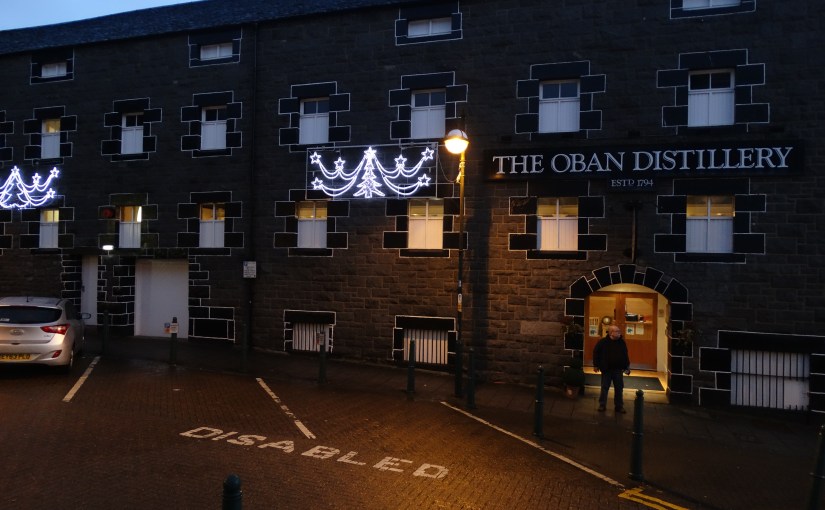
On the tour we stopped to test the brew age 11 years and 58.2% alcohol by volume. Very nice and we got to keep our tasting glass. Then we passed through to the tasting room where we tried the finished product.

A nice ending to the tour. However our hotel was not as close as we had expected and our trip through the dark foggy late afternoon along narrow highland roads proved trying.

Go back

Your message has been sent

Warning
Warning
Warning
Warning

Warning.

Bishops Visit – Fort Augustus, Fort William and the Western Highland Museum

Once again the day started brilliantly. Clear skies and truly brilliant sunshine suggested a magnificent day. Our goal was to get to Oban on the west coast travelling down Loch Ness past Urquhart Castle onto Fort Augustus and Loch Oich. From there we wanted to be in Fort William for lunch, visit the Highland Museum and then go onto Oban to sup a dram of their wee fine spirit.

Travelling through Inverness to the Loch took no time at all. The ruins of Urquhart Castle seemed little changed from 1990 except there was now a visitor’s centre and a fee for admission. We had seen enough ruins so we moved on quickly enjoying the scenes across the Loch. Nerida had the desire to drink from the Loch. After some whining from the back seat, I stopped and granted her wish. It was at this time she was certain she saw a large dinosaur looking animal in the water – I told her it was her reflection and beat a hasty retreat to the car. After she had her drink and promised no retribution for the Nessy crack, we moved on to Fort Augustus.

In the aftermath of the Jacobite rising in 1715, General Wade built a fort (taking from 1729 until 1742) which was named after the Duke of Cumberland.  The fort was captured by the Jacobites in April 1745, just prior to the Battle of Culloden. In 1867, the fort was sold to the Lovat family, and then passed to the Benedictine order. The monks established Fort Augustus Abbey and later a school. In 1998 the monks abandoned the site, and it reverted to the Lovat family which in turn sold it.

Of principal interest to us was the series of locks in the centre of the village. The Caledonian Canal connects the Scottish east coast at Inverness with the west coast at Corpach near Fort William. It was constructed in the early nineteenth century by engineer Thomas Telford, and at Fort Augustus it has 5 locks giving access into Loch Ness for traffic from the Irish Sea. Intended for commercial traffic it appears now to be principally pleasure craft. Very picturesque.

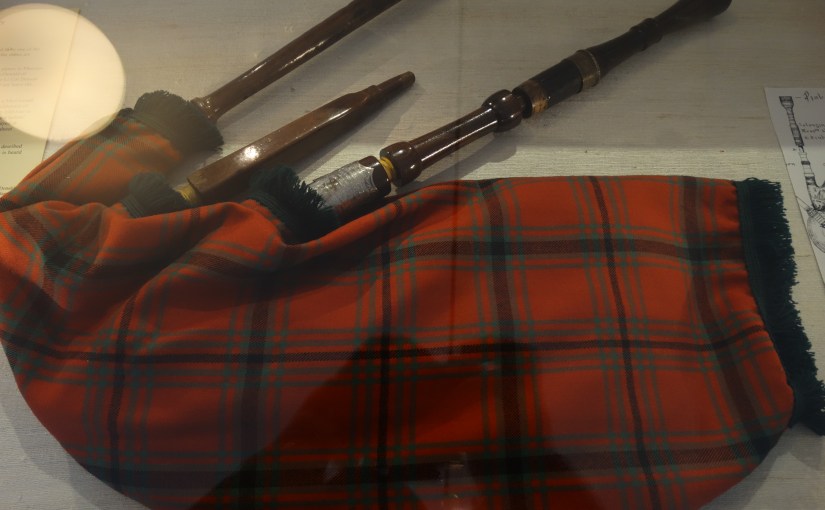
The trip into Fort William was equally pleasant. Sunshine, a fair wind and great scenery made the trip very pleasant. On arriving in Fort William we made our way to the Western Highland Museum on Cameron Square. Although not what I expected it was very interesting. One of the features for me was a set of bag pipes said to have been played in battle in 1344. Who keeps old bag pipes for 670 years?

“The West Highland Museum is one of the oldest museums in the Highlands. It was founded in 1922 by a group of local enthusiasts led by Victor Hodgson, who had neither a collection nor a building to display it in. In 1925, after several temporary exhibitions and the acquisition of significant collections, the Museum launched a fundraising appeal, and in 1926 purchased the present building, a former branch of the British Linen Bank.” See their web page http://www.westhighlandmuseum.org.uk/about/.

Fort William is the 2nd largest settlement in the highlands and a major tourist centre with Ben Nevis nearby. Named firstly after King William (William of Orange) and then renamed only to be named after the Duke of Cumberland it was established firstly during the English Civil War by Oliver Cromwell and reinforced as a fort against the Jacobites and the uprisings during the first part of the 18th century with the present township developing around it. The Caledonian Canal finishes near here with 8 locks.

Neptune’s Staircase at Banavie, near Fort William just north of Loch Linnhe is the longest staircase lock in Britain lifting boats 64 feet (20 m). It consists of eight locks, each 180 feet (55 m) by 40 feet (12 m) and it takes about 90 minutes to pass through the system.

Go back

Your message has been sent

Warning
Warning
Warning
Warning

Warning.

Bishops Visit – Ullapool – Granny Who?

One of the reasons we travelled to Inverness was to enable Doug Bishop to visit the place of birth of his granny. At first he said the village was just outside Inverness. Then we find it is just outside Ullapool which is just outside Inverness. Well on the other side of the country from Inverness actually.

Despite this set back we determined to see what we could see. Now Ullapool is on the west coast and Inverness is on the east coast of Scotland. Fortunately this must be the shortest distance across the country – only 79 miles, so after 1 hours driving through some very pretty hills and glens, we arrived in Ullapool.


The weather was once again kind to us with the sun racing us across the country. I think we won because there was still daylight in Ullapool when we arrived. The post office was our first place to visit. Enquiries with the postmaster revealed that Granny’s village was a further 40 miles north along a rather crude track. The sun was tracking below the horizon and the weather had decided to rain on our party. So we decided that Doug needed to do some more research before we trekked into the wilderness of the Highlands.

We took some shots of this lovely little village and its harbour before finding FBI – Ferry Boat Inn – the locals find the abbreviation amusing. FBI had a lovely fire with views over the harbour. So we warmed our selves with fire and fire water (Whisky) before dining and heading back to Inverness. The journey home was a little less comfortable to the journey there. With darkness falling around 5.00pm, travelling home at 7.30pm was pitch blackness without aid of street lights in drizzling rain.

Go back

Your message has been sent

Warning
Warning
Warning
Warning

Warning.

Bishops Visit – Fort George – An expensive insurance policy

Outside of Inverness is Fort George. Built following the defeat of the Jacobite rebellion at Culloden in 1746, the fort was intended to be a deterrent to further rebellion by the Clans who sought to restore the Stuarts to the throne of England and Scotland. It cost 200,000 pound which was an enormous sum for the time. It incorporates some old defensive items like two moats and draw bridges, a palisade, battlements and watch towers, but it includes modern innovations like the low profile and the star shape none of which has ever been tested as James fled to France never to contest his right to the throne against William and Mary. By the way Jacobite takes its name from Jacobitism, from Jacobus, the Latin form of James.

The fortification is based on a Star design, it remains virtually unaltered and nowadays is open to visitors with exhibits and recreations showing use at different periods, while still serving as army barracks. Originally the depot of the Seaforth Highlanders and later the Queen’s Own Highlanders (Seaforths and Camerons), it was more recently home to the Royal Irish Regiment, and as of 2007, the new garrison of the Black Watch, 3rd Battalion, Royal Regiment of Scotland.


The fort housed a lieutenant-governor as administrator and as the fort became like mini village wives and children also. The governor’s residence has been turned into the Highlanders’ Museum – well worth a visit to understand all the different highland regiments that have been formed.


As it is on the end of a promontory into the Firth of Moray, it is open to the wind and it must get bitterly clod on the battlements. My trip up on a sunny day with little wind was enough for me to be certain I did not want any guard duty. Entry costs about 8 pound and you get an audio tour guide. When we returned our audio guides to the gift shop, I noticed “Stag’s Breath”. so one of my readers will be happy to know that I remembered him despite his criticism of my blogs – he may be lucky enough to see it arrive back to Australia unopened.

Go back

Your message has been sent

Warning
Warning
Warning
Warning

Warning.

Bishops Visit – Thoresby Hall – Ingrid Pears MBE

In July 2013, we visited Nottingham to manage the business for a couple of weeks and in that time we met Ingrid who was then a member of and then President of the Rotary Club of Nottingham. On the night of our visit to the Club, they conducted a raffle for a piece of Ingrid’s work; a modern styled glass vase, and of course we won it. It is a delight piece and with this introduction we felt compelled to visit Ingrid at her studio. Her studio is located at Thoresby Hall, a former Abbey taken over by Warner Hotels and renovated into a luxury hotel. The former stables form a commercial area in which Ingrid has developed her studio. Her web site is worth a visit: http://www.ingridpears.com/

We had visited her again in February and now with Doug and Nerida in tow we visited again. On arriving we found Ingrid in the middle of prepare new stock for her showroom. She is preparing glass balls for the Xmas trees of England and this particular ball has golden specks.


We can never visit Ingrid’s showroom without purchasing a piece of her exquisite glass. But as this is my Xmas present there is no peeking until after Santa has been.

Bishops Visit – Brodie and the Laird Brodie


Our first icy windscreen but the day is clear. After removing the ice, we decide to drive east to the estates of Clan Brodie.

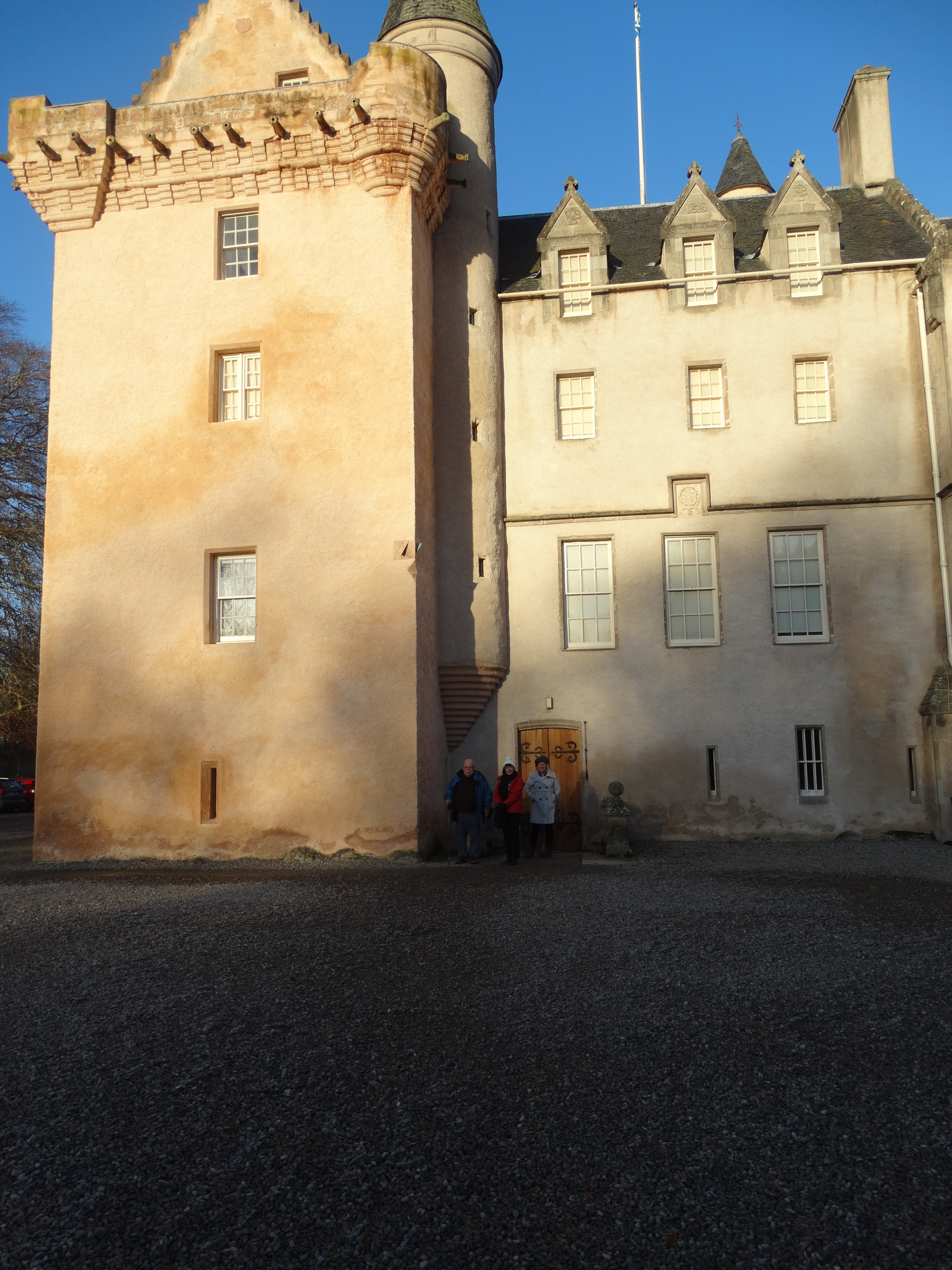
In 1990 Kerry and I were in Scotland and we discovered Brodie Castle. This was the ancestral home of Clan Brodie and the Laird’s (known as the Brodie) home. The area is named Brodie so he is the Brodie of Brodie. The Brodie’s have mysterious origins but can claim their rights to the ancestral lands come from a grant form Robert the Bruce in the 13th century.

We were fortunate to be shown the castle by the Brodie Montagu who used the name Ninnian because of his theatrical interests. Ninnian died in 2003 but before dying he entrusted Brodie castle to the National Trust of Scotland. The present Brodie is Ninnian’s grandson Alexander but he no longer resides in the ancestral castle.

Now in 2014 we have returned. We chose an excellent day for our visit. The sun was shining brightly and the sky was a clear pale blue. The wind was light but chilly. As we pulled into the car park there was a sense that something was wrong. Nevertheless we walked down the path leading to the castle and saw that there were cars parked beside the castle. The castle is closed to the public for the season and this is the staff arriving to undergo training and to attend to cleaning and maintenance. Kerry checks the web site and then rings to find out why the web site says it is open. This leads to the Estate manager letting us into the castle and arranging a personalised tour for us.

The present castle is a mixture of a 16th century defensive tower, and extensions in the 17th, 18th and 19th centuries. We only got a shortened version of the full tour viewing the basement hall of the tower with its ancient armaments and memorial to the Brodie Castle a member of the family constructed in Madras India, the space that was the original kitchen now part of the entry, the library, the dining room with it extremely different ceiling (plaster ornaments decorate the entire ceiling), the drawing room and it’s supplements from the Gordon Clan through a fortuitous marriage. No photos allowed so you will have to visit it yourself one day. I can recommend it.


Castle Brodie
Castle Brodie

Go back

Your message has been sent

Warning
Warning
Warning
Warning

Warning.