We awake in Poitiers. I am still waking early despite the lack of sunlight and the overcast weather. Breakfast in our room, packed up checked out then strolled the medieval city which has been transformed by modern paving in the narrow streets and limiting traffic to essential commercial traffic. But Mondays are strange in that none of the shops opened before 2.00 pm. Visited a Romanesque church Notre Dame Le Grand Dame said to be the oldest church in France (12th century) and it still has some of its original frescos.
As we walked through the old streets we entcountered a hairdresser with a big imagination. Spotted a cafe – well actually we smelt it first – so we shot over for a hot chocolate. Met a French woman who teaches French to foreign students and they in turn are teaching her English and she practised on us. We also visit another Romanesque church Eglise la Porchaine unusual because it is square and has a 3 storey square bell tower.
It was still raining and very little open so we decide to trek on to Dampierre sur Boutonne to visit cousin Terri and her husband Mick. We arrived just about lunch time.
Dampierre is a rural village of about 50 homes about 1 hour west of La Rochelle. Mick and Terri have lived here (I’m not certain) 15 years plus. Shortly after moving from Brighton to Dampierre, they renovated an abandoned house and create “gites” French holiday accommodation, Mick turned his hand to renovating for other Poms taking advantage of their EU status to invade France once again. One of the projects they have taken on is the renovation of a house at Leger. Mick’s youngest son Daniel is visiting (he also has bought and renovated abandoned houses) and over lunch we talk them into showing us the progress with this renovation (Daniel says it still looks like a WW1 house on the Somme). So we drive toward Aulnay through the back blocks of the back of beyond to Leger.
It is as pretty as I remember it. An abandoned house with granny flat looking across open French fields. Today one of Terri’s neighbours is planting a plot of potatoes with a garden fork – a centuries old scene. There is still a lot of work to be done but they are both still enthusiastic about the project. A combination of poor holiday seasons and Mick’s health not permitting him to work has seen a shortage of cash for the project but still Mick has performed a lot of the fundamental reconstruction needed. Personally and Mick now agrees he should have bull dozed the house and started again but that would not have the same charm, Back to Dampierre a warm fire and hot meal. Kerry has developed a sore throat and goes to bed and I bore Terri, Mick and Daniel with photos and we reminisce about Dad’s emigration as a 19-year-old to start a new life in Australia.
After a relaxing night in the piggery (now renovated as a gite) I awake early once again – I cannot seem to sleep past 4.00 am. Still dark and cold but it must be time for a cuppa to start the day. It is the end of February and we are still in winter. It is raining windy and cold. We thought we would visit the donkeys and then go to La Rochelle to see if our memories of the town are accurate.
So we drove over to the donkey farm where we saw the local breed of donkey brought back from extinction through one stallion and careful breeding. The Poitou donkey or Poitou ass, also called the Poitevin donkey or simply the Poitou, is a breed of donkey originating in the Poitou region of France. Long ears and a hairy coat they look a little strange.
Then we travelled out to the coast to La Rochelle. It was windier and colder making it difficult to find the town we remembered. But we did buy a Euro millions ticket and out popped two tickets = a good omen and Kerry who had been longing for a crepe citron got her crepe. The weather does not improve so we head home for a warm fire and a cuppa. Mick and Terri arrived later and we put on some nibbles before dinner. Terri pulls out her Euro Millions ticket and we agree to pool our chances.
Boxing Day started with a dense fog which overnight had settled over the Charente-Maritime and we were hoping to visit La Rochelle and Ile de Re. However Terri assured us that more than likely it would be clear on the coast. So we loaded up the esky with a Xmas leftover picnic and sailed off to La Rochelle. We chose to pass through Surgeres rather than the freeway into La Rochelle thus wetting the girls appetite to do shopping in the old village.
We parked on the waterfront under the old city walls, then walked through the old harbour entrance into this famous maritime city of France and at times England. The history and its influence are astounding for a city few people I know are even aware it exists.
The old city is very unique with its covered footpaths and the remains of medieval fortifications and modern submarine pens built by the Germans during WWII still visible. I have extracted from Wikipedia the history of the city and set it out below for those interested. For those not interested I have posted some photos which I hope give you some idea of the quaintness of this place and its seaward region of Ile de Re. More on the island in another blog.
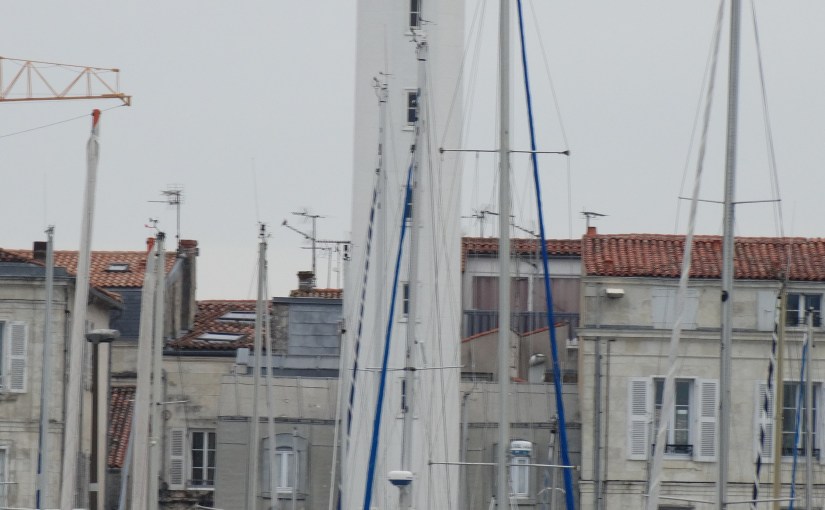
La Rochelle was one of the centres for Huguenots and therefore involved in the Religious Wars in France and I found a Protestant Church which has survived those Wars. The waterside quays remain and are frequently adorned with markets and the lighthouse located in one of the main streets also remains and is operating..
Potted history of La Rochelle
La Rochelle is a city in western France and a seaport on the Bay of Biscay, a part of the Atlantic Ocean. It is the capital of the Charente-Maritime department. The city is connected to the Île de Ré by a 2.9 kilometres (1.8 miles) bridge. Its harbour opens into a protected strait, the Pertuis d’Antioche.
The area of La Rochelle was occupied in antiquity by the Gallic tribe of the Santones, who gave their name to the nearby region of Saintonge and the city of Saintes. The Romans then occupied the area, Roman villas have been found at Saint-Éloi and at Les Minimes, as well as salt evaporation ponds dating from the same period. La Rochelle was founded during the 10th century and became an important harbour in the 12th century.
Plantagenet rule (1154–1224)
Eleanor married Henry Plantagenet in 1152, who became king of England as Henry II in 1154, thus putting La Rochelle under Plantagenet rule, until Louis VIII captured it in the 1224 Siege of La Rochelle. The Knights Templar had a strong presence in La Rochelle since before the time of Eleanor of Aquitaine.
During the Hundred Years’ War in 1360, La Rochelle again became English. La Rochelle however expelled the English in June 1372, following the naval Battle of La Rochelle. In 1402, the French adventurer Jean de Béthencourt left La Rochelle and sailed along the coast of Morocco to conquer the Canary Islands. Until the 15th century, La Rochelle was to be the largest French harbour on the Atlantic coast.
During the Renaissance, La Rochelle adopted Protestant ideas. An early result of this was the burning at the stake of two “heretics” in La Rochelle in 1552. Conversions to Calvinism however continued, due to a change of religious beliefs, but also to a desire for political independence on the part of the local elite, and a popular opposition to royal expenses and requisitions in the building projects to fortify the coast against England. La Rochelle was the first French city, with Rouen, to experience iconoclastic riots in 1560. Protestants pillaged churches, destroyed images and statues, and also assassinated 13 Catholic priests in the Tower of the Lantern. From 1568, La Rochelle became a centre for the Huguenots, and the city declared itself an independent Reformed Republic on the model of Geneva. This led to numerous conflicts with the Catholic central government. The city supported the Protestant movement of William of Orange in the Netherlands, and from La Rochelle the Dutch under Louis of Nassau and the Sea Beggars were able to raid Spanish shipping.
In 1571 the city of La Rochelle suffered a naval blockade by the French Navy. The conflict ended with the 1573 Peace of La Rochelle, which restricted the Protestant worship to the three cities of Montauban, Nîmes and La Rochelle.
Louis XIII and his Chief Minister Cardinal Richelieu declared the suppression of the Huguenot revolt the first priority of the kingdom. The English came to the support of La Rochelle, starting an Anglo-French War (1627-1629), by sending a major expedition under the Duke of Buckingham. The expedition however ended in a fiasco for England and Cardinal Richelieu blockaded the city for 14 months, until the city surrendered and lost its mayor and its privileges. The remaining Protestants of La Rochelle suffered new persecutions, when 300 families were again expelled in November 1661, the year Louis XIV came to power.
The growing persecution of the Huguenots culminated with the Revocation of the Edict of Nantes by Louis XIV in 1685. Many Huguenots emigrated, founding such cities as New Rochelle in the vicinity of today’s New York in 1689. La Rochelle, and the siege of 1627 form much of the backdrop to the later chapters of Alexandre Dumas, père’s classic novel, The Three Musketeers.
In 1809, the Battle of the Basque Roads took place near La Rochelle, in which a British fleet defeated the French Atlantic Fleet. In 1864, the harbour of La Rochelle (area of the “Bassin à flot” behind the water locks), was the site for the maiden dive experiments of the first mechanically-powered submarine in the World, Plongeur, commanded by Marie-Joseph-Camille Doré, a native of La Rochelle.
During the Second World War, Germany established a submarine naval base at La Pallice (the main port of La Rochelle). A German stronghold, La Rochelle was the last French city to be liberated at the end of the war. The Allied siege of La Rochelle took place between 12 September 1944, and 7 May 1945; the stronghold, including the islands of Ré and Oléron, was held by 20,000 German troops under a German vice-admiral Ernst Schirlitz. Following negotiations by the French Navy frigate captain Meyer, and the general German capitulation on 7 May, French troops entered La Rochelle on 8 May. (source Wikipedia)
So, what do you think? It astounds me that this rural port and nearby Rochefort have been so influential. One thing further if you visit La Rochelle and the boat trips to Fort Boyard are running don’t miss the opportunity to visit it. Here is a fort built on a bank in the ocean –surrounded by water and only accessible by boat. Again a Wikipedia extract on its history follows:
Fort Boyard is a fort located between the Île-d’Aix and the Île d’Oléron in the Pertuis d’Antioche straits, on the west coast of France. Building started in 1801 and was completed in 1857.
The fortifications were completed in 1857, with sufficient room for a garrison of 250 men. However, by the time of its completion, the range of cannons had significantly increased, making the fort unnecessary for national defence. After 1871, Fort Boyard was briefly used as a military prison, before being abandoned at the beginning of the 20th century. In 1950 it was made a listed building, and in 1961 was sold to Charente Maritime Regional Council.
I am in the Eva Air business class lounge facing a 19 hour delay before our next flight and you know I don’t care. Just had a shower. What a fantasy that is. The only thing missing is the personal attendant to rub your back.
I have answered my emails reviewed the results of the Easts directors retreat reviewed the amended budget and shot off some questions to the CFO and oh yes Kerry and I have discussed our day. We plan to take a free half day tour to Longshan Temple, the Presidential office building, Chiang Kai-shek memorial Hall, Martyrs Shrine and the Taipei Mall (hunting and gathering again).
A walk around the terminal for an hour or so and back to the lounge. This gave us the opportunity to check out the weather – shitty to say the least. Kerry is still over tired and does not feel up to the tour in rainy weather. Cancelled the tour. Killed time walked the entire terminal 1, 2, 3, and 4 – they all join up.
Finally on the plane and business class is a treat. Next stop Paris (only 13 hours flying). The trip was probably the bumpiest trip I have ever had and the layout of the seats meant that Kerry and I could barely see one another and over that period it becomes annoying.
Landed at Charles De Gaulle and waited for the luggage and waited and waited. Extremely high winds made it impossible to unload our plane. Got the luggage and collected the car. Set the GPS and off to Amboise in the Loire Valley we go. Interesting trip just under 2 hours but how the scenery changed. The suburbs of Paris looked dirty and cold while the country side around Amboise is clean and fresh but also cold. Amboise has been around since the Neolithic times when it was settled by a Celtic group called the Turones, occupied by the Romans and the first signs of a castle appeared in the 4th century AD. Clovis the King of the Franks met Alaric King of the Visigoths on Ile d’Or (the island in the Loire river just off Amboise) in 503AD (no idea why) but this gives you some idea that when I say the buildings here are a real mixture of old and new and the roads are all designed for donkey carts that its true.
Jet lag caught up with on the first day. We found our hotel, walked to the Tourism office bought our tickets for the next day’s adventures and came back for a nanna nap and I woke again at 3.00am.
Our Hotel/Downtown Amboise
Up bright and early – hey who played around with my watch its 7.45 am? It’s overcast so no idea of the time therefore slept in. Never the less we left the hotel on time to visit Clos Luce, Leonardo da Vinci’s last home (gifted to him by Francois 1st). It’s a bit more than a home but not quite a chateau. It is surrounded by lovely gardens and contains a history of da Vinci’s engineering designs and inventions from military to civil. Even had Kerry interested (oops spoke to soon she’s sitting down – time to move on).
Clos Luce
We had chosen to walk but it’s another shitty day weather wise windy and wet which made the entrance to Castle Amboise a bit treacherous. The castle is in the middle of the city and as we walked to the castle we noticed that the castle walls contained houses. I don’t know when but people have constructed house in the castle walls. They are privately owned so we could not see inside but quite different. Les Troglodytes – Oui!
Troglodytes
The castle itself is only part of the original (about 50% I guess has been demolished over time). What remains was interesting. Da Vinci is buried there. He lived in Amboise only 3 years before dying and in his will he asked to be entombed in the St Florentin church in Castle Amboise and when this was demolished they dug up his bones some coins (by which they determined these were da Vinci’s bones) and reinterred him in the St Hubert Chapel also in the castle grounds (where you can see him today).
Castle AmboiseSt Hubert’s Chapel
Home for a sandwich and then we drove to Chateau Chenonceaux. Now this place is unique in that it is built in the river Cher with a short timber bridge on one end and a 60m bridge connecting it to the other side (the bridge was covered in by Catherine de Medici (wife of Henri II) after his death and after she took the chateau back from Henri’s lover Diane of Poitiers (for whom Henri acquired the Chateau). The “bridge “was turned into a banquet hall by Catherine and the chateau changed hands a few times up to 1945 but is now a heritage building. It is not opulently fitted out but is interesting because of the various people who have called it home since 1521.
Chenonceaux
“the Bridge” – Chenonceaux
Back in Amboise we noticed a very old building containing a quaint restaurant across the road from the hotel (across the road – you can see into the restaurant and vis a versa – the road is 6m wide from the wall of our hotel to the wall of the restaurant). So we had drinks in the living room of the hotel browsing the local picture books on the sites of the Loire Valley then ambled across the road for dinner. But for the fact it was blowing a gale and probably close to 0c it was lovely. To bed to dream and check the internet. Bugger! We had planned to visit Futuroscope outside Poitiers but it is closed until February 14 – one of our goals was to go back to Futuroscope but now we are going to miss it. In France when something says on its web site opening in February do not think they mean the 1st of February.
Next morning breakfast in our hotel room (porridge and a cuppa) and travel onto Chinon and the Fortresse Royale. Amboise was like a village you see all over France – history in every house and town planning for donkey carts and pedestrians. I enjoyed the town but I am a 21st century boy and looking forward to an Ibis Hotel in Poitiers.
On the road again and we made good time down to Chinon. As seems usual in France the GPS “Tommy” has the difficulty of finding its way in the villages but this time it was the town of Chinon. “Turn right” it said and all I could see was a barely sealed road connecting houses with an uncertain end round a corner. So I missed the turn but my co-pilot insisted we go down that path. Within 50m we came to a roundabout and on the third exit a bloody big sign “Chinon – medieval citie” and “Fortresses Royale – Parking”. Under co – pilot instructions I went back to the muddy lane and down we went until we shocked a French woman walking her dog who politely told us yes you can get to the fortress this way but it is better to go over there as there is parking for the car (at least that is what we determined as she was as good with English as we were with French – avoided running over the dog).
Got to the parking and then to the visitors centre then to the fortress. Sited on a rocky outcrop (as usual) it towers over the city. It is actually three forts in one. The oldest Coudray Tower is where the last of the knights Templar were held after Louis Philippe ordered the arrest of all members of the temple. The Middle Tower contains a very interesting display on the history of the fort (last used for military purposes in the 15th century) the visits by Joan of Arc to Charles VII and the archaeology discoveries. It also contains the bell tower (which we climbed after it rang 12noon) and this is an additional 5 stories above the fort and probably 100m above the city. (It is said that the bell has rung over Chinon since 1399 and this is where the “Plantagenet” started life when Geoffrey V Count of Anjou took the nickname “Plantagenet” after a sprig of broom he wore in his hat and his son Henri II became King of England through his mother). So Chinon remained a little bit of England through Richard the Lion Heart and then King John who lost the fortresse to Philippe Auguste King of France and Chinon became part of France for the first time. As you can see I enjoyed this part.
Coudray TowerMiddle Tower
Finally there is the Tower of St Georges which was not really part of the military defences but the royal suites and administration centre for France under Charles VII. The emblem for the city is three towers. After the reign of Charles VII Chinon loses popularity and the last fortification work was in 1560. Thereafter it falls into disuse and comes close to destruction in 1854. In the intervening period many parts of the three towers and principally the third one is destroyed (the visitors centre is located where the third tower once stood). It is now a listed historic monument and as you can see some significant historical moments occurred here. Great fun for me not so much for Kerry who become angry and distressed (and rightly so) when I went exploring in the Coudray tower and the cells below ground.
We notice there is an elevator on the side of the cliff about 50m from the visitors centre so we went in search of a hot chocolate in the town. Just like Amboise its design is from other eras and has a mixture of the oldest and the older throughout. Found the hot chocolate in a Tabac – not much open on a Sunday had a sandwich in the car then off to Poitiers. We arrived about 2.00 booked in settled in and I had a nanna nap. After dinner in a very interesting pub called Au Bureau we strolled the streets and are keen to see it all in daylight.
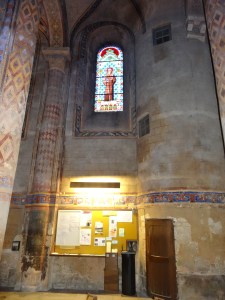
Still waking early despite the lack of sunlight and the overcast weather. Breakfast in our room, packed up checked out then strolled the medieval city which has been transformed by modern paving in the narrow streets and limiting traffic to essential commercial traffic. But Mondays are strange in that none of the shops opened before 2.00pm. Visited a Romanesque church Notre Dame Le Grand Dame said to be the oldest church in France (12th century) and it still has some of its original frescos.
Notre Dame Le Grand Dame
Eglise la Porchaine Poitiers
Spotted a cafe – well actually we smelt it first – so we shot over for a hot chocolat. Met a French woman who teaches French to foreign students and they in turn are teaching her English and she practised on us. We also visit another Romanesque church Eglise la Porchaine unusual because it is square and has a 3 storey square bell tower. It is still raining and very little open so we decide to trek on to Dampierre sur Boutonne to visit Cousin Terri and her husband Mick. We arrived just about lunch time.
Dampierre is a rural village of about 50 homes about 1 hour west of La Rochelle. Mick and Terri have lived here (I’m not certain) 15 years plus (I first met my cousin when she visited Dad and Mum in Brisbane and then returned the favour in 1990 when she and Mick lived in Brighton Hove and Mick bought and sold motors.) Shortly thereafter they moved to Dampierre to renovate an abandoned house and create “gites” French holiday accommodation, Mick turned his hand to renovating for other Poms taking advantage of their EU status to invade France once again. One of the projects they have taken on is the renovation of a house at Leger. Mick’s youngest son Daniel is visiting (he also has bought and renovated abandoned houses) and over lunch we talk them into showing us the progress with this renovation (Daniel says it still looks like a WW1 house on the Somme). So we drive toward Aulnay through the back blocks of the back of beyond to Leger. It is as pretty as I remember it. An abandoned house with granny flat looking across open French fields. Today one of Terri’s neighbours is planting a plot of potatoes with a garden fork – a centuries old scene. There is still a lot of work to be done but they are both still enthusiastic about the project. A combination of poor holiday seasons and Mick’s health not permitting him to work has seen a shortage of cash for the project but still Mick has performed a lot of the fundamental reconstruction needed. Personally and Mick now agrees he agrees he should have bull dozed the house and started again but that would not have the same charm, Back to Dampierre a warm fire and hot meal. Kerry has developed a sore throat and goes to bed and I bore Terri Mick and Daniel with photos and we reminisce about Dad’s emigration as a 19 year old to start a new life in Australia.
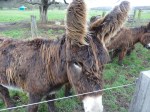
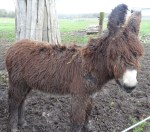
Its early once again – cannot seem to sleep past 4.00am. Still dark and cold but it must be time for a cuppa to start the day. Raining windy and cold. We decided to visit the donkeys (not open on Tuesdays) and go to La Rochelle to see if our memories of the town are true. So we drove over to the donkey farm where we saw the local breed of donkey brought back from extinction through one stallion and careful breeding. Long ears and a hairy coat they look a little strange.
L’Assinere Baudet Du Poitou
Then we travelled out to the coast to La Rochelle. It was windier and colder making it difficult to find the town we remembered. But we did buy a Euro millions ticket and out popped two tickets = a good omen and Kerry who had been longing for a crepe citron got her crepe.
St Malo sea wall
Weather does not improve so we head home for a warm fire and a cuppa. Mick and Terri arrived later and we put on some nibbles before dinner. Terri pulls out her Euro Millions ticket and we agree to pool our chances.
Next morning happy birthday to Kerry and up early to travel to Le Mont St Michel and St. Malo. Mick cooks us a hot breakfast and makes us lunch as well while Terri checks the lotto results. The weather has cleared to a fine day. After breakfast and the disappointment that we missed out on Euro millions it is farewell and hit the road. As we approach the address of our accommodation, Kerry has serious doubts about its location. We are driving through vacant paddocks and ancient farm villages but suddenly Le Mont appears behind all the villages and our accommodation comes into view. It turns out to be perfect, well located and cheap.
Le Mont St Michel
Meet the proprietor (who cannot speak English) but we muddle through then off to St Malo. Fabulous old walled city but even the GPS got lost in the city. So we parked outside then walked through fighting a fierce storm with strong winds and rain. It is too early for dinner so we decide to go back to Le Mont and a nice restaurant there for a birthday dinner for Kerry. Nothing opens before 7.00pm so in frustration we go home and have vegemite sandwiches and a cup of tea. Try again tomorrow.
The next morning we dine on a sumptuous continental breakfast and leave for the Mont. Extraordinary the car parking available for excursions to the Abbey. After parking we walked to the navette (bus) and travelled with hundreds of Japanese tourists to the Abbey (they thought it was the Tokyo underground and 100 tried to get on a fifty seater bus). At the Abbey we tried to lose them by walking up onto the ramparts and then up the stairs to the Abbey but there they were at the top and we tripped thought the Abbey together (giggling teenage Japanese girls doing stupid poses for their cameras all the way around). We got a surprise when we tried to pay to get in – a computer malfunction meant we got a free entry (gratuitie). The Abbey is large on a monumental scale and being on top of an island mountain it is a bloody long way up (hence a defibrillator at the top of the steps). The Abbey is a labyrinth of rooms passages and halls and kept us interested for hours. There is a garden like a roof garden which on one side is open to the sea sky and air (hence they have installed a perspex sheet to stop silly Japanese girls from falling out which I am certain they would have done – they all crowded around the opening like they did on the bus). Had a nice lunch and then returned to the area on the land – it has hotels a supermarket and restaurants all on a grand scale – the tourists in summer must be as thick as blow flies on a carcass.
View back to the main landView of the abbey
Back to our B&B room for a nanna nap and dream about tomorrow






 glendon1954