“THE RETIREES GO AROUND THE WORLD – BARI to MATERA”

Matera

Robert wanted us to visit Matera as he thought it was so unique. The first unique thing was, it was accessible on a private rail line. Its station was beside the principal station in Bari but the line ran its own trains etc. So, a new railway experience – here is the train driver awaiting departure and on departing it soon became obvious we were going rural.

Before its integration into the modern Italian state, the city of Matera had experienced the rule of the Romans, Lombards, Arabs, Byzantine Greeks, Swabians, Angevins, Aragonese, and Bourbons. Matera is believed to have been settled since the Palaeolithic (10th millennium BC) times. This makes it potentially one of the oldest continually inhabited settlements in the world. Robert had two reasons to bring us here; to learn about and see the Sassi and for his own personal reasons that I cannot go into.

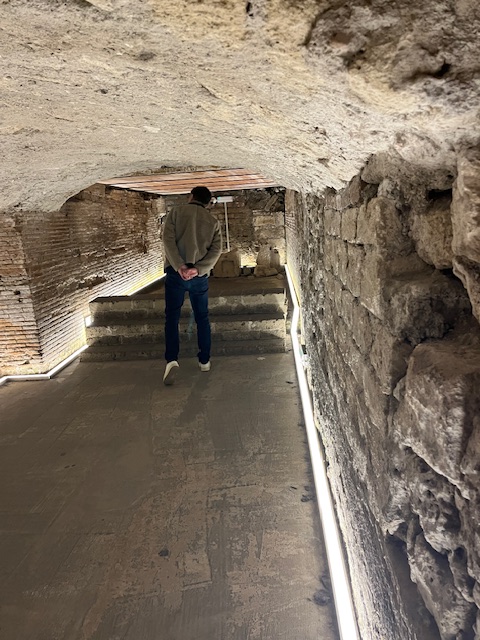
The train journey was through some impoverished looking rural countryside arriving at a modern station where the train turns around and goes back to Bari. Walking down to the old town we thought everything looked clean and reasonably modern, but it starts to change at the old well. Amid the town piazza, Piazza Vittorio Veneto was a pit to leading to Roman ruins and a viewing platform of the Sassi – we had no idea that this is what awaited us.

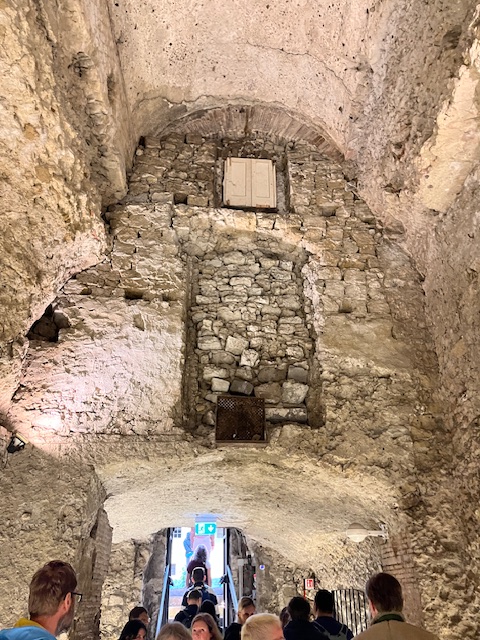
The ruins shown above are part of Roman settlement that has survived and beyond is the Sassi. The Sassi can be best viewed through a balcony which can be accessed through the ruins or through arches above the the ruins.
The view of this well of houses and streets stunned me but I had no idea what lay hidden amongst the houses, shops roads walkways and arcades. The Sassi are cave dwellings and consist of around twelve levels spanning the height of 380 m, connected by a network of paths, stairways, and courtyards (vicinati). The tripartite urban structure of Civita and the two Sassi, relatively isolated from each other, survived until the 16th century, when the centre of public life moved outside the walls to the Piazza Sedile in the open plain (the Piano) to the west, followed by the shift of the elite residences to the Piano from the 17th century onward. By the end of the 18th century, a physical class boundary separated the overcrowded Sassi of the peasants from the new spatial order of their social superiors in the Piano, and geographical elevation came to coincide with status more overtly than before, to the point where the two communities no longer interacted socially. Yet it was only at the turn of the 20th century that the Sassi were declared unfit for modern habitation, and the government relocation of all their inhabitants to new housing in the Piano followed between 1952 and the 1970. A new law in 1986 opened the path to restoration and reoccupation of the Sassi, for the benefit of the wealthy middle class. The recognition of the Sassi, labeled la città sotterranea (“the underground city”), together with the rupestrian churches across the Gravina as a UNESCO World Heritage Site in December 1993 has assisted in attracting tourism and accelerated the reclaiming of the site. In 2019, Matera was declared a European Capital of Culture from poverty and degradation to the flavour of the month.
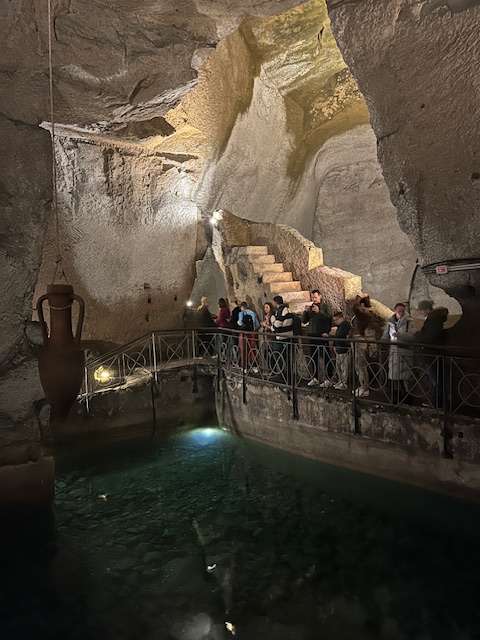
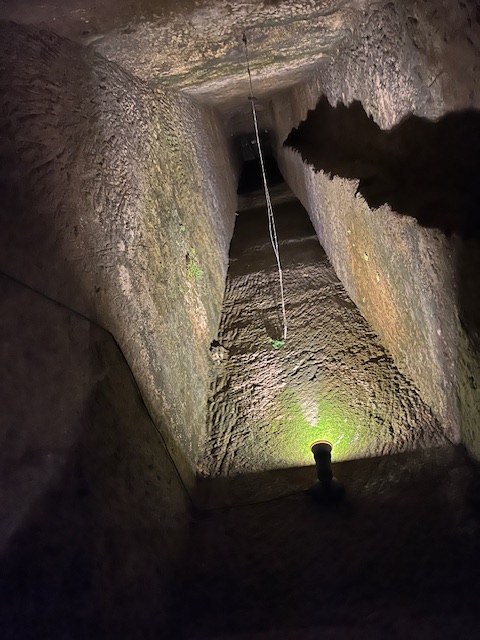
Firstly, we went to the Roman ruins. Below the ruins are cisterns. Early dwellers invested tremendous energy in building cisterns and systems of water channels. The largest cistern has been found under Piazza Vittorio Veneto, the Palombaro Lungo which was built in 1832. With its solid pillars carved from the rock and a vault height of more than fifteen metres, it is a veritable water cathedral, which is navigable by boat. Like other cisterns in the town, it collected rainwater that was filtered and flowed in a controlled way to the Sassi. Kerry and I walked through marveling at the depth which the water could fill up to.
After exiting the cistern, we entered the Sassi through the ruins and commenced our decent into the Sassi which originated in a prehistoric troglodyte settlement, and these dwellings are thought to be among the first ever human settlements in what is now Italy. You will see in one picture bones have been used to support the rainwater gutters. I don’t know whether they are animal or human. We visited one of the dwellings open for tourist inspection. Inside the cave is the main bedroom, a loom, a place for the donkey (if you had one) and further down further space. Remember these were still in use in 1950. We left the cave to explore some more of the Sassi – there were some we did not want to explore. You will se Kerry and Robert viewing a cave once occupied and vacated in 1952. Close inspection was not possible by reason of the odour emanating from who knows what now occupies it.

 Amongst the jumble of buildings and at the bottom of the Sassi, we found an authentic Italian Restaurant Amore Crusco. The appealing landing was victim of the showers that followed us all day, but the interior was very pleasant and warm so here we enjoyed lunch. Everything that goes down must eventually come up so after lunch we clambered out of the Sassi and took in some of the newer parts above the Sassi. The pictures below are of our lunchtime repast. The climb back to the modern square knocked the wind out of Kerry and me after which I was ready for a nap.

Robert had personal reasons/plans for the evening in Matera, so being experienced train travelers, we caught the train home minus Robert. So our next trip was the last trip with Robert as our guide. We visit Alberobello, so be watching for “THE RETIREES GO AROUND THE WORLD – BARI to ALBEROBELLO”

“THE RETIREES GO AROUND THE WORLD – BARI to TARANTO”

TARANTO

Another town I had not anticipated visiting. Taranto is much further south than we planned traveling. It is a coastal city in Apulia, southern Italy. It is the capital of the province of Taranto, serving as an important commercial port as well as the main Italian naval base. Founded by Spartans in the 8th century BC during the period of Greek colonization – good to see the Spartans had finished fighting long enough to do something positive.

This was a longer journey and moved us out of the coastal areas of the Adriatic Sea to cross some long flat plains into an industrialized centre on the Mediterranean Sea.

The walk from the station to the old town was also longer than other towns. Taranto was clearly a much larger town. To get to the old town we had to cross a substantial bridge. Cactus seemed to be a popular roadside plant and was coming into flower.

Another church. This time atop a large staircase – Chiostro de san Domenico – plainly adorned but with a new twist on the stations of the cross. In the pictures below you can make out the plaque on the walls put forward the picture of the Crucifixion.

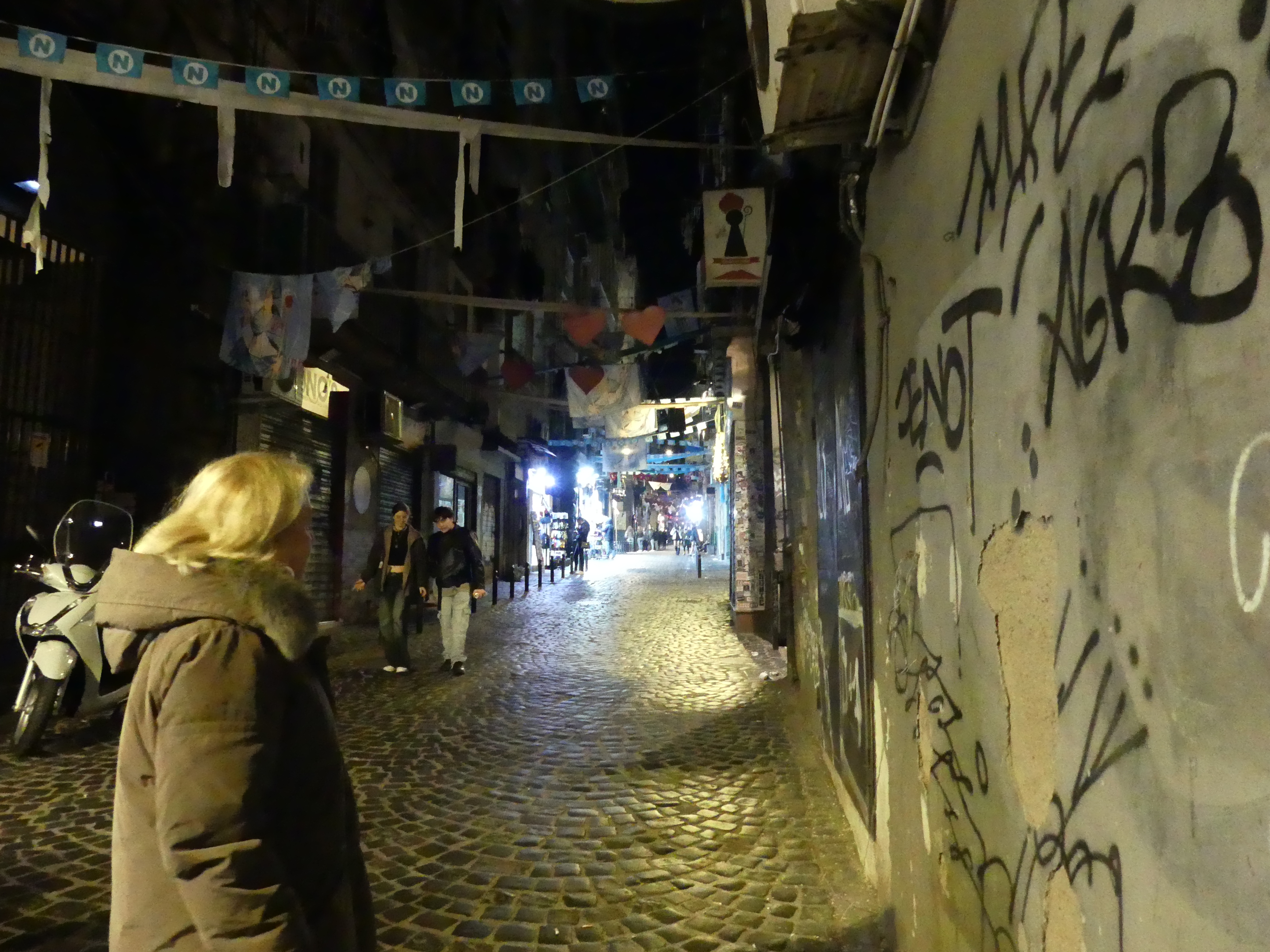
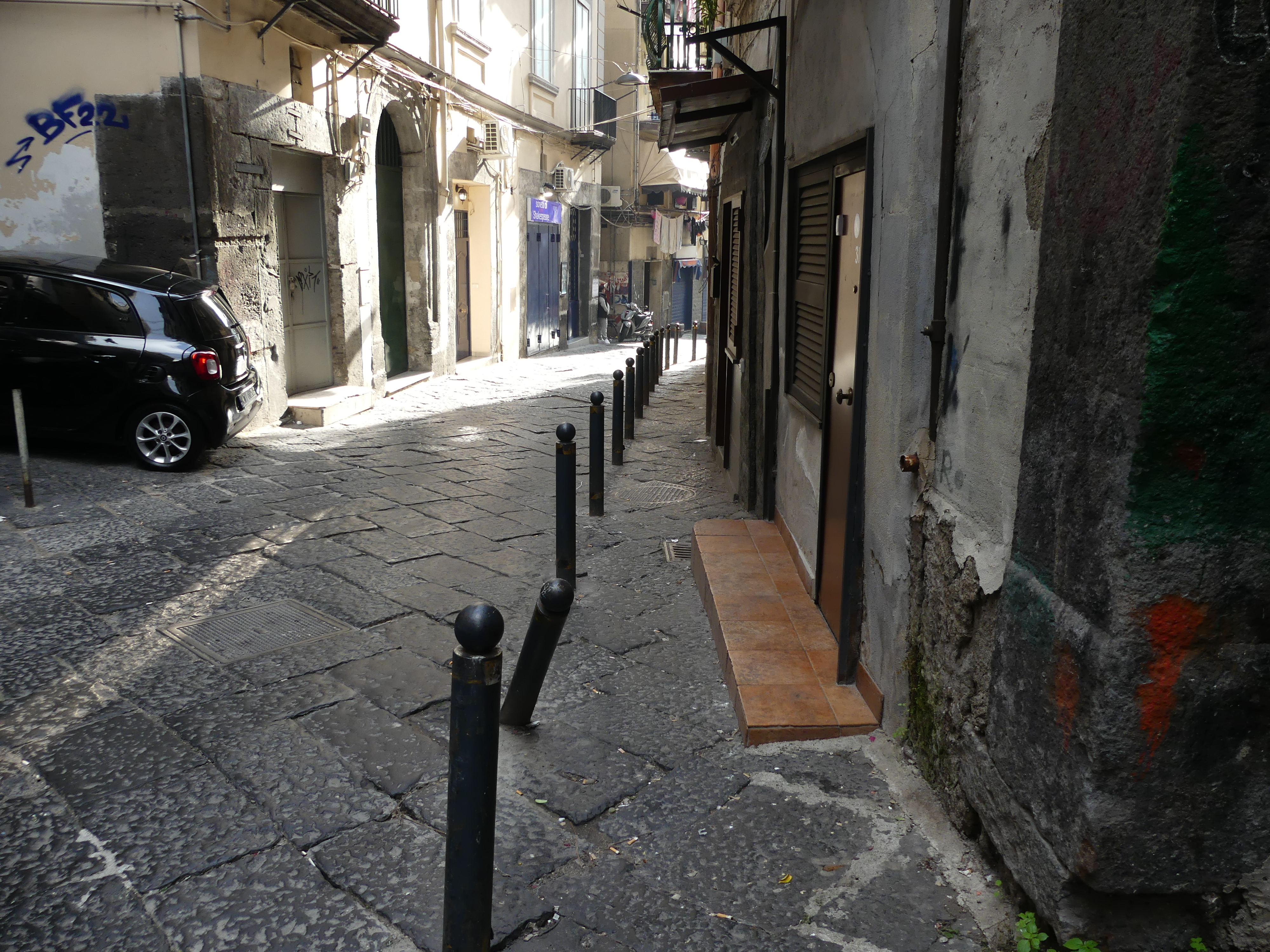
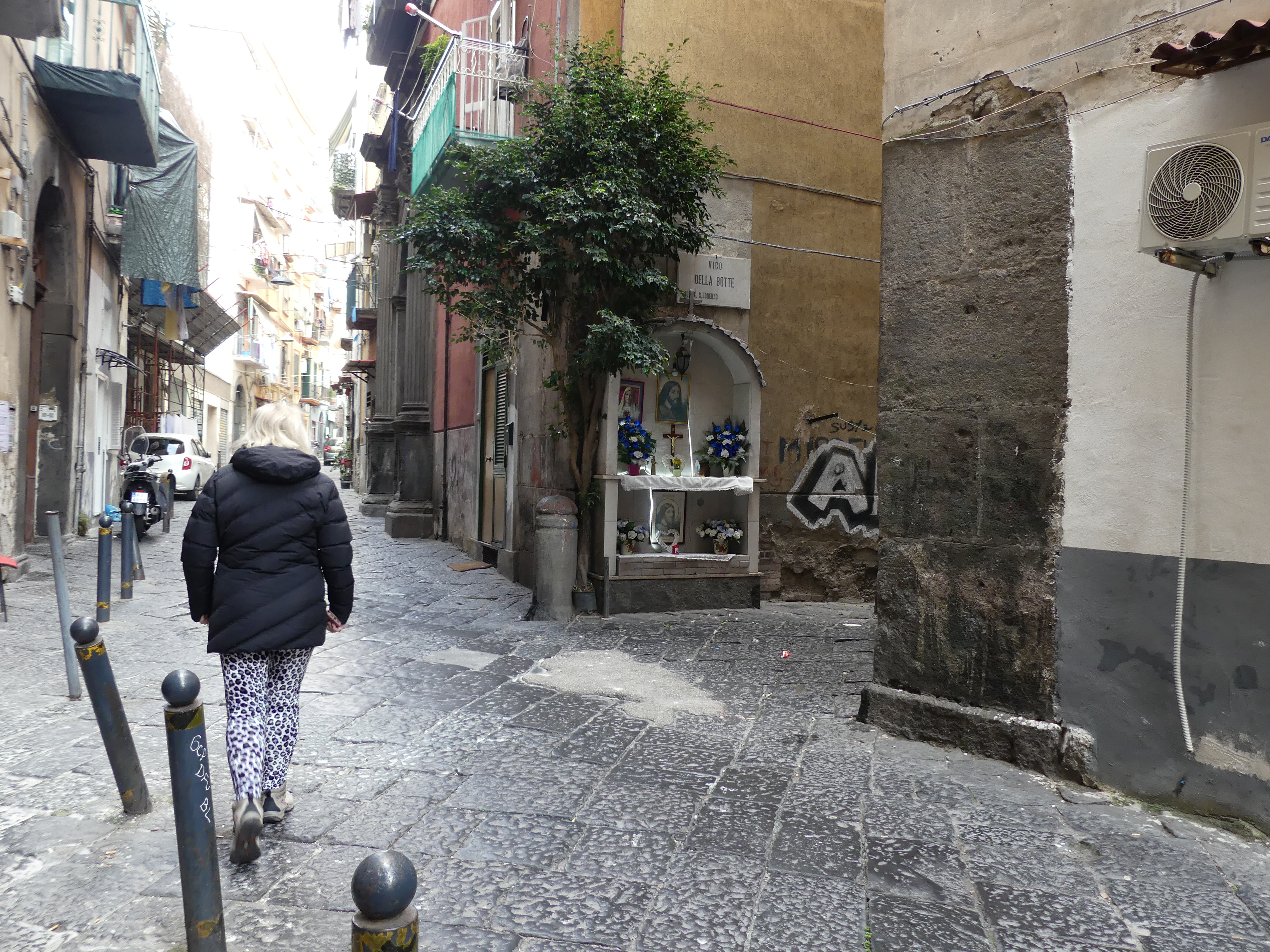
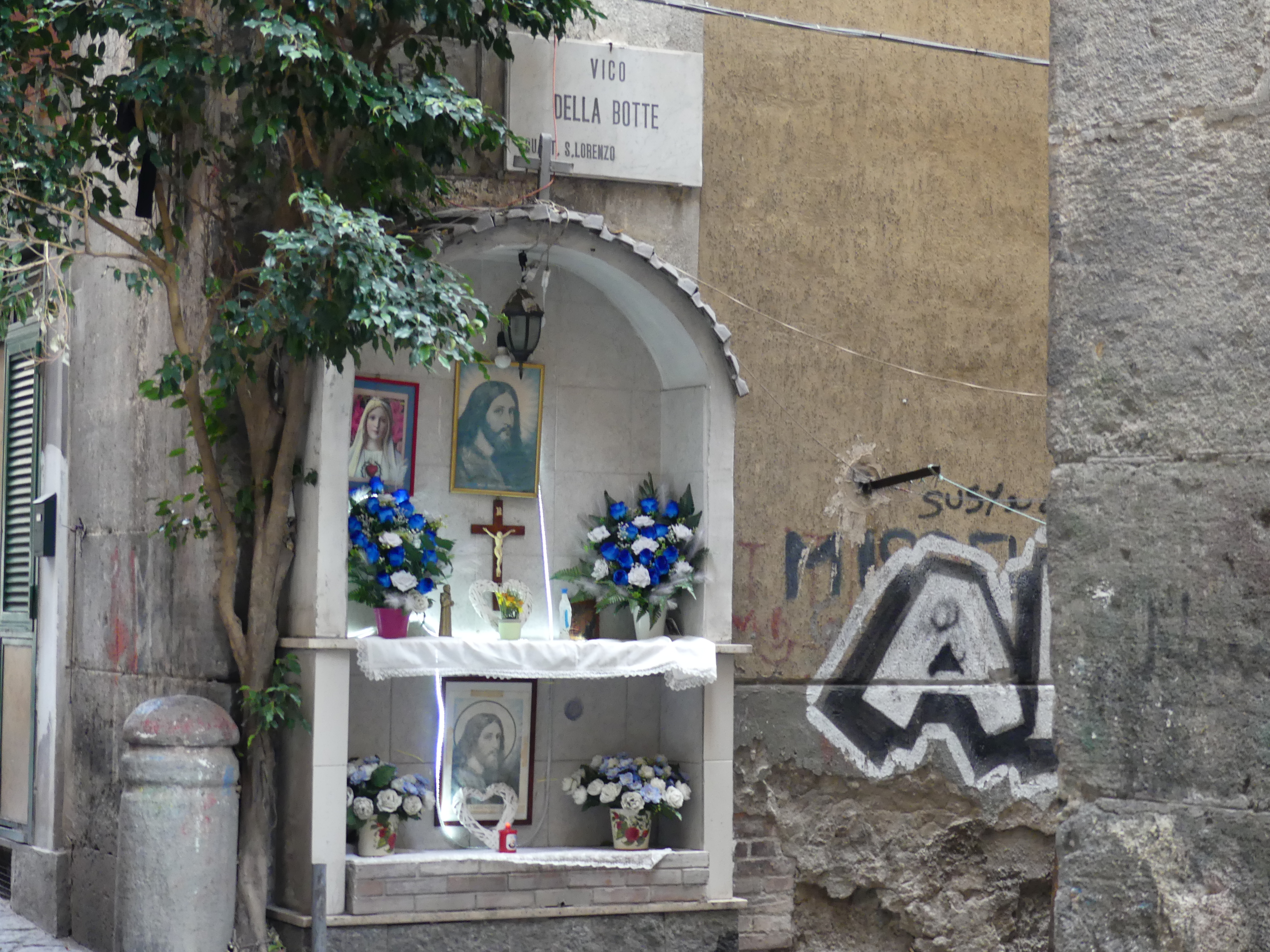
As we walked through the old town some of the passageways reduced to single file and some of the doors must have had some big hay wagons storing goods behind them. Here we encountered the practice of adorning the front door with bows celebrating the birth of a child blue for boys and pink for girls. In this case I think a little girl but they have forgotten to take an earlier birth “notice” down. We were to see this regularly in Naples. We also encountered the back street cafes – yes that’s it in the last photo. There is our fearless leader forever conscious of the WHS rules of being seen.

In our walk about we uncovered an Italian national monument Basilica Cattedrale san Calaldo. We were told that the primitive early Christian cathedral, attested since the 7th century, had to be placed outside the walls of the town and its location could probably be in the area where the Church of Carmine is now located, where a piece of the column on which Saint Peter is said to have celebrated the Holy Sacrifice is currently preserved. However, the church we see today was built by the Byzantines in the second half of the 10th century, following the sacking of the city by the Saracens in AD 927, when the Muslims definitively destroyed what remained of the ancient Greco-Roman city. The building contains some very interesting features and remains in use.

After leaving the gift shop (they must spoil it don’t they) we continued our walk about passing a florist with a novel presentation. The space inside was very tiny and this shopkeeper had utilized every inch of space including the back of the doors. It’s not yet Italian lunch time and the street cafes are empty. But judging by the number of tables in all sorts of spaces they expect a crowd. Then we found what the Byzantine Saracens left behind – a bit of the Greco- Roman ruins they missed in their sacking of the city. Across the road was the castle in use today for what appeared to be some para-military purpose and not permitting visitors. It had been constructed by the occupying Aragonese and still in use. I got cranky about that and the fact that I couldn’t take any photos inside. I was still receiving chemotherapy and tiredness brought on my bad temper. Kerry correctly pulled me away and I stomped off.

I moved on over another bridge and spotted this fishing vessel full of fish with trailing gulls. Fishing remains an important part of Taranto. Across another bridge (it dawned on me that we were on an island) and here is the HQ for Marina Militare.

Nearby we found a café for lunch. It fitted into a tiny space with some imaginative interior design and colour schemes – here is a photo of Robert leaving the bathroom bitching like hell about how small it was.

After a rather disappointing lunch (I still had no appetite due to my chemo) we continued our exploration following the main road around the island. The road took us to the sheltered harbour housing the fishing fleet and a rather tired section of the old town. Notably the church looked in good order.

We had circumnavigated the island containing the old town of Taranto and called it a day. I needed a nap so we made our way back to the train station, and I had my nap going back to Bari.

You may note that Robert has taken over the itinerary but we didn’t mind. He had a few more surprises for us so get ready for “THE RETIREES GO AROUND THE WORLD – BARI to MATERA” in my next blog.

“THE RETIREES GO AROUND THE WORLD – BARI TO POLIGNANO A MARE”

POLIGNANO A MARE

This town was one of the towns we wished to visit. Our research showed that it had many points of interest and it was on the itinerary prepared by Chat GPT. Irresistible wouldn’t you say. Robert thought so and agreed it was worth a visit. Our train was loaded with beach goers and we were concerned that we were going to be crowded out.

It is a town in the municipality of Metropolitan City of Bari, Puglia southern Italy, located on the Adriatic Sea. My research showed there is a tour of sea caves by boat that can be taken from the town. That interested me but as I have said before we were there in winter and out of season, so it was closed for the season. After arriving on the train there was a short walk to the city gate – oops it was closed also but then it’s not really in operation anymore.

The area has been settled since prehistoric times. It is believed to be the site of the ancient Greek city of Neapolis of Apulia. Thanks to its strategic position on the Adriatic Sea, it soon became a trade centre. The Byzantine Empire, in the 6th century, turned it into a municipal structure; subsequently, it was dominated by the Normans. Under the Aragonese crown, Polignano reached its peak in both economic and cultural terms.

Not to worry, the crowd who came on the train with us showed us the way into town and moved on quickly down the road until reaching a bridge showing exactly why people come to here – the breath taking vista out to sea, not the black cat on the rock ledge but rather the natural rock walls holding the town out of the sea. People do live here – notice the washing on the line and the altana on the roof (Italian roof top terraces). Everywhere in town brings you back to the coastline.

Excited by the movement above us we went back to the City gate and found a passage onto the rocky escarpment above us into the houses on the cliffs. The views were fantastic – all along the coastline houses and building clung to the cliff face, even into the inlet below. The sea caves were quite obvious but the tours were not running so further disappointment that we had chosen the wrong season. We had hoped to have lunch at a restaurant in the walls of the cliff face but it was closed of course for the winter season. You can see the entrance to the restaurant in the photos below. Still we were able to weave in and out of the passage ways all appearing to be alive with lights and decorations. We stopped for lunch after which I was weary and we decided to make our way back to the station.

In one of the piazzas, we discovered a memorial to the soldiers lost in WW1 & WW2 – not often have I seen these memorials in rural Italy. Kerry found one of the oldest olive trees we had seen so she gave it a hug for good luck.

The trip on the train to Bari was comfortable and I even had a nap – the photos don’t tell you how far we would walk through these towns and I can tell you I needed the nap. Tomorrow will be a very big day with a trip to Taranto in the very south of the Italian peninsula so be on the lookout for “THE RETIREES GO AROUND THE WORLD – BARI TO TARANTO”

“THE RETIREES GO AROUND THE WORLD – ” CESI and TERNI”

Cesi

Our trip continued the next day with a train ride to Terni and a stay with Robert in the village of Cesi an ancient village 400 metres above Terni. Things had changed in Cesi (Cesi formerly the site of Clusiolum) is dated back to 6th century BCE. A land slide had closed off the main road up the mountain, so the usual bus was not traveling the road but the ever resourceful Robert made other arrangements with a community bus to give us a lift from Terni to Cesi on the pretext I was an invalid and so my wearing the appropriate neck brace validated his story for the need of the community bus. Our plan was to spend about 5 days in and around Cesi and then to visit Bari and Naples by train with excursions by train to the villages nearby.

Robert has some of the most dramatic views of the valley below and to the mountains beyond. Even though it was overcast most days the view is extensive and includes the city (Terni) to country. The photos that follow speak for themselves.

Another change for Cesi is the restaurant that has opened in the village. Beside the church is a modern restaurant sharing the fabulous views and the tucker isn’t too bad at all. The price is affordable, and the ambiance is a mixture of ancient village and modern restaurant. Kerry (photo bombing again) enjoyed it particularly outside the restaurant the views of the valley and surrounds, and at nighttime the view from the restaurant.

On the face of the building across the road from the restaurant is an ancient Sundial. The Latin inscription reads “Hora fugit, ne tardes.” (“The hour flees, don’t be late.”). Very interesting even if you cannot tell the time using it. The one remaining church along side the restaurant is the only building still in use as a church with the other former places of worship now performing community duties.

There are a couple of sections of the old town walls, and the photo below shows the northern city gate. As we circulated around the village, other features are the church and its bell tower, the former town house and its verandas, and ooh Robert walking the dog (this is another change – the dog is pregnant and although not belonging to him he insists on walking and feeding it – it gave birth to its litter after we had left)

Terni

One morning we visited Terni and what remains of its old town. Because of its industrial past the British bombed the crap out of Terni during WW2 so to find pieces of its old town walls was very surprising. We found 2 remaining city gates and bits and pieces of the city walls. Kerry and I stopped for mid-morning coffee and there behind us is part of the old town in rubble and ruin.

Its market day in Terni. The markets are set up in the streets amongst the remaining old buildings of the old town and the rebuilt town replacements built after the end of WW2. Below are some market scenes. We found the State Archives (built as Palazzo Mazzincolli in 15th century), Palazzo del Governo (Town Hall) and the central church for the town.

We had sought Robert’s local knowledge on places to go in drafting our itinerary but Robert saw our itinerary as fluid. So our next trip was not on our itinerary. We took a train to L’Aquila. We caught the train through a valley bordered by high snow capped mountains in an old two carriage rail motor containing first class and second class (of course we rode in “first class”). We arrived and stumbled off into a pretty, and well organised and clean square with an old church with a relatively unadorned interior, but some old frescoes had been exposed to show its age. The design of all these old villages is that it sits atop a hill, and we found the hill.

Atop the hill was market day, and this seemed to be the reason we were here also (I suspect Robert had a rendezvous lined up). After the rather plain church in the square, here located in this small enclave of the old town was a huge church with its Nativity scene still on show. As we explored around the church (it was not open to tourists) we found what was on the other side of the hill – not such a small village. Then we discovered tucked away nearby was the “ordinary folks” chapel used by the residents with some interesting but not pretty décor. The priest had parked outside – a plastic Fiat. I couldn’t believe it, but it was the real deal just in plastic.

One of the shops offered a product that seemed out of place. So I obtained this photo that all is possible where ever you are.

The day had developed from cloudy to sunny although Kerry’s jumper tells you it still was not warm – pictured below is a wall leading to Roberts front door. The next photo is Kerry in the restaurant again after which we visited the rock fall on the entrance road. It appears to be cleared but some further work needs to be done with retaining the rest of the mountain – nice to know.

Our time in Cesi was up and tomorrow we have an early train to Bari via Rome – it’s a shorter train trip to return to Rome and travel across to the east coast to Bari than to go to Bari directly from Cesi – go figure. Look out for the next chapter and our adventures in THE RETIREES GO AROUND THE WORLD – “CESI to BARI”

“THE RETIREES GO AROUND THE WORLD – ROME to CESI”

ROME

I opened the window of our room. It was the 12th and it was Kerry’s birthday. In flooded sunlight and the structure containing the terminus known as “Terminii”. The photos below show the size of the station and the view from the courtyard of the building containing our B&B – the contrast between the front and the back is like a time ship – new and old.

Kerry had a birthday wish. She wished for a celebratory dinner and had chosen from the internet “La Terrazzade de Papi Roof Top Restaurant”. The restaurant is overlooking the roof tops of the city. That morning, we set out to find this place (booked online sight unseen) in preparation for the night. I hate using google maps to guide you to your chosen place – it always seems to play tricks on you like it’s a game. We ended up in a park Piazza Victorio, also known as Piazza Vittorio Emanuele II and we had never encountered it before. Wikipedia tells us that the piazza was built by Gaetano Koch shortly after the unification of Italy. It is the largest piazza in Rome (316 x 174 metres). In the centre of the piazza is a garden with the remains of a fountain built by Alexander Severus (so called Trophy of Marius), and the Porta Alchemica (Alchemist’s Portal or also called Magic Gate or Porta Magica), the entrance to Villa Palombara, former residence of the alchemist Marquis Palombara. It also contains Giardino Nicola Calipari, named after an Italian secret agent, killed accidentally by US soldiers in Iraq on 4 March 2005, in the phases immediately following the liberation of the journalist of Il Manifesto Giuliana Sgrena. I captured some of these features and post the photos below.

Back tracking from the piazza, we found the hotel with the roof top restaurant and checked out the shortest route home. The scenery was a grand mixture. Starting with Kerry photo bombing my picture of the grand church at the end of the street to the hotel passed the Porta Esqualina Gate and the Arch of Gallineus (The Arch of Gallienus is a name given to the Porta Esquilina, an ancient Roman arch in the Servian Wall of Rome). It was here that the ancient Roman roads Via Labicana and Via Tiburtina started. We saw the statue of Santa Maria Maggiore standing on a pinnacle in front of a grand Basilica constructed in her honour through to an architectural museum and conference centre (see Turismo Roma) again unseen by these eyes – very interesting and made us think of George Hazell an architect and former next-door neighbour for almost 20 years. I expect he would have enjoyed visiting the unique oval building.

In Piazza Manfredo Fanti, surrounded by a small garden, is the monumental building, inspired by classical architecture, for the construction of a fish farming establishment with an aquarium the Acquario Romano which has been restored as Casa dell’Architettura. In the garden, there is one of the most interesting sections of the Servian Walls, built around the 4th century BC to defend Rome.

There was a small café in one of the outer rings of the building where we had coffee and lunch. We then made our way to our Dream Station B & B, and I had an afternoon nap a legacy of my chemotherapy then we dressed for dinner.

We retraced our steps back to La Terrazzade de Papi. To access the roof top we followed a roundabout path of stairs and corridors to the roof – 7 to 8 stories above ground. The interior of this level was on level 7 and the exterior on level 8. It was still daylight, so we were afforded views from most points of the compass before witnessing the rising of the moon and the clouds then encircling and covering up the moon. In front of us was the statue of Santa Maria Maggiore in a Piazza to her honour tall enough we felt we could nearly touch it. Behind it was the Basilica also named after the saint. I believe this is the Basilica chosen by the late Pope Francis who was very much alive at this time.

We had no idea what to expect for dinner and were surprised when we were presented with two platters. It was like an Italian tapas with our choice of drinks. We nibbled away at the food and took selfies for Facebook from every reachable corner of the roof. Just the dream come true for Kerry’s birthday. To finish the evening we went inside to the restaurant for Tiramisu and coffee. We were the only ones in the restaurant except for one other patron sucking away on one of the many “hookahs” offered by the establishment.

A slow stroll back to our B&B and early to bed for the trip to Cesi tomorrow and a visit to Roberto’s villa. Keep reading and follow THE RETIREES GO AROUND THE WORLD – “ROME to CESI ” in Cesi.

THE RETIREES GO AROUND THE WORLD –CORNWALL UK/NOTINGHAM UK

Nottingham

Kerry continued the driving and returned the car to Green Motion, where we caught the shuttle to Heathrow terminal 3 and caught the National Bus to Nottingham. I thought the bus ride would be a bit nostalgic, but time has brought about change and the bus route had numerous stops at Luton, Luton Airport, Milton Keynes, Leicester before finally delivering us to Broadmarsh Bus Station in Nottingham. When we left Nottingham in 2015 the Bus Station was connected to an old shopping Centre called Broadmarsh but now the Centre is partially demolished a new Bus Station built and the skeleton of Broadmarsh is partially standing as thought awaiting a decision as to what’s next. We dragged our suitcases up the hill to the Ibis Hotel. The room was small but did the job. The reception was a combination of café and reception with the receptionist sitting amongst the shop customers – novel.

It was drizzling rain and cold, but we still ventured out to reacquaint ourselves with the city. Martin & Christine were due to visit us tomorrow and we had lined up how and when we would catch up. Dinner that night proved a bit different. We made for the restaurant that our friend Pam had shown us last visit but it was booked solid and the directed us to the neighbouring restaurant with the same result. Things were getting a bit desperate – we may need to get fish ‘n chips. We were both interested to find out what the place across the road offered – it is called “the Alchemist”. The interior was decorated with bottles and shelves like an old-style alchemist with images of a changing geometric designs projected on a wall making it a different style of venue. After a small selection of entrees, a glass of wine for Kerry and a Guinness for me we retired to bed. The bus trip had been tiring, and the hauling of the luggage tipped us over the edge of tiredness.

Nottingham Castle:

The following day at our arranged rendezvous we caught up with Martin and Christine. We had met on a river cruise from Cologne Fr. to Rüdesheim am Rhein Ger. and remained in contact since. They had traveled over from Manchester and stayed overnight at the Premier Inn in town, so we decided to go with my first choice of place to visit – Nottingham Castle.

On the way to the castle we called into the Town Hall. We were unable to look through the hall due to Council meetings being held there that day. So we moved onto the castle. We had been there previously so knew what to expect. Martin thought he was in for a full-on old castle experience. Not so. The castle had been demolished by the people of Nottingham after the restoration of the Charles the Second to the throne of England. The castle had the reputation of being impregnable hence Charles the First had used the castle as the place to raise his standard against the Roundheads starting the English Civil War. Once the War ended Cromwell ultimately took control of England and with the restoration, the people of Nottingham tore down the castle for fear that the castle may be used again as a power base in the midlands. Martin was disappointed to learn that the Duke of Norfolk had purchased the ruined site to build his country home which he continued to call “Nottingham Castle” which remains its name to the present. It is filled with artistic treasures and a memorial to the local regiment of the British Army “the Foresters”. Martin was not impressed with the castle but was taken with the memorial having served in the army in the military police.

Part of a visit to the castle is to visit the caves constructed to provide a hidden access to the castle and from the castle to the pub Ye Olde Trip to Jerusalem claimed as the oldest remaining in the UK from the 12th century.

The first 2 pictures are in Town Hall. Then follows the picture of “Nottingham Castle” and its gate. No photos are permitted inside the castle but the formidable gate gives a fair idea of what the castle may have looked like. Then follows the photos of the caves – the toy fox marks the way down. Of course the pathway has been prepared for today’s tourist but when it was used for its original purpose it would have been rough and ready. When you exit the caves you get a better idea of the nature of the development. At the foot of the hill is an array of the housing for the ordinary folk of the time close by the pub.

The second part of my plan – to visit the pub unraveled as after doing the tour of the caves we found the pub full to overflowing. Martin came to my rescue and suggested we go to the Navigation Hotel just nearby.

Visit to the Navigation Inn at Castle Lock Nottingham

There is a canal runs through Nottingham separating the old town from the newer part of town and the Navigation Hotel was a leftover from times when the canal was in commercial use. Old building charm with nostalgic decoration in the interior and no crowds. So, we settled in for some lunch and drinks finishing late in the afternoon. The picture below is part of the interior and outside is the canal. Martin and Christine had planned to return to Manchester the following day so after some sad farewells we retired to our hotel and later braved the cold to find a place for dinner. Somewhere during those two days Kerry made a call to Nick Smith the owner of the business supplying stretch fringing to Glitter and Dance. So it was arranged for the following day that we would have lunch with Nick and Selina at country manor outside the city.

Visit to Nick & Selina Smith

Nick had given Kerry the opportunity to open her business in the UK and though Glitter and Dance UK has not survived Nick has continued to supply stretch fringing to G & D. We called an Uber to take us to this destination nominated by Nick which he said was nearby. Like hell it was – we seemed to meander for miles through countryside until we suddenly turned left at an obscured turning, and we had arrived. It is an old Country Manor of some past minor gentry for the area now operating as a club style meeting place. There was a fixed menu and no choices which did not suit me at all but nothing to be done but soldier on. It was all very pleasant but expensive as I was unable to eat most of the meal. Nick and Selina ran us home to the city as it turned out they are living in Derby these days and they had to drive through Nottingham anyway.

Visit to Bob & Cilla, phone call to Pam and visit to RC Nottingham

It is now Monday. Kerry has organized for us to meet with Bob and Cilla later that morning and we have had a chat with Pam by phone. Pam has had some oral surgery and does not want visitors at present but she was able to inform us that she had resolved the trouble she had with the publisher of her first children’s book which problem had seemed to have depressed her the last few years.

I had been struggling with a cold the last week and I had now run out of antibiotic tablets that we had brought with us as a precaution. So, before we caught the bus to Attenborough, we had rung around some medical practices to get a new script with no luck. When we made it to Bob and Cilla’s house, we had a lovely catch up and were surprised by a visit from one of our fellow gardeners. We had met Cilla at the local church and our friendship had grown from there. One thing led to another about my health and Bob and Cilla were of considerable help with resolving the problem. They were both in good health and there is a chance we may catch up in NZ when they next visit their daughter and family.

After returning to the hotel, we prepared for our Rotary meeting at our other club – Rotary Club of Nottingham. We made our way to the meeting place and were greeted by a lot of old familiar faces and some new faces. It was like old times and a great surprise for many of the members. The Club remains robust and maintaining its membership.

Travel National Bus to Heathrow London – Depart London to Rome

Our return trip to Heathrow went as planned and we soon landed in Rome. Rome and the area around Terminii Station is now a familiar precinct so catching the train at Fumincino Airport to Terminii felt familiar even though it was 11.00 o’clock at night. Once at Terminii the short stroll to the front door of Dream Station was like coming home. We inserted the code and the big front door (no doubt once the doors to a forecourt in its early days) and now an obstacle track for guests coming to stay. Th elevator is big enough for two persons or 1 person and suitcase. Kerry went ahead and I followed next time round. So, we were now ready for bed in Rome.

So, until my next blog “THE RETIREES GO AROUND THE WORLD – “ROME, CESI, BARI, NAPLES and back to ROME” – keep on following our journey.

THE RETIREES GO AROUND THE WORLD – BRIGHTON HOVE to TRURO CORNWALL UK

I recall that it was almost sunny on our way to Cornwall and our stop in Dorchester was welcome to stretch our legs.

Dorchester

It is situated between Poole and Bridport on the A35 trunk route. A historic market town, Dorchester is on the banks of the River Frome to the south of the Dorset Downs and north of the South Dorset Ridgeway that separates the area from Weymouth, 7 miles (11 km) to the south. In the 17th and 18th centuries Dorchester suffered several serious fires. Only a few of the town’s early buildings have survived to the present day. Dorchester remained a compact town within the boundaries of the old town walls until the latter part of the 19th century because all land immediately adjacent to the west, south and east was owned by the Duchy of Cornwall.

This was a stopover to have lunch and break our trip. Despite the many attractions trumpeted by the local visitors bureau we were limited to dining in a quirky coffee shop and wandering through the quirky building in which the coffee shop was located.

Truro

We arrived at our B & B “The Fielding” late in the afternoon. To our delight onsite parking was included at no cost but a little bit squeezy. The premises are an Edwardian style two/three story house with two accommodation rooms and the couple who own it living on site – breakfast was included. I am certain this pair were older than us by 10 years and still running a B & B.

The accommodation was comfortable, and we spent little time in it, so it did the trick. A group of workers was staying at the premises whilst they fixed whatever needed fixing around about and we shared breakfast in the dining room. Then they would leave for their days work and we had no problem with the parking arrangements.

St Ives and Penzance.

Our first journey involved a visit to St Ives.

St Ives is a seaside town, and port in Cornwall. The town lies north of Penzance on the coast of the Celtic Sea. In former times, it was commercially dependent on fishing. The decline in fishing, however, caused a shift in commercial emphasis, and the town is now primarily a popular seaside resort. It is notable in achieving the title of Best UK Seaside Town and named best seaside town of 2007 by The Guardian newspaper. We kept to the waterfront and were lucky to find parking on one of the shoreline parking areas. Unfortunately, it was a showery day but not miserable. We made our way from the car park to the seafront in the town’s centre and found the mariner’s church. On the way we encountered St Ive’s Church. St Ives is a parish church on the waterfront in St Ives. The church is dedicated to the Virgin, also known as Ives, supposedly an Irish holy woman of the 5th or 6th century. The current building dates to the reign of King Henry V of England (1413 to 1422 AD).

A small “A” frame sign beckoned us to enter with the word “Café” – yes inside in one of the wings of the church was a modest coffee shop offering a free service for those who could not afford a coffee. I believe it had a volunteer operating it so we stopped had a coffee and cake and paid forward for the next two people in need to receive a coffee. What a great idea!

We continued our walk keeping to the waterfront. The weather remained overcast and rained intermittently so there was not much excitement – so we moved onto Penzance.

It is the westernmost major town in Cornwall. Situated in the shelter of Mount’s Bay, the town faces south-east onto the English Channel. Penzance’s Chapel Street has a number of interesting features, including The Admiral Benbow public house (home to a real life 1800s smuggling gang and allegedly the inspiration for Treasure Island’s “Admiral Benbow Inn). It is also the base of the pirates in Gilbert and Sullivan’s comic opera “The Pirates of Penzance”. Exploring the town we came upon Rotary Shop in New Street. We stopped off to check it out and Kerry introduced herself. The Rotary Shop is unique among local Charity Shops. The shop raises funds specifically to assist local groups and charities by selling goods donated by the community.

From Penzance we went to find Land’s End. Land’s End is a headland in western Cornwall, on the Penwith peninsula about eight miles (13 km) west-south-west of Penzance at the western end of the A30 road. To the east of it is the English Channel, and to the west the Celtic Sea. However, we followed the route given to us by our maps on my phone. This proved to be a mistake as there are two ways to Land’s End – one along the A30 to the end and the other being the route we took, through farm roads and lanes to a vacant paddock with a sign saying, “Land’s End – 800 metres”. It had been raining for several days, and the paddock was a bog, so we turned around to return from whence we had come, and there was a garbage truck in our way. Kerry managed to get passed (I don’t understand how) and we got to the A30 saw the sign to Land’s End and decided we didn’t need to see it at all. So we decided to push on to St Micheal’s Mount. The following photos show how the weather deteriorated and the narrowness of the lanes. This building is part of a tin processing plant from ages gone by.

We arrived at St Micheal’s Mount where the tide was out. It is a tidal island rising high out of the surrounding water, topped by a towering stone castle complete with battlements, a church, and a museum. I remembered the French version Mont St Michael, its steep steps and defibrillator at the top awaiting you. The castle is also the home of the St Aubyn family, who have owned the island for nearly 400 years. At the base of St Michael’s Mount is a small village with a harbour with charming eateries and picnic areas. Whilst it was appealing, with the tide out we were not going to get across the causeway and the light was fading. Next time.

We returned to Truro for the evening and rest as tomorrow we planned to find Port Issac and Tintagel Castle.

Port Isaac is a small fishing village on the Atlantic coast of north Cornwall. From 2004 to 2022, the village served as the backdrop to the ITV television series Doc Martin. It also is home to the sea-shanty singing group Fisherman’s Friends. For those who don’t know Fisherman’s Friend is an all-male a cappella group (a group who sing unaccompanied by instruments) who sing sea shanties. Just as Doc Martyn became a popular TV series a movie made about Fisherman’s Friends in 2019 and its sequel Fisherman’s Friends: One and All in 2022 has kept Port Issac as a popular tourist destination. The trip through the countryside was pleasant and as we approached Port Issac we noticed of course, we are here in winter, and the place is very quiet with lot’s of maintenance being done for the spring and summer. We could not park in the village itself but the walk down to the the village centre showed us some of the unusual building styles. We saw the school house and the bay, the oldest building housing the boat rescue crew, Doc Martyn’s house and surgery and where we had coffee.

Still, we had a great time locating and identifying things from the TV series. We have seen the first of the Fisherman’s Friend movies but all we could recognize there was fishing nets and boats. We enjoyed a coffee in the restaurant/café closest to the boat ramp. It felt special being in the place as seen on TV. After coffee we moved on to the village of Tintagel and the ruins of Tintagel Castle.

Tintagel Castle is a medieval fortification located on the peninsula of Tintagel Island adjacent to the village of Tintagel. No Roman-era structure has been proven to have existed there. It was settled during the early medieval period and a castle was built on the site by Richard, 1st Earl of Cornwall in the 13th century, during the High Middle Ages. Archaeological investigation into the site began in the 19th century but later digs exposed significant traces of a much earlier high-status settlement, which had trading links with the Mediterranean world during the Late Roman period. Two digs in 2016 and 2017 at Tintagel Castle uncovered the outlines of a palace from the 5th or early 6th century (the early medieval period), with evidence of writing and of articles brought in from Spain and from the eastern end of the Mediterranean Sea. Investigation is continuing.

The castle has a long association with legends related to King Arthur. This was first recorded in the 12th century when Geoffrey of Monmouth described Tintagel as the place of Arthur’s conception in his mythological account of British history, Historia Regum Britanniae. Geoffrey told the story that Arthur’s father, King Uther Pendragon, was disguised by Merlin’s sorcery to look like Gorlois, Duke of Cornwall, the husband of Igraine, Arthur’s mother Cornwall and managed by English Heritage.

As we drove into Tintagel, we noticed there were numerous signs directing the visitor to parking. Some were remote from the ruins and the closest we found was the rear yard of a pub which was still 1 klm away along a rough path from the ruins. We ended up finding Camelot Castle Hotel (see below) situated above the ruins of Tintagel Castle. It is a grand Victorian building built in 1899 and has been a popular destination for artists (check out the painted car) and travelers for decades since. The hotel sits on a clifftop overlooking Tintagel bridge and the island beyond, offering panoramic views its stunning views of the castle ruins and the coastline. It continues the Arthurian theme with the Round table (Kerry was amused by the Merlin circle on the table). We could clearly see the ruins but as with everything else it was closed due to maintenance on the bridge crossing to the island. Apart from the pictures below we didn’t get to the site, but we had a cozy drink and some lunch before moving on.

We had realised after arriving in Truro that a return trip to Heathrow and catching the bus to Nottingham would prove a challenge so we had a change of plans – we would leave Truro a day earlier and travel to Amesbury then onto to Heathrow return the car before bussing it to Nottingham – an overnight stop at Amesbury was required.

Amesbury

Amesbury is a town in Wiltshire, best known for the prehistoric monument of Stonehenge which we passed on our way to our hotel.

The town is claimed to be the oldest occupied settlement in Great Britain, having been first settled around 8820 BC. Amesbury is also associated with the Arthurian legend: the convent to which Guinevere retired was said to have been the one at Amesbury. Our hotel was in the centre of the town, and it too had history most notably the many additions over time such as in the hallways where the halls weaved and rose and fell without any rhyme or reason.

A walk around the town was hardly exciting but we were able to find a few treasures – our photos are below.

That brings us to the end of our Cornwall adventure, so, until my next blog “THE RETIREES GO AROUND THE WORLD –CORNWALL UK/NOTTINGHAM UK” – keep on following our tour.

THE RETIREES GO AROUND THE WORLD – SAN FRANCISCO USA/BRIGHTON HOVE UK

The B&B (pictured above) was well located on the road that marked the exact boundary between the two towns (Brighton and Hove), and you would not have known the difference save for a sign on a building at the end of the road announcing the boundary. Upstairs It had two bedrooms both with an ensuite and downstairs a powder room kitchen lounge room and a dining table in the middle. Enough room for us but no garage. The missing garage came as quite a shock. The hiring of the car was based on the B&B having “private parking”. Our strategy was to spend the day traveling around and hope to find a space at night when it was free to park on the streets. Mick and Terri had joined us.

Mick had in his younger days worked in or owned a garage at the end of the street with a “lady of the night” working from the building across the road and the Robin Hood Pub on the opposite corner. The garage has gone, and the Lady has moved on but the pub was still there.

I had prepared an itinerary and planned to drag Terri and Mick around. Despite the itinerary we got side tracked on our way to Battle Abbey and Battlefield. We visited Beach Head and the suburbs of Eastbourne to allow Mick to catch up with an old friend. The wind was howling this day and sea mist blanked out the sun. The coastline is a continuation of the white cliffs of Dover and towered over the beach. It’s known for its dramatic, 531-foot (162-meter) high cliffs being the highest chalk cliffs in England and offers stunning views of the coastline and the English Channel. Beachy Head is part of the Seven Sisters Country Park. The visitor centre measures the distance from the edge of the cliffs to the centre and predicts that the centre will be lost over the cliff by 2050. We drove to the highest point and stepped out to take photos and were close to being blown away. The first picture is the visitors centre which will one day be in the sea as they lose a portion of the cliffs each year. The little lighthouse is further along the coast until you come to the highest point which is the last photo.

We moved on through Eastbourne to the town of Battle and parked behind Battle Abbey at the monastery car park. Terri had put the money in the meter and we moved onto the Abbey which was closed – it was Sunday. Disappointed we walked through the village and found somewhere warm for lunch. We paid no further attention to the parking meter until we received a rude email from the car hire people. We paid the administration fee but never received the fine – its in the mail. The first two pictures are Eastbourne Pier and its “shop” followed by the advertisement for a re-enactment of the battle on the carpark wall in Battle. The last picture is the phone box outside the Abbey from which King Harold rang home to tell his Queen he may be late for dinner. The battle with William in 1066 AD took place in this area.

With the Abbey closed our afternoon was free so we headed to Lewes and Lewes Castle and Museum of Sussex Archaeology. The town was buzzing, and the only parking space was the council car park near the river Ouse 500m away from the castle and museum. The castle is largely a ruin with a castle gate and some other buildings remaining. Still, it was very interesting. Lewes Castle is a medieval Norman castle originally called Bray Castle. it occupies a commanding position guarding the gap in the South Downs cut by the River Ouse and occupied by the towns of Lewes and Cliffe. It stands on a man-made mount just to the north of the high street in Lewes and is constructed from local limestone and flint blocks. The Barbican gate is mostly intact and can be accessed. The sign on the wall in the photo below tells the passerby that ten of the seventeen protestant martyrs were imprisoned in the vault below this building and burned at the stake a few metres from this site in 1555 to 1557.

This tour ended our day, and we returned to Hove to find a car space, a place to eat and a warm space to retire.

My niece Louise, who is presently managing the race days for Formula 1 Racing around the world, took time out of her busy schedule to come down by train to Hove and arrange for more of my relatives to meet us. Louise, Trish (Terri’s sister and my cousin) and her daughter Sarah arranged for dinner at the Connaught Hotel in the heart of Hove. We parked in the Aldi parking station and walked on to the Connaught Hotel – large and noisy hotel and a table of 7.

We also managed to fit in a visit to Ditchling a very small village with a lot of history. Even so the place was busy with visitors, and we ended up parking in a puddle in a dead-end lane – the only park we could find. It brought into the churchyard and as is typical of English churches we also passed through the cemetery finding a very quaint grave with its own font. Some of the buildings look to be from the Tudor era but the pub was warm and cozy. On the way to Ditchling we passed through some pretty country as you will see below. In the village itself the church stood out as the centre of the village and the buildings all to be very early or Georgian built.

After spending the morning in Ditchling we returned to Hove and the “Nevell” an old haunt for Mick and we met up with one of Terri’s sons for a drink and get together. The following day we continued our visits to beach side towns and the photos following show a mariners church where the sailors went to sea after visiting the church.

We had a lovely time renewing friendships meeting more of my father’s family in the UK and visiting new things in Brighton Hove. Our time in Brighton Hove had come to an end and we had the discussion as to when we might catch up again before we headed off to Truro in Cornwall. We had not visited places like Port Issac where Doc Martin had his practice (the TV show) and King Arthur’s alleged castle at Tintagel. The drive would take over 4.5 hours so we scheduled a stopover in Dorchester for a break and some lunch.

Read on in my next blog “THE RETIREES GO AROUND THE WORLD – BRIGHTON HOVE UK/ CORNWALL UK.

THE RETIREES GO AROUND THE WORLD – BRISBANE/SAN FRANCISCO USA

Ever wondered what it would be like to go around the world dropping in at various points of call, visiting relations and friends and visiting new points of interest? Well, we did wonder and now I am here to tell you what it was it was all about. Welcome to our holiday blog – The Retirees go around the World in 51 days.

It started with booking a cruise from Japan to Taiwan and return then taking fright at the cost to travel to Tokyo to catch the cruise ship. This caused us to investigate traveling around the world with connecting flights starting with a flight from Brisbane to Sydney, then Sydney to San Francisco departing on 24th January 2025 and arriving there the same day due to the time zones.

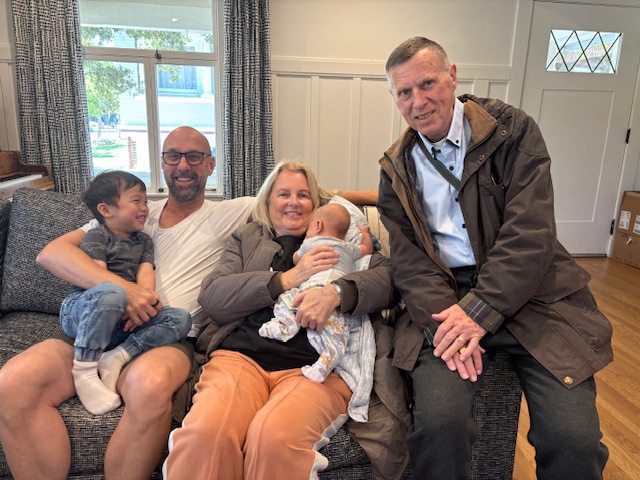
Our son Ben collected us from the airport and put up with us visiting them in their home for 5 nights enjoying spoiling grandson Angus and learning about Jee’s progress with Angus #2.

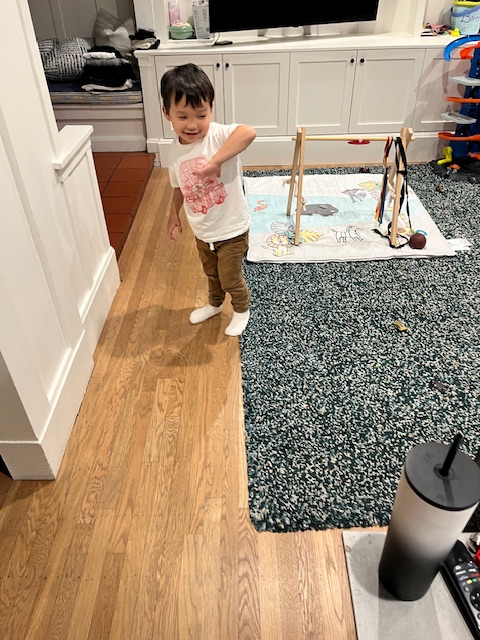
We played Garage – getting out boxes of cars and trucks and racing them down the track. We then had a mess, and we had to pack it away under grandson’s supervision. Then we visited his preschool at Saint Joseph’s Basilica, played in the park with a new friend and found a new park developed over a discontinued rail line.

Photo

It was just a few days with them but being so far away makes it difficult to connect. Gus is such a personable child I never feel as though we have been away. After those glorious few days, sadly, we waved goodbye. Angus is a joy for grandparents – not so sure it’s always that way for Ben and Jee.

Ben took us to the airport where we then flew from San Francisco to London Heathrow, where we collected a hire car from Green Motion Car Hire. The car collection point was outside of the airport, but the hotel shuttle bus got us to the collection point easily. From there Kerry drove to our accommodation in Hove. A tip for all travelers – ensure you understand the local rules regarding parking. Brighton / Hove Council has made parking on the street a costly dance to avoid the parking costs and fines. We found ourselves finding overnight parking up to 200m away from our B&B in weather down to freezing at times. The parking could easily cost £30 per day on the street. My cousin Therese (Terri) and her husband Mick (former residents of Hove but now gite owners in France) met us at the B & B and wisely had parked their car with friends outside the parking limited areas and caught a cab into Hove.

Read on with my next Blog – The Retirees go around the World –San Francisco/Brighton-Hove.

THE RETIREES VISIT HOBART AND THE TAHUNE FOREST

Star Date 5th August 2024

We were staying in the Allurity Hotel in Bathurst St and had dined nearby. It was a regular school day for Lola and a working day for Paul, so we decided to look around for a breakfast joint. Photo #1 (looking left to right) is the view from our bedroom window – the building had been converted from its former use of an office building to a hotel, and it had an unusual arrangement for the shower and toilet, but the bed was comfortable, and we were close to the CBD.

At first we walked up Bathurst St in the direction we had gone the night before and were pleasantly surprised by some of the street art. Photo #4 is the hotel and photos #2, 5, 6, & 7 some of the street art. Photo 7 is in a narrow lane and getting a clear picture a challenge.

We found a cafe serving breakfast and then moved onto towards and into Salamanca Markets which were not open but it meant there were no crowds. We walked down Elizabeth St passed the Post Office – a 19th century styled building, and onto the Seafarers Centre and the Mission to Seafarers in the midst of Salamanca its Custom House, wharves and chandleries. A piece of history of sailing ship and sailors lost in many cities Photos 9, 10, & 11. What has helped preserve the history is the construction behind the historic buildings providing residences and work places photos 12, 13, & 14.

We found the site of the American Embassy from the times of the sailing ships in one of those lanes but apart from the plaque and the story it told there is nothing of the embassy.

As we made our way back to our hotel we walked through the park Franklin Square which we had passed by going to Salamanca. Who was it that is remembered by the statue in the park photos 15, & 16. The statue commemorates Sir John Franklin (1786-1847), Lieutenant Governor of Van Dieman’s land. Sir John Franklin was appointed Lieutenant-Governor of Van Dieman`s Land in 1837. Sir John established a State education system, founded the Tasmanian Natural History Society (which became the first scientific Royal Society to be established outside Britain) and subsidised the Tasmanian Journal of Natural History. During his period in office, Tasmania became the intellectual hub of the Australian colonies. There may be some doubt about that claim but that is what I found out on Monument Australia – https://monumentaustralia.org.au/.

After his Tasmanian appointment he conducted two significant polar explorations, the first in 1845 and the second in 1847 in his attempt to discover the North West Passage. The statue was intended to commemorate the governorship of Tasmania by the great Arctic navigator, Sir John Franklin.

In 1847, Franklin reminded the Admiralty of its promise that his having held a civil post should not debar him from further naval service. The Admiralty kept its word. At 59 he was too old for Arctic exploration and died on this expedition, in the HMS Erebus, which was beset in the ice-pack off the coast of King William’s Land, on 11 June 1847, in sight of the North-West Passage which he had first set out to find nearly thirty years before.  Franklin and 128 sailors aboard the HMS Erebus and HMS Terror perished in the Royal Navy’s worst polar expedition disaster.

We had a rest while waiting for Paul to call to take us to Lola’s performance. Lola attends Taroon State High School situated on picturesque Little Sandy Bay near Dixon’s Beach. You can see through the headlands at the mouth of the Derwent River and that means you look directly south to Antarctica and the winds from the south howl through – bloody cold. The programme was arranged so that each band played two numbers and whilst they were playing the next band was setting up at stage 2. The band sounded quite good and were roundly applauded by their school mates and thank god it was over quickly – we were not dressed for this weather. We left Lola Paul, her mum Emily and sister there to enjoy the celebrations that followed returning to the hotel. Paul and Lola would later pick us up for dinner.

Next morning we had booked a tour to take us to Tahune Forest on the Huon River.

Tasmania is known for towering trees. In fact, the second tallest tree in the world lives here (according to the Tasmanian Tourist Bureau and Tahune Adventures. So it’s no surprise that the Tasmanian government went through the trouble to build the Tahune Airwalk.

Built amongst the treetops in the Huon River Valley, the Tahune Airwalk takes you 50 metres above the forest floor. From here, you’ll be able to see across the verdant valleys that earn Tasmania the nickname ‘Apple Island.’

The morning did not start well with Kerry needing a day off. So on my lonesome I walked up the hill to the pick up missed the pickup but saved the day by a phone call to the operators of the tour – Tahune Adventures – http://www.tahuneadventures.com.au.

It was a small bus with some obvious tourists aboard like me with my camera around my neck who awaited the round trip to pick me up. We left Hobart traveling to Taroona (yes past the school I visited yesterday) hung a right turn and headed to Huonville and into Franklin. On the way I noticed a sign about a cafe in Franklin that raised a legal heckle on my neck – Osteria – cafe of petty sessions.

The phrase “petty sessions” in Australia, historically referred to a lower-level court that dealt with minor criminal offenses and civil matters, akin to what is now typically handled by Magistrates’ Courts. Petty Sessions courts primarily handled summary offenses—minor cases such as traffic violations, petty theft, or public order issues—where quick decisions were appropriate. These courts operated in a more informal setting than higher courts, with magistrates often presiding over cases without juries. The term “petty sessions” has largely fallen out of common use. So I was interested to check it out when we stopped in Franklin.

Franklin, is a small town in Tasmania’s Huon Valley, with a rich history tied closely to Tasmania’s maritime heritage, agriculture, and early settlement. Named after Lady Jane Franklin, the wife of Sir John Franklin (yes Sir John Franklin, the fellow immortalised by the statue in Franklin Square, who was the governor of Van Dieman’s Land (now Tasmania) from 1837 to 1843. Franklin was initially established as an agricultural and timber town in the 19th century.

With its riverfront location, Franklin is historically known for its wooden boat-building industry. The town’s rich maritime heritage continues today with the presence of the Wooden Boat Centre, a workshop and museum dedicated to traditional boat-building skills ( unfortunately closed this day). Franklin’s location along the Huon River made it a prime spot for riverboat transport. The riverboats played a critical role in transporting goods to and from Hobart and surrounding settlements, and the Huon River became a lifeline for local communities. Photos #1 & 2 (left to right below) picture the Cafe of petty sessions which Photo # 3 identifies as the former police station, court house, Gaol, and residence for the Franklin area. Photos #4 & 5 identify the water mill and the painting depicting an earlier time in Franklin’s history and alongside is one of the pub’s (suitably located across the road from the former court and police station). Finally photo 7 provides a view of the harbour on the Huon River. Our break was quickly over and we were on the road again to Geeveston where we took a right hand turn to follow the river into the hills and its headwaters.

We had chosen this tour to see Newdegate Cave and the Tahune Skywalk. On arriving at the tourist centre I learned about everything else that was available but this was a tour no changes permitted. Photos # 1 to 3 (viewed left to right) is the entrance to the carpark, and the Tourist Information Centre. Newdegate is one set of caves in the Hasting Caves area. Firstly we explored thermal hot spring Photo # 7 (yes the water runs into the swimming pool – not very natural), the picnic area, photos #4 to 6 (one of the smaller trees provides the centre pole) and the entrance to two short walks – photo #8. After killing time doing those things we started the march to the cave entrance.

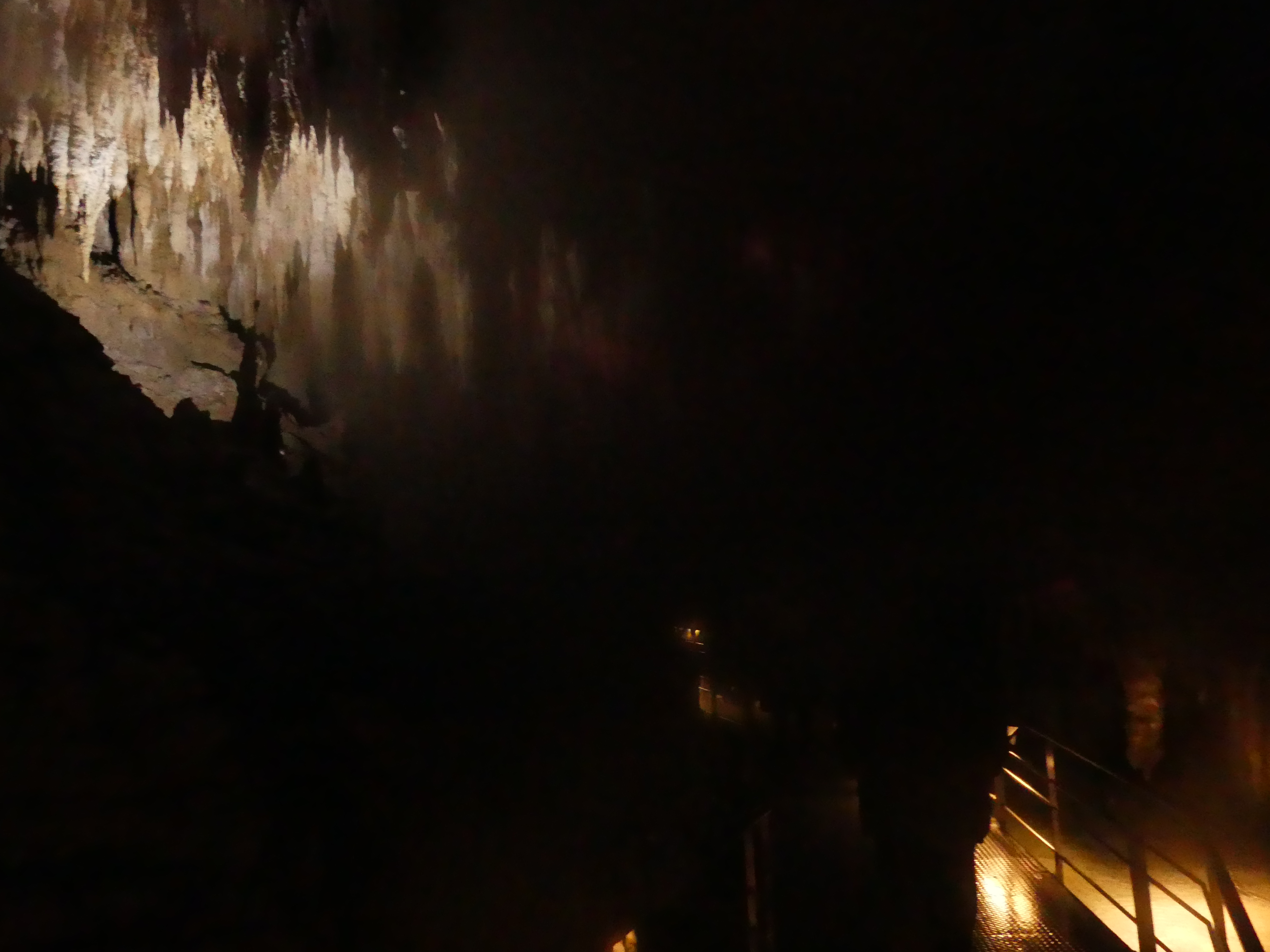
Photos #9 to 12 are photos of the walk along with two feature notice poles which could not be read to to the weathering and photo #13 is the cave entrance. Photos #14 to 26 are all from the interior of the cave which was dry in the sense there was no stream running through it.

After completing the cave we returned to the Tour centre and took a different path to the Forest walk. Photos #27 to 30 show the lodge front and back then the bridge across the Huon River. Then the climb started until we go to the entrance to the Sky Bridge – photos #31 to 33. The walk is made up of a circuit and then a viewing platform over the Houn and Picton River conjunction – photos 34 to 42 and the final photo is the view back to the tourist centre. The journey concludes at a cantilever sitting high above the intersection of the Huon and Picton Rivers to give you breathtaking views. There’s no better way to experience the healthy natural abundance of the Tasmanian island.

We were offered the opportunity to take the long walk or short walk back to the bus. The long walk had the attraction of a swinging bridge whereas the short walk had the bus, so I took the short walk. Good thing too, the driver came with me while the rest went on the long walk so I could rest while the driver panicked when the group did not come back by the designated time. I offered to stay with the bus and after two abortive attempts to find them, the group turned up oblivious to the time – did I say they were Japanese & Korean? On the road again and it was lunch time – we were stopping at Kermandie Hotel Port Huon on the mouth of the Huon River.

Port Huon, a small town on the Huon River, has a rich history tied to its role as a key port and hub for the apple and timber industries. Located around 40 km southwest of Hobart, it developed in the 19th century, mainly to support the bustling timber trade and the apple industry, both crucial to Tasmania’s economy. During World War II, Port Huon played a role in military logistics. The Australian and U.S. navies used the nearby waters for strategic operations, and the port served as a repair and refueling station. In recent decades, the area around Port Huon has seen significant growth in the aquaculture industry, particularly salmon farming, which has become a major part of Tasmania’s economy. This industry now provides employment and supports the local economy.

Today, Port Huon is known for its scenic beauty, with views over the Huon River and surrounding hills, and draws visitors interested in Tasmania’s natural environment and local produce, especially apples and seafood. Its history as a port, agricultural hub, and center for timber and salmon farming remains an important part of its character.

We stopped at the Kermandie Hotel. Charming old building decorated with the history of French exploration. The notable French expeditions to the region were led by explorers such as Bruni d’Entrecasteaux and Nicolas Baudin. In 1792 and 1793, Rear Admiral Antoine Raymond Joseph de Bruni d’Entrecasteaux was sent by the French government to search for the lost expedition of fellow explorer Jean-François de Galaup, comte de Lapérouse. While searching, d’Entrecasteaux charted much of Tasmania’s coastline.The Huon River and subsequently Port Huon were named after Vice-Admiral Jean-Michel Huon de Kermadec, one of the expedition’s officers.

Nicolas Baudin arrived in Tasmanian waters in 1802. This expedition also mapped various parts of Tasmania and was significant in gathering scientific data. The French naturalists and artists aboard Baudin’s ships, including François Péron and Charles-Alexandre Lesueur, extensively documented the plants, animals, and landscapes, leaving a rich archive of illustrations and descriptions. The expedition anchored in areas around the Huon Valley and the channel, further solidifying French influence on place names in the area.

The hotel carries this history on its walls. Although the exterior may disappoint the interior has a 19th century charm.

Loaded with all accounted for, we headed back the way we had come to the Tahune Forest. One beer and a meal meant nap time for me so whilst the others prattled on in their own languages, I spent a little time walking amongst the stars. Safely home I found Kerry rested in bed and restless to do something as usual. So, I took her for dinner.

Our time on tour over we flew back to Brisbane and planning for our next voyage off the beaten track.

December 2024