The Retirees Invade China – Day Three – The Summer Palace, The Pandas and the Hutongs

Kerry is not well and needs to rest but insists I carry the flag, so I meet the bus as scheduled and we head for the Summer Palace. Everything is an hour plus in the bus. The hotel is well out of town and the traffic is always horrendous. So after sitting in traffic we arrive. The Summer Palace, is a vast ensemble of lakes, gardens and palaces. Mainly dominated by Longevity Hill and Kunming Lake, it covers an expanse of 2.9 square kilometres three-quarters of which is water.

Longevity Hill is about 60 metres (200 feet) high and has many buildings positioned in sequence. The front hill is rich with splendid halls and pavilions, while the back hill, in sharp contrast, is quiet with natural beauty. The central Kunming Lake, covering 2.2 square kilometres (540 acres), was entirely man-made and the excavated soil was used to build Longevity Hill. The natural landscape of hills and open water is combined with artificial features such as pavilions, halls, palaces, temples and bridges to form a harmonious ensemble of outstanding aesthetic value.

Just as the Forbidden City has the political and the pleasurable pavilions so it is with the Summer Palace. Built in the Qing Dynasty it is only 200 years old but continues in the Ming style. The reversed position of the Phoenix and the Dragon comes about because of a female regent exercising her power. The horned beast is a stylised fertility beast outside of the throne room.

As we walked around the grounds we found several senior citizens practising their calligraphy which is said to be very therapeutic. The lake is the feature along with a covered walkway with paintings depicting Chinese history. The visit over we walked back to the bus which had found a park some distance away. On our way, to find the bus and travel to the Zoo, I found another group of Chinese electric cars and their electric bike.

This is Sunday and parents are visiting the Zoo with their children. Cars park 4 deep from the gutter to off load the family whilst Dad seeks a car park so the bottleneck is again horrendous. Finally, we are offloaded and Eddie goes to buy our tickets – he must have known a man because he seemed to get to the top of the queue very quickly. So, in we go. We are here to see the Pandas – nothing else. Eddie knows the short cut to the Panda trail and the three pavilions built for the Olympics and the Asian games. Fortunately, Pandas are very sedate and it was easy to get photos but that day the China Daily carried an article about a wild Panda that attacked and devoured a goat. Are Pandas China’s great white shark????

Eddie then organised a visit to Yandai Byway (also known as Smoking Pipe Lane). There were stores selling tobacco bags and smoking utensils which led to the name “Yandai Byway” after the large wooden sculpture of a large tobacco bag at the eastern end of the street. You can still find the old image of the store now.

Our main purpose was to visit the Hutong lanes. Hutongs are a type of narrow streets or alleys, commonly associated with Beijing. Hutong is a Mongolian word meaning “water well” and Hutongs were part of the Ming dynasty town planning on a class basis. In Beijing, hutongs are alleys formed by lines of siheyuan, traditional courtyard residences. Many neighbourhoods were formed by joining one siheyuan to another to form a hutong, and then joining one hutong to another. The word hutong is also used to refer to such neighbourhoods.

Since the mid-20th century, a large number of Beijing hutongs were demolished to make way for new roads and buildings. More recently, many hutongs have been designated as protected, in an attempt to preserve this aspect of Chinese cultural history. We walked through the alleys to a hutong which had been owned by its present family down through the generations. Along the way, we encountered more of the small electric cars that seem to be do popular as well as some of the past history of bicycles. After many turns and walking past the public ablutions (hutongs share a communal toilet block which does not have any walls or partitions so you get to know your neighbours intimately) we arrive at the front door of the hutong we are to visit.

Inside the court yard we met the eldest son in the parents’ room to hear the history of the hutong, and then check out the remaining rooms. Beijing has now introduced laws to retain the history of these residences.

We finished off the day with a rickshaw ride/race, the drivers must have the best legs with single gear bikes towing two larger Australians and no brakes other than the soles of his shoes. He also had to contend with traffic of all kinds – wheel chairs motor scooters cars and pedestrians.

← Back

Thank you for your response. ✨

The Retirees Invade China – Day Two – The Jade Factory, the Great Wall and The Forbidden Palace

The next morning was an early start. One thing we were learning about this tour was that the itinerary was flexible according to Eddie which meant what you expected rarely happened. So, we were expecting to go to the Great Wall but Eddie wanted to go to the Jade Factory firstly. Eddie is very fond of Jade in all its shades and hues and was very chuffed that China included Jade in all the medals awarded to athletes in the Games and the Disability Games.

So, he took us to the factory that made the medals. The factory was nothing to look at but inside we were warmly greeted by Monica (not her real name) who showed us the cubicle where the craftsmen carved the jade to time honoured patterns. Then she took us into the showroom to see their wares and put the bite on us tourists. It was very interesting to hear the reason for the popularity of jade amongst the Chinese, how to distinguish the real from the fake and what a good investment it was. Monica chased us around the show room until she finally got the idea we were not buying. As we were departing I noticed a forlorn group of Chinese and went to visit them. No wonder they were forlorn there was a bear amongst them. Buddha was happy though.

The bus chugged out the gate and slowly climbed to the tourist stop for the Great Wall. Now I had been to the Wall (but at a different location) in 1998, so I knew what to expect but still I was surprised by the steepness of the hills then some of the segments of the Wall along the way and finally the section we were going to climb and looked at it wondering how far I would get on that hill. We gathered at a coffee shop below Fortress No 7. We commenced our climb and Kerry had to turn back – her left foot still troubles her. In the photos, you can see Fortresses 8,9, and 10. Fortress 7 can be made out in one photo in the bottom left hand corner. I made it to Fortress 9 and the photos will tell you what I saw going up when I got to Fortress 9 and coming down – note the ice on the steps and that some fool put a pagoda on top of the opposite hill.

Returning was quite difficult due to the ice and the steepness of the stairs but I made it in one piece. I met up with Kerry at the coffee shop talking to fellow tourist Polly. A chance to sit down and take in a hot cup of coffee. Some of the younger ones made it to Fortress 10 and beyond but I was very happy with my achievement.

The morning was not finished yet. Eddie had line up the Cloisonne workshop and restaurant. Cloisonné is an ancient technique for decorating metalwork objects. The decoration is formed by first adding compartments to the metal object by soldering or affixing silver or gold wires or thin strips placed on their edges. In antiquity, the cloisonné technique was mostly used for jewellery and small fittings for clothes, weapons or similar small objects decorated with geometric or schematic designs, with thick cloison walls. In the Byzantine Empire techniques using thinner wires were developed to allow more pictorial images to be produced, mostly used for religious images and jewellery, and by then always using enamel. By the 14th century this enamel technique had spread to China, where it was soon used for much larger vessels such as bowls and vases; the technique remains common in China to the present day, and cloisonné enamel objects using Chinese-derived styles were produced in the West from the 18th century. Eddie arranged a guided tour for us before shuffling us upstairs to another Chinese banquet.

Our appetites sated, Eddie determined we would return to the Forbidden City to see what we had missed out on. Along the route, we passed at speed an unusual building which I photographed poorly but which I have included here because of its strange appearance. We were dropped off a few streets away from the Forbidden City due to the parking problems, and after walking for 15 mins arrived back at the moat and the southern gate to the Forbidden City – Gate of the Divine Might. Of course, we could not enter there but has to walk around to the Eastern Gate – East Glorious Gate where we had left off yesterday.

Inside the inner walls, we encountered the Hall of Supreme Harmony where the Emperor held court received envoys and important persons and generally lorded it over everyone. We followed the meridian through to the Palace of Heavenly Purity where the Emperor resided, spotted the Buddhist White Pagoda where Marco Polo was first received in the 12th century, into the Imperial Garden and then out the gate and onto the street from where we could see the temple where the last Ming Emperor hung himself as the Manchus pillaged and burned Beijing before taking the throne and creating the last dynasty, the Qing Dynasty.

I thought we were at last going home but wait there is more. Another “5 min” walk that turned into 15 or 20 mins to the Chinese Academy of Medicine where we were treated to a lesson on herbal remedies a 20-minute foot bath followed by a massage and the hard sell to buy some of the remedies. Kerry was not fairing very well and had sat out the revisiting to the Forbidden City and desperately wanted to go the hotel. So after travelling to the restaurant for dinner we persuaded Eddie to call us a cab and we travelled back to the hotel and room service.

← Back

Thank you for your response. ✨

The Retirees Invade China – Day One – Tiananmen Square and The Forbidden City

One thing the travel itinerary did not tell us was how much walking was involved. The bus could never park where we intended to go but some distance from the site and we had to hoof it there. Such was the case with the Forbidden Palace. Now everyone knows the Palace is accessed from Tiananmen Square (not true and I will tell you why – keep reading).

We left the restaurant and we were dropped off near the Square. It has changed a bit since I was there in 1998 so it took me some time to work out that it had been fenced off with a security check installed so you cannot get to the Square without a security check. Unbeknown to everyone an American tourist had been caught with a bullet in his pocket trying to enter the Square and this caused a tizz. There were multiple queues 150 people long and it took an hour of waiting in line to get through so that we could cross to the Square.

From the queue, we could see the Forbidden City and Chairman Mao’s picture on its outer wall. Once in the Square we saw the Column acknowledging all the ordinary people who sacrificed to bring about the new China, Mao’s mausoleum the National Congress Building the National Museum of China and the outer wall to the Forbidden City.

On passing through the outer wall you realise that there were a number of other external walls which have been pulled down over time and all that remains to tell this is the meridian – the central path that runs through the city joining up the random bits that remain of the once mighty walls of the city.

The Forbidden City was the Chinese imperial palace from the Ming dynasty to the end of the Qing dynasty—the years 1420 to 1912. It now houses the Palace Museum. It served as the home of emperors and their households as well as the ceremonial and political centre of Chinese government for almost 500 years.

Constructed from 1406 to 1420, the complex consists of 980 buildings with 8,886 bays of rooms and covers 72 ha (over 180 acres). The Forbidden City is a rectangle, with 961 metres from north to south and 753 metres from east to west. The palace complex exemplifies traditional Chinese palatial architecture. The Forbidden City was declared a World Heritage Site in 1987, and is listed by UNESCO as the largest collection of preserved ancient wooden structures in the world.

Since 1925, the Forbidden City has been under the charge of the Palace Museum, whose extensive collection of artwork and artefacts were built upon the imperial collections of the Ming and Qing dynasties. We passed through the inner wall and were confronted with a fenced off entrance to the Imperial Palace – the long delay at the security check meant we were too late to visit the Forbidden City.

However, I took photos of the buildings and the architecture which included the sign which I think says Gate of Supreme Harmony.

We left by the eastern gate called East Glorious Gate and outside found remnants of the old moat. At the four corners of the wall sit towers with intricate roofs boasting 72 ridges, reproducing the Pavilion of Prince Teng and the Yellow Crane Pavilion. These towers are the most visible parts of the palace to commoners outside the walls. We walked along an unknown street following Eddie’s yellow flag supposedly a long walk back to the bus which changed to a long walk to “5th Avenue” and a long wait for dinner. The walk allowed us to see more of the old Beijing until we hit 5th Avenue when it all changed and we were in down town New York except everything was in Chinese. We also saw some interesting street art but fled to McDonald’s for warmth and a cup of coffee where we met the “Little Rabbit “. She and her mother sat beside us and her mother allowed us this photo.

Finally, Eddie returned to take us to dinner. We catch the bus for the shortest bus trip of the tour thus far to our restaurant for dinner.  As we get out of the bus, there in front of us is Wangfujing Catholic Church. It was originally named after Joseph, the father of Jesus Christ, as ‘Saint Joseph’s Church. As we walk along I encounter one of the scooters with the cold weather enhancement seen all over Beijing, Dinner was pretty good – five Star restaurant and we left very satisfied for a long ride to our hotel through some traffic snags and I began to realise the Chinese driver is very patient driver to go through this each day. Our trip took us past one of the Olympic Games site all of which was illuminated against the night sky. We also saw the huge growth in apartments that was to be repeated everywhere we went.

← Back

Thank you for your response. ✨

The Retirees Invade China – Day One – Temple of Heaven

The following morning, we meet all our fellow travellers – 23 of us altogether. Our first tour was to the Temple of Heaven. However, the trip on the way gave us some surprises. Firstly, we saw the Olympic rings above the city, the Birds Nest and the Pool cube some mysterious totems and as always new innovations on the traditional motorbike. Beijing is now full of man – made canals and most were partly frozen.

The temple is surrounded by walls and until the revolution was only accessed by the Emperor. Inside the walls are gardens with various bits and pieces one being the Seven Star Stones. During the Ming Emperor Jiajing’s Reign, seven gigantic pacifying stones were placed to the southeast of the Great Hall of Sacrifice. These are stones with motifs of mountains engraved on them, not the meteors as the hearsay goes, symbolizing the seven peaks of the Taishan Mountains. After the Manchus came to the throne in central China, in order to show that the Manchu is one of the nationalities in China, Emperor Qianlong issued an edict for another stone to be placed in the direction of the northeast, meaning the Chinese nation is a big family and the country is unified. Interestingly this is also the site of China’s biggest dating agency – all the grandparents meet to exchange photos of their grandchildren and try to match them up with future partners because they are too busy to look for themselves. At least that is the explanation given for the crowd of grandparents congregating at the Seven-Star Stones by our guide Eddie.

The Temple of Heaven was built in the Ming Dynasty (AD 1420) by the emperor Zhu Di in the royal garden. Once a year, at winter solstice, the emperors came here to worship Heaven and to solemnly pray for a good harvest.

The design of the Temple of Heaven is complex, and reflects the mystical cosmological laws believed to be central to the workings of the universe. Both the overall arrangement and the buildings themselves reflect the relationship between sky and earth, the core of understanding of the Universe at that time.

The Temple is made up of various buildings including the Hall of Prayer for Good Harvest, the interior twenty-eight columns are divided into four central pillars to represent the seasons, twelve inner columns to represent the months, and twelve outer columns to represent the two – hour sections that make up a day. There are many such examples of this intense numerology at play. Another interesting fact is that the Hall of Prayer for Good Harvest is built completely without nails.

I took plenty of photos including one of the locals playing dress up.

After a hard morning’s work we were scheduled to have lunch at Beijing’s best Peking Duck restaurant (Eddies’ words not mine). We boarded the bus and travelled deep into the heart of the city with the bus pulling up on a roundabout and discharging us to fight our way to the restaurant which was cleverly camouflaged as a building site. Another motorbike innovation sat out the front – the Peking Duck takeaways delivery van. You want to know the name of this restaurant – see below. We had the joy of watching the chefs cut up two ducks and fortunately there was other food to supplement this meagre amount of Peking Duck. I don’t know whether it was good or not – I hate duck.

← Back

Thank you for your response. ✨

The Retirees Invade China – Beijing or Bust

It all started one Saturday afternoon with Kerry going through the specials for overseas travel. What about China she says. No been there and done that says me. Yeah but I haven’t – listen to this….
So here we are at Brisbane International Airport flying China Southern Airways to Guangzhou and then Beijing. The flight was a little under 9 hours to Guangzhou and was quite pleasant with comfortable seats and almost everything going like clockwork – the flight was delayed.
Arriving in Guangzhou we taxied for about 1 hour to get to the terminal where we caught a bus to the entrance and then traipsed through to the Domestic terminal which took almost as long. However happy ending we arrived just before the boarding call for Beijing came over the public address. After boarding the plane there was clearly a problem as take-off time came and went and we were still there. Then the Hosties started serving dinner and we were then told our take off would be delayed an hour. Hmmmm!
Well we finally took off fearing our connection in Beijing would be home in bed – ETA 11.45pm Beijing time. Arriving in the Arrival hall we were gripped with fearful thoughts of finding our way to our hotel unassisted but as we left the Arrival hall here was Eddie with his Yellow Nexus Tours sign – relief. We joined Taylor a young Australian social worker and retirees Leonie and Peter alongside Eddie but we were missing one more couple – the Jones es who ultimately turned up missing Geoff’s luggage.
We boarded the minivan just in time – it was below freezing and we were not exactly dressed for it. The trip to the Loong Palace Hotel was long and lumpy but we finally got there and into bed by 2.00 am Beijing time. Bed was very welcome and sleep irresistible.
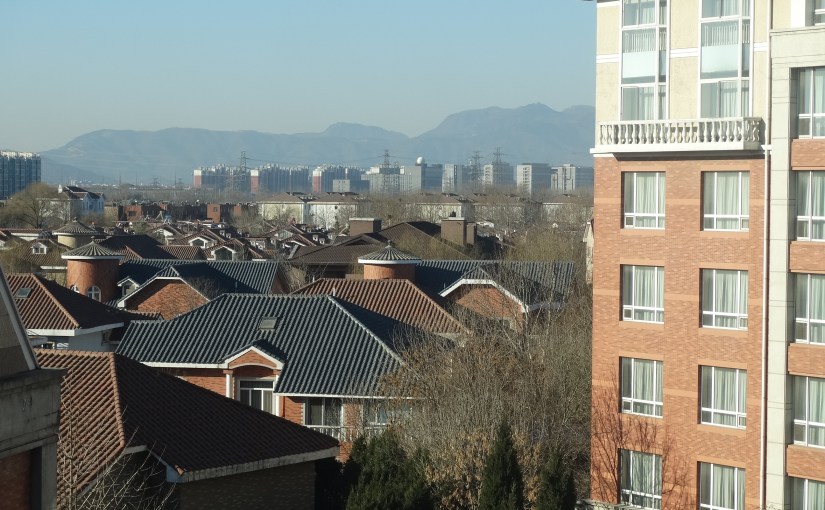
We woke to the alarm on the phone showered and changed ready to start the day. I took the opportunity to take some photos of the Loong Palace Hotel, our breakfast buffet, and the view from our room.

← Back

Thank you for your response. ✨

The Retirees in the Capital – Canberra

On 12th January 2017, we received wonderful news. Adam and Fasheena have brought another grandchild and their first child into the world. We had arranged to be in Canberra shortly after the birth. Arriving on the 31st January we settled into our hotel and then went to visit number 5 grandchild Francis (after my Dad and me) John (Fasheena’s father) with a third name Nakandemb referring to Fasheena’s passed relatives that Francis will not meet. Francis is a healthy 3 week old boy. Clearly adored by his parents. Fasheena is a confident relaxed mother taking motherhood in her stride. Adam is as excited as I can recall seeing him and like Fasheena seems to take to parenting with a natural instinct. So we have spent some time bonding with Francis and spent sometime looking around Canberra.

We stayed at Olim’s Mercure Hotel near the War Memorial in Ainsley Road. Whilst this is one of the earliest hotels in Canberra and is built in the style of a 1927 country hotel parts of it have been added to provide modern accommodation. Unfortunately we had not done enough research and we were given a standard room – standard for 1927 and the maintenance on the room had not been attended to regularly. To their credit our hosts recognised our complaints and waived breakfast charges.

We spent the first day with Fasheena and Francis until Adam got home from work. Fasheena had a friend Betty visiting as well. So after they had prepared dinner (we were bonding with Francis), Adam showed us Canberra at night from Mount Ainsley.

The next morning we caught the RED bus to see the sights of the city. We did not have enough time to visit the War Memorial (next time) but the Bus went down Anzac Ave past the memorial to the seven conflicts involving Australians at War. We then left the bus at the Lake Burley Griffin boat dock to take a trip around the lake on an electrically powered boat hand painted to depict I know not what.  Some of the sights were Anzac Ave to the War Memorial, Australian National Museum, Telstra Tower at Black Mountain, Australian National Library, Old and new Parliament House, High Court, Blundell’s Cottage an early stone cottage formerley part of the original Duntroon Farm, the Carillion and Kingston shoreline from the Lake.

We disembarked at the same spot and from there went to the High Court. I did not know the court was sitting hearing an Appeal from the Court of appeal in Western Australia. It involved an interpretation of the Constitution and all Attorneys General from the States and Territory were there to intervene. Her Honour Justice Susan Kieffel QC was presiding with the full bench including Mr Justice Eidlmann the new man on the bench getting blooded. For me it was interesting particularly as I was not on the spot briefing Counsel. The Court is very impressive and free to visit. Security is not as tight as I expected. No metal scanners met you at the door. Instead we were met by a friendly member of staff who also volunteered to take some of the following photos.

From there we went to the Australian National Gallery but we were short on time as we wanted to have lunch and visit the Australian Mint. The Mint is not regularly on the RED bus itinerary. You have to ask the driver and provided it is 2.15 pm  he then dashes to the Mint before returning the bus to the scheduled route. In the Mint there is an interesting video on the Australian-born artist Stuart Devlin of the reverse side of Australia’s coins and all of the other designs he has done in precious metals and stones.

After the video we caught up with the guide taking visitors around the history cabinets of Australia’s currency. From the First Fleet until minting of gold coins following the 1850’s gold rush currency proved difficult to keep in the colony until Governor Macquarie obtained 40,000 Spanish dollars from the UK government and punched out the middle of the coin to create our first N.S.W. currency. After the gold rush and the competition between various Mints federation saw the unification of minting coinage. The Royal Australian Mint produced other pennies and shillings until decimal currency. All current coins portray Her Majesty Elizabeth II, Queen of Australia, on the obverse, with the present effigy having been designed by Ian Rank-Broadley. This is matched with designs by the Australian-born artist Stuart Devlin on the reverse.  They now comprise 50c, 20c, 10c and 5c coins – all still referred to as ‘silver’ though actually 75% copper and 25% nickel, and for many years there were also “bronze” 2c and 1c coins.

The tour then took us to the minting floors where collectable coins are produced and another floor where the standard currency is manufactured by robots with minimum human intervention.

I was so engrossed in everything that we almost missed the bus. Exiting the building we spotted the bus moving off in the car park. Fortunately the driver spotted us and waited for our late arrival. Unlike the previous day of clear skies and high temperatures this day was scattered cloud threatening rain. Our plans for an al fresco dinner at Kingston looked at risk particularly as we had brought clothes for summer evenings not wet and windy afternoon and night. So after the bus dropped us at Civic there was a spot of shopping at MYERS and we were set for dinner. Adam, Fasheena. Francis and Betty joined us on the lake at Kingston. Francis was perfectly comfortable and well mannered for a three week old. The next day was spent with Fasheena Betty and Francis before we caught the plane back to Brisbane but not before planning the next trip when Francis would visit us in our home and meet Tank the Cat who will join him in Canberra.

← Back

Thank you for your response. ✨


The Retirees Escape to Auckland – Part 5

It is our last day to travel around the Auckland environs so after some nifty work on the internet we hired a car from “Go” for a days tripping. Stupidly I did not arrange a pickup from our apartment thinking the early morning walk would be nice. Auckland has many volcanic cones and they are all steep sided so the walk through Albert Park was more a climb and then we went the wrong way to make the walk “more enjoyable” and finally the decent to the hire company office. We agreed immediately that we would not return home that way. After picking up the car we planned a trip to the western beach of Piha and ended up in the northern village of Helensville. No GPS and the turn off was hidden by road works.

No worry we got directions and headed for Henderson the Great Scenic Drive and then Piha (where 800 Words was filmed). I guess it had to rain one of our days there and it chose today, so the dramatic views entering Piha we somewhat muted by the overcast skies. As we twisted down the narrowing road the village of Piha appeared spread like a blanket below us.

After descending to the sea level, I was reminded of Sunshine Coast probably in the 70’s. Beach shacks abound and the occasional shop. Here it is middle of the week and clearly no one in NZ has a job to go to – there are no car parks at the first beach, but as we make it to the Piha Surf Life Savers Club it is clear that some school has decided that the students all need to learn how to lounge about in the surf club. It is lunch time and the kitchen is closed so it is to Rough Eddies Fish and Chip Bar we stroll to buy the biggest load of chips and smallest piece of fish to eat on the black sand beach. Even the gulls were on holidays as they crowded us for lunch.

After a relaxing lunch, we drove through the area but it was all much the same.

So we headed for Karekare beach to the south. Karekare is a popular destination for Aucklanders in summer, but receives fewer visitors than nearby Piha, partly because the road is narrow and only recently sealed. Also the beach is a long walk from the car park with the beach sandwiched between hilly escarpments either side. This is not a road for the fainthearted. The location will also be familiar to viewers of the film The Piano, which included beach scenes shot at Karekare and Piha.

We started the trip home reaching Titirangi around 3.00pm. Titirangi is a suburb in the Waitakere Ward of Auckland 13 kilometres to the southwest of the Auckland city centre. at the southern end of the Waitakere Ranges. Just before getting to Titirangi we encountered Arataki Learning Centre a part of  the Arataki Visitor Centre the gateway to the Waitakere Ranges Regional Park. With more than 16,000 hectares of native rainforest and coastline, 250km of walking and tramping tracks providing access to beaches, breathtaking views, and spectacular rocky outcrops, including the Hillary Trail, black sand beaches, waterfalls and giant kauri trees, this is a must stop. The Learning Centre gave us an overview of the Park and it views.

.Returning home to our apartment we relaxed until catching the plane home to Brisbane the next day.

The Retirees Escape to Auckland – Part 4

Tomorrow we meet Cilla and Bob who were our inspiration to travel to Auckland New Zealand. Cilla and Bob live in Attenborough outside Nottingham (Yes the UK). For those who followed our travels in the UK you will already know them and for those who don’t then let me put it this way – Cilla organises the local church working bee for the Church of St Mary the Virgin in Attenborough and we toiled with her amongst the gravestones and Bob well he works at the Nottingham University (not Trent Uni). Cilla and Bob were visiting Auckland for their daughter’s wedding and we thought it was a good opportunity to catch up as our visiting flight was only 3 hours not 26 hours if we went to the UK.

Arrangements had been made – we would meet outside our apartment building and go to One Tree Hill and have lunch at a cafe close by. We knew when Bob had arrived – typical English driving you park your car in the direction you want to go not the direction of the traffic.

One Tree Hill located in Cornwall Park is a 182-metre (597 ft) an important memorial place for both Maori and other New Zealanders. Cilla was certain that visitors could no longer drive to the summit so we walked (and walked and walked and then climbed to the summit past the parked cars of the other visitors). It is surrounded by the suburbs but located within Cornwall Park which is owned by a private trust established to hold the land for the use of the public.  The summit provides views across the Auckland area, and allows visitors to see both of Auckland’s harbours.

On the summit of the hill is an obelisk (not a tree surprisingly), a memorial to Maori. Before the obelisk stands a bronze statue of a Māori warrior. Beneath it is the grave of Sir John Logan Campbell who bequeathed £5,000 for the obelisk and established the trust for the creation of Cornwall Park.

Of course we then had to walk down the hill to the car for a short journey to the Cornwall Park Cafe. Whilst not as splendid as Tantalus, the ambience and the company made up for it and we reminisced about church yards gravestones and that bloody holly tree that I had to trim. It was lovely to meet them again and made us both miss the Midlands of England even more. After lunch (about 3.00pm) Bob dropped us at the Auckland City Hospital to try and recover the records of Kerry’s visit and pay any outstanding expenses. The clinical notes had not been written up and we are still waiting for the records. Australia and NZ have an agreement about emergency trips to the hospital so there was not charge for the overnight stay.

The Retirees Escape to Auckland – Part 3

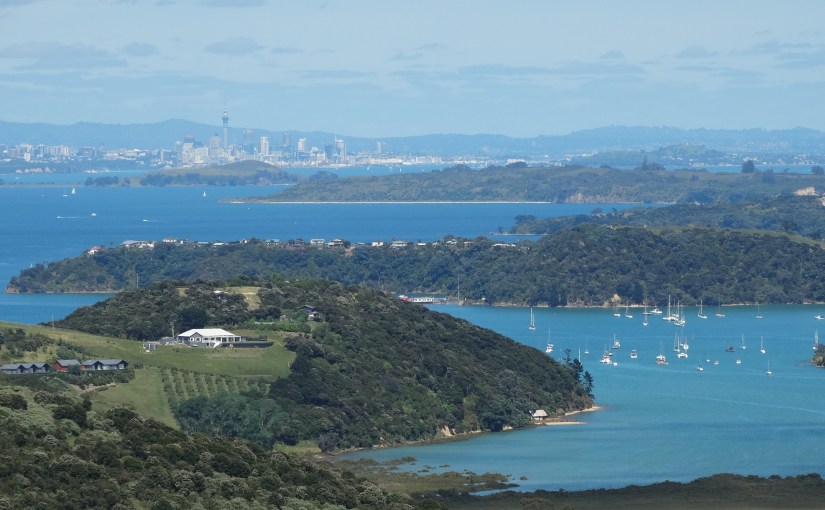
Kerry has been released from hospital and insists that we embark on our plans for Waiheke Island and the Eco Zip Lines. It is a beautiful day and we catch the ferry to Waiheke. This is an island just off Auckland and a popular tourist site with many small wineries and breweries as well as walks and beaches. We pass Devonport, North Head the other islands and other travellers and within 30 mins we are docking.

We transferred from the ferry to the bus with one other couple who turned out to be American tourists from Orange County. The bus wound its way along the smaller roads to give us scenic views of the island before arriving at Eco Zip Line HQ.

Eco Zip is a series of 3 zip lines (flying foxes) running over the top of some old original forest and modern regrowth. It appears expensive until you see the gear you have to wear and realise that there are two guides working with you all the way. The first line was very gentle to get us started then the second line faster and finally the last line rocketed us down hill about 60 kph thumping into the brake at the bottom. We were warned not to hold onto the bar to closely otherwise you can break your nose as you slam into the break.

Of course what comes down must walk back up only you get to see the forest you sailed over. After getting back to HQ we decided to join our American companions in a trip to a winery and brewery and we would have done that but I left my wallet in my zip line harness and after $35 cab fare we recovered the wallet and ended up at Tantalus Vineyard. A mistake the result of which we found the perfect place for lunch. Both a winery with surrounding vines and a brewery in a stylish building with the dining room styled like a 1950’s American house with bespoke light fittings.

By the way this place was great for its food and ambience. We ordered the wines and beers we wanted taste at our table with lunch. After lunch we strolled through the vines and down the road to our bus stop and rode the bus to the quay to catch our ferry ending a fabulous visit to Waiheke Island.

The Retirees Escape to Auckland – Part 2

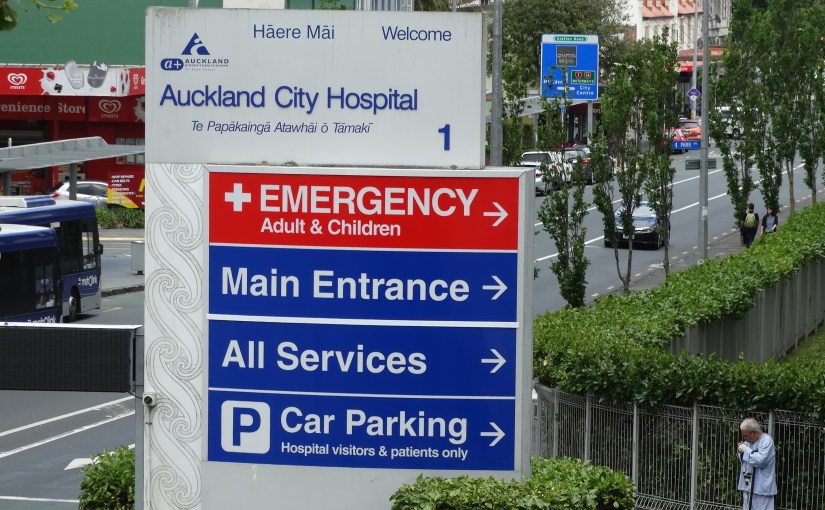
At the end of Part 1 Kerry had been told by her GP to go to the Emergency Dept at the Auckland Hospital. This is not a place that tourists frequent so we did what everyone does – we called a cab. The hospital is on the edge of the CBD near the Domain and this was 5.30 pm peak hour Friday evening traffic. So it was close to 6.00 pm when we arrived. The GP had rung the Registrar so we got through the immediate steps quickly but thereafter things dragged until the ward nurse told me that visiting hours were almost up.

So after tucking Kerry into bed I headed to catch a bus back to the CBD and our Apartment which I did successfully first go. In addition I discovered another Auckland icon in the White Lady; a very large cafe de curbside/pie van that has been an institution in Auckland for 60 + years. After passing this cafe I could see the Apartment building and trekked home.

Next day I reversed the journey and caught the bus back to the hospital. The x-rays, ct scans, blood tests had all been completed and a very weary Kerry greeted me with the news that she was unlikely to be discharged until after 2.30 pm that day. The investigation had identified her problem and they had commenced a course of treatment that she would have to continue after discharge. Kerry urged me to find something to do for the day so I ventured out into the street without any real idea of what I might do. So I walked outside and as I did so I asked at the information desk about a museum nearby. To my surprise the Auckland War Museum is in the domain next door to the hospital. So off I went.

Very quickly I found the Domain; literally 100 metres from the hospital steps. This is a large park area with a cricket oval water features the War Museum and open space. Unfortunately, the Museum is on the opposite side of the cricket oval. A brisk walk and I arrived at the back door (not that I knew that at the time). Entry for Auckland residents is free but for “International Tourists” (and that is what I am despite feeling as though I have gone to another suburb in Brisbane)it was $25. The entry was quite amazing. The exterior is a conservative museum look from the 40’s but the interior entry is modern raw and warm dressed timber a great contrast with the cold stone of the building exterior. The ground floor is made over to Maori traditions and culture and Maori/Pakea interaction following the Treaty of Waitangi and a tree house. The second floor is natural history and the third floor the war memorial. Inside is a desk made for General Baden Powell purchased by the museum from the family, a clock which has no particular history but gives the story of the creation of Greenwich Mean Time and how the introduction of railways necessitated the establishment of a unitary measure of time.

Leaving the Domain I contacted Kerry about her discharge and there was still no word so I went to subway to get lunch and as Murphy’s Law applies Kerry was discharged and waiting for me. Show I showed her what I had learned of the Auckland bus system and we went home.