Retirees Go Abroad – Oxford and Cambridge – An Education at Oxford – the Second Day

Retirees Go Abroad – Oxford and Cambridge

An Education at Oxford – the Second Day

Our second day in Oxford. The B&B was comfortable (The Conifers) and the breakfast was good. The sun was shining and Oxford was waiting for us. We parked our cars at the Peach Tree Park and Ride and caught the bus into town. One pound for 24 hours parking and our 24 hour ticket from yesterday could be used until 12 noon today. The public transport is truly easily accessible.

The Oxford Visitors Information Office provides (for One pound 50p) a visitor’s guide which is a good investment. Inside is the information on the main colleges and a self – guided walking tour. With the benefit of our knowledge gained the previous day we elected to follow the self – guided tour. But before that we visited England’s first public museum the Ashmolean Museum of Art and Archaeology, cnr. Beaumont and St Giles St opposite that old Morse drinking hole the Randolph Hotel.

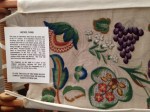
Founded in 1683, there is no entrance fee to a museum of wonders. Sure there is the usual Greek and Roman antiquities sprawling across the gallery on the ground floor (many of which were donated by Lord Arundel a person who may have some special interest to me but I may say more about that in the future if research supports myth), but the museum has created a path for you to explore the different civilisations with examples of life for ordinary people as well as the Rulers/Gods. We set ourselves a time limit and I had not got off the ground floor within the time set and there are 4 floors. The most dramatic was an image of a boy mummy from one of the Egyptian periods created from a CT scan and laid on 133 glass sheets so that when you looked at the glass sheets you saw the mummified remains in full and side on all you saw was the edge of the glass panels. My photo did not do it justice but I have included others I found interesting. Kerry meanwhile visited the English Embroideries Trail. Before photography there was embroidery. Just as the Bayeux Tapestry recorded the events leading up to and William’s victory over Harold, there are tapestries of both religious romantic ideas and other works on display. Kerry also ran out of time.

We reconvened at the coffee shop after which we started our walking tour in Cornmarket St where we found Oxford’s oldest surviving building a stone Saxon Tower being part of St Michael’s Church. It was part of city walls and is over 1,000 years old. You can climb to the top of the tower for a fee and on the way up you can see the old door to the goal which imprisoned some religious heretics (Queen Mary trying to restore Catholicism to England had these three gentlemen burnt at the stake in Broad St) and the bells of the tower. On the roof you get very good views over the city – there are no high rise in Oxford.

Unlike yesterday we then continued down Cornmarket into St Aldates and passed Christ Church College entrance on the way to Christ Church Meadow and the Broad Walk to the river. We were supposed to find the shop where Alice Liddell (Alice in Wonderland) bought her sweets but all I could find was a Curry shop. How things change. I wonder if Lewis Carroll would have had Alice drop in for a curry.

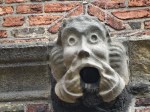
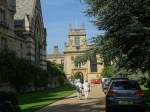
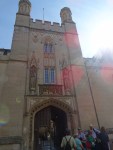
We strolled down the meadow lane passed the visitors entrance to Christs Church (7 pounds 50p entrance fee). Across the fields we could see Corpus Christi and Merton Colleges until we reached the river (the Cherwell I presume). We emerged in front of Magdalen College decorated in some unique grotesques and saw that there was a punt ride available under the bridge across the river. We chose a chauffeured half hour cruise for twenty five pound and glided quietly (well we were quiet but the kids at play in the school yards adjoining the river were not) along the river. Our chauffeur was a female student from Brighton having just completed her degree in anthropology and working part time during the term break until she could pick up a job in her chosen profession – event management would you believe!

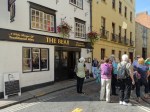
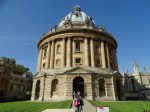
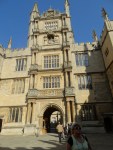
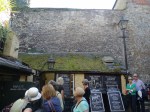
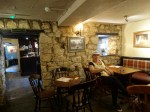
We left the river to walk along the High St past St Edmund College and into Queens Lane and into New College Lane past Edmund Halley’s house (you know Halley’s comet), under the Bridge of Sighs and into Catte St. Here we diverged from the walk and passed All Souls College, around Radcliffe Camera, to the door of Brasenose College (and this time I got a photo of the nose) and into the Bodleian then back to St Mary the Virgin and down that passage across the High Street into Alfred St and down to the Bear for a well – earned drink. There was another reason to lead Rod and Kerry to this pub and that is the quirk for which it is famous or infamous. The walls and ceiling of the hotel are bedecked with the ends of gentlemen’s ties. A former publican collected different ends of ties by shearing the end of the ties of his customers off and displaying it on the hotel walls.

Time was getting away and we needed to be in Cambridge (or more precisely Saffron Waldron just outside of Cambridge and closer to Stansted Airport). So after a pint and a Pimms we set sail for Cambridge. By the way they made the Pimms identically to the Turf. That and the fact that the name of the same hotel group was on the wall confirmed that the dispute about the oldest pub was in the hands of the same owner.

Go back

Your message has been sent

Warning
Warning
Warning
Warning

Warning.

The Retirees Go Abroad – Oxford and Cambridge – An Education at Oxford

The Retirees Go Abroad – Oxford and Cambridge – An Education at Oxford.

The Retirees Go Abroad – Oxford and Cambridge – An Education at Oxford

The Retirees Go Abroad

Oxford and Cambridge – An Education at Oxford

We had a long standing arrangement to meet our good friends and erstwhile neighbours Rod and Kerry at Oxford. They were touring in Somerset and on the way to Spain we agreed to meet half way (well sort of half way). We had planned to meet in Oxford and travel together to Cambridge where Rod and Kerry would catch their flight to Madrid from Stansted Airport. We in turn planned to arrive in Oxford a day earlier to make the most of our visit.

Packed on the Sunday ready to travel on Monday September 8, we rose early and were on the road by 8.30am. Tommy was slow to wake up and we were half way to the M1 when he clicked in. Suddenly I was in a panic. My wallet was not in my pocket and I had left it at home. So instead of exiting at the first exit we upset Tommy by going all the way around the roundabout and home again. As we did so Kerry remembered we had forgotten our accommodation vouchers.

It is now approaching 9.00 am – school drop off time – and travel back to the flat was slow. I collected all the forgotten items (not quite later on I was to realise I had not picked the spare battery for the camera) returned to the car and we tried again. I had planned that we would go to the White Horse Hill south of Oxford and join our Morse and Lewis foot tour at 1.30 pm. Not to be unfortunately. The forgotten essentials and traffic jams at road works in Northamptonshire meant we travelled directly to our B&B in Oxford.

On arriving in Oxford I was surprised to find the city was ringed with Park and Ride facilities. We had been advised against driving in the city itself and I would wholly endorse this. We found the bus service efficient and cheap both from our B&B and later from the Park and Ride. Our accommodation was well located and near a bus stop which meant we arrived into the city well in time before the walking tour. There seemed to be some controversy around the tours offered by the Information Centre with other guides promoting their free tours (the Information Centre charge 10 pound per person for their official tour) directly outside the Centre. I don’t know the quality of the free tour but it would bear investigating and don’t be in a rush to use the services of the Information centre which charged for every service (including the basic street map of the city).

Our guide arrived a little after the appointed time (she had just finished the Harry Potter tour) and she seemed somewhat disorganised when she stepped in front of a bus. Fortunately no one was hurt but she had forgotten that there was a Fair in town and buses were diverted up Broad St (we were standing in the middle of that very street as the Information Centre is located on the old city side of the street.).

We are both interested viewers of Morse and Lewis (both programmes are on English TV continuously) but I was astounded at how seriously others on the tour took the show (mainly Americans). So this was about seeing some of the sites of the city with a slant towards those parts of the city where the programme had been filmed.

Firstly I will get the big question answered. Where is Oxford University? Answer – everywhere!

The University is made up of 38 Colleges which are scattered among the streets of the old city and the extended old city (outside the walls). Many of the shows are set in the forecourts and buildings of the colleges and pubs of Oxford and this tour was going to show us these special places.

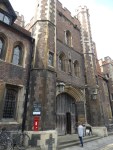
Broad St represents one of the boundaries of the old city. The street is broad because that is where Oxfordians threw their rubbish. Oxford gets its name from the ford across the Cherwell and the Thames at this point. Many of the colleges were founded by religious orders and it is believed the Augustinians were the first to do so in the 12th century. By the 13th century many friars of most of the prominent orders of the day were studying in Oxford. Our first look at the front gate of one of these colleges was Balliol College (founded 1263 was for many years reserved for the poorer scholars) a regular set for Morse episodes (apparently) but we did not get past the front door. Beside Balliol is Trinity College with its’ tell – tale blue gates. From there we proceeded down Turl St and turned into Market St and the city markets (apparently there have been a few chase scenes through these markets) then across the High St into Alfred St and the intersection with Blue Boar St where we find one of Morse’s drinking holes (and the oldest pub in Oxford), the Bear. A small two level pub with crooked windows tiny rooms and narrow staircases it claims establishment from 1249 (not as old as Ye Olde Trip to Jerusalem in Nottingham 1141). We return to the scene of this crime later on.

We walk down Blue Boar St and into Oriel St and the front door of Oriel College, where again we see inside the door but entry is not allowed. Again some misadventure had taken place here in one of the series but the best was yet to come. Into Merton St and we arrive at Corpus Christi College. Our guide has a quiet word with the porter (all the gate keepers are called porters) and we are in despite the “No entry to Public” signs. I think there may have been some graft and corruption here as most colleges will for the right fee allow entry and I think our guide has a deal which she has been unable to swing with the other colleges.

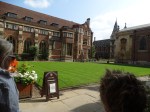
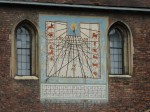
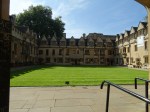
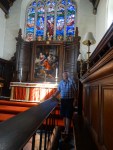
The fore court of the college is very interesting. Unlike the others there is no grass and in the centre of the court is a sundial (handy when there is sun). Graffiti adorns the walls but this is to do with successful rowing teams crowing about their victories. We are taken to the chapel and told more “secrets” from the shows. The chapel is typical but probably the smallest as this is the smallest college with accommodation for only 300 students. Typically there are 20,000 students per year shared among 38 colleges, 8 of which is for graduates and one only All Souls for Fellows (no it is not sexist – these are senior academics). We walked through the garden to see all that remains of one of the Saxon walls that enclosed Oxford, spied on the students using Merton field and viewed the spires of Christ’s College before making our way out to look at the front door of Merton College the third oldest in Oxford (1264 – University College 1249 being the oldest). Once again bloody cobbled streets. Merton St is the only remaining cobbled street and therefore distinguishable in any Morse or Lewis episode.

We then back tracked to Magpie Lane, once again crossing High St, and into Catte St passed St Mary the Virgin Church(interesting how many churches are dedicated to St. Mary the Virgin) and the precinct of the Bodleian Library and the Radcliffe Camera (this is connected to the library through underground tunnels). This is an enormous Library with miles of underground tunnels (although it is only three storeys high it has 8 floors underground) housing tens of thousands of books. It is a copyright library and therefore entitled to receive a copy of every book published in Britain. We could not get inside as it is a working library but tours are available and even tours which include the tunnels (if you know what to ask for and where to look).

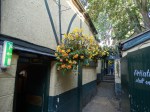
From there we moved into New College Lane (the New College was founded in the 13th century) under the Oxford imitation of the Bridge of Sighs as seen in Venice (actually it is nothing like it – the genuine bridge in Venice connects part of the old palace to the goal cells and when a prisoner passed over that bridge he sighed with resignation over his fate). Then we turned suddenly left into a small lane distinguished by a sign saying “To the Turf”. Following the lane the guide shows us the other remaining section of the original Saxon wall and the entrance to Oxford oldest pub (Yes this one also claims that title and I think the dispute has been settled by the one person buying both hotels and sharing the claim). This pub is squeezed in between other buildings and you have the distinct feeling of being underneath. We visit the scene of this crime a little later on also.

There is another exit out to Hollywell St where we pass another pub this time part of the Young’s Chain and into Broad St once again. We duck back into the Bodleian to view the door through which every student who matriculates passes on their way to the Sheldonian Theatre (a Christopher Wren building) to receive the awarding of their degree. Across the road from the Sheldonian is Blackwell’s bookshop which often features in the Morse and Lewis episodes. Reportedly the bookshop has 2.5 miles of shelving. Alongside is another Morse favourite the White Horse Pub.

There our tour finished. I felt that our guide just ran out of enthusiasm and her audience the same. Whilst I enjoyed it thoroughly I don’t think it was well organised or as well presented as the opportunities to do it better seem endless to me.

In need of something to wet the whistle Kerry and I returned to the Turf to soak up the atmosphere and an ale or two. The building is clearly old with bits and pieces everywhere very low ceilings small rooms and higgledy piggledy patios all of which gave it an intimate atmosphere. Here they made the best Pimms – not just cucumber or lemon or lime but all of those plus strawberry and apple.

We ended our day and caught the bus back to the B&B where we found that Rod and Kerry had arrived. After settling in we returned to the Turf where we did in a couple of burgers, and a bottle of wine. My photos follow.


Go back

Your message has been sent

Warning
Warning
Warning
Warning

Warning.

The Retirees Go Abroad – Somewhere different – Lincolnshire

The Retirees Go Abroad

Somewhere different – Lincolnshire

It is a grey day. The forecast is for scattered showers across the midlands and the forecast looks pretty accurate. In addition there is a grey mist hanging just above the ground so all in all a great day to stay in bed or visit Lincolnshire. So we decide to visit. But where and what?

We have joined the National Trust and this is proving to be a great investment. So I hop onto the web site and select to visit Tattershall Castle at Tattershall in the north-west and Belton House in nearby Belton Village.

Although Lincoln itself is only 35 mins from Nottingham these places are in the eastern side of the county so we had a 1.5 hour drive to our first stop at Tattershall. Lincolnshire is very agricultural and most of our drive we passed open fields of fertile looking soil going off to the horizon (shrouded in mist today). It has the appearance of being very flat with villages spread out so that the farms appear much larger than down south. I don’t know if that is true but the country side we drove through seemed largely to be farmland. There were a few changes such as the RAF bases (RAF Cranwell RAF Waddington) we passed on the way, an air museum which we will have to visit next time and RAF Coningsby from the turrets of Tattershall Castle. The RAF seems to like Lincolnshire and I have attached a link to the official website of RAF Lincolnshire museums for those interested – http://www.raf-lincolnshire.info/museums.htm.

The road was good but the mist did not leave us and we passed through some small showers/ spits of rain. We arrived at Tattershall around 11.15 am which is good timing as the Castle is not open til 11.00 am. The car park had at least a dozen cars in it surprising for what seemed one of the more remote places we have visited. We walked passed the lawn bowls green into the church yard. Wow!

A surprisingly large church stood there in front of us –the Collegiate Church of the Holy Trinity Tattershall. “The Church of the Holy Trinity at Tattershall was completed in 1500 AD having been endowed, in 1439 by King Henry VI, with Collegiate status. A Collegiate Church is one that has attached to it, a Chapter of canons and prebendaries – priests whose livings are paid through endowments and by the income from land or tithes.” http://www.httf.org/history.html.

From the moment you walked in you knew this was going to be in its original state. The sign at the entrance was the give-away. Inside you could see this was a grand church although somewhat raw by other standards. Still it had a substantial presence and was clearly loved by its community and the local bats who roost in the exterior (and sometimes the interior) of the church. It had an obvious bell tower but the cords were just out of reach. I suspect only part of the church is now used as a consecrated church. The web site above is well worth a visit and I hope my photos give you some idea of the presence of this church. We bought some local baked wares and Kerry found an “antiquities” stall purchasing some bits and pieces for the 50p each.

Walking from the church we passed under shady trees and through an open area across a timber footbridge into a building called the guardhouse (it may have once served such a purpose but today it is a ticket office gift shop and visitors centre). Immediately in front of us but probably 200 meters away is the only remaining portion of the castle, a six story tower that was once the centre of a fortified castle surrounded by two moats. One of the moats exists today whilst only part of the outer moat remains. Built in 1434 by Ralph Lord Cromwell Treasurer to Henry VI (he also served in the army of Henry IV at Agincourt) it was saved from complete demolition (and pillaging by American entrepreneurs) by Lord Curzon in 1911 and bequeathed to the newly formed National Trust in 1925. When Cromwell died in 1456, the castle was initially inherited by his niece, Joan Bouchier, but was confiscated by the Crown after her husband’s demise. Tattershall castle was recovered in 1560 by Sir Henry Sidney, who sold it to Lord Clinton, later Earl of Lincoln, and it remained with the Earls of Lincoln until 1693. It passed to the Fortesques, but then fell into neglect until bought by Lord Curzon. It remains today one of the three most important surviving brick castles of the mid-fifteenth century.

As we approached the tower we noted that there are foundations for the old kitchens in the moat. These kitchens were connected to the castle along with the guest apartments, the enclosing walls and watch towers. There are three doors at ground level the middle one leads to the basement where the castle servants lived and provisions were stored. The right hand door leads to the parlour where estate business was conducted by the Lord’s warden (tenants paid rent etc). The third doorway on the left is the stair case to the upper floors. On the first floor is the Great Hall where the Lord would wine and dine and entertain guests, the second floor was the Audience Chamber where only special; guests would be entertained, the third floor was the Private Chamber where the Lord retired for the night and the family lived, the fourth floor is the roof and the fifth floor the turrets. The sixth floor is the below ground servants quarters.

In the basement was the well for the castle, on the first and third floors there were garderobes (a medieval toilet – the garderobe on the third floor included the dressing room as it was believed the smell of human urine drove fleas and lice from clothing and this configuration is believed to have led to the word ”wardrobe”). On the second floor a dovecote was installed in one of the anterooms in the 18th century (a dovecote is a nesting construction so that the occupants of the castle had fresh eggs and meat when other sources were not available. For more information go to http://www.nationaltrust.org.uk/tattershall-castle/.

The visit to the castle was very interesting. Belton House however was entirely different. Built between 1685 and 1689 for Sir John Brownlow–Cust (they did not like the “Cust” so they dropped it despite the added wealth that marriage brought to the family) and often cited as the quintessential country house with a 1300 acre estate and deer herds. Unfortunately only the house was open and the below stairs tour would have to wait for another day. So we keyed in the post code for Belton House and Tommy took us right there – as though it was still 1700. Because Tommy took us to the front gate which these days is locked we alighted and walked the last 1.6 kilometers to the house only to find there is a new entrance from Belton Village to a car park directly alongside the house. We were not the only ones fooled by our GPS.

Even so it was pleasant walking along the avenue. It was still overcast although the mist had lifted about 3.00pm so it was cool walking along watching the deer frolic in front of us. The grounds were lush and the deer prolific. In the distance we could see a grand house in a green sea with figures running around in white. It was a cricket match. Apparently the local cricket team counts the ground in front of the house as their field.

We circumnavigated the pitch and climbed the front stairs into the marble entrance hall filled with family portraits. The house has three storeys above ground and one below. Two storeys are open to visit and the below storey is accessible only by tour. We moved into the saloon with more portraits of the family, to the Viscount Tryconel Room, to the Chapel Drawing room. Here in this room is a Delander long case clock made in the 18th century showing not only the time but has an in built calendar – a Julian calendar (a bit like a betamax video recorder wrong technology). Beside this room is the chapel which is actually in the basement and we were standing in the organ room overlooking the chapel. The organ retracted into the wall. In the Chapel Drawing room we had the opportunity to see the original colour of the room (a brilliant Lapis blue with gold and white flecks) and the degraded colour after 300 years.

In the Blue Dressing Room we saw the Lapis cabinet of 21 draws two of which were secret drawers. Italian made it is completely decorated in lapis lazuli, the favoured precious stone of the Pharohs. There was also a portrait of Richard Brownlow founder of the family fortunes and the Chief Prothonotary of Queen Elizabeth I’s Court of Common Pleas (principal clerk of the court). There are 3 main staircases in the house (not counting the hidden staff stair cases) and at this point we entered the Little Marble Hall and went upstairs. They did not forget the Cust family altogether as there is a bust of Harry in the West Stair case

Upstairs we saw the bedroom which is a bit unusual in these old country houses. There was the Queen’s bedroom and the Windsor bedroom with ensuite (Prince Charles stayed here while training at the RAF base at Waddington and I found two “toby” jugs in this room one portraying George V and the other Winston Churchill). There was the library and then the study which looked like a second library, the Red Drawing Room and then down the west staircase to the tapestry room but we could not go into the breakfast room (they had hosted a showing of the silver ware from No 10 Downing St and had not cleaned up after 17,000 people visited the display.

We then ventured out to the stables (now the shop, café, book shop etc etc,) and into the ornate Italian garden. Like all of these gardens just beautiful. The topiary was fascinating as it waved through the trees with no particular shape but joining them all together as a green wall. The Orangery (hothouse) was filled with sub – tropical plants and behind it was a formal Dutch garden. Hidden in the trees was the family church and crypt. All the Brownlow’s are there including one pair who died in 1670’s.

We needed a cup of coffee and to sit down for a rest because we now had the walk back to the car. The deer had coalesced into a larger herd but still there were the odd few rambling about as we walked back to THISTLE. The sun had finally come out we warmed up walking to the car. Our trip had ended and we now had 34 miles (yes they still use miles in the UK) to go to return to Nottingham.


Go back

Your message has been sent

Warning
Warning
Warning
Warning

Warning.

Retirees go Abroad – Lake Como Italy – Milan/Milano – Farewell

Retirees go Abroad – Lake Como Italy

Milan/Milano – Farewell

Friday we decided to try the train to go to Milano. Our hotel offers free airport transfers to Malpensa Airport. The train station at the airport provides express transport to Cardarno station in Milano. So we went to the airport on the shuttle and caught the train – 24 euros for both of us and it only takes 29 minutes. No trouble with the train but when we arrived in Milano it is not easy to find the tourism office. We got some directions which led to us purchasing an underground pass for the day (only 4.50 euros). We travelled to Duomo metro station then walked aimlessly till directed once again to the tourism office just near the Castello Sforzesco, just around the corner from Cardarno railway station. I said we wandered aimlessly.

So armed with city maps we go to the Sforzesco Castle.
“Historical background
Along with the Cathedral – Milan’s most famous and much beloved monument – the big Castle is linked to the vicissitudes and dramatic events that the city has been experiencing over the past centuries. For many years, in fact, it has represented a symbol of the power in the hands of the Dukes, as well as of the foreign dominators. Only at the beginning of the 20th century the Castle assumed its distinctive role, becoming a place of culture, which hosted numerous Lombard art collections. The Castle was named after Francesco Sforza, who transformed it into a ducal residence in 1450. But its origins date back to the second half of the 14th century, at the time of Galeazzo II Visconti. ”

For more information go to http://www.milanocastello.it/ing/home.html

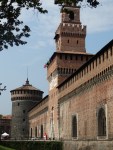
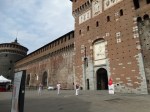
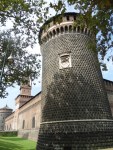
We stumbled through the castle grounds (bloody cobblestones maybe romantic or authentic but very hard on the feet) – there does not appear to be much of the military castle left now and the skeleton of the castle now holds multiple museums. I have taken photos of some of the features of the castle but it did not hold much interest for me. The internal walls are pock marked with holes which appeared to be for either ventilation of the passage ways behind or weapons windows. Either way this has been a significant fortress and center of the city with three or more circles of walls outside the main fortress. I hope my photos tell a story. Whilst wandering through in the midst of the castle we found a playful cat chasing lizards in a fountain in the wall. Then another cat and then more and more cats. I think there is a very playful and productive Tom at work here.

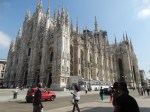
Then we walked back to the Cathedral Duomo. Magnificent grand and impressive. Facing Palassio Reale the cathedral started in 1386 and it evolved over the centuries. From the ornate finish on the outside I expected something far more ornate inside but instead it is just huge and dark – not very exciting to my mind. The thing that took our attention most was the floor and the variety of marbles creating amazing tiles for the floor. Having seen enough we headed over to the Galleria Victorio Emanuele II for a spot of shopping – ouch! The shops were very expensive and this worked up my appetite for a spot of lunch. We found a very nice little place in Via Marino and whilst enjoying lunch we worked out we were close to the Museo Teatrale alla Scala.

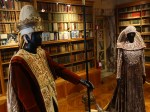
“The museum, which is adjacent to the opera house in the Piazza della Scala, was opened on 8 March 1913 and was based on a large private collection which had been purchased at auction two years earlier, with funds raised both from government and private sources. The displays include costumes, set designs, autograph scores, and musical instruments of historical interest as well as paintings of musicians and actors, and a range of related paraphernalia including precious ceramic figures portraying characters from the commedia dell’arte, and board games which used to be played in the theatre’s foyer.” Wikipedia

If you want to read more about Duomo then go to http://www.duomomilano.it/en/
and the theatre http://www.teatroallascala.org/en/discover/museum/museum.html

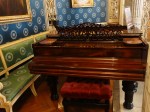
Included below are my photos which include the Steinway gifted to Franz Lizt  by  the manufacturers which was later subject of litigation to save it for the museum.

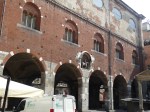
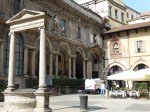
We did find something not on the tourist trail and out of the ordinary. Just near to the Duomo was an old building that had been used as a hall of justice from the mid 14th century by the Milanese and later conquerors including the Hapsburgs (Austro-Hungarian empire)and is amongst a group of buildings all with different building styles around one of the city’s old well heads. Oh yes and I found this delightful “Jolly Bar” (don’t let the innocent ice cream signs fool you) and they still use drop sided trams. There may be a lot more churches and museums in Milan but I could not get excited about them or the city unfortunately.

Photos.

The next day Kerry, after her disappointment in Milan, decided she needed some retail therapy. We were fairly unsuccessful in finding a local venue to quench the appetite for shopping so we returned to the hotel some-what frustrated. As it approach dinner time, we had to make a decision about where to dine. The hotel had been spectacularly unspectacular so we ambled down to the village. There was certainly more life in the village than the Sunday we arrived and we found a cosy and cheap pizza restaurant to dine and watch the world go by and contemplate the return journey to the UK the following day.

We had chosen to stay in a hotel near Malpensa Airport which we thought would give us best access to the lakes. We had flown into the airport at Begamo (which of course is not called Begamo Airport just to make it difficult when consulting google maps to plan your journey) so we had to drive for an hour across Milan and hope the traffic was not a problem. Well early Sunday morning in Italy no one is on the roads so we arrived two hours earlier than required. Murphy’s Law! Isn’t that the way of things.

We had an uneventful flight to East Midlands and decided we would try the bus back to Long Eaton. It was magic and only 7 pound for the two of us. A lot different to 25 pound for the early morning taxi.

Go back

Your message has been sent

Warning
Warning
Warning
Warning

Warning.

Retirees go Abroad – Lake Como Italy – The Borromeo Trifecta

Retirees go Abroad – Lake Como Italy

The Borromeo Trifecta
As we travelled back to our hotel we passed above Arona and I happened to spot Rocco di Angera on the other side of the lake. Doing some research on the internet we decided we had to visit the Rocco and complete the Borromeo trifecta. Thursday we drove over to Angera where we spotted on top of the highest point in town the Rocco.

“Rocca Borromeo at Angera.
Before 1227, the castle belonged to the Della Torre family, who lost the possession to the Visconti after the Battle of Desio (1277). In 1449, it passed into the ownership of the Borromeo family. It once belonged to the Visconti family, beginning with Bernabò Visconti and his wife, Beatrice della Scala. But it was purchased by the Borromeo family who expanded and refurbished the castle over the centuries. It still belongs to the Borromeo family. It is best known for its Hall of Justice (Sala di Giustizia) which still contains its original late 13th century fresco depicting the victory of Ottone Visconti, archbishop of Milan, at the Battle of Desio. The castle suffered damage during bombardment in the Second World War.

The castle also contains the Museo della Bambola (Doll Museum), founded in 1988 by the wish of Princess Bona Borromeo Arese, and displays over a thousand dolls made between the 18th century and the present day. Wikipedia”

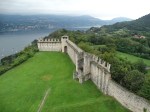
We started by walking up to the gatehouse and then onto the barbican and through the main gate but before doing so we took a look at the view from the walls of the castle. In the stable we found an old and large wine press. Inside the castle is the major museum of the history of dolls. Mixed amongst the museum are elements of the original castle but as you progress through you find some of the castle furniture and then we came across the hall of Justice. What a find and some of the original frescos still on the walls. Then there is the staircase up to the roof and the watchtower above the roof. Truly amazing. I hope my photos do it justice.

Photos

After Angera it was still early so we decided to go back to Como 40 minutes away. After programming Tommy, we drove off and I had a strange feeling that we had passed that way before. We stopped and checked Tommy. Somehow Tommy was taking us to Stresa and not Como. Como was now 1 hour 40 minutes away. Oh well a few extra euros for tolls but otherwise no real harm done.

We got to Como and it was lunch time. There is a nice little restaurant in the main square outside the Cathedral so after a healthy lunch we strolled the streets of the old city finishing off what we had started two days before.

Photos

Go back

Your message has been sent

Warning
Warning
Warning
Warning

Warning.

Retirees go Abroad – Lake Como Italy -Two out of Three (marvels) ain’t bad

Retirees go Abroad – Lake Como Italy

Two out of Three (marvels) ain’t bad

It’s Wednesday. Roberto and Sue are off to the Dolomites. We are going in the opposite direction to Lake Maggiore and the three marvels of Maggiore – Isola Madre, Isola Bella and Isola Pescatore. Well that is what Roberto told us but in truth Pescatore is another tourist trap with little of culture history or architecture to recommend it. If you want to buy a T shirt or go for a swim its fine but otherwise it is not a marvel. The third marvel is Rocca di Angera.

To understand why these rocky islands have been turned into marvels you have to understand the history of the current owners. Let me introduce the Borromeo family. “The aristocratic Borromeo family were merchants at San Miniato around 1300 and became bankers at Milan after 1370. Vitaliano de’ Vitaliani, who acquired the name of Borromeo from his uncle Giovanni, became count of Arona in 1445. His descendants played important roles in the politics of the Duchy of Milan and as cardinals in the Catholic Reformation. In 1916 the head of the family was granted the title Prince of Angera.” “The family has owned the Borromean Islands since the 16th century. The islands have beautiful gardens. Two of the islands have grand palaces, still owned by the family. Vitaliano Borromeo built a summer palace on the Isola Bella for his wife Isabella between 1650 and 1671 which was later enlarged by cardinal Giberto III. (1615–1672) and count Vitaliano VI. (1620–1690). Count Carlo IV. (1657–1734) had the garden terraces added. The family still owns the majority of the Borromean Islands.”(Source – Wikipedia).

Pescatore was a fishing village and now one large shop/ rest stop for tourists. Rocco on the other hand was a fortified castle which together with Rocco di Arone (a fortified castle on the opposite shore destroyed by Napoleon when invading Lombardy) controlled the place where the lake drains into a river. We visited Isola Madre and Isola Bella on Wednesday and Rocco di Angera on Thursday. We chose to travel to Stresa and to catch a water taxi to each of the 3 islands for 15 euros each one way. The taxi (looked like a Venetian canal cruiser) takes you to Madre and gives you 2 to 2 .5 hours to view this island and its palace. I formed the view that the taxi operators want you to go to Pescatore where they hope you will spend your money. I wonder if the taxi operators don’t get any additional revenue from Madre or Bella hence the limited time on Madre. At Pescatore the taxis call every half hour to take you to Bella with the last taxi leaving at 4.30,

Isola Madra

“Isola Madre, at 220 m wide and 330 m long, is the largest island of the Isole Borromee archipelago which falls within the Italian part of the Alpine Lake Maggiore, in the Province of Verbano Cusio Ossola, Piedmont.” Wikipedia

We boarded our Venetian canal cruiser and glided across the lake to Madre. As you approach this little rock by boat the first thing you notice is the palace covering just about the whole island. A little closer and you see a gift shop and restaurant called La Piratera (and like the pirates of old they will rob you blind) sitting hard up against the water but that is the only commercialism you will encounter. Sure you have to pay to get in to the gardens and the palace but you will appreciate this is a moderate cost for what you see. Try to purchase a ticket which gets you into Madre and Bella (35 euros) and save 5 euros and unless you are very interested in the botanical information on the garden don’t worry about the programme.

The walk to the palace is cool and relaxing with outstanding Lake views. Plants from all over the world are in a garden designed for the leisure of the stroller. Australian casuarinas to black bamboo are some of the strange plants found here. There are white peacocks and other large birds roaming around and an aviary but the most amazing piece was a large Tibetan Kashmir cypress (Cupressus cashmeriana) which appears to have been planted in 1862 following a trip to the Himalayas. Until 2006 it had grown steadily to its grand height towering over the palace. Then a whirlwind uprooted the tree but rather than pull it out the family replanted it and supported it to where it continues to survive to day.

We toured inside the palace but photos were not permitted. Unlike other palaces I have visited this had the feeling of openness and light, coolness and relaxing surroundings. It has not always been a home. There is a lot of evidence of gun emplacements and guard points. One of the surprises was the marionette theatre and the variety of the marionettes in the house. These were for the entertainment of the family and their guests but I was to be surprised even more at Isola Bella.

The island structures are completed with the family chapel.

Photos

Isola Pescatore

When we arrived at Madre there was only one other couple with us but the numbers quickly grew. When we sailed for Pescatore the boat was full as was the island. It was lunch time so we went looking for a restaurant. We crossed the island to get away from the crowds and chose an outdoor umbrella restaurant for no other reason than it looked inviting. Unfortunately looks are deceiving and we waited for 1 hour to get a salad and a pizza. Like most of this island this was disappointing.

There was an interesting small church on the island and some interesting houses and lanes. The church had a cemetery at the back and all of the tombstones had a photo of the deceased – something I have not seen before. Amongst my photos you will see a Jolly Roger and I thought that was the definition of Pescatore. So we sailed for Isola Bella.

Photos

Isola Bella

As you approach you are struck by how large this palace is and how much of the island it consumes. Unlike Madre this is palatial as well as grand. No photos were permitted but like most laws and speed limits in Italy everyone ignores them so you will see my photos below.

At the entrance there is an enormous hall with a domed ceiling. I got some of the best views of Pescatore and Madre from the windows of the palace. Then there were the marionettes and the theatre settings. These were just wonderful. I have given you just three examples in my photos.

The gardens were very different from Madre but just as wonderful. At one end is a wall of statues and fountains which run back down to the lake in 10 terraces. I found a pond in which there was a frog croaking but I could not find the frog so I photographed one of the water Lilly flowers instead. But the unique thing was the grottos.

Rooms in the palace decorated to look like underwater grottos. I have taken photos and they will give you an inkling of the amazing scenes.

Photos

We got back to Stresa about 4.00 pm and I noticed on the way back that there was a cable car running from a building at the wharf up into the hills. We investigated and not really understanding what we were doing we parted with 40 euros to ride the cable car and do something else when we got to the top.

The trip started very quickly travelling by cable car up to Mottarone 1385 metres above the lakes. We could see the three islands then the whole of the lake but we were nowhere near the top yet. We changed cable cars and went up to 1491 meters where we took a chair lift to the top. I have no idea of the height at the top – suffice it to say it was high and above 1500 metres.

From the top we were able to see the whole of the lakes district for 360 degrees. We also saw the Alpyland fun park. For a further 5 euros each we took a trip on the bob sled ride on rails. 1.2 klms of twisting down hill track and a bloody steep hill at that. Threatened with the loss of my manhood I drove the bob sled with Kerry in front of me and kept the sled to a reasonable pace (he he he heeee – she screamed her head off). I got a few photos which will give you the idea and show you the scenes from the top. Truly magnificent and well worth the cost.

Photos

Go back

Your message has been sent

Warning
Warning
Warning
Warning

Warning.

Retirees go Abroad – Lake Como Italy – Where are the rich and famous

Retirees go Abroad – Lake Como Italy

Where are the Rich and Famous?

Tuesday and our second day in Italy. Roberto is touring around Lake Como and going to Belliago by ferry. George Clooney is supposed to have residence somewhere near here which might be of interest to some people so it did not upset my day that he remained reclusive. Having arranged with our Italian mate to meet at Bellagio, I plugged in “Ferry Belliago” into the GPS (which we call “Tommy” as it is a TomTom) and we set sail. Now I was not expecting that Tommy would take me literally so when Tommy announced “after 800 metres turn left and take the ferry” I was astounded. But sure enough there it was a car ferry to Bellagio.

We parked and for 10 euros each return we boarded as walk-ons arriving at Belliago 15 minutes before the bus tour/boat tour. Belliago is located on the western shore of Lake Como and a tourist trap with expensive shops set in an old village of many stairs (it is all very hilly). Strolling through the village was interesting once we got away from the shops. One of the interesting buildings was the local church which had an amazing interior. The exterior is not so exciting. But I got an interesting photo of the back of the church which I have included below.

Roberto and Sue turned up with the rest of their tour about 20 minutes after us and we then started exploring the remaining areas of Bellagio. Kerry and Sue found an oversized cork screw outside one of the many “caves” at Bellagio.

Lunch was partaken in the back streets as the lake front is overdone. After lunch I found the oldest building in Bellagio behind the church – the only remaining part of the 12th century watch tower. There were some exquisite gardens, beautiful vistas, and ancient vestiges of an elegant past. Time went quickly and like Cinderella, Roberto and Sue rushed back to their “coach” to join their tour.

We returned to the other side of the lake and drove back toward Como. On the way we stopped at another village. Argegno is on the lake and has a stream running through it. Colourful and quaint we felt compelled to walk through before taking a milkshake at the Hotel Argegno. Some photos follow.

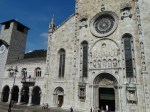
Roberto (being first generation Australian from Italian heritage) had expressed the view that there was nothing worth looking at in Como. We thought we would check it out for ourselves. So when we drove into a central Como car park alongside the remnants of an old walled city then to find in the basement of the car park Roman foundation for the original Roman village founded in or around 1 BC (it was moved from the hills to the site of these foundations on the order of Julius Caesar) we had to disagree. There is evidence of an earlier Bronze Age village present also. I have included some photos of the remaining towers, the foundations and a massive cathedral constructed in 1397 on the centre square. There is also examples of 16 th century residences still in use today. As well it is situated on the lake with very accessible public parks and gardens close to the city centre. We found at least two other churches in the old city precinct and just outside the city is a funicular. So I have no idea what city Roberto visited to find nothing of interest.


Go back

Your message has been sent

Warning
Warning
Warning
Warning

Warning.

Retirees go Abroad – Lake Como Italy – Up, Up, and Away

Retirees go Abroad – Lake Como Italy

Up, Up and Away

Our first morning in Lake Como. After 3 to 4 hours sleep, I awoke to a cloudy sky and irregular showers. The sunny day Sunday had promised was gone but we had made our plans to meet Roberto and they could not be changed. To add insult to injury when we entered onto the highway we were met by a car park. Some multi vehicle collision was holding up all traffic (see photo below) and in true Italian style we reversed back through the entry lane to try a new direction and as we crossed over the highway the blockage had been cleared and traffic was flowing again.

We finally started our journey for Lugano on the lake of the same name in Switzerland. There are tolls on most autostrada in Italy and the A9 is a set 2.20 euro. But the Swiss do it differently. At the end of the A9 we were met by the Swiss border control. They were not interested in our passport. They only wanted to collect 35 euros road tax. (Note to self – Switzerland charges a 70 euro toll to use their toll roads for one year and this toll reduces to half at June). So the cost for the joy of visiting Roberto – 35 euro. Even though we were delayed twice we still managed to beat Roberto with his friend Sue into the old city. After the usual ritual – a cuppa and a transfer of gossip -we decided to find the funicular to the top of Monte Bre for views of Lugano and the lake. We found a disused funicular and on the basis that I had read on the internet that you caught one line to join the main line to the top, we climbed a couple of hundred stairs to find that we were way off target. But we got some great photos. We decided to grab a cab and asked to be taken to the funicular but went not to Monte Bre funicular but Monte San Salvador Funicular – I did not even know there were two funiculars in the town. Nevertheless we bought tickets which included lunch at the summit. Two (2) funicular journeys later we were 813 meters above sea level and in a white out – low cloud prevented us taking in the view. So we went to lunch which turned out to be pretty good. We had hoped the cloud would lift after lunch but no such luck and Roberto and Sue had a bus to catch. On a clear day the views would be fantastic. An excursion I can recommend.

Roberto and Sue rejoined their tour and we then drove up to Mont Bre. Kerry drove and we both were very nervous about this trip. Monte Bre is higher than Monte San Salvador and the road is winding with an ever decreasing road width. Further because it is higher we drove through the cloud with oncoming traffic just appearing in front of us. We arrived in Monte Bre with a feeling of relief and trepidation as we had to drive back down.

Monte Bre is an ancient village of stone houses. Rough paved lanes join the houses into a village. The village has been home to a number of renowned artists who lived and worked in the village and an outdoor walking museum of their art and others artists has been developed. We walked around the outdoor museum which is in the lanes of the village with art posted on the exterior of houses. Kerry was fascinated with the architecture of the village particularly the old and its integration with the newer (there was nothing new). If you wish to read more go to www.lugano-montebre.ch.

Suffice it to say I drove down the hill and we found out that the funicular was not operating that day. In fact we witnessed the operators testing the funicular on our return trip. We had decided to visit Roberto and Sue at their hotel in Saranno for dinner. Saranno is a bigger village and the Grand Hotel (where they were staying) in Saranno is a true 4 star hotel when compared with our Best Western. We had aperitifs at the bar and a pizza at a cafe near the Hotel. The cafe was in a derelict looking building beside a pile of broken concrete at the railway station. Cheap in every sense. So it was home to Best Western and a good nights sleep. I have included photos of our trip up Monte San Salvador and trip up Monte Bre:


Go back

Your message has been sent

Warning
Warning
Warning
Warning

Warning.

Lake Como Italy – The Trouble with cheap airfares…..

Retirees go Abroad – Lake Como Italy

The Trouble with cheap airfares…..

Sunday morning and the alarm goes off at 4.30am. We are prepared to dress and catch the taxi we have booked for 5.00am to go to East Midlands Airport for our flight out at 7.40am. However despite the best laid plans we did not read all the endorsements on our tickets so we went through security to learn that we were supposed to get our tickets endorse with our passport check before going through security. This would not have been a problem if a particular Greek family had not delayed our clearance through security because they ignored every possible preparation before going through security – they had scissors, knives, aerosols and liquids all through their carry-on luggage. Now East Midlands may be a rural airport but it has 23 gates and during school holidays is really busy so our margin for error evaporated and instead of quietly having breakfast before catching the plane we were breaking our necks to get to the gate.

Oh a point to note even if you miss the passport check as we did, you can still get the check performed at the gate but they don’t like doing so.

The airport trauma behind us, we settled in for our flight to Bergamo. Ryanair is a true no frills airline and we purchased breakfast taking turns to eat because of the lack of space.

Arrived at Bergamo and picked up the car. Ooh an upgrade. A BMW station wagon. It is twice as big as the car Kerry wants so not a good start. Anyway we made it to our hotel Best Western at Cardano Al Campo by accident (spotted a sign on the side of the road) and at first when we first saw the building we were quite impressed. But it was deceiving.

The room was large and spacious but the carpet has seen a better day. We unpacked and went down to the bar for some lunch. Well the porter was called to serve us in the bar and the bar snacks were lasagne or cannelloni microwaved to death. Not a good start. We spent the afternoon walking around Cardano Al Campo centre (note to self – don’t expect anything to be open in an Italian village between 12.00 and 4.00 on a Sunday afternoon). But we did find a bar run by a Chinese expat from Tsin Jing and the local drunk who wanted to make friends and take us to dinner. We politely passed on the opportunity.
We decided to have dinner at the hotel which was a big mistake. We had the buffet which was cold when it was intended to be hot the fish was full of bones and the choice very limited. Most disappointing. After dinner we went to our room to plan our meeting with Roberto who was going to Lugano on a bus tour. But first I had a teleconference with Australia for three hours at midnight.

Photos of Cardona Al Campo on a lazy Sunday afternoon.

Go back

Your message has been sent

Warning
Warning
Warning
Warning

Warning.