Bishops Visit – Interval- De je vu – Southwell Minster

Between returning from Scotland and leaving for France, we had a window of opportunity which I have called “the Interval”.

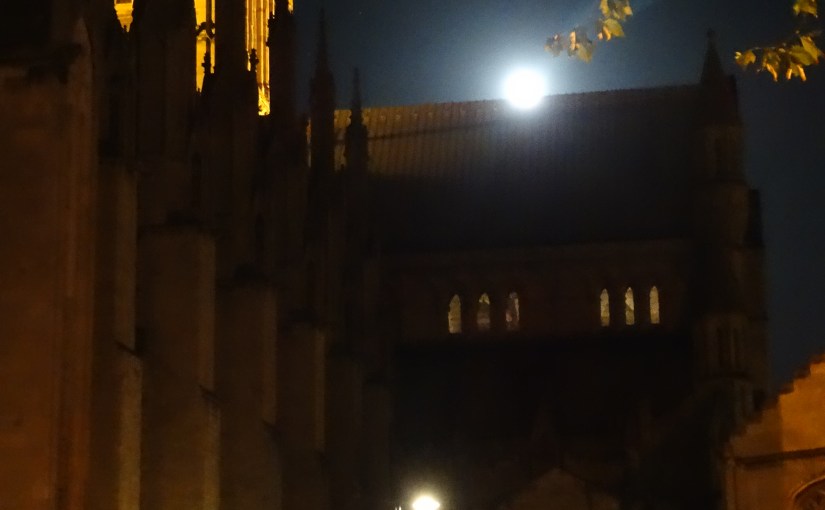
During these few days we visited Southwell Minster north east of Nottingham, Haddon Hall north west of Nottingham and London (I presume you know where that is). This blog concerns Southwell (pronounced “Suthull” by Nottinghamites and “South Well” by its residents – work that out). Norwell (pronounced “Norrell”) approximately eight miles northwest may support the notion of there being “south” and “north” wells in the area.

Southwell is a town in Nottinghamshire, best known as the site of Southwell Minster, the seat of the Church of England diocese that covers Nottinghamshire. The town lies on the River Greet, approximately 14 miles (22 km) northeast of Nottingham.

The early history of this Minster as noted by Wikipedia: “Eadwy of England gifted land in Southwell to Oskytel the Archbishop of York, in 956. Eadwy’s charter is the first dated reference to Southwell. Evidence of a tessellated floor and the 11th-century tympanum over a doorway in the north transept are evidence of the construction of the minster after this time. The Domesday Book of 1086 has much detail of an Archbishop’s manor in Southwell. A custom known as the “Gate to Southwell” originated after 1109 when the Archbishop of York, Thomas I wrote to every parish in Nottinghamshire asking for contributions to the construction of a new mother church. Annually at Whitsuntide the contributions known as the “Southwell Pence” were taken to the minster in a procession that set off from Nottingham headed by the mayor followed by clergy and lay people making a pilgrimage to Southwell’s Whitsun Fair. The Southwell Pence was paid at the north porch of the minster to the Chapter Clerk. The name of this custom – the Southwell Gate – derives from the Scandinavian word “gata” meaning street or way to. In its original form it persisted well into the 16th century. In 1981 Dolphin Morrismen revived the tradition.

Geoffrey Plantagenet was ordained as a priest at Southwell in 1189. On 4 April 1194, Richard I and the King of Scots, William I, was in Southwell, having spent Palm Sunday in Clipstone. King John visited Southwell between 1207 and 1213, ostensibly for the hunting in Sherwood Forest, but also en route to an expedition to Wales in 1212. The Saracen’s Head was built in 1463 on land gifted in 1396 by the Archbishop of York, Thomas Arundel, to John and Margaret Fysher. When built, the first floor overhung the roadway in the vernacular of the time.

In 1603, James VI of Scotland passed through Southwell on his way to London to be crowned King James I. During the English Civil War, King Charles I spent his last night as a free man in May 1646 in the Saracen’s Head (then the King’s Head), before surrendering to the Scottish Army stationed at nearby Kelham. The fabric of the town, the minster and Archbishop’s Palace suffered at the hands of Oliver Cromwell’s troops, as they sequestered the palace as stabling for their horses, broke down monuments, and ransacked the graves for lead and other valuables. In 1793, iron rings fastened to the walls to secure the horses were still in situ. The end of the civil war left the Archbishop’s Palace in ruins apart from its Great Hall. It is reputed that Cromwell also stayed in the King’s Head.”

So you can see that this small town (around 7,000 people) has played a big part in bits of history of the UK. The Archbishop’s Palace was home to Cardinal Wolsey who was Henry VIII’s advisor and when unable to secure Henry’s divorce from Rome Wolsey hid out at Southwell until summons by Henry to London but fortunately for Wolsey he died on his trip back to a trial and execution planned by Henry.

The Saracen’s Head is still there. It changed its name from the King’s Head when Charles lost his head. So we visited the Minster and the pub. Whilst at the Pub we picked up this fascinating leaflet on the history of the hotel which told us more of the story of Charles I last meal than the dry facts given by Wikipedia. Remember that in 1642 Charles had raised his standard at Nottingham Castle to signal the beginning of the Civil War. By 1646 the Royalist Army had been all but defeated or surrendered. After the Battle of Naseby Charles realised he needed the Scots to help him defeat the Parliamentarians.

The leaflet told us that Charles escaped from London and went to the Inn disguised as a Clergyman with his clerk to meet with the Scottish commissioners then in Southwell Minster with a regiment of Scottish soldiers. You may recall in earlier blogs I have written about Cromwell’s son in law Henry Ireton and how he was negotiating with Charles around accepting a role as constitutional monarchy. Well the Scots were talking to Charles about supporting him if he accepted Presbyterianism as the religion of England and Ireland amongst other things.

So Charles revealed himself to the Scottish general and started negotiations to have the Scottish forces join his Royalist Army. However he prevaricated so much (as he was doing with Ireton) and refused to sign an agreement that the Scots who left Southwell and marched with Charles as their “prisoner” to Kelham outside Newcastle where they treated with Cromwell’s Parliamentary army and handed over Charles in exchange for 400,000 pounds. And, as they say the rest is history and Charles lost his head at Whitehall on January 30, 1649.

Whilst at the pub and we saw a copy of Charles I death warrant signed by Parliament and in particular Cromwell and Ireton. The leaflet says that as well as Charles I many other notable people stayed at the Inn, namely:

  • Lord Byron (who lived close by),
  • Cardinal Wolsey of course
  • Kings of England, Richard I, Richard II, John, Henry II, Edward I, Edward II, Edward III, and Edward IV
  • King of England and Scotland James I
  • Charles Dickens – he was a very wide travelled individual as he has popped up as a visitor in many places we have been; and
  • The Beatles

So well worth a visit to this village and see the Minster (there are displays of the remains of an old Roman villa under the Minster visible, Saxon “bread” pews and Norman and Gothic architecture), the ruins of the Archbishops Palace and the restored Great Dining Hall and the Saracen’s Head (so named as the sword used to behead Charles was a Saracen sword)
Bishops Visit – York the city of the Viking – St Leonard’s Hospice and lighting the Christmas Tree in St Helen’s Square

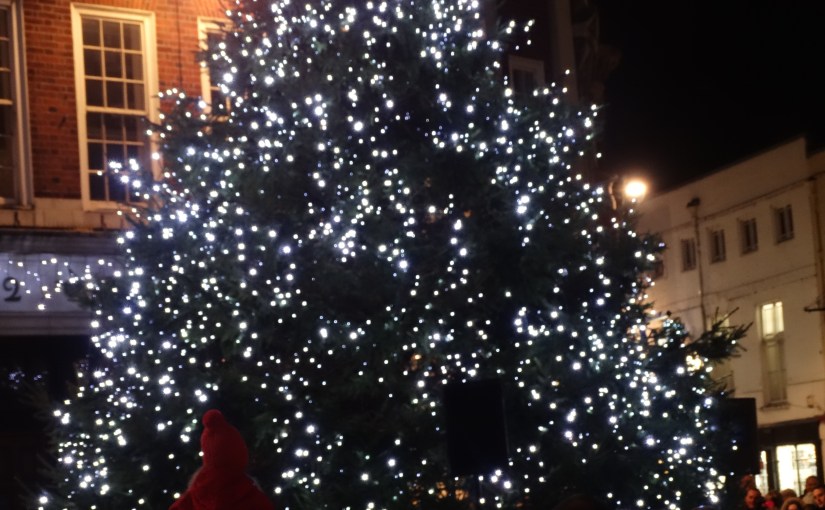
It started with a band, horns and drums assembling in the square around a plain fir tree. Then the school children assembled on the dais and the crowd closed in. The carols started and the crowd sang along to all the old favourites, Good King Wenslas, Silent Night, Once in Bethlehem and more. We were shivering with cold but transfixed by the joyful sight. St Leonard’s Hospice was lighting the Christmas Tree in St Helen’s Square, in the old town of York.

Then suddenly the tree was lit up to spontaneous applause and cries of Merry Xmas. This was the end of our first day in York. Filled with the spirit of Xmas we journeyed home to our hotel. We would have tomorrow to explore more.

Go back

Your message has been sent

Warning
Warning
Warning
Warning

Warning.


Bishops Visit – York the city of the Viking – Merchant Adventurers

The following day we visited The Merchant Adventurers’ Hall which is a medieval guildhall. Other such guilds still exist such as in Bristol and London, but do not have the medieval hall such as in York. The majority of the Hall was built in 1357 by a group of influential men and women who came together to form a religious fraternity called the Guild of Our Lord Jesus and the Blessed Virgin Mary. In 1430 the fraternity was granted a royal charter by King Henry VI and renamed ‘The Mistry of Mercers’. It was granted the status of the Company of Merchant Adventurers of York by Queen Elizabeth I in the sixteenth century. The main part of the building consists of the Great Hall and the undercroft, which was originally a hospital or almshouse for poor people of York.

The Great Hall is a timber-framed structure and is the largest timber-framed building in the UK still standing and used for its original purpose. The roof of the hall is of two spans supported by a row of large central timber posts. It includes complex crown posts and is held together by wooden pegs.

The undercroft, like the Great Hall, is divided in two by its supporting row of timber posts. The undercroft also provides access to an attached chapel built for the use of the ill and poor in the hospital as well as the members of the Merchant Adventurers’ Guild. It is still used for worship.


The Hall belongs to and is still regularly used by The Company of Merchant Adventurers of the City of York, who still exist as a charitable membership group. They have an extensive set of records, with documents dating from the 13th century and accounts dating back to 1432.

You can see more at their web site: http://www.theyorkcompany.co.uk/.


Lady Peckett’s Lane. Kerry loves to poke her nose into these sort of places just to see what is there.

Go back

Your message has been sent

Warning
Warning
Warning
Warning

Warning.


Bishops Visit – Bothwell Castle

After resting in Perth, we had planned to visit Scone Palace on our way to York but as is often the case this time of the year it was closed for the winter so a quick change of plan and we visited Bothwell Castle.

Historic Bothwell Castle “is a large medieval castle sited on a high, steep bank, above a bend in the River Clyde, in South Lanarkshire, Scotland. It is located between Bothwell and Uddingston, about 10 miles (16 km) south-east of Glasgow. Construction of the castle was begun in the 13th century by the ancestors of Clan Murray, to guard a strategic crossing point of the Clyde. Bothwell played a key role in Scotland’s Wars of Independence, changing hands several times.

The huge cylindrical donjon was built in the 13th century, but before the rest of the castle was completed it was severely damaged in a series of sieges. Rebuilding in the early 15th century enlarged the castle, but it was abandoned by the 18th century. The present ruin is rectangular, with the remains of the donjon to the west, and the later Great Hall to the east. The courtyard is enclosed by long curtain walls, with round towers at the south-east and south-west corners.” (source Wikipedia)


We had a little difficulty finding this site because of the surrounding residential development. However once you arrive it is immediately apparent that this edifice has had a tumultuous life. Parts of the former castle like the well and a watchtower – now only the footings remain, lie scattered in front of todays entrance  . Inside we met a very friendly and knowledgeable volunteer for the Scottish National Trust. We showed that we had some interest in the history and then he could not do enough for us right down to displaying for us chain mail, a two handed broad sword and the various arrow head used in the medieval period. If he had a trebuchet (early form of catapult) I am sure he would have rolled it out for us.

The main part of the remaining castle the donjon or keep was under maintenance so we could not go inside but we were able to tour around the court and our friendly custodian opened the basement so we could view a display of history cards and he told tales of the how the Scots prevented captured English Long Bow men from raising their fingers against Scotland ever again. They chopped them off (the bow fingers that is) giving a two fingered salute was how the English returned the compliment to the Scots and just as the salute is an insult today so it was in the 13th century sieges of Bothwell Castle.

Go back

Your message has been sent

Warning
Warning
Warning
Warning

Warning.

Bishops Visit – York the city of the Viking – Evensong at York Minster

After Bothwell we travelled down to York where stayed at the Hotel Noir. A descent hotel, reasonable cost, with lots of character and an easy walk to the old city. We arrived in the late afternoon and made our way by cab (we did not know how close we were at this stage) through the traffic striving to get to York Minster for the Evensong service.

Evensong is different from Vespers but I don’t know how – it appeared very similar to Vespers we participated in at Lincoln cathedral. Anyway, we gained entry to the Minster just in time to witness the choir convening outside the chapel and singing before enter the chapel for the service. No photos allowed but a certain individual did not tell me that insisting that I take the photos appearing herein. I have done my penance for this blasphemy.

The service was enjoyable with a superb male choir chanting and singing us through the service. Once the service was completed we ventured out into the old city lit up from head to toe for Xmas.

Earlier we had wandered around soaking up the history of York. The schools were running a competition for the best nativity scene and they were featured in many of the shops around the town.

Walls of the City

Before taking to the walls we journeyed through “the Shambles” and down to the river to stroll along the bank. It was too bloody cold so we retreated to a coffee shop to reconsider visiting the Walls. Fortified we proceeded with our plan.

The old city of York is partly enclosed by the city walls. On a cold autumn evening we braved the walk on the walls giving different views of the cathedral and the city beyond.

After strolling the walls we returned to the Cathedral to meet Doug and Neri where we found them trying to hail a taxi to get out of the cold and back to the hotel.


Bishops Visit – Castle Howard

Castle Howard is a stately home in North Yorkshire, England, 15 miles (24 km) north of York. It is a private residence, the home of the Howard family for more than 300 years. Castle Howard is not a true castle, but this term is also used for English country houses erected on the site of a former military castle. It is the fictional “Brideshead”, of  Brideshead Revisited.


The house is surrounded by a large estate which, at one time, covered over 13,000 acres (5,300 ha) and included the villages of Welburn, Bulmer, Slingsby, Terrington and Coneysthorpe. In 1952, the house was opened to the public by then owner, George Howard, Baron Howard of Henderskelfe. It is currently owned by his son, the Honourable Simon Howard, who grew up at the castle.

A large part of the house was destroyed by a fire which broke out on 9 November 1940. The dome, the central hall, the dining room and the state rooms on the east side were entirely destroyed as well as valuable paintings and mirrors. Some of the devastated rooms have been restored over the following decades. In 1960–61 the dome was rebuilt and in the following couple of years, the frescos on the dome was recreated. The East Wing remains a shell, although it has been restored externally. Castle Howard is one of the largest country houses in England, with a total of 145 rooms.

Go back

Your message has been sent

Warning
Warning
Warning
Warning

Warning.

Bishops Visit – York the city of the Viking – Jorvig Viking Centre and Barley Hall

The Jorvig Viking Centre is widely advertised in York as a must see. Despite its appearance as a commercial kids attraction, this is a serious historic/archaeological site and reconstruction of Viking life in York. Whilst the archaeological finds are there on display along with the work to uncover them, a ride through a reconstruction of an 890AD village is part of the experience. The ride takes you through the village at a time of change in the construction of their homes and there are real life smells sounds and visual effects. As you would expect no cameras allowed but you can see more at their web site: http://jorvik-viking-centre.co.uk/ and it is worth the visit.

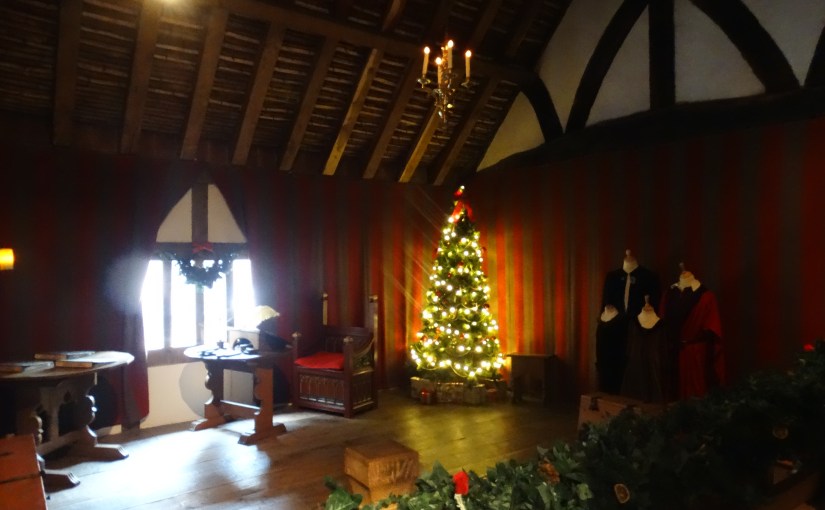
After visiting the Viking Centre we made our way (with some hiccups) to the Barley Hall. Named after Professor Maurice Barley who supervised the restoration of the hall, the Hall started life in 1114AD when Henry II established an Augustinian Priory for a community of hermits. In 1540 Henry VIII closed the Priory and confiscated the property. The hall was then used for multiple purposes thereafter and gradually is covered over with later development. In 1984 the building was due for demolition to make way for a new development, When a survey of the site is done the old building is rediscover and in 1987 it was purchased by York Archaeological Trust and restored and opened to the public by 1993.

On the ground floor, Barley Hall comprises a number of rooms. The store room, used as an admissions area, contains a large quantity of original 1360 woodwork, which leads onto a second store room, now called the Steward’s room. At the heart of the building is the Great Hall, a 1430 construction, decorated on the basis of equivalents elsewhere in the city of York. The building also includes a pantry and a buttery. On the first floor is the parlour, which overlooks the hall, a gallery and several bedchambers. These rooms now form a museum of medieval life in York. Rather gruesome and interesting at the same time. To read more I suggest a visit to http://barleyhall.co.uk/.

Go back

Your message has been sent

Warning
Warning
Warning
Warning

Warning.


Bishops Visit – France and More – Dampierre and Cognac

Kerry and I had been to Cognac previously so going back there was only intended to be a quick visit. There was no hurry this morning, no ferry to catch or traffic to avoid so we cruised through bright sunlight with clear skies with expectation that we would travel wider than just Cognac today. Tommy decided to give us the “Cook’s Tour“ and we travelled down back roads past thousands of vines all dedicated to the divine brandy called cognac.

The weather is not a trustworthy friend for as we arrived at Cognac the wind rose and the temperature dropped – I could feel the cold through my corduroy trousers and my fingers were losing sensation without the warmth of gloves. As we approached the town we caught sight of this odd house overlooking the river and the town boundary for Cognac. Cognac is situated on the river Charente between the towns of Angoulême and Saintes. The majority of the town has been built on the river’s left bank, with the smaller right bank area known as the Saint Jacques district. The town is situated on one of the pilgrimage routes to Santiago de Compostella. We parked on the banks of the River by the St Jacques Gate a remnant of its medieval past.

Flying high above us was the flag of Hennessy and the flag of Otard, two of the international distillers of Cognac located in the city (there are three other internationally known distillers in town – Camus, Remy Martin and Martell – and many lesser known brands as well). But there is more to this city than the distilleries.

We start by walking through the Gates of St Jacques along the cobbled streets to the city centre. The architecture tells a story of an old city with a variety of influences. Cognac was unknown before the 10th century and was established as a fortified town which changed hands a number of times during the 100 year war. The Chateau de Valois remains looming over the township but it is closed for visitors til next year. One of the special sights was the “Maison de la Lieutenance” the house of the Lieutenant General of Cognac from 1603 to 1624. Made of timber rather than stone and ornamented with carved figures it is unique.

Strolling on up the hill we discover a whole new Cognac. Kerry and I had gone straight to Hennessy last time we visited but there is another part to the town (particularly the old town) which we had not seen. I was sent back to the car to bring it up to the centre and on returning found the girls had found the shopping. Doug and I found St Leger Church.

As we passed through the mall I noticed that some of the citizens were more interested in modern history as shown by the graffiti of Marilyn Munroe. We made our way to the centre of the old town and found a nice coffee shop. Kerry found out the hard way that the southern French have a different idea of a cappuccino – espresso topped with whipped cream and sprinkles! We ended up overstaying our planned time and with a special dinner tonight we headed back to Dampierre. Not to be out done Tommy found even smaller roads in even remoter parts of the Charante to get home.

Go back

Your message has been sent

Warning
Warning
Warning
Warning

Warning.

Bishops Visit – France and More – Dampierre and Ile de Re

Lying just off La Rochelle are the islands of Ile de Re and Ile d’Oleron. We only had time to visit Ile de Re this time.

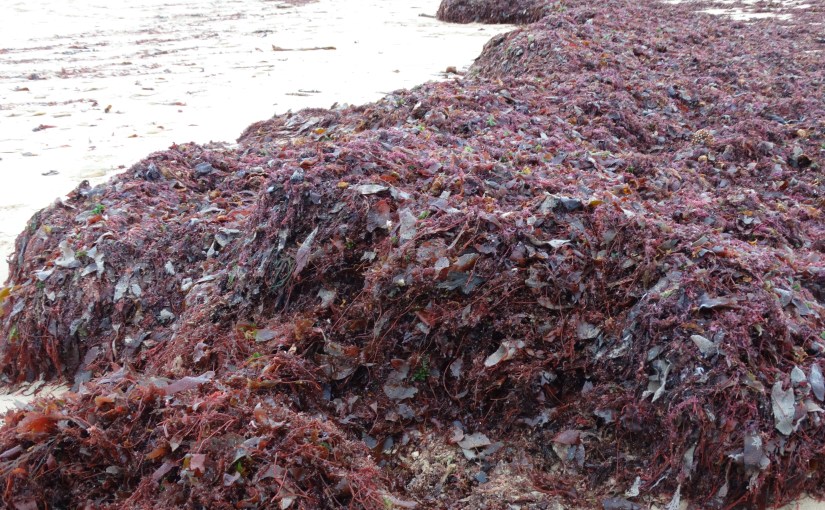
An impressive new bridge and an expensive toll now give easy access to the island and its oyster farms. There are also many residents on the island with a number of villages dotting across it. We drove out to the most westerly point through fields of grapes (that is an interesting terroir for wine grapes) and ponds of oysters. As you might expect the western point was wind swept with large masses of mixed sea vegetation bundled up on the beach. A very interesting colour and contour across the beach. See the featured image at the beginning.

The island is popular as a tourist destination with pretty villages across the island. We called into Ars en Re. We were drawn by the unusual spire on its church and then by its picturesque setting. As we strolled through the streets to the marina it commenced to rain driving us into a local emporium of ales and brews. The ceiling was covered with memorabilia and there on the wall was a photo in sepia shades of three of the 19th century’s most powerful men – King George V of Great Britain, Tzar Nicholas of Russia and Kaiser Wilhelm. George and Nicholas were almost twins but Kaiser Bill had little family resemblance. Strange that with all three being cousins.

The sky was beginning to drain of colour and we did not want to be travelling in darkness back to Dampierre it being so rural that without the moon to show the way we would travel in pitch black darkness.

Go back

Your message has been sent

Warning
Warning
Warning
Warning

Warning.

Bishops Visit – France and More – Dampierre and La Rochelle

Boxing Day started with a dense fog which overnight had settled over the Charente-Maritime and we were hoping to visit La Rochelle and Ile de Re. However Terri assured us that more than likely it would be clear on the coast. So we loaded up the esky with a Xmas leftover picnic and sailed off to La Rochelle. We chose to pass through Surgeres rather than the freeway into La Rochelle thus wetting the girls appetite to do shopping in the old village.

We parked on the waterfront under the old city walls, then walked through the old harbour entrance into this famous maritime city of France and at times England. The history and its influence are astounding for a city few people I know are even aware it exists.

The old city is very unique with its covered footpaths and the remains of medieval fortifications and modern submarine pens built by the Germans during WWII still visible. I have extracted from Wikipedia the history of the city and set it out below for those interested. For those not interested I have posted some photos which I hope give you some idea of the quaintness of this place and its seaward region of Ile de Re. More on the island in another blog.

La Rochelle was one of the centres for Huguenots and therefore involved in the Religious Wars in France and I found a Protestant Church which has survived those  Wars. The waterside quays remain and are frequently adorned with markets and the lighthouse located in one of the main streets also remains and is operating..


Potted history of La Rochelle

La Rochelle is a city in western France and a seaport on the Bay of Biscay, a part of the Atlantic Ocean. It is the capital of the Charente-Maritime department. The city is connected to the Île de Ré by a 2.9 kilometres (1.8 miles) bridge. Its harbour opens into a protected strait, the Pertuis d’Antioche.

The area of La Rochelle was occupied in antiquity by the Gallic tribe of the Santones, who gave their name to the nearby region of Saintonge and the city of Saintes. The Romans then occupied the area, Roman villas have been found at Saint-Éloi and at Les Minimes, as well as salt evaporation ponds dating from the same period. La Rochelle was founded during the 10th century and became an important harbour in the 12th century.

Plantagenet rule (1154–1224)

Eleanor married Henry Plantagenet in 1152, who became king of England as Henry II in 1154, thus putting La Rochelle under Plantagenet rule, until Louis VIII captured it in the 1224 Siege of La Rochelle. The Knights Templar had a strong presence in La Rochelle since before the time of Eleanor of Aquitaine.

During the Hundred Years’ War in 1360, La Rochelle again became English. La Rochelle however expelled the English in June 1372, following the naval Battle of La Rochelle. In 1402, the French adventurer Jean de Béthencourt left La Rochelle and sailed along the coast of Morocco to conquer the Canary Islands. Until the 15th century, La Rochelle was to be the largest French harbour on the Atlantic coast.

During the Renaissance, La Rochelle adopted Protestant ideas. An early result of this was the burning at the stake of two “heretics” in La Rochelle in 1552. Conversions to Calvinism however continued, due to a change of religious beliefs, but also to a desire for political independence on the part of the local elite, and a popular opposition to royal expenses and requisitions in the building projects to fortify the coast against England. La Rochelle was the first French city, with Rouen, to experience iconoclastic riots in 1560. Protestants pillaged churches, destroyed images and statues, and also assassinated 13 Catholic priests in the Tower of the Lantern. From 1568, La Rochelle became a centre for the Huguenots, and the city declared itself an independent Reformed Republic on the model of Geneva. This led to numerous conflicts with the Catholic central government. The city supported the Protestant movement of William of Orange in the Netherlands, and from La Rochelle the Dutch under Louis of Nassau and the Sea Beggars were able to raid Spanish shipping.

In 1571 the city of La Rochelle suffered a naval blockade by the French Navy. The conflict ended with the 1573 Peace of La Rochelle, which restricted the Protestant worship to the three cities of Montauban, Nîmes and La Rochelle.

Louis XIII and his Chief Minister Cardinal Richelieu declared the suppression of the Huguenot revolt the first priority of the kingdom. The English came to the support of La Rochelle, starting an Anglo-French War (1627-1629), by sending a major expedition under the Duke of Buckingham. The expedition however ended in a fiasco for England and Cardinal Richelieu blockaded the city for 14 months, until the city surrendered and lost its mayor and its privileges. The remaining Protestants of La Rochelle suffered new persecutions, when 300 families were again expelled in November 1661, the year Louis XIV came to power.

The growing persecution of the Huguenots culminated with the Revocation of the Edict of Nantes by Louis XIV in 1685. Many Huguenots emigrated, founding such cities as New Rochelle in the vicinity of today’s New York in 1689. La Rochelle, and the siege of 1627 form much of the backdrop to the later chapters of Alexandre Dumas, père’s classic novel, The Three Musketeers.

In 1809, the Battle of the Basque Roads took place near La Rochelle, in which a British fleet defeated the French Atlantic Fleet. In 1864, the harbour of La Rochelle (area of the “Bassin à flot” behind the water locks), was the site for the maiden dive experiments of the first mechanically-powered submarine in the World, Plongeur, commanded by Marie-Joseph-Camille Doré, a native of La Rochelle.

During the Second World War, Germany established a submarine naval base at La Pallice (the main port of La Rochelle). A German stronghold, La Rochelle was the last French city to be liberated at the end of the war. The Allied siege of La Rochelle took place between 12 September 1944, and 7 May 1945; the stronghold, including the islands of Ré and Oléron, was held by 20,000 German troops under a German vice-admiral Ernst Schirlitz. Following negotiations by the French Navy frigate captain Meyer, and the general German capitulation on 7 May, French troops entered La Rochelle on 8 May. (source Wikipedia)

So, what do you think? It astounds me that this rural port  and nearby Rochefort have been so influential. One thing further if you visit La Rochelle and the boat trips to Fort Boyard are running don’t miss the opportunity to visit it. Here is a fort built on a bank in the ocean –surrounded by water and only accessible by boat. Again a Wikipedia extract on its history follows:

Fort Boyard is a fort located between the Île-d’Aix and the Île d’Oléron in the Pertuis d’Antioche straits, on the west coast of France. Building started in 1801 and was completed in 1857.

The fortifications were completed in 1857, with sufficient room for a garrison of 250 men. However, by the time of its completion, the range of cannons had significantly increased, making the fort unnecessary for national defence. After 1871, Fort Boyard was briefly used as a military prison, before being abandoned at the beginning of the 20th century. In 1950 it was made a listed building, and in 1961 was sold to Charente Maritime Regional Council.