
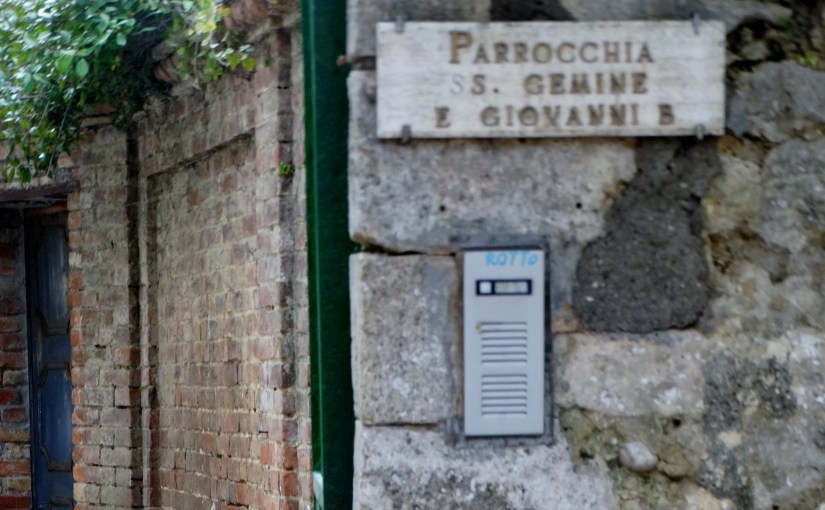
San Gemini is a commune (municipality) of c. 4,500 inhabitants in the province of Terni in the Italian region Umbria, located about 60 km south of Perugia and about 13 km northwest of Terni. After catching our bus down the hill to Terni, we had time to do some shopping and buy our tickets, get a cup of coffee and still have time to spare. San Gemini is famous in the region for its spa water and its old town. It borders the municipalities of Montecastrilli, Narni and Terni and is a well-preserved medieval burgh with two lines of walls, built over the remains of a small Roman centre along the old Via Flaminia.
Our bus takes us up the hill and drops us at the old town gate. After entering through the gate and making a quick right turn we encounter San Gemini Cathedral or Duomo – a 12-century church dedicated to the commune’s patron, the locally venerated Saint Gemine, whose relics were recovered in 1775, which was rebuilt in 1817. Brother Gemine was a monk of Syrian origins who died in 815 AD. The burial urn and original stone are conserved in the sacristy; the saint has been reburied under the high altar.


We strolled along the main street Via Roma to Piazza San Francesco and the Franciscan church with 15th-century frescoes. The piazza also has an open aspect with views to Cesi and beside the church is a courtyard with the town well and an old press. We journey on through the next gate to San Nicolò a Romanesque architecture church in the Piazza Palacio Vecchio but it is under restoration. This piazza is much smaller but is the oldest piazza in the village.


We continue to follow Via Casventino to San Giovanni Battista an 11th century church which strangely was semi circular and Taberna del Torchio where we have lunch. Again, we can clearly see Cesi from the old town walls of San Gemini. Lunch is very enjoyable with Roberto rushing off while lunch is prepared to buy some cups he saw before the midday siesta.


With our hunger sated, we complete our walk of the old town returning along Via del Tribunale ending up back at Piazza San Francesco and thereafter we returned to the bus stop along Via Roma.


Our bus returns us to Terni where we do some grocery shopping and collect our parcels from the morning excursion. Roberto gets chatting with the owner and suddenly we have a free ride to Cesi coutesy of Umberto who used to reside in Cesi. He certainly knows his way around taking the short cut up the hill though the olive groves and then taking the back road to the western gate of Cesi and winding through its narrow streets until we are almost at Roberto’s front door. Walking to home Umberto points out the house where his parents lived and ran their hair dressing shop – under 100 metres from Roberto’s home. Umberto is invited in and given the grand tour by a very proud Roberto.




 glendon1954