The Retirees go Abroad – the Iberian Peninsula – the new city of Lisbon and our Fado Tour

On the way home it started to rain – ominous for tomorrow. Through the night the garbage collectors found that some idiot had parked his car awkwardly so at 1.00am they had to spend 30mins + trying to manoeuvre their truck through our street all the time yelling and screeching tyres.  Despite this we got some sleep and awoke to stormy weather. Despite the weather we trekked outside and found that the car remains there and another has parked near it so tonight will be worse. Umbrellas open we caught the tram to the underground and from Baix-Chiado we travelled to Oriente in the new city. The weather was now dreadful with high chilling wind and rain. We found a shopping centre attached to the metro and re-evaluated our plans. Today would be best spent at home in bed with a book. So after snapping some of the modern buildings in this area (the exact opposite of the old town) we retreated home.


That afternoon I did some research on a trip to Sintra. Surprisingly the roads to the attractions in Sintra were closed and yet the day before the Tourism office had recommended we travel to Sintra. That night we had arranged to meet Joanna for our Fado and dinner tour. We waited in the square for Joanna and the other 11 on the tour and I took pictures of the Hard Rock Cafe and the Averido do Campo Grande. Right on time Joanna arrived and whilst we waited for the others she told us that the storms that morning had brought down trees and flooded roads in and around Sintra. The others arrived except for one couple so we waited in the square whilst Joanne told us more about her city including a tip about the best roof top bar in town in the hotel on this square. She also told us that the monument in the square represented the wars against Spain to throw off its occupation in the 17th century.

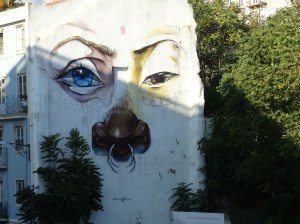
As we were on the Fado tour she then took us into a back street to show us some graffiti commemorating their Princess of Fado Amalia Rodriges. Then we made our way to the Jingjiha bar to try this liquor again. Graffiti is evident in most places of Lisbon and in my previous blog I showed the Fado graffiti along some stairs. Joanna took us there as this is famous as representing the Portuguese way of life and it love of Fado. We had seen it in the daylight when it was far more impressive but as we travelled down the stairs there was another piece of graffiti mural I had missed the other day but I have included here. This is in the old Moorish sector of the city. She took us down a narrow lane where portraits of elderly residents of the sector were posted on the walls. She also showed us how some of the images in the tiling on the footpaths showed different things about the area – like this outline of the church it surrounds.

Then we boarded a number 12 tram to travel up the hill to the Alfama area which she said was the area where Fado had its true origins. We got off the tram very close to our apartment. Joanna showed us the new mosaic of Amalia. From there we walked to the viewing platforms in Alfama near St Georges Castle down some never ending staircases to our restaurant Pateo Alfama. Inside we heard Fado being performed and watched a stage show of dancing and Fado music whilst eating a traditional potato soup, tapas and a custard desert whilst consuming local wine. The performance was good but I am not a Fado fan.

We got away at 11.00pm and home was but a short and steep walk away. I tumbled into bed and was out to it fairly quickly. Even so I heard the rain that came all night long – not much promise for tomorrow.

← Back

Thank you for your response. ✨

The Retirees go Abroad – the Iberian Peninsula – Food and Wine of Lisbon

We returned to the square to meet our guide for the evening guided walk. Whilst there we watched a street performer “blowing bubbles”. Right on 4.30pm we found Andre our guide. We were joined by Paul and Catherine from the west coast of Canada and later 7 others all from the US of A – two of whom were from Texas and were there to run in a marathon on Sunday.

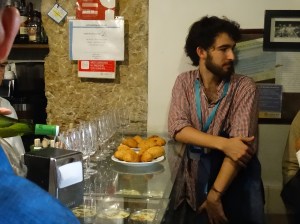
This was a food and wine walk which started at Tendinha (little tent) for traditional cod fish cakes and “green wine”. The majority of cod used in Lisbon is salted and dried cod (the same as the cod used by her sailing explorers over the centuries) so the cakes are naturally salty. The wine is made with a grape originating in Portugal and grown in the colder higher altitudes. It is light white and spritz – a good wine with the salty fish cakes.

Leaving Tendinha we went across to the Square do Figurea with a statue of Cortez on his horse. In this square is one of the oldest continually operating delicatessen in Lisbon – Manteigaria Silva and beside it the fish shop named after the cod fish – Bacalhoaria Silva. From the deli we tasted sheep’s cheese with quince paste and a tawny port – yum oh.

Our tour then continued in the Chiado district up the hill from the old city. Kerry met one of Portugal’s famous poets, we saw Portugal’s oldest coffee shop where expresso was first drunk in Portugal, and we made our way to Grapes and Bites for some tapas and red wine. But we are not finished yet.

We head back down into the old city through the tables of restaurants with the view which epitomises Lisbon to the first “Jingjinha” outlet in Lisbon. It is a sour cherry liquor first sold as a medicine but at 25% proof it soon became too popular to be a medicine. Our last port of call was a restaurant epitomising the cuisine of southern Portugal and having the most fabulous ambience – tiled walls and Moroccan styled court in the centre of the building, they served bbq choriso with salted mushrooms and a scrambled egg. I don’t think the egg was all that special but the other two dishes and the red wine was great.

← Back

Thank you for your response. ✨

The Retirees go Abroad – the Iberian Peninsula – Lisbon and Mosteiro de Sao Vicente de Fora

Next morning there was no sign of rain. Our planned tasting tour for tonight remained promising so what to do for the day. Kerry had been wondering about twin bell towers which appeared to be nearby. After breakfast we headed up the hill instead of down to the old town. Within five minutes of walking, we found the Church of St Vincent de Fora- a grand building but the church seemed to be only a small part of the structure. Also there was a bridge across the road connecting it to who knows what. Inside the church seemed to be higher than any other (probably not just appeared to be) and strangely one of the statues was dressed like a barbi doll.

After leaving the church I noticed a gateway with a sign “Mosteiro de Sao Vicente de Fora – Welcome”. So we went in. Inside the wall was a garden and another doorway leading into another part of the building. It was now clear that the Church was part of the Monastery. The Monastery ceased to be a monastery in the late 19th century with the abolition of monasteries throughout Portugal but now it is open to the public to view the roman remains on which the monastery was built. This was to prove to be a hidden gem of knowledge and history.

For 5 euros each we visited the roman cistern which was adapted by the Augustinians to catch the rain water to provide for the whole of the monastery. From there we walked up into the monastery itself. The walls are tiled with frescos of life in every room with each tile hand painted to make up the Fresco. The ceiling has been painted by an Italian master and this is the only remaining piece of his work. Even the bannisters had tiled posts that had been hand painted. From here we could look into the entrance courtyard and even view the coffin of one of the past residents. Then followed a treasury of gold and silver ecumenical gowns and ornaments (which I was not permitted to photograph) along with a history timeline giving the progression of the site from the Romans to the present.

Out in the courtyard in the centre of the monastery the tiled frescos continued until we found the Sacristy (where the canons would robe). The ceiling is painted with a vivid mural whilst the walls are covered in tiles with the robes contained in jacaranda chests. The in the next courtyard is the mortuary of the kings – a mausoleum of the last Kings and Princes of Portugal.

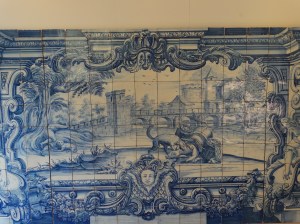
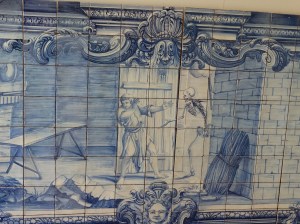
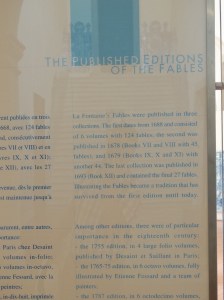
Up to the next floor we find a display of items from archaeological digs around the monastery and Lisbon items going back to the Phoneticians. On the same floor there is a display of La Fontaines’ Fables in tiled frescoes. La Fontaine published 3 collections of fables commencing in 1688 – a total of over 240 fables using animals to portray morals and ethics of the 17th century community.

After viewing a number of the fables we found the doorway to the bell tower so up we went – over 50 stairs. From this point we could see the castle do St George, another domed church nearby and the enormous roof of the monastery.

We left the monastery after 3 hours to head toward the castle. On finding the castle I read that it was made up of the ruins, a small museum and the community living within the castle walls. We chose to spend the money on lunch not the castle so we found a restaurant under the castle walls in the back streets. Lovely lunch – quiche and salad for Kerry and a toasted sandwich topped with olive tapenade for me coffee and two cakes.

Now we headed down the hill to the city via a different route. We found some interesting graffiti leading us to the major square in Lisbon. Later on our Fado tour we were to learn the reason for the graffiti.

Moving from the square we found the train station in the Manueline form of architecture (a mixture of renaissance and Moorish architecture favoured by King Manuel). Near the train station we found the official tourism office and learned more about Portugal before buying our day passes and catching the funicular “Grace” up the hill. On top of the hill we found more parks, views to the castle and some quiet places to watch the world go by.

← Back

Thank you for your response. ✨

The Retirees go Abroad – the Iberian Peninsula – Ferry Across the Targus

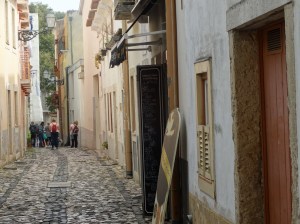
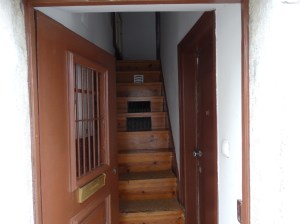
The sky is clear and blue as we leave the apartment. The apartment is in an old building where the door is wide enough for one slim person and the stair case very steep.

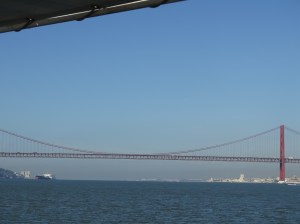
We caught the tram down this morning, arriving at the ferry terminal. The wind carries a chill and Kerry is already complaining about not having brought her coat. We visit the Metro station to plan for future trips whilst we wait for the ferry to open. Finally the gates open and the crowd rushes in – unbelievable the attitude of some French tourists pushing their way through as though they are the only people of importance. There is another cruise ship docked in the river and we are able to make out the 16 kilometre bridge crossing the Targus just west of us.

Our first port of call is Almada and we have no idea what we want to do. Most people come here to walk for an hour and visit the Christo Rei a towering Christ statue on the southern bank of the Targus. But not us. I spot the masts of a three masted man-of-war in dry dock and head straight for it. The Frigata “Dom Fernando II E Gloria” a wooden hull fifty gun frigate of the Portuguese Navy launched in 1843 after being built in the Portuguese colony of Daman India and was the last navy sailing ship in the Portuguese Navy. It has been restored to its fit out as at 1850 and is open to the public. Excellent restoration and brilliant historical descriptions tell you the story of life on board as you traverse the deck and below decks of the ship. The powder room was a surprise – lined in brick it was illuminated by lamps in the adjoining room to save an embarrassing incident. In the dry dock alongside is a submarine presumably awaiting restoration?

We the strolled through Almada taking the route pilgrims and tourist would take to the Christo. Of course we did not go all the way only as far as the tourist information centre in the old fire station. On the way to the TIC we saw a local shop keeper starting a BBQ on the footpath using a hair dryer as billows and on the way back to the boat he had it started but was super heating it with the hair dryer and a pipe to channel the forced air to the base of the coal fire.

As we waited for our boat we watched the large brown jelly fish floating in the river. Boarding the boat we headed for Bellum an outer suburb of Lisbon and passed the Christo Rei, the look alike Golden Gate Bridge, the monument to Prince Henry the Navigator and all the Portuguese explorers who followed him and the “Tour do Bellum” a remnant of the guard towers along the coast and waterways. Lunch was a bagel at the cafe de curb and eaten looking at the fountain. Then we went to the church of Jeronimos Monastery. What a place. We have seen churches from the Sistine chapel to the cathedrals of England but this was a surprise. It also holds the tomb of Vasco de Gama the Portuguese explorer from the 15th century who prayed with his crew for safe return from the Orient in 1497 in the church and one of Portugal’s most famous poets form the 16th century Luis Vaz de Camoes. After spending most of our time at the church we made a quick pass by the Presidents Lodge and back to the boat.

By the time we returned to Lisbon and caught a tram to our apartment it was too late to do anything but crash. The weather had remained fine and became hot but rain was promised for tomorrow.

← Back

Thank you for your response. ✨

The Retirees go Abroad – the Iberian Peninsula – Lisbon Portugal

We have said farewell to Long Eaton – it will always be one of my homes in my heart. Farewell to our neighbours Pam and John and farewell to our other Rotary Club – Nottingham. After bouncing off the walls at the Novotel Long Eaton for 4 days we are finally on our way to Portugal and Spain. We still have the car as it is cheaper to park the car (and luggage) than just the luggage and hope to sell the car on 31/10/2015; the day before we leave for Australia.

Flying to Lisbon was no problem and finding our apartment in the old city no problem. But finding out where we are on a map of the city is impossible as the streets are so small and so numerous that all we can determine is our general area. Fortunately I spotted a restaurant around the corner so we could eat but only if we can speak Portuguese (it’s the 5th most widely spoken language so surely we know a few words – not a one). Hand signals and a lot of pointing at the dishes on other tables brought a result sort of.

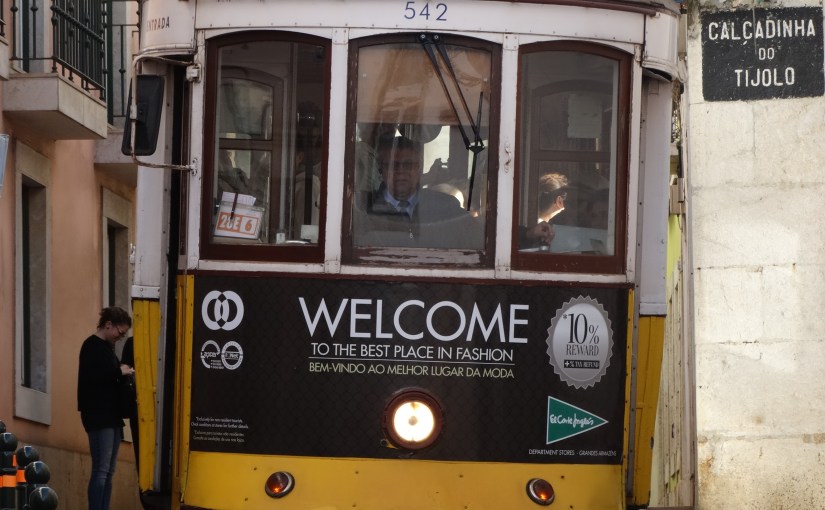
To bed to dream – not bloody likely they pick up the garbage every night because the streets are so narrow. We managed to find a mercador (small shop) to buy some corn flakes (Portuguese variety), milk and other provisions so after breakfast we hit the track. Now the city is serviced by trams; small trams, but even though they are small there are some places where pedestrians are crushed against the buildings by the trams because the streets are so narrow. But it provides a bloody obvious track to follow to find whatever you want.

We wanted to find the information centre to plan our visit. So we followed the tracks, passing a viewing platform with restaurants and what appeared to be a public pool, an ancient tree, the main Cathedral, trams and buses jousting for passage along the narrow streets until arriving at the commercial area where we were inundated with things to do. There was even a stationers sharing the family name of our son-in-law. We decided on the “Red Tram” tour around the old city and two walking tours one for tapas and drinks and the other for dinner and Fado – the traditional mournful music telling stories of resignation to what life may bring. The Red Tram tour started under an impressive gate beside an equally impressive square and monument.

The tram took us back up the hill we just walked down around the castle (yes another castle) back down to the commercial area and out to the Basilica of the Scared Heart of Jesus and back down to the square. This can be an ponderous journey depending on the misadventures of the motorists sharing the road with the trams.

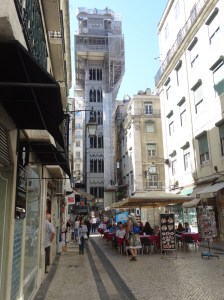
After completing the tour and gaining an idea of where everything was we had lunch – cod cakes, a glass of wine and a glass of beer. This is a new version of the traditional concept in Portugal (the cakes include a soft cheese) and the restaurant was a bit bohemian as well. having completed our repast and a stroll down the avenue viewing some of the exotic tiled buildings and a viewing tower constructed against the ruin of another monastery, we headed for the Basilica of the Sacred Heart as the tram audio had informed us that there were magnificent views from the church.

Our tour ticket gave us use of the public tram system as well. Arriving at 3.00pm we were able to go up to roof where we could view the city and view the dome of the church. 120 steps later and 8 euros lighter we stepped out onto the roof of the Basilica. The views are outstanding until we then stepped into the dome.

Then we went into the Basilica to view the tomb of Queen Maria who had built the church to keep a promise after giving birth to a son. Inside we found the tomb but I also found behind the tomb the Nativity Scene of Estrela Basilica sculptured by Joaquin Machado de Castro in wood and cork with over 450 ceramic and clay figures. Not only is this the biggest nativity scene you will ever see you will be surprised by all the people present at the birth of Christ – even a bloke with bag pipes! After that I decided to get a haircut.

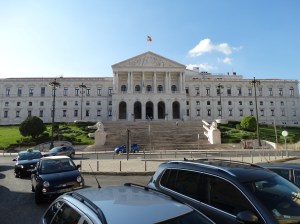
We walked back to the old city along the tram tracks past the Parliament building but we could not go inside – at least that is what the two armed guards at the front door said and I was not in an argumentative mood. We discover some wonderful graffiti in Lisbon and it all seems to relate to the culture and the people. Here is one on the side of a building in the street below the Parliament. Then we passed what I thought at that time the most ornate church on the planet – Church of Santa Catrina and Monastery of the Paulists (Church of Saint Catherine – there must have been a sale on gold leaf and silver leaf in the 18th century and this church bought the lot!) I left there shaking my head about the extravagance of the Catholic Church – there is no end to it.

After that experience we found the funicular running down to the river banks of the River Targus and into the Time Out markets – a mixture of fresh food markets and restaurants, bars and dining areas, where there is nothing your heart could desire that was not for sale. Even beer on tap that you pulled for yourself. Take one credit card, tap it on the beer of your choice and pull your beer.

The day is drawing to a close. The traffic is chaotic so it’s time to take a tram home buy some dinner and get some rest for tomorrow is another day in Lisboa (Lisbon). The tram takes it time so I photograph one of the many baroque buildings in Lisbon. After arriving at the apartment we carefully make our way to a restaurant in Rua Ecole do Gervais – nothing special about the food but the view and the music floating up from the Fado restaurants below gave it charm its drab exterior would never convey.

← Back

Thank you for your response. ✨

The Retirees go Abroad – Visiting Richard III – Leicester

I have been trying to fit in a visit to the tomb of Richard III after having visited Bosworth Field where Richard was killed and Henry Lancaster acquired the throne of England by conquest. Leicester is only 55 minutes from Keresley in the Cotswolds so it was important that I take the time to visit.

The visitors centre is in part attached to the carpark in which Richard’s remains were excavated and alongside the Cathedral. The entrance is part of a new square developed because of the reburial of the remains. After paying the entrance fee, we sat through a video presenting the early life of Richard and the last days of Edward IV. After that there was a series of picture boards starting with the capture of the Woodvilles transporting the young Edward V and his brother Richard to London to be crowned (the lost boys in the Tower). Then Richard was crowned and he placed the boys in the Tower from whence they did not return (a mystery to this day) and from which Richard earned the reputation of a cruel king. The display had a computer programme which gave various facts around the missing boys and what may have actually have happened to them. It also identified those most likely to have killed the boys (motive, means and opportunity). No definite conclusion but interestingly a public voting system on the most likely villain for the missing boys acquitted Richard and accused the mother of Henry (Henry was hiding out in Brittany at this time).

The display then gave the story of the Battle of Bosworth Field and the achievements of Richard during his short reign (about 5 years). The display continues on the next floor where a guide shows you from a viewing platform the carpark where the excavation took place. The place where the remains were found is under cover and can be viewed through a glass floor. The rest of the display described the investigation and discovery of his remains. Interestingly and coincidentally there was an “R” painted on the bitumen in the carpark and the remains were found under the letter “R”. The “R” stood for reserved. The display included a scan of the bones showing the injuries he suffered in the battle (the wound that killed him and the wounds that were inflicted during the battle and one after he was dead), there was a suit of armour that is like the one worn by him, the facial reconstruction, his disfigured spine, and how they found his maternal relations to test the DNA. Fascinating!

We then went across to the Cathedral (St Martins at the time of Richard) where the Presbytery has been converted into a tomb room to hold the royal remains. We returned to the car passing the Guildhall which according to the historic information on the building claimed the hall had been constructed in 1390AD.

Despite some anxious moments over Kerry’s lost purse and my lost cap I am so glad I made the effort to go there. We have been living in that part of England where English history has been made everywhere we turn. Whether it be battle between Kings or the creation of the industrial revolution, it is all here.

← Back

Thank you for your response. ✨

The Retirees go Abroad – Visiting the Cotswolds – Banbury, Burford and Moreton-on-the-Marsh

Sunshine greets us at 7.30 am. Autumn is in full gear with the days being considerably shorter, the mornings colder and the hotel central heating overheating the room. However today may have some promise. We are going to Banbury which is famous for – the nursery rhyme

Ride a cockhorse to Banbury Cross,

To see a fine lady upon a white horse;

Rings on her fingers and bells on her toes,

She shall have music wherever she goes.

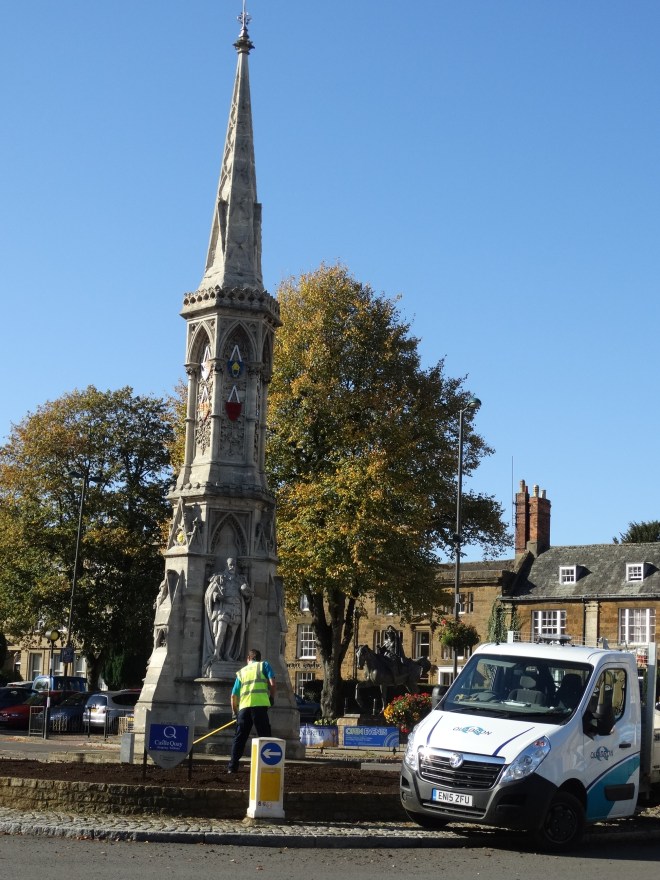
No one knows what the rhyme is really saying and there have been a number of speculations about it. Whether the Cross is one of the three crosses destroyed by Protestants in the 1600s or the crossing of the Jurassic Way with an old Roman road no one is certain but it does not relate to the Cross at the crossing of the High St today nor does the bronze of the fair lady riding the white horse but both pretenders have some of the tourists fooled.

I had done some research and found that it was claimed that Oliver Cromwell planned his part of the Battle of Edge Hill from the Globe Room at the Yea Olde Reine Deer Inn so I thought a visit and soak in the atmosphere might be a good idea. But the pub did not open till 11.00am so we headed for the tourist information centre which was somewhat hard to find. We made our way to Castle Port Shopping Centre and behind the centre is the canal servicing Banbury and the canal boat basin and repair yards. One mariner was in the midst of sailing through the canal so we watched and helped raise the draw bridge, lower the lock waters and see the narrow boat safely on its way.

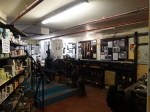
Now where were we? Yes the information centre. It is in the museum but what is this Tolley’s Slip and Repair yard – free to enter. So in we went and what a little jewel. History of the canal and industry in Banbury through the centuries. We chatted with the receptionist and the manager of the dry dock (even got to see inside the dry dock where they were repairing a boat). The industry is alive and well with many young people taking on apprenticeship but the problem for the industry is the repair of the old wooden work boats constructed with timber beams steamed to be bent into shape and shaped with an adze – very few shipwrights have those old skills as most new boats are built with steel). As the manager said “If you cut a piece of timber short you cannot add a bit on but cut steel short and you weld on the missing bit”.

It is past 11.00am and time to return to the Olde Reine Deer. We get there order some coffee and it is delivered to us in the Globe Room where it is said that Oliver Cromwell planned the attack on the Royalist Army marching on London. Well this may not be true because the Battle of Edge Hill took place outside nearby Kineton (you will have read my blog on Kineton Edge), it was the first battle of the first Civil war and occurred in October 1642 with Parliaments army lead by the Earl of Essex and the King’s army by his cousin Prince Rupert. Cromwell did not arrive in time to participate. Too much thinking at the Ye Olde Reine Deer Inn perhaps. Anyway it was interesting to visit. The room contained a copy of the painting of Charles 1 and part of his Army in the field to give it some authenticity.

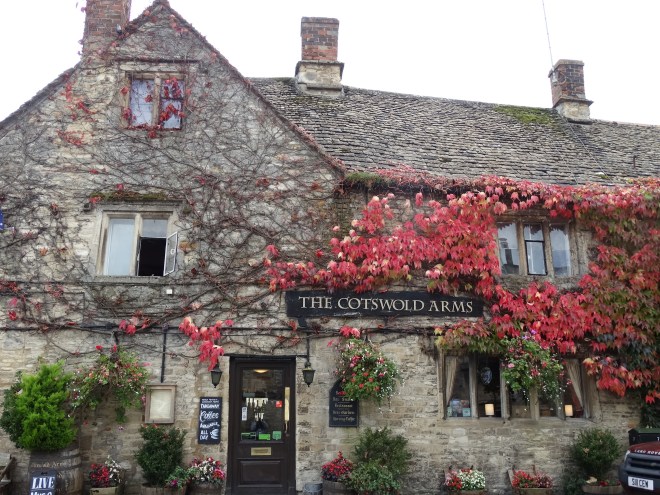
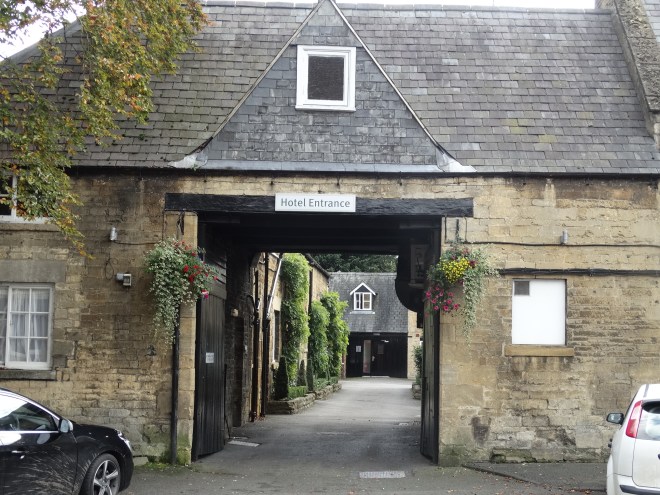
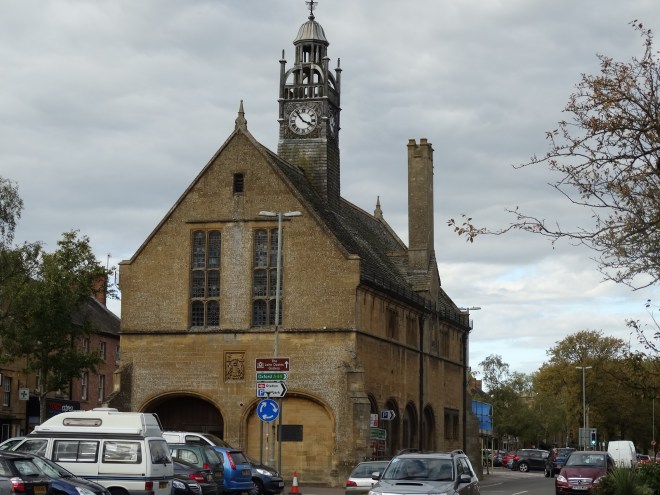
And so we leave Banbury and its romantic remembrances of Oliver Cromwell. Onto Burford. A tourist village. So we have lunch at the Mermaid and then visit the Oxford Shirt Shop and find something for someone for Xmas – shush it is a secret. When returning to the bus I spot the Cotswold Arms and the autumn colours of the vine draped over its rocky facade. Then onto Moreton-on-the-Marsh; another tourist village. We march up one side of the High Street (Kerry finds the scarf of her dreams for £3 quid) then march down the other side, a beer and Pimms with a bag of crisps in the Black Bear and around the block – I spot a hotel where they have preserved the old coach entrance and snap a photo and then before we are swept up by the bus I catch a glimpse of the Town hall standing solemnly and alone on an island in the High St.

The tour has ended and we will return home (the Novotel at Long Eaton) by our car and hopefully find something more interesting.

← Back

Thank you for your response. ✨

The Retirees go Abroad – Visiting the Cotswolds – Stratford-on-Avon and Evesham

We have visited Stratford previously and took in the Shakespearean sites so this time we strolled looking at the architecture of the quaint old buildings. As you would expect they make a living out of having these old buildings for us to gawk at. However we started with a monument to theatre and then the birthplace of the bard – bloody tourists buggered up my photo. Onto the library and the Shakespeare Bookshop, a cafe and kebab shop. A jewellery workshop, the Shakespeare Charity Shop, and the Old Thatch Tavern. Whilst we were checking out the tavern the driver of a Ford Ka hesitated about running a yellow light. Not so the bus driver following who was unable to avoid the now stationary Ka and pushed it through the pedestrian crossing. Time we moved on.

Just across the road another monument. It looked like someone had chopped the top off city hall. Down the road we found Garrick Inn and beside that Harvard House. We then made our way to the Avon and the canal basin, then back past the Tudor Museum, and past the Bard’s House – no tourist queues. Enough site seeing – two pasties and the world’s thickest milkshake (4 scoops of ice cream and two teaspoons of instant coffee blended – one milkshake).

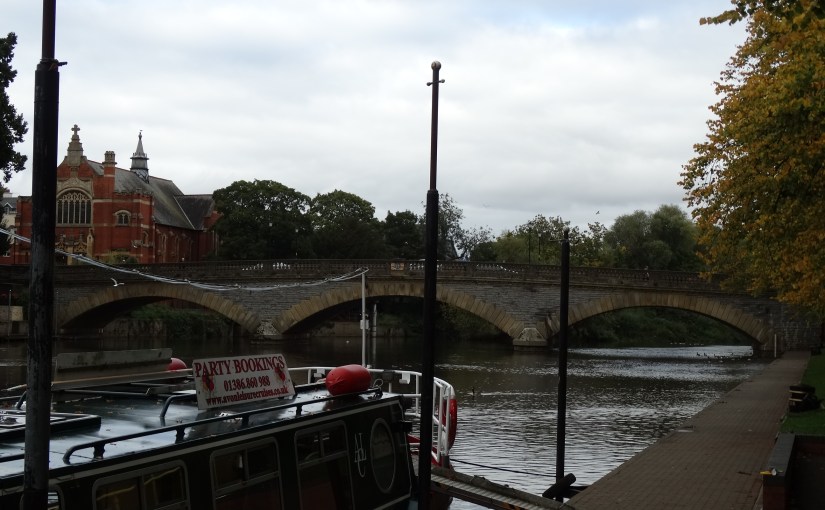
We returned to the bus but by 1.00pm our departure time two dopey old sheilas had not returned. Fifteen minutes later they wandered up – oh we thought it was 2.00pm they said. The bus driver makes a habit of not giving too much information which I find frustrating but this is why – dopey oldies who don’t pay attention or had the attention span of a gnat. We travel to Evesham. Never heard of it – neither had we. But it was founded in 700AD with a monastery which was destroyed in part during the reformation (Henry VIII’s answer to Rome about divorcing his first wife). So the town has old buildings like the Round house (its square actually), a remaining gate from the Norman period of 1130 AD two churches once part of the monastery, All Saints and St. Lawrences. The Abbey has gone but the land remains as parkland. After that we strolled through the town until joining our river cruise on a canal boat. Very relaxing. The following photos trace our path to the canal boat and up the river.

Back to the hotel to rest up for another hectic day tomorrow. We will visit three sleepy villages. If you suspect I am being sarcastic you are correct. The only good thing is that doing this tour is cheaper than staying in a hotel and buying meals but the boredom is mind numbing.

← Back

Thank you for your response. ✨

The Retirees go Abroad – Visiting the Cotswolds – Bourton-on-the-Water and The Gloucestershire Warwickshire Steam Railway

Tuesday we visited the small village of Bourton-on-the-Water. Unfortunately it was raining steadily making it uncomfortable as for the first time we packed light – no umbrellas. It is nothing more than a pretty village and we have just about had our fill of pretty villages. Once again we were dumped there with free time. Now we cannot really complain. The tour has cost us £200 quid each and that is for the hotel and half board and the tours. So here are the photos of Bourton-on-the-Water.

For the afternoon we were dumped in Cheltenham – a mid-sized town with no special features. So we had lunch and kicked around killing time until the highlight of the day – our train trip. Our photos include a strange couple – a bull (note the appendage) and a rabbit seated romantically in the mall. The Municipal Offices suggest a grand town but not anymore.

The Gloucestershire Warwickshire Steam Railway is a thirteen mile long piece of historic steam railway starting at the Cheltenham Race Course and finishing at Toddington. All run by volunteers and starting from a discussion between two blokes in a pub at Broadway (they are renovating the old station at Broadway presently to extend the range of the train). After a boring day this little bit of excitement saw me running between windows with my camera like a cattle dog in the back of a ute. Here are the pictures.

After arriving at Toddington we were met by the bus and made our way back to the hotel for a good nights sleep ready for our visit to Stratford-on-Avon and Evesham.

← Back

Thank you for your response. ✨

The Retirees go Abroad – Visiting the Cotswolds


We have just returned from Germany and have one day to finishing packing clean the flat say our farewells to our neighbours and move out to the Novotel Long Eaton for the night. Then we have to ready ourselves for Monday when we travel to Nottingham and catch a bus tour to the Cotswolds. We managed to accomplish all our preparation and spent the afternoon in front of the TV.

The next morning, Monday, was raining and grey. Not good. Then our cab did not arrive and to make matters worse when we contacted the base they told us he was just around the corner delayed by an accident. It was bullshit. We ended up driving to the hotel where the bus tour was to base itself for the week and meet the tour bus. In the end the cabbie may have done us a favour giving us more options than the bus tour.

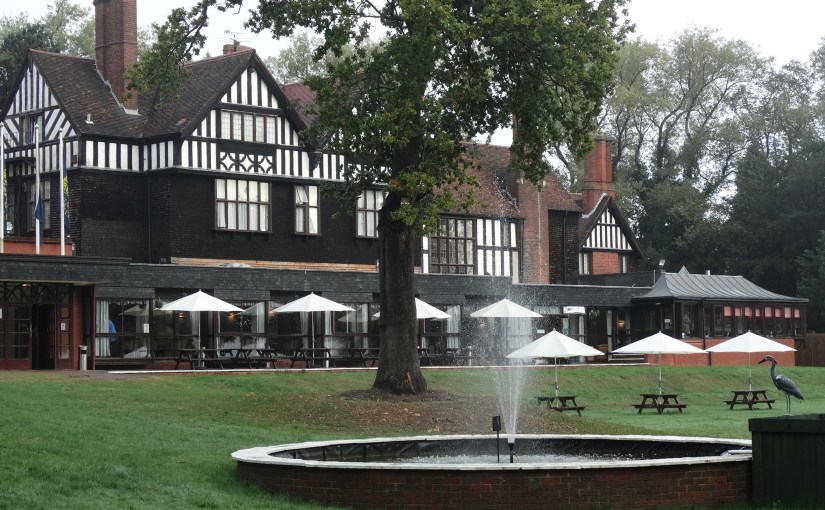
We arrived at the Britannia Royal Court Hotel which is based on the former family home of William Hillman of Hillman cars fame. In 1894 Sir William built Keresley Hall and the family resided in it (8 daughters) until William and his wife died when the hall was sold. Between 1929 and 1968 it became a convalescent hospital after which it became the Royal Court Hotel.

We learned that the tour was visiting Leamington Spa that afternoon so we drove over to see what they were doing. Nothing. Precisely nothing. The bus had dropped them off with free time in the town and then dropped them at the hotel. This was to become a theme in this tour. One advantage we had was that we visited the old town hall and we were given a guided tour of the building just because we asked. Otherwise not much to report about Leamington.

← Back

Thank you for your response. ✨