Bishops Visit – Fort George – An expensive insurance policy

Outside of Inverness is Fort George. Built following the defeat of the Jacobite rebellion at Culloden in 1746, the fort was intended to be a deterrent to further rebellion by the Clans who sought to restore the Stuarts to the throne of England and Scotland. It cost 200,000 pound which was an enormous sum for the time. It incorporates some old defensive items like two moats and draw bridges, a palisade, battlements and watch towers, but it includes modern innovations like the low profile and the star shape none of which has ever been tested as James fled to France never to contest his right to the throne against William and Mary. By the way Jacobite takes its name from Jacobitism, from Jacobus, the Latin form of James.

The fortification is based on a Star design, it remains virtually unaltered and nowadays is open to visitors with exhibits and recreations showing use at different periods, while still serving as army barracks. Originally the depot of the Seaforth Highlanders and later the Queen’s Own Highlanders (Seaforths and Camerons), it was more recently home to the Royal Irish Regiment, and as of 2007, the new garrison of the Black Watch, 3rd Battalion, Royal Regiment of Scotland.


The fort housed a lieutenant-governor as administrator and as the fort became like mini village wives and children also. The governor’s residence has been turned into the Highlanders’ Museum – well worth a visit to understand all the different highland regiments that have been formed.


As it is on the end of a promontory into the Firth of Moray, it is open to the wind and it must get bitterly clod on the battlements. My trip up on a sunny day with little wind was enough for me to be certain I did not want any guard duty. Entry costs about 8 pound and you get an audio tour guide. When we returned our audio guides to the gift shop, I noticed “Stag’s Breath”. so one of my readers will be happy to know that I remembered him despite his criticism of my blogs – he may be lucky enough to see it arrive back to Australia unopened.

← Back

Thank you for your response. ✨

Bishops Visit – Thoresby Hall – Ingrid Pears MBE

In July 2013, we visited Nottingham to manage the business for a couple of weeks and in that time we met Ingrid who was then a member of and then President of the Rotary Club of Nottingham. On the night of our visit to the Club, they conducted a raffle for a piece of Ingrid’s work; a modern styled glass vase, and of course we won it. It is a delight piece and with this introduction we felt compelled to visit Ingrid at her studio. Her studio is located at Thoresby Hall, a former Abbey taken over by Warner Hotels and renovated into a luxury hotel. The former stables form a commercial area in which Ingrid has developed her studio. Her web site is worth a visit: http://www.ingridpears.com/

We had visited her again in February and now with Doug and Nerida in tow we visited again. On arriving we found Ingrid in the middle of prepare new stock for her showroom. She is preparing glass balls for the Xmas trees of England and this particular ball has golden specks.


We can never visit Ingrid’s showroom without purchasing a piece of her exquisite glass. But as this is my Xmas present there is no peeking until after Santa has been.

Bishops Visit – Brodie and the Laird Brodie


Our first icy windscreen but the day is clear. After removing the ice, we decide to drive east to the estates of Clan Brodie.

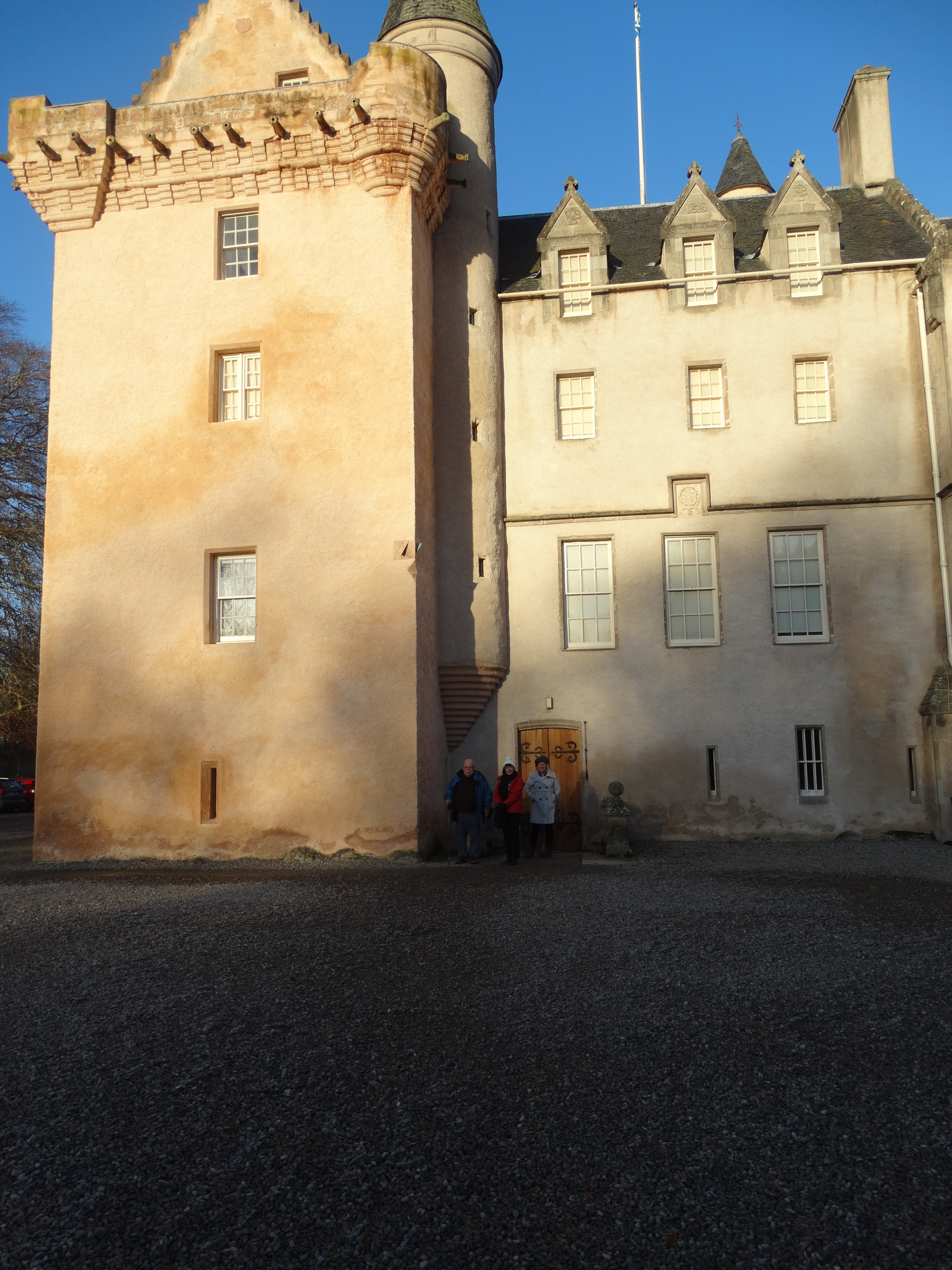
In 1990 Kerry and I were in Scotland and we discovered Brodie Castle. This was the ancestral home of Clan Brodie and the Laird’s (known as the Brodie) home. The area is named Brodie so he is the Brodie of Brodie. The Brodie’s have mysterious origins but can claim their rights to the ancestral lands come from a grant form Robert the Bruce in the 13th century.

We were fortunate to be shown the castle by the Brodie Montagu who used the name Ninnian because of his theatrical interests. Ninnian died in 2003 but before dying he entrusted Brodie castle to the National Trust of Scotland. The present Brodie is Ninnian’s grandson Alexander but he no longer resides in the ancestral castle.

Now in 2014 we have returned. We chose an excellent day for our visit. The sun was shining brightly and the sky was a clear pale blue. The wind was light but chilly. As we pulled into the car park there was a sense that something was wrong. Nevertheless we walked down the path leading to the castle and saw that there were cars parked beside the castle. The castle is closed to the public for the season and this is the staff arriving to undergo training and to attend to cleaning and maintenance. Kerry checks the web site and then rings to find out why the web site says it is open. This leads to the Estate manager letting us into the castle and arranging a personalised tour for us.

The present castle is a mixture of a 16th century defensive tower, and extensions in the 17th, 18th and 19th centuries. We only got a shortened version of the full tour viewing the basement hall of the tower with its ancient armaments and memorial to the Brodie Castle a member of the family constructed in Madras India, the space that was the original kitchen now part of the entry, the library, the dining room with it extremely different ceiling (plaster ornaments decorate the entire ceiling), the drawing room and it’s supplements from the Gordon Clan through a fortuitous marriage. No photos allowed so you will have to visit it yourself one day. I can recommend it.


Castle Brodie
Castle Brodie

← Back

Thank you for your response. ✨

Bishop’s Visit – Eyam Village (the Plague Village)

Eyam is an English village in the Derbyshire Dales district that lies within the Peak District National Park. The village is noted for an outbreak of bubonic plague which occurred there in 1665, in which the villagers chose to isolate themselves rather than let the infection spread. The present village was founded and named by Anglo-Saxons, although lead had been mined in the area by the Romans. Formerly industrial, its economy now relies on the tourist trade and it is promoted as ‘the plague village’.

Our visit was marred by wet weather and cold. My investigations proved to be flawed as most of the attractions had closed for the Winter. We drove into the village amidst mist and drizzle, parking opposite Eyam Hall. The stable area had been converted into a visitors centre and some speciality shops but the Hall had closed after the Xmas fete last week. Still we were able to sample the local cheese and check out how a local joiner reuses timber. From there we visited the plague house with their sombre plaques reporting those who died from the plague and the church which was the centre of the resistance against the spread of the plague. Not a lot more to see until March when the weather should be warmer and brighter.

← Back

Thank you for your response. ✨

Bishop’s Visit – Chestnut Centre

Any visit to the Peak District has to include the Chestnut Centre particularly if your favourite animal is otters. I have blogged about this centre previously but last time our visit was interrupted by rain. So I will just give you the photos and you can read about the centre in my earlier bog.

← Back

Thank you for your response. ✨

Bishops Visit – Arrival in Long Eaton

Our first Australian a visitors arrive today. Doug and Nerida have been friends for over twenty five years and we have done trips down the Volga, up the coast of Norway and through Paris with them but this is the first time we have lived together and travelled. They are flying into Manchester International Airport and we have driven over to collect them. Their arrival is on time and Manchester is much easier to navigate than Heathrow.

After greetings and the short walk to the car, we decide to avoid the motorway on the return journey and by the time we get into Long Eaton it is already dark but their journey through the

villages of the Peaks District gives them a taste of what is to come including unexpected users of the road.

Conscious of the effect of jet lag, we don’t plan much for the next day. Our neighbours John and Pam have told us that Shardlow (a nearby village) has had a glorious history during the great industrial canal era. I don’t need any more than that to make me curious as to what it looks like today.

So I looked on Wikipedia to find the history of the village and it says: “An important late 18th century river port for the trans-shipment of goods to and from the River Trent to the Trent and Mersey Canal, during its heyday from the 1770s to the 1840s it became referred to as “Rural Rotterdam” and “Little Liverpool”. Today Shardlow is considered Britain’s most complete surviving example of a canal village, with over 50 Grade II listed buildings and a large number of surviving public houses within the designated Shardlow Wharf Conservation Area.”

The trip over to Shardlow took little more than 10 minutes and we did not find anything of the past glory. It is cute in some ways but nothing of a “Rural Rotterdam” remains. The most interesting bit was the canal house caught between the canal and the lock


The next day we showed them around Long Eaton and then a trip was into Nottingham to the caves under the city.

“Nottingham sits upon a soft sandstone ridge which can easily be dug with simple hand tools to create artificial cave dwellings. Indeed Nottingham was once known as Tigguo Cobauc meaning Place of Caves and was referred to as such by the Bishop of Sherborne Asser in The Life of King Alfred (893AD). The caves here are some of the oldest remaining in the city, with pottery finds dating them to 1270-1300, and were inhabited from at least the 17th century until 1845 when the St. Mary’s Inclosure Act banned the renting of cellars and caves as homes for the poor. None of the caves are natural, they were all cut into the sandstone for use as houses, cellars and place of work by the inhabitants of the city.

As of 2014 more than 500 caves in the city have been catalogued, including 100 that were only rediscovered in the last four years. Construction of the Broadmarsh Shopping Centre began in the late 1960s, but the opening up of the caves to vandals and plans to fill them in with concrete caused a public outcry. A detailed study by The Nottingham Historical Arts Society led to the caves being scheduled as an ancient monument and the development plans were subsequently changed to preserve most of the caves. The caves were cleared by volunteers from the 2418 Sherwood Squadron Air Training Corps and Rushcliffe School and opened to public tours by the Friends of Nottingham Museum in 1978.”(source Wikipedia)

After visiting the caves we took a walk through part of the city and stumbled onto the city square set up as a Christmas wonderland.

← Back

Thank you for your response. ✨

Bishops Visit – A Roman’s Life – Housesteads Fort and Hadrians Wall


When asked about Britain I am invariably asked about Hadrian’s Wall and have I been there. Well until today, my answer was I plan to visit one day.Today I changed that answer to “yes I have and I visited Housestead Fort, the best preserved Roman fort along the remnants of the wall”.

As days go the weather was pretty ordinary. We left Hexham and its Abbey headed for Housesteads said to be “just round the corner”.


Grey and misty to start with sun trying to break through. Then we got onto the B6318 from Wall and the mist descended as we followed a swaggering hay truck obviously overloaded and sneaking along this back road. Then there was a sudden lifting of the mist and the visitor’s centre appeared suddenly before us.

Inside the centre we learned two things, one, that the fort and museum were some distance from the road and the centre and, two that part of the road we had just driven on once formed part of the wall. As this was winter and we were the only visitors at the time we were given the privilege of driving into the museum car park. It meant we had to pass through a cattle gate and drive a meandering road up to the museum and the fort.

DSC01765

The museum is small but includes a video presentation of the fort and diagrammatic reconstructions of fort as well as a short history of its use and decline. Following the video we walked up to what was formerly the South Gate an into the foundations of the fort, its barracks granary and other buildings. From the North Gate I could view the wall running east and west and view the undulating landscape watched over by centurions 1900 years ago from my same position. The fort must have seemed a real barrier and threat to the tribes of the north.


There is not a lot to see unless you can imagine the buildings that once sat upon the foundations. But equally there is a lot to activate your imagination. After walking around I made my way to the south east corner and lowest point of the fort to view the roman latrines. Placed at the lowest point to gain downward flow (old saying “Shit flows down hill”) of water and waste the latrines were impressive in the mastery of the design to move the waste with gravity and running water.


Time was against us doing further exploration as we were due in Inverness that evening – some 5 to 6 hours driving and the weather had turned decidedly against us.

Bishops Visit – The Best of Barnard Castle.


We set sail today in the most brilliant sunshine, clear blue sky and moderate temperature such that I could have mistaken it for a spring morning. High spirits abound as we travel north making good time and arriving in Barnard Castle about 10.30am. Barnard Castle is a market town in Teesdale, county Durham with an unusual market rotunda in the centre of town called the Butter Market. It has been a court, a goal and a market over the years. The town grew up around the castle of the same name and is home to Bowes Museum.


The Bowes Museum, housed in a chateau-like building, was founded by John Bowes and his wife Josephine, and is of national status. It contains an El Greco, paintings by Goya, Canaletto, Boucher, Fragonard and a collection of decorative art. A great attraction is the 18th century silver swan automaton, which periodically preens itself, looks round and appears to catch and swallow a fish.


DSC01728

John Bowes lived at nearby Streatlam Castle (now demolished). By reason of his father’s late marriage in England to his mother John did not receive the hereditary Scottish title which passed to his Uncle. His Streatlam stud never had more than ten breeding mares at one time, but produced no fewer than four Derby winners in twenty years. The last of these, “West Australian”, was the first racehorse to win the Triple Crown (1853).


Bowes Lyon lineage
Bowes Lyon lineage

Born into the wealthy coal mining descendants of George Bowes, he was the child of John Lyon-Bowes, 10th Earl of Strathmore and Kinghorne (1769–1820) and his mistress or common-law wife Mary Milner. His uncle’s line ultimately produced the Queen mother Elizabeth Bowes Lyon.

The museum had a very interesting interior decorating section showing the interior designs from Tudor to today and along side this was a fashion exhibit and a most interesting visual art display. In the photos I have taken you will see what appears to be three different portraits but in fact it is the one portrait which changes expression. Also there is a second portrait in which the earrings in the picture move.

Bowes is a very different and interesting museum but well off the beaten track. Nevertheless it is well patronised by those who discover this oasis. We overnighted at the Hadrians Hotel in Wall, a village outside of Hexham. Before visiting the wall we called into Hexham and found an interesting old town with a fabulous mall Abbey and history. These photos are included.

← Back

Thank you for your response. ✨

The Retirees go Abroad Trent and Erewash Canals


People over here and at home often ask why we chose Long Eaton as our base. Well I think I can safely say Long Eaton chose us. Business brought us here but the diversity, centrality and hidden history of the area have kept us here. The history may not be momentous but it involves ordinary people and the development of life as we know it today.

Take the canal that runs behind our flat. Today it is a recreational waterway and walk connecting with the River Trent and the canal network that criss-crosses the UK. This canal has been my subject earlier so I won’t repeat the history. But once you get to the River Trent, the story just goes on – to Liverpool, Hull just about anywhere.

Here is a series of photographs of our recent walk and a bit of the story around the canals and the people who lived and worked on the canal. On this day we set out along the canal and stopped at the Steamboat for refreshment.

For us our walk of discovery started at the Steamboat now a pub but once serving the canal people.


Beside the Steamboat is the Teahouse. Built in 1783 it still operates today providing tasty food and beverages. Its history includes a lockup. Underneath the shop was a cell used to hold people arrested on the canal. The cell is no longer there but the lock and key from the cell can be seen on the wall in the shop. This shop is crammed with memorabilia from the great days of canal industry.

Across the Trent is the boat club and rowing club and in the background the steaming pots of the power station may be seen. We follow the river toward Nottingham. It is possible to walk all the way but not today. After 40minutes we get to Cranfleet Lock; one of the many locks along the Trent and the River Soar. As we sit in the sun a narrow boat arrives to pass through the lock. It is a young family holidaying on the canal and we look and help as they enter the lock, release the water and sink down for the next leg of their journey.

Job done we turn around and walk home – a trip of 90 minutes.

← Back

Thank you for your response. ✨

The Retirees go Abroad – Living in Tudor Times


If you have been following my blogs then you may well be sick of manor houses and gardens. But before you turn off, this is a tale of a manor house built in wood that has been in the same family ownership since 1500 and was last added to or changed in 1610. When you see the photographs you may agree with me – how is it still standing?

Little Moreton Hall at Congleton Cheshire is a National trust property. It is moated. It is built of wood and daub plaster. It is the ancestral home of a family of yeoman farmers named the Moretons. The earliest parts of the house were built for William Moreton in about 1504–08, and the remainder was constructed in stages by successive generations of the family until about 1610. The building is highly irregular, with three asymmetrical ranges forming a small, rectangular courtyard. The house’s top-heavy appearance, is due to the Long Gallery that runs the length of the south range’s upper floor which was built in about 1560–62 for William Moreton II’s son John It includes the Gatehouse and a third storey containing a 68-foot (21 m) Long Gallery, roofed with heavy grit stone slabs, the weight of which has caused the supporting floors below to bow and buckle. I could not remember all this so I have extracted what I thought would explain to you the uniqueness of this house from Wikipedia. If you wish to read more go to http://www.nationaltrust.org.uk/little-moreton-hall/ and http://en.wikipedia.org/wiki/Little_Moreton_Hall.

Wikipedia has this comment which I thought was important for your understanding: “Architectural historians Peter de Figueiredo and Julian Treuherz describe it as “a gloriously long and crooked space (the Long Gallery), the wide floorboards rising up and down like waves and the walls leaning outwards at different angles.” The crossbeams between the arch-braced roof trusses were probably added in the 17th century to prevent the structure from “bursting apart” under the load.”

A small kitchen and Brew-house block was added to the south wing in about 1610, the last major extension to the house. The fortunes of the Moreton family declined during the English Civil War. As supporters of the Royalist cause, they found themselves isolated in a community of Parliamentarians. Little Moreton Hall was requisitioned by the Parliamentarians and used to billet Parliamentary soldiers. The family survived the Civil War with their ownership of Little Moreton Hall intact, but financially they were crippled. The family’s fortunes never fully recovered, and by the late 1670s they no longer lived in Little Moreton Hall, renting it out instead to a series of tenant farmers.

Elizabeth Moreton, an Anglican nun, inherited the almost derelict house following the death of her sister Annabella in 1892. She restored and refurnished the Chapel, and may have been responsible for the insertion of steel rods to stabilise the structure of the Long Gallery. In 1912 she bequeathed the house to a cousin, Charles Abraham, Bishop of Derby, stipulating that it must never be sold. Abraham opened up Little Moreton Hall to visitors, charging an entrance fee of 6d (equivalent to about £8 as of 2010) collected by the Dales who had taken over the tenancy in 1841, who conducted guided tours of the house in return. Abraham carried on the preservation effort begun by Elizabeth Moreton until he and his son transferred ownership to the National Trust in 1938. The Dale family continued to farm the estate until 1945, and acted as caretakers for the National Trust until 1955.

Tours of the house are available and they are really worth it. In the course of the tour our guide told us the house originally had a dirt floor and as the chooks and other animals would also be running through they threw a grass like product called “thresh” onto the floor and to keep the thresh in the house they erected a bar at the foot of each door called a “hold”. Hence our word “threshold” There is a chair in the main hall and we were told this was probably the only chair as everyone bar the elder of the house (the chairman) had stools or benches.

The house still contains a little furniture from the end of the 16th century. Apart from the chair there is the table top. We were told that in the 16th century this was called the “board” and it was not affixed to legs like today but rather sat on trestles. When the servants cleaned the room and everyone retired the board would be turned over because many servants received “board and lodging” instead of pay. There would have been other boards at the side of the room for other eating utensils – “side boards” and “cup boards”. If minstrels were visiting they would receive food in exchange for entertainment. So the boards would be taken into the courtyard and placed on the cobbles for the minstrels and troubadours to perform or “tread the boards”. Amazing where our vocabulary comes form.

Our tour included a visit to a room where we saw 16th century wall paper. In maintaining the house the National Trust has uncovered original “wallpaper” form that same time. The fashion was to draw patterns on the walls and colour them in but between the top of the wall and the ceiling is a fresco of biblical scenes drawn on paper affixed to the wall.

The Chapel is a sight to behold. It must have been constructed out of square to be so obviously crooked. The tour ends in the Chapel (which is still consecrated and used for short services). Walking around the remaining rooms there are picture boards with information on various aspects of the house. The “garderobes” are simple benches with holes and a drop into – you guessed it – the moat. Even so some poor sod had the job of cleaning out the mess and spreading it on the fields.

There is a good little café here with reasonable prices a warm fire and tasty food. We both recommend a visit to live in Tudor times.

← Back

Thank you for your response. ✨