The Retirees in Cesi visiting Spoleto

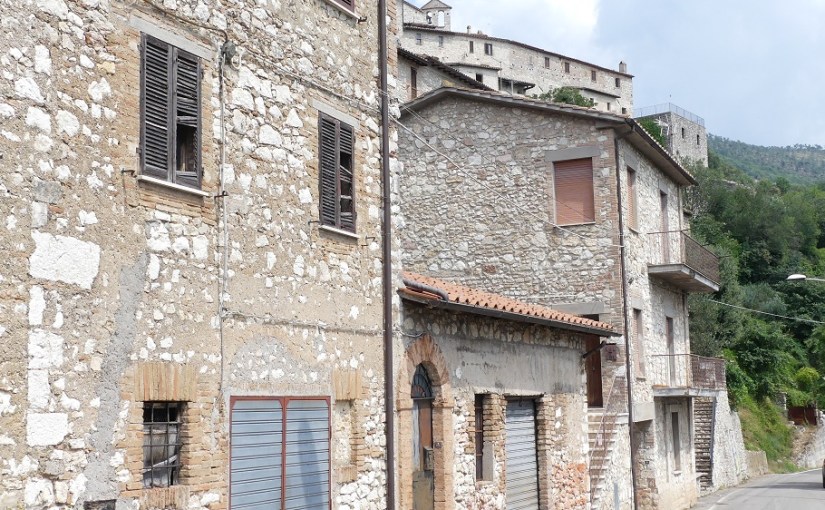
Spoleto in the province of Perugia Umbria is an hours drive north of Terni. One of Robert’s neighbours works in Spoleto and on our second day we were offered a lift to that village. Early the next day the four of us crammed into his motor vehicle (sadly I have forgotten the name of this kindly neighbour) and headed off arriving in an interesting square where our friend dropped us off while he continued his journey to work. This was one of the less celebrated squares but even so, its character and the sites/sights surprised us. From the public graffiti to the ancient clock tower to the Roman amphitheatre/ruins beside the square we were entertained. A well-appointed coffee shop provided an ideal viewing point to see a roman theatre whilst having a cappuccino. Outside of the coffee shop the ancient arches that once held the audience now afforded a view of the countryside and the ruins to passers-by.

We proceeded (after coffee) down a lane to the entrance to the museum containing the artefacts uncovered by the excavation of the amphitheatre.

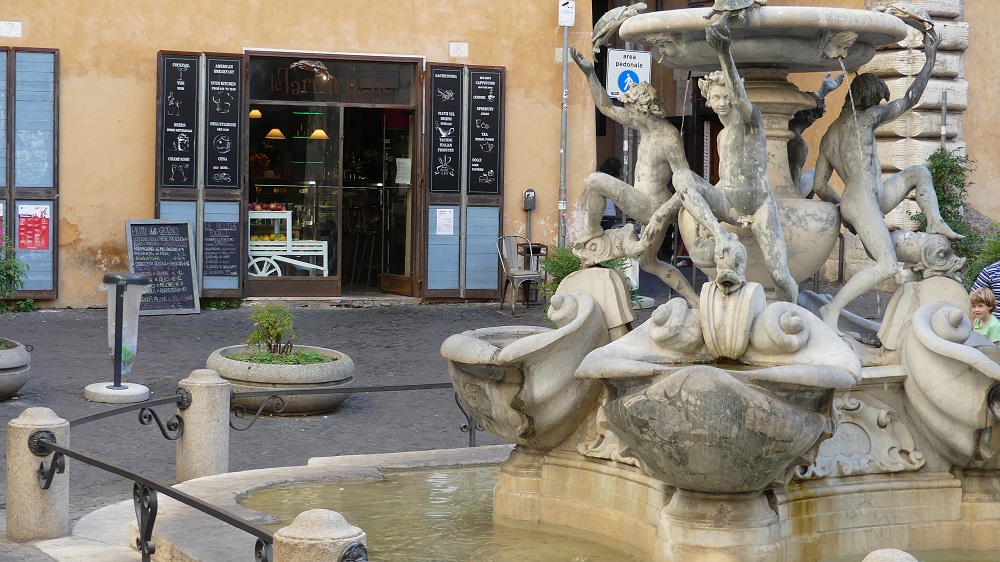
Back out of the lane way and into the main street we rushed passed the dress shops and shoe shops of the old town (this is vastly bigger than Cesi) into another square of coffee shops pubs and tourist souvenir shops which appeared to be the former marketplace of the village now serviced by pop up shops serving meats fruit and vegetables as well as traditional cooked Italian foods. A toilet break required so into another cafe for another cup of coffee. We proceed to follow the streets where they may lead us – passing the town hall.

From the town hall we walked to the majestic Rocca Albornoziana fortress, built in 1359–1370 for Cardinal Albornoz – Spoleto at this time was part of the Papal States. It has six sturdy towers which formed two distinct inner spaces: the Cortile delle Armi, for the troops, and the Cortile d’onore for the use of the city’s governor. The latter courtyard is surrounded by a two-floor porch. The rooms include the Camera Pinta (“Painted Room”) with noteworthy 15th‑century frescoes. After having resisted many sieges, the Rocca was turned into a jail in 1800 and used as such until the late 20th century. After extensive renovation it was reopened as a museum in 2007. The Rocca is so immense that I could not photograph the whole structure.

At the foot of the Rocca is Duomo (Cathedral) of S. Maria Assunta: Construction of the Duomo begun around 1175 and completed in 1227. The Romanesque edifice contains the tomb of Filippo Lippi, who died in Spoleto in 1469, designed by his son Filippino Lippi. The church also houses a manuscript letter by Saint Francis of Assisi. We found the manuscript in a chapel off the main chapel. It appears so non-descript until you realise how ancient it is and who is the author. It is tiny. There were a number of ancient looking writings in the Duomo one being on the face of a door. No translations were available nor was there any importance ascribed to the document but not a usual feature of such churches.  They have retained a part of the Duomo in its original condition with frescos.

We continued to saunter through Spoleto old town and eventually were evicted into the modern town of Spoleto. Here we caught our bus back to Cesi without any eventful happenings.

All of this time I have been wearing a moon boot to aid the healing of a split tendon (the Achilles) on my right leg. By the third day I was in need of a rest. I spent most of the day writing my earlier blog whilst Kerry and Robert filled in their day. Rested Kerry and I returned to Rome to celebrate the reason for this extravagance – our 30th anniversary.

← Back

Thank you for your response. ✨

The Retirees visit Roberto in Cesi Italy

We flew to Rome landing at Ciampino Airport not Fumincino as we expected. This meant finding a way from an Airport we had never been to before to Terminii and our hotel. We located a bus which took paying passengers to Terminii – eventually. When we arrived the driver dropped us off at Terminii station. Now we have been here numerous times but the bus had dropped us on the opposite side to where we usually arrived. So we spent some time dragging the luggage up and down looking for the hotel Dreamstation B&B. After about an hour we located the hotel. A shower a change of clothes and a comfortable bed and it was dream time at the Dreamstation.

As planned after awaking we strolled across the road pushing our luggage and boarded the train to Terni Umbria. We were more relaxed than our first trip to Terni. We knew it was platform 1 and knew that it was a 20 minute walk dragging the luggage and that we had to validate the ticket. The trip takes over an hour but to compensate there is some interesting countryside once you leave Rome. The deeper into Umbria the more hilltop villages can be spotted. These villages are often 800 – 1,000 year old settlements and some of the inhabitants have had generations of ancestors making a living in the fields around the village.

On arrival nothing has changed form our last visit 2 years earlier. The fountain in the main square still had not been repaired. The heat of the day was intense. We moved to the taxi rank and as we were slow getting out of the train (the platform lift is still not repaired), all taxis (there is only one or two of them) were busy rushing their fare to a destination. I spotted a passing taxi and waved it down. “I thought all a passenger she had arrive, wheres ya wanta go? Said the moustached Italian driving the Skoda. “Cesi” we say. “Cesi?” said the cabbie eyeing us up and down. With a shrug of his shoulders “Cesi!” Off we go, and I asked about the route he was taking, and he says “roada works, we go thisa way”.

Our arrival at Cesi in the main square was quite deflating – no Robert to greet us and the driver was not interested in tackling the narrow streets to get closer to our destination. So with the sun turning up the heat we dragged the luggage up the hill to the town hall through the shadows of the crowded town houses (they gave some relief from the sun) and after two further hills we see a beaming Robert swanning out of the shadows of his villa complaining about the heat. F**k me what a welcome.

Aided with the luggage (Robert suggested I leave the heavy bags in the foyer downstairs) we were offered a refreshing libation (a cordial or something) and told he had booked a table at the restaurant at Portaria where he can purchase his favourite meal. S**t we felt wrung out and in need of a lie down but no onto the bus (we had to stand in the sun at the bus stop and the bloody rattletrap excuse of a bus (unairconditioned) finally decided to attempt the climb up the hill and across the range to Portaria. The season has changed since we were here last and outdoor dining is all the go – well outdoor in the sense that we sat under a crude lean to, against a stone rampart in an airless courtyard. The saving grace an icy beer with the hot lunch and a breeze hot enough to dry the sweat from my shirt. Finally, I could stand it no longer, so making some excuse I made a break for the eastern side of the village where there is deep shade of an afternoon and hopefully a breeze that does not feel it was produce by a fan forced oven.

The eastern gate opens onto the road that circles outside the town walls. Many of the residents park their cars out here and there is, as in many other places in the village, a little shrine with the Virgin seeking your prayers. The countryside is still green, but the heat has caused a haze adding to the feeling of oppression. Here are some photos of the gate, the Virgin, the road around the walls, the walls, the houses perched on top and the memorial to the lost youth of the village through fighting in both the first and second wars.

I walked up past the war memorial past the shuttered empty former restaurant in the town walls and spotted Kerry and Robert sitting in the shade of a (the only) cafe in the village which also serves as the bus stop. The return journey is not straight forward. We have to travel by the bus back out from the village onto the main hill road down to the town of Aquasparta to the bus terminus turn around and travel back to Cesi. This time the bus was air-conditioned and more modern. The sting of the sun was waning and we were feeling tiredness wrapping around us so the journey passed unnoticed. The final walk through the village to Robert’s Villa Contessa from the bus stop for the day saw us flake into the lounge and after showering off the dust of the road bed to sleep and dream.

← Back

Thank you for your response. ✨

The Retirees return to Nottingham

Our trip by bus to Nottingham was part of the nostalgia of this entire trip. Whilst living in the UK we travelled the M1 by bus from Nottingham to London frequently even though we had Thistle (our car). For me watching the familiar countryside slip by was a cathartic feeling I had returned to somewhere where we had both been content.

Arriving at Nottingham and we made our way to Attenborough where Cilla and Bob have lived and raised their family. Bob is a retired Professor formerly working at Nottingham University in human genes and biology and Cilla a retired physiotherapist. Cilla has an interest in Leprosy and supports a foundation aiding people afflicted and seeking a cure. Hence upon arrival we had great joy in assisting in setting up a garden party in their back yard in aid of the Leprosy Foundation. Leprosy remains a problem in Niger Africa.

Saturday morning and its all happening. Ladies dropping in the cakes for the cakes stall, Michelle (another gardener from the church) dropping in with masses of plants for the plant stall and Kerry and me assisting where needed (me assisting on the BBQ doing bacon butties) and Kerry aiding in the kitchen. All the neighbours and other people from throughout the village attend with 77 people attending in all (the head count courtesy of a door prize raffle setup by me) and takings from sales raffles etc and donations in excess of 1,000 pounds to be donated to the Leprosy Foundation. This is something they do every year to help.

After assisting cleaning up we made our way by bus into Nottingham to meet up with Martin and Christine our fellow travellers on the Rhine in 2015. Martin is a former MP in the Army and was stationed for a period in Germany and else where and has a deprecating sense of humour and a thirst for a lager (two hands and only one mouth). We have stayed in touch visiting them in Manchester last time we were over that way and they made the trip to Nottingham (we haven’t been here before) to see us. We met at the Ye Ole Trip to Jerusalem a pub claiming to be established in 1172AD and the oldest in Britain ( a claim challenged by Martin who says he has drunk in pubs of much greater age but cannot remember where). It was as usual very busy but we battled through and made “friends” with a bunch of young blokes taking their friend for a buck adventure dressed in a pink chiffon dress and tiara. He got too close to me at one stage.

We moved on from there to another pub up the road and across the canal in brilliant sunshine unusual for Britain and then another pub for an evening meal. Both Nottinghamshire and Derbyshire are blessed with narrow boat canals from the Industrial Revolution when all cargo went by canal to the ports. Whilst the meal disappointed the company was grand and we parted promising to catch up again and keep in touch. Since returning home we have pledged to meet again on the Rhine in 2020.

Returning to Attenborough we noticed that one of the marquees remained standing in the back yard. Bob had invited Roger and Joan and Sue around for lunch the following day. We had met Roger, Joan and Sue at the Leprosy fund raiser and they were coming back to help with the leftovers. Not really although the menu included sausages from the BBQ. I am not sure how many bottles of wine (Roger is ex-military also) were consumed but Bob found himself needing a rest after lunch. So we finished cleaning up and packing away the marquee and still the sun shined.

We continued to click with Bob and Cilla and they offered to take us for a country drive to a pub for lunch the next day. They had chosen a remote pub in the Derby dales out past Eyam. The pub a former something converted to its present use sits on a ridge overlooking the valley below. On the way we travelled to Monsal Head where we could see a former rail bridge and line now converted to a bike and walking path through the hills.

We drove from Monsal Head to Tideswell.

In the Middle Ages, Tideswell was a market town known for lead mining. The Tideswell lead miners were renowned for their strength and were much prized by the military authorities. The Domesday Book of 1086 lists TIDESUUELLE as the King’s land in the charge of William Peverel with fewer than five households.

Tideswell is now best known for its 14th-century parish church, the Church of St John the Baptist, known as the “Cathedral of the Peak”, which contains three 15th-century misericords. A sundial lies in the churchyard; it is positioned on steps which local historian Neville T. Sharpe thinks likely to be those of the village’s market cross. A market and two-day fair were granted to the village in 1251. The Foljambe family, later the Foljambe baronets, were the principal landowners from the fourteenth to the eighteenth centuries. The tomb of Sir Thurstan de Bower and Lady Margaret lie in the chapel.

From Tideswell we moved onto The Barrel Inn, a traditional Derbyshire country inn, dating back to 1597 and stands at the head of Bretton Clough, in the heart of the Peak District.

Being one of only five properties in this small hamlet, on a table of land some 1300 feet above sea level, The Barrel Inn claims to be the highest pub in Derbyshire. It has panoramic views of the majestic Hope Valley and the Peak District National Park. Old worldly charm – peaceful oak-beamed bar, real log fires, flagstone floors, studded doors in low doorways, beamed ceilings and polished copper and brass – have all been retained to enhance the overall charm and friendliness of the Inn.

Lunch was very pleasant and again Kerry and I found it difficult to resist the draw to once again return to live in Derbyshire.

Kerry had been trying to find some 3 ply wool for a shawl she had started and she had been unable to obtain it in Brisbane or at the wool shop at Chillwell nor at John Lewis in Nottingham so Bob made his way through the Dales to Buxton where Kerry had purchased the wool some 2 and 1/2 years ago. Buxton is an old Victorian spa town and often very busy with traffic. So whilst Bob and I caused a traffic jam Kerry and Cilla ran to the wool shop and purchased the necessary wool. An excellent day.

We also had time to visit Long Eaton and our old neighbour Pam Fowler. One of the memorable things about Long Eaton was the public gardens throughout the village. Here the Union Jack is proudly displayed in flowers and garden beds blooming line the streets and roundabouts.

Our time with Bob and Cilla was coming to an end but we had to visit the church. It was Tuesday the coffee morning at the Church, but the old crowd was not there. Trevor master of the kettle has passed on and Sue his widow (at the garden party) continues to work at the church but apart from Cilla, Sue and Michelle none of the old crowd were there. We visited the new memorial to the victims of the Chillwell munitions explosion from WW1 something that is still raw with some members of the community.

We had wanted to catch the bus to East Midlands Airport but Bob and Cilla would not have it and drove us to the drop off at the newly refurbished airport. Regretfully our nostalgic return had come to an end and who knows if we will ever have the opportunity to return.

← Back

Thank you for your response. ✨

The Retirees Celebrate 30 years – Nottingham, Cesi and Rome

We don’t often decide to embark on a journey with such speed and decision as on this occasion. We had barely returned from our Mississippi trip that was over 12 months in planning than we were off again to celebrate 30 years of marriage. In truth we had celebrated at year ten then forgotten about anniversaries often finding ourselves remembering on the day but with no other particular thought or preparation.

Over dinner on the American Queen outside of Memphis and after a bottle of wine I said words to the effect that we should celebrate this 30th year with a trip to Rome. I don’t know why. Why Rome? Why this particular year/milestone. But Kerry didn’t miss the slip (if it be a slip) and the planning began in earnest upon our return to Brisbane.

The final itinerary;

Travel to London overnight and then catch the National Express bus to Nottingham and catch up with Cilla and Bob and meet with Martin and Christine visit the Rotary Club of Nottingham members, visit St Mary of the Virgin church in Attenborough where we tended the gardens and graves.

Travel to East Midlands Airport for the flight to Rome by RyanAir landing at Ciampino Airport travel into Rome and overnight at the Dreamstation Hotel before catching a train at Terminii out to Terni then the taxi up to Cesi in the hills overlooking Terni to visit Roberto and whilst there to visit Splato, Portaria and Kerry to visit Purugia (I was resting my injured tendon and doing the washing).

Travel to Rome by train and find our accommodation at the Maittise B&B in Via Nationalize to enjoy 5 romantic days in a stinking hot and humid Rome,

Then travel back to Australia.

That’s it – two weeks and we return home. Most unusual for us to take such a short trip. So settle back whilst I take on the trip across the world and back again.

← Back

Thank you for your response. ✨


The Retirees visit Graceland

Memphis is best known for Elvis and his home “Graceland”. Graceland is a mansion on a 13.8-acre (5.6 ha) estate, that was owned by Elvis Presley. It is located at 3764 Elvis Presley Boulevard in the vast Whitehaven community, about 9 miles (14.5 km) from Downtown. It currently serves as a museum. It was opened to the public on June 7, 1982. The site was listed in the National Register of Historic Places on November 7, 1991, and declared a National Historic Landmark on March 27, 2006. Graceland is the second most-visited house in America with over 650,000 visitors a year; second only to the White House. It is also across Elvis Presley Dr from a “Disney” type park celebrating Elvis’s fame and life.

I found Graceland to be unsurprising and ordinary in many ways which I think describes the type of person Elvis appears to have been away from the fame. He maintained many of his childhood friends had great affection for his mother and father (Mum Dad and his Aunt are buried at Graceland) and whilst he spent big on toys he also seems to have been quietly philanthropic in many ways to the community of Memphis. However, it did have its moments with the Louis Comfort Tiffany stained glass panels in the piano room and the (original?) Matisse on the wall and the Tiffany light shades in the pool room. I enjoyed the fact that the Mario Lanza album is on display in his den (Lanza was a poor immigrant Italian boy who made good singing opera and had a movie career singing opera in film – just like Presley sort of). Starting at the front door we entered into the sitting room and piano room then around to Mum and Dad’s bedroom (they lived with Elvis) then to the dining room kitchen (with carpet) downstair to the bar, the media room with its Mario Lansa album the pool room the Picasso(?) and the graveyard.

The park as opposed to his home is made up of various pavilions (some of which are only available on the VIP tour) each pavilion focusing on different aspects of his life (eg) his military service, his toys, his music etc. And each one having its own gift shop of course. You walk through the yard of the house through the cemetery then cross to the pavilions. We saw his cars his bikes his awards his fatigues then over to the planes. Although not in a pavilion you can visit Elvis’s two planes parked casually to one side of the other pavilions. Overall worth the visit.

Memphis is struggling to regain its economy with a number of buildings boarded up and the town centre seemingly on holiday all the time. But one of its highlights is the Peabody Hotel. There are a number of Peabody Hotels around the USA but none like the Memphis Peabody. The Peabody Memphis is a luxury hotel and is known for the “Peabody Ducks” that live on the hotel rooftop and make daily treks to the lobby where they swim around in a fountain in the main lobby. The Peabody is a member of Historic Hotels of America, a programme of the National Trust for Historic Preservation. It also has as a tenant the clothier to dress Elvis whilst he was getting fame and throughout his life. We were told on our tour into Memphis that Elvis continued to use the same barber that he used before getting fame.

The Peabody has a roof top party at various time of the year on a Thursday night and we were there at the right time to visit the ducks in the duck palace on the roof (the ducks had been fed and gone to bed). The following day we took a walk along the Mississippi watching acrobatics by a couple of stunt planes.

Our trip has come to an end with an early start for the airport. Unable to get an Uber (4.30am) the hotel security guard offered to drive us to the airport (I suspect he does this regularly) but he took us on a different trip to what I had expected. When I commented that I had not seen any signs directing to the airport he commented that he doesn’t use the freeway because of the random drive by shootings that occur at night ever since the gangs had moved up from New Orleans following Hurricane Katrina. That may explain the downturn that Memphis appears to be stuck in. However, we left safely to enjoy a 12 hour layover in LA where we encountered complete disarray with our travel arrangements leaving us shuttling between terminal 2 and Tom Bradly terminal trying to determine where we caught our flight back home. All is well that ends well – we are home safely.

← Back

Thank you for your response. ✨

The Retirees visit Memphis and the King

Memphis, Queen of the delta – believe it or not the delta of the Mississippi commences up here. What we would ordinarily consider to be the delta at the river mouth is the creation of the last ice age filling in the opening existing prior to the ice.

We left the American Queen on a tour bus with the plan that the bus would drop us at our hotel. The first stop was the Tourist Information Centre. Elvis and B.B. King are big personalities in Memphis as borne out by the large statues in the Information Centre. During the tour our tour guide sang and played her guitar as she told the story of Elvis and B.B. King in Memphis. We visited an open air auditorium where Elvis used to play before becoming a household name. We saw the recording studio and other sights but all a bit weak. Nevertheless, it was a great introduction helping us to find all the things we would do in the next 5 days except our hotel.

After locating our hotel (which was under renovation – not amused) we took a walk in Main Street where the tram line runs and the tram occasionally does too . There were blokes in blue official looking shirts riding bikes around Main St and they were a mix of tourist information and Policing. A good idea actually. Walked down to Beale St (not a tram in sight) but there was nothing happening due to daylight being present. They follow the practice of keeping the heritage front of a building and whacking a new building behind. We spent the rest of the day doing very little of anything as did the rest of Memphis. Where is everybody?

The following day Kerry was very weary so she stayed in bed whilst I went to the National Civil Rights Museum just past Beale St on the tram line. Built around the Lorraine Motel where Dr Martin Luther King was assassinated it is a historical record of slavery and its origins and the struggle of African Americans to be recognised as equal in America. Photos were not permitted inside the museum but it is riveting in its explanation of the growth of the civil rights movement and the racial hatred on both sides of the colour divide. I was fascinated by what I did not know of this part of the American history. It reminded me of the statements my mother made about the American soldiers visiting Brisbane during W.W.2 and how the coloured soldiers weren’t allowed in just any pub they had one allocated on the west side of the Victoria Bridge I think it was the “Crown and Anchor” – long since disappeared from South Brisbane.

The museum is in two parts the first being the Lorraine Motel where Dr King was staying containing the history of the national civil rights movement including Dr King’s assassination and the second part in a building on the opposite side of the road being an old boarding house from which James Earl Ray fired the killing shot. this part details the assassination, the investigation, the capture, and the conspiracies around the assassination.

I spent the whole day at the museum and I was moved by the images and the history and the even-handed presentation of the events it dealt with.

As you enter Memphis across the Bridge from Arkansas you are met by a large metallic pyramid once the home of the local NBA basketball team “the Grizzlies” and now the home of Bass Pro Shop Megastore and the 100-room hotel known as the Big Cypress Lodge. The Pyramid contains 600,000 gallons of water features and the largest collection of waterfowl and hunting related equipment in the world. In addition to the retail store itself, Bass Pro at the Pyramid is home to an archery range, shooting range, and laser arcade. The building also includes an Uncle Buck’s Fishbowl and Grill with a bowling alley and a saltwater aquarium. The tallest freestanding elevator in America takes visitors to The Lookout at the Pyramid at the apex of the building, where they can take in the view on an indoor and outdoor observation deck or dine and drink at the “Sky High Catfish Cabin”, a restaurant, bar, and aquarium at the top of the building. See for your self – and you can buy any automatic rifle or hand gun just as though you were shopping in Target (no pun intended).

Upon entering we encountered the largest range of fishing rods and stuck in the middle an ag bike being raffled or you can buy it. the store is supposed to depict a Mississippi swampland with big buttress trees standing in sluggish waterways filled with strange creatures – fish and alligators. Of course you can buy your swamp boat just yonder in bayou. Then there are the aquariums huge tubs of water with fish over a foot long. Standing in the middle is the free standing elevator to the summit – its not free USD $10 per person for the journey the entrance to the Lodge/hotel is to all intents a hunting lodge. And what is a hunting trip without a concealable hand gun or an automatic Armalite.

The trip up the elevator was a little alarming watching as everything on all four sides fell away. That is part of the hunting lodge you can see but once at the top it was truly magnificent. Essentially a restaurant and bar but with an enormous aquarium stuck in the middle and a viewing platform outside. You can see down to the entrance into the pyramid, the bridge to Arkansas, the city centre and up and down the Mississippi including over to Mud Is (Yes a novel name).

That night we went back to Beale St where there was a restored American road car show and far too much daylight to go inside the restaurant. The B.B. King tribute restaurant is on the first floor overlooking the action in Beale St and Second Ave. After dinner we listened to a fabulous band playing B.B. King covers whilst sitting in the bar. emblazoned on the wall was the name of that guitar. We had the real thing in a set of CDs bought from the BB king Museum, so we resisted the stage hand selling the cover band’s CD. Out in the street there were people everywhere, but we are told it was not busy. Unfortunately, lots of people living on the streets and hustlers everywhere. There was a booze bike going around appearing to be powered by the persons seated drinking but on closer examination it is motorised with the peddles just for show. On the walk back to the hotel we went past the Orpheum Theatre. What a day.

← Back

Thank you for your response. ✨

The Retirees in the South East USA – Greenville, Indianola and BB King

After Vicksburg we sailed to Greenville and the launching point to visit Indainola the birth place of B.B. King. The boat landed against a huge levee bank emblazoned with a welcome message from the towns folk. We boarded the bus for the trip to Indianola, a little mid western town likely unchanged for 100 years.

Leaving the American Queen we travelled by bus to the museum outside of Indianola. We arrived in front of an old gin which has been transformed into a music hall with the museum to great man attached and his grave and tombstone beside it. Our visit commenced with Kerry posing in front of a monument to “Lucille” BB Kings guitar followed  by an ensemble of male gospel singers presenting some of BB’s tunes in the music hall from which we proceeded to the museum. The museum is superb. It is a mixture of pieces of the past brought together to follow Riley B King from birth to his death. The story is told by a mixture of story cards with static displays of related things photographs, recordings interviews and film clips. Married twice but without any children from those relationships King fathered 15 illegitimate children that he supported throughout his life. Of course, his estate is the subject of disputed claims. After his death in 2015 the decision was made to bury him at the museum. Presently it is exposed to rain hail and sunshine but there are plans to build a chapel around the tomb. No visit to B.B. King’s museum is complete without visiting Club Ebony in Indianola. This is a African American Club built after the 2nd World War which has seen the likes of B.B. King, Ray Charles, Count Basie and others start their careers. King purchased the club and returned each year till his death to play. Sadly, it looks like it needs a good deal of maintenance.

We returned to the boat and set sail immediately. We sat in the cool of the evening watching the river pass by and watched our boat overtake a river tug pushing 49 barges somewhere. These barges carry everything from crops to coal and chemicals and although they are slow compared to road transport these barges keep thousands of trucks from clogging the roads. The record for the number of barges stands at 82 and each barge represents 15+ semi-trailers. We were nearly at Memphis and this part of the river did not have the high levy banks which had covered the view of the river banks and the inhabitant almost from New Orleans.

Next morning, just as we were steaming to Memphis, we witnessed the lowering of the smoke stacks on the boat to allow us to pass under low power lines and bridge crossing the river. In parts of the river they even have to lower the wheel house. This is our sailing day (no ports of call) as we arrive in Memphis tomorrow morning.

← Back

Thank you for your response. ✨

The Retirees in the South East USA – Sailing into history – Vicksburg

The following day we went to Vicksburg, the scene of a major battle in the American Civil War and a turning point when Vicksburg capitulated to the Union Army.

(May 18 – July 4, 1863) was the final major military action in the Vicksburg Campaign of the American Civil War. Vicksburg was the last major Confederate stronghold on the Mississippi River. After holding out for more than forty days, with their reinforcement and supplies nearly gone, the garrison finally surrendered on July 4.

We had no desire to walk the battlefields so we boarded the hop on hop off bus to visit the town. The old town was quite attractive and going through a rejuvenation with apartments being developed in the major street of the central business district.

We strolled down Washington St stopping when we came across Biendenharn Candy Co building. Herman, and Uncle Henry, founded a retail confectionary business known as Biedenharn and Brother. In 1890, Herman’s son Joe and his father built a two-story brick building at 1107 Washington Street which served as Joe’s wholesale candy company on one side and his father’s shoe store on the other. Joe eventually took over the operation of the candy business and it became the Biedenharn Candy Company. It was here that Cocoa Cola was bottled for the first time. Up till then Coke was sold by the glass from soda fountains. Joe bottled the Coke and sent 6 bottles to the manufacturer who then licenced the company to bottle Coke. The Biedenharns bottled Coca-Cola here and in other locations in downtown Vicksburg until 1938 when the new Coca-Cola plant was constructed at 2133 Washington Street. The building was sold out of the family and used for a variety of commercial purposes.  In 1979, the family repurchased the building and began a rehabilitation using historic photographs to restore the building’s major spaces and to install exhibits interpreting the Biedenharn’s Coca-Cola heritage. The family then donated the building to the Vicksburg foundation for Historic Preservation.

After enjoying a bottle of Sprite, we crossed the road to Yesterdays Children Doll and Boys Toys Museum over 1,000 dolls dating back to 1843 in an historic setting. We encountered a Popeye doll, every kind of Barbie GI Joe and Cabbage Patch dolls even Laurel and Hardy.

Further down Washington St we found the Museum of the River. The Army Corp of Engineers has been tasked to maintain the waterways of the USA. This is the museum of the engineers achievements and the setback they have overcome. Attached to the building is a retired riverboat designed as the floating HQ for the Corp. The museum described how the Corp has kept the waterway open and managed the disasters created through flooding and most recently improved the river environment. From there we walked down to the river to the old rail station now a storybook for model trains and the civil war naval engagements and the Battle of Vicksburg. One of the tasks for the Corp is too build levees and walls along the river to protect townships from flooding.

Vicksburg has turned their levee walls into a picture book of its history. Here are a few photos of the sights of Vicksburg.

← Back

Thank you for your response. ✨

The Retirees in the South East USA – Onboard the PSS American Queen

When fronting at the Pursers desk to book our spot on the Hop on Hop off bus, all spots were gone. We were not beaten yet. So we left the boat after it had landed found a cab and for USD $8 we got a trip into up town Natchez with a guided tour by our cab driver.

Once we arrived up town we were dropped off at one of the hop on hop off bus stops and joined the tour. We decided not to await the bus but start our own tour by visiting the major church in town (catholic so nicely dressed up) then we walked to Magnolia Hall – see the feature photo above. Magnolia Hall was built by Thomas Henderson, a wealthy merchant, planter and cotton broker. The home is one of the finest examples in Natchez of the Greek Revival style. It is an antebellum home and during a bombardment of Natchez by the Union gunboat Essex, a shell hit the soup tureen in Magnolia Hall’s kitchen.

The Natchez Garden Club has restored Magnolia Hall. Rooms on the main floor are filled with mid-nineteenth century antiques, while rooms on the upper floors contain a costume collection.

Note the picture of the plate warmer.

After the Hall we move onto the home of William Johnson. William T. Johnson (1809 – June 17, 1851) was a free African American barber of biracial parentage, who lived in Natchez, Mississippi. He was born into slavery but his owner, also named William Johnson and thought to be his father, emancipated him in 1820. His mother, Amy, had been freed in 1814 and his sister Adelia in 1818. Johnson trained with his brother-in-law James Miller as a barber, and began working in Port Gibson, Mississippi. He returned to Natchez, becoming a successful entrepreneur with a barbershop, bath house, bookstore, and land holdings. Though a former slave, William Johnson went on to own sixteen slaves himself. He began a diary in 1835, which he continued through the remainder of his life. In 1835, he married Ann Battle, a free woman of colour with a similar background to his, and they had eleven children. Johnson loaned money to many people, including the governor of Mississippi who had signed his emancipation papers.

Johnson was murdered in 1851 after an adjudicated boundary dispute, by a mixed-race neighbour named Baylor Winn, in front of his son, a free black apprentice, and a slave. Winn was held in prison for two years and brought to trial twice; Johnson was such a well-respected businessman that the outrage over his murder caused the trial to be held in a neighbouring town. In that town no one knew Winn, so they didn’t know that he was half-black. Since Mississippi law forbade blacks from testifying against whites in criminal cases, Winn’s defence was that he was half-white and half-Native American, making him white by law. The defence worked, none of the (black) witnesses could testify, and Winn escaped conviction. Johnson’s diary was rediscovered in 1938 and published in 1951. It reveals much of the daily life of a 19th-century Mississippi businessman, including the fact that he was himself later a slaveholder. His papers are archived at Louisiana State University.

Through an act of Congress, the home of William Johnson became a part of the Natchez National Historical Park in 1990.

Here is a photo of the Johnson house and next door the Adams County Jail (Goal to us).

Natchez grew up in two parts Natchez below the Hill which provided for the boatmen and the handling of cargo and Natchez above the Hill which was built by the Spanish on the high ground for a fort and township not affected by the river. Our next stop was to visit the few remaining buildings forming Lower Natchez then return to the boat for lunch. Parked nearby was the American Duchess a sister boat of the American Queen.

In the afternoon we had booked to see a historic plantation with original slave quarters church cookhouse gin etc. Frogmore Plantation and Gin contrasts a working cotton plantation of the early 1800’s with a modern cotton plantation and gin of today. Our tour started with a drive through the present-day gin -1800 acre cotton plantation with a computerized 900 bales-per-day cotton gin, then through the fields to the church where we heard songs from the fields from locals who had experienced this life. We listened to the slave customs, secret music, and their surprising relationships with the master, mistress, and overseer. We then walked through authentically furnished slave quarters, a relic of a rare steam gin, and other plantation dependencies.

Our day ended with a bus ride back to the American Queen a grand dinner in the dining room then the show. Tough life.

← Back

Thank you for your response. ✨

The Retirees in the South East USA – All aboard the American Queen – the Mississippi River, Nottoway Plantation and St Francisville

The following morning, we caught the bus from the hotel to the American Queen Steamboat – a distance of 200 metres. We knew it was nearby but not that close. So we boarded the boat (not a ship because its on the river) using our boarding cards obtained when we registered at the Hotel and then found our way to our cabin on floor 4. Although an internal cabin, it looked to the chart room and out across the bow deck – an excellent position and a large cabin.

We took a stroll around the boat. Starting at the top on the 5th floor there are the wheel house and the exclusive cabins, swimming pool and gyms. Fourth floor is the chartroom where the Riverlorian Jerry hides out, cabins, the front patio and one of the only decks allowing you to circumnavigate the boat. Third floor is cabins, and the front patio which is the smorgasbord all day dining. The front patio is an undercover patio deck with access to the engine room and the engine room bar. Second floor has the Purser, the Tour director and gift shop. It also includes the gentlemen’s card room the ladies parlour and the library. First floor has the main dining room and the theatre where evening performances delight.

When registering onto the boat we selected our tours but in addition we could register daily (if quick enough) for the hop on hop off bus tours of our daily stops. The boat set sail (nautical term – there are no sails on a steam powered paddle boat). We made our way up river to our first port of call – a stop at “Nottoway Plantation” – an antebellum plantation home.

The boat landed by running onto the bank. this was an exercise that the crew would go through many times. Two unfortunates had to get into the water and receive the ropes then find the anchor spots under the water in the bull rushes to tie up the boat. On this occasion they used a tree to tie up at the stern. Then a walkway was lowered onto the bank and we walked over to the levee (nearly the length of the river has levee banks) up and over the levee to the entry of Nottoway.

We were greeted by our tour guides in costume of the time of building before the American Civil War. Our guides toured the house giving us its history of its first owners and the impact of the American Civil war.  In 1855 John Hampden Randolph purchased 400 acres (1.6 km2) of highland, and 620 acres (2.5 km2) of swamp and Mississippi River-front land to grow sugar cane and where he sought to build a prestigious home that he named “Nottoway,” after Nottoway County in the part of Virginia where he was born. The plantation house is a Greek Revival and Italianate-styled mansion built by John Hampden Randolph in 1859, and is the largest extant antebellum plantation house in the South with 53,000 square feet (4,900 m2) of floor space.

Soon after the house was completed the Civil War began. Randolph did not support secession from the Union, but once the war began, backed the war financially and sent his three sons to fight for the Confederacy, losing his oldest son, Algernon Sidney Randolph, at the Battle of Vicksburg. With the war coming ever closer to Nottoway, it was decided that Randolph would take 200 slaves to Texas and grow cotton there while his wife, Emily, stayed at Nottoway with the youngest children, hoping that their presence would save it from destruction. The plantation was occupied by both Union and Confederate troops and though the grounds were damaged and the animals plundered, Nottoway survived the war with only a single grapeshot to the far left column that did not fall out until 1971.

With the emancipation of the slaves, John Randolph contracted with 53 of his former slaves to continue working as paid laborers; when he returned to Nottoway after the Civil War, most chose to return with him. The sugar business was not as profitable after the war and by 1875, Nottoway was reduced to 800 acres (3.2 km2). John Randolph died at Nottoway on September 8, 1883, leaving the plantation to his wife.

Emily Randolph sold the plantation in 1889 for $50,000, which she divided equally among her nine surviving children and herself. She died in Baton Rouge in 1904. Nottoway has become a resort destination.

We returned to the boat for lunch whilst the boat moved further up river to St Francisville where we caught the hop on hop off bus to Louisiana and the plantation “Myrtles” which was an unscheduled stop on the hop on hop off tour that day. Generally, the hop on tours were disappointing (the towns are rural mid-western towns like any Queensland rural town providing a centre for the rural communities surrounding it). This was interesting because it claims to be the most haunted place in USA and has documented proof of its ghosts.

The Myrtles has 22 rooms spread over two floors. The Myrtles Plantation was built in 1796 by General David Bradford on 600 acres and was named “Laurel Grove.” Bradford lived there alone for several years, until President John Adams pardoned him for his role in the Pennsylvania Whiskey Rebellion in 1799. In 1834, the plantation, the land, and its slaves were sold to Ruffin Gray Stirling. Stirling and his wife changed the mane of the plantation to “The Myrtles” after the crepe myrtles that grew in the vicinity.

The Myrtles survived the American Civil War, though robbed of its fine furnishings and expensive accessories. In 1865, Mary Cobb Stirling hired William Drew Winter to help manage the plantation as her lawyer and agent. Winter was married to Stirling’s daughter, Sarah, and they went on to have six children, one of whom (Kate Winter) died from typhoid at the age of three. In 1871, William Winter was killed on the porch of the house, possibly by a man named E.S. Webber. After being shot, he staggered inside the house and died trying to climb the stairs. He died on the 17th step of the stairs. Visitors, as well as employees in the home, still hear his dying footsteps. Touted as “one of America’s most haunted homes”, the plantation is supposedly the home of at least 12 ghosts, historically only Winter’s death has been recorded. Our tour guide maintains that Mrs Winter and two of her children were poisoned by a negro maid who had her ear cut off by Winter for eaves dropping and ejected from the house to work with the field slaves. To try and ingratiate herself in the household again she intended to make the children sick but she poisoned all three and in turn was killed by the other slaves fearing reprisals from the master. The one eared ghost steals visitors earrings as evidenced by the large number of single earrings found in the house. National Geographic are said to have sent an investigator who captured photos of the spirit and the ghosts of the two children and these are on display at the house. The rest of the town was rather unexciting. We visited the local Presbyterian Church (the usual unadorned interior for this religion) and then across the road passed the court house after which we returned to the boat.

Dinner was great. We found ourselves seated with Jim and Jacqui both retired teachers from Chesapeake Bay Maryland. We struck up a great rapport with them and can count them amongst “our new best friends”. The dinner was superb, and the evening show followed. The performers were excellent but we made the mistake of not booking our hop on hop off tour for Natchez the next day.

← Back

Thank you for your response. ✨