The Retirees in Helsinki – Searching for Sibelius

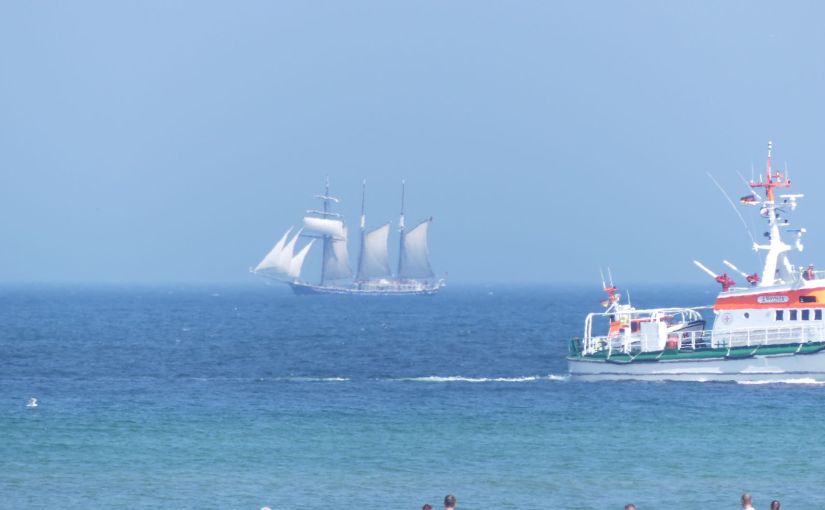
As we enjoyed the weak sunshine on the ferry returning to the mainland (not the sloop shown in the picture below) we decided to go to the Stockman building. We had noticed a roof top something on the Stockman so our next port of call was the roof top of that department store. The roof top bar was exposed cold and windy – the girls tried to enjoy a G&T but an accident with the delivery lost part of the G&T and left us looking for a warmer spot. In front of the Stockman is the monument to the workers of Finalnd. It was getting colder and nearing our dinner time so we returned to the apartment to warm up.

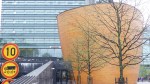
The following morning Kerry and Rod were leaving us to visit an exchange student they had hosted many years ago. To use some of the remaining time together, we decided to find the church called the Rock. Walking through the village past the local museum we spotted an opening in the rock face in front of us – here was the church. Recently constructed and without any charm I saw it as a gimmick and soon lost interest. Rod and Kerry departed at the Rock church whilst we set out to find the Sibelius memorial.
Jean Sibelius (8 December 1865 – 20 September 1957), was a Finnish composer and violinist. He is widely recognized as his country’s greatest composer and, through his music, is often credited with having helped Finland to develop a national identity during its struggle for independence from Russia.
Sibelius composed prolifically until the mid-1920s, but after completing his Seventh Symphony (1924), the incidental music for The Tempest (1926) and the tone poem Tapiola (1926), he stopped producing major works in his last thirty years, a stunning and perplexing decline commonly referred to as “The Silence of Järvenpää”, the location of his home. His home was named Ainola after his wife.
Our trip started by tram and then a walk through a park. On the way we passed an unusual church. Its colour first caught my eye then the unusual rounded end and the bell tower with its reliefs/murals on its ceiling. There was a service being performed and parents were dropping off and collecting children from the attached creche.

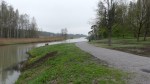
Beyond the church was the park and across the park is the memorial. The memorial acknowledges his connection with the Finnish countryside and his musical composition.

We then returned to the city and visited the Helsinki Lutheran Cathedral. Helsinki Cathedral is the Finnish Evangelical Lutheran cathedral of the Diocese of Helsinki, located in the neighbourhood of Kruununhaka in the centre of Helsinki, Finland. The church was originally built from 1830-1852 as a tribute to the Grand Duke of Finland, Tsar Nicholas I of Russia. It was also known as St Nicholas’ Church until the independence of Finland in 1917. It is a major landmark of the city. Austere and lacking the glitz of a catholic cathedral the building does not resonate with the riches of the roman church.


Having seen the Sibelius memorial I decided I wanted to visit Ainola so the following day we went to the bus station to catch a bus out into the country. Whilst waiting for the bus we walked through the station and out of the station onto another square where we encountered and odd structure that turned out to be a church and found that we were within walking distance of the Central Railway Station – in fact we could see the damn thing.

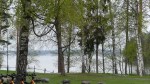
We returned to the bus station and awaited the arrival of our bus. It arrived shortly before the appointed time. we boarded and paid our fare took our seats and waited for departure time when the bus left precidely on time. Having caught our bus we found ourselves some what lost. Without a route map we were not certain where to get off the bus and missed our stop meaning a 15 min walk back to our stop. Fortunately, the only other passenger waiting at this bus stop spoke excellent English and gave us some further directions – which we followed and proved to be wrong. So here we are in the wilderness of Finland and not a clue where that was. One thing though, our bus ticket seemed valid wherever we travelled. We got onto back roads looking for a lakeside walk and end up at a resort at Onnela.

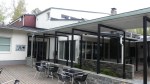
The resort was just starting to re-open for the spring (they were clearing the snow from the ground) but the restaurnat was open for lunch. After a simple lunch we got some further directions and made our way back to the highway to await and flag down another bus.
Finally, we arrived at Ainola although you would never know it from any street signs. We walked along the dirt track towards a suspicious group of vehicles suggesting a carpark. Arriving at a kiosk/café/toilet we were relieved to learn we had arrived – this was Ainola home of Jean Sibelius. And there was an English guided tour due to start. So we had struck it lucky.

The tour only covered the lower floor of the house as the upper floor was considered unable to handle constant trafic of visitors. The tour of the house was great. Here in this country cottage Finland greatest composer lived and worked or should I say his wife lived and worked – he spent a lot of time in Germany and the US and did not handle money well. Further he saw music in colour – the green fire place was “F” major. We went out to the grave site where he and his wife lay and the laundry and bath house, the potato store and the place where the sauna once stood. For most of his life the house did not have running water or electricity. They had two helpers – a cook and a house maid both who stayed with them for years. I cannot see anyone replicating this lifestyle today. Well you may be wondering how we got home – train. Yes we caught the bus again to the end of the line where we caught the train into Helsinki and the underground home.

← Back

Thank you for your response. ✨

The Retirees in Finland – Helsinki

Our time in Berlin had expired. Our flight to Helsinki awaited.

Helsinki is the capital and most populous city of Finland. Located on the shore of the Gulf of Finland, it has a population of 650,058. The city’s urban area has a population of 1,268,296, making it by far the most populous urban area in Finland. Helsinki is located north of Tallinn, Estonia, east of Stockholm, Sweden, and west of Saint Petersburg, Russia. It has close historical ties with these three cities.
Helsinki was established as a trading town by King Gustav I of Sweden in 1550. The construction of the naval fortress Sveaborg in the 18th century helped improve Helsinki’s status, but it was not until Russia defeated Sweden in the Finnish War and annexed Finland as the autonomous Grand Duchy of Finland in 1809 that the town began to develop into a substantial city. Russian Emperor Alexander I of Russia moved the Finnish capital from Turku to Helsinki in 1812 to reduce Swedish influence in Finland, and to bring the capital closer to Saint Petersburg. Despite the tumultuous nature of Finnish history during the first half of the 20th century (including the Finnish Civil War and the Winter War), Helsinki continued its steady development. A landmark event was the 1952 Olympic Games, held in Helsinki.

It was cool when we arrived at the airport and joined the queue for a cab. There is a flat fee for a cab from the airport and the volume of our luggage proved to be a difficulty until one fellow took the attitude that he would make it fit which he did. The trip into town seemed quite long and on arriving the apartment seemed not to exist. Eastern European architecture (and this looked familiar to St Petersburg architecture) approaches things differently. In this case there were two entrances one for apartments 1 -20 and another around the corner for 21 to 40. We unloaded our luggage and took a walk to get a meal. Just down the road was a Nepalese restaurant completely empty save for a little brown fellow behind the bar. Yes they were open but the kitchen would be closing in an hour. With no pressure from other customers we were soon enjoying a variety of Tibetan meals. It turns out the restaurant has been there for 25 years – just odd! At least I thought a Nepalese restaurant in the heart of Helsinki was a bit odd.

The following day we made our way to the bus station/underground station and purchased a multiride ticket and caught the underground to Central and the CBD. Later we were to find out that had we walked through the bus station we would have viewed the central railway station – we were literally 10 mins walk from the CBD. The escalator into the underground was very steep and long. That’s because the bus station is underground but on top of the underground if you get my meaning.

On board the underground train we travelled 1 station and surfaced at the Central Rail Station and a department store called Stockman. This store was to become a landmark for us to orientate ourselves. From there we walked down a park lined avenue to the markets and the wharves. Trams were everywhere. We were to learn that the trams all ran through the CBD. Each route would start outside of the CBD run through the CBD to the suburbs on the other side. There did not appear to be any inter suburban connections.

The sea is a major part of life for the Finnish people. Car ferries (moving mainly semi-trailers) criss-crossed the Gulf of Finland uniting Tallin and St Petersburg. However, we were down here to catch the ferry to the naval fortress Sveaborg. Helsinki is sheltered by a host of islands but unlike Brisbane which is sheltered by some large islands, these islands are rocky outcrops up to a few acres in size the biggest being Sveaborg. The trip was very pleasant, provided you stayed inside out of the icy wind that represented Spring and the cost was included in the bus pass.

Suomenlinna (or Sveaborg (Swedish), literal translation in Finnish is Castle of Finland and in Swedish Castle of Sweden is an inhabited sea fortress built on six islands and which now forms part of the city of Helsinki. Originally named Sveaborg (Fortress of Svea), or Viapori as called by Finnish-speaking Finns, it was renamed in Finnish to Suomenlinna (Castle of Finland) in 1918 for patriotic and nationalistic reasons, though it is still known by its original name in Sweden and by Swedish-speaking Finns.

The Swedish crown commenced the construction of the fortress in 1748 as protection against Russian expansionism. Sweden started building the fortress in 1748, when Finland was still a part of the Swedish kingdom. Augustin Ehrensvärd (1710–1772) (his grave is located on the island) and his gigantic fortification work on the islands off the town of Helsinki brought the district a new and unexpected importance. Fortifications were also built on the Russian side of the new border during the 18th century and some of the Swedish ones were added to. In addition to the island fortress itself, seafacing fortifications on the mainland would ensure that an enemy would not acquire a beach-head from which to stage attacks. The plan was also to stock munitions for the whole Finnish contingent of the Swedish Army and Royal Swedish Navy there. In the Finnish War the fortress surrendered to Russia on May 3, 1808, paving the way for the occupation of Finland by Russian forces in 1809.

Arriving at the Island you first observe the naval academy still in operation on one of the adjoining islands and a long low set pinkish building forming the boundary wall to the community/fortress inside. Cobbled streets abound creating a real problem for Kerry’s feet. Still she soldiered on (pardon the pun).

To access the fort you pass through a tunnel out into an unexpected domestic looking scene. The island also supported the families of the sailors stationed here. Timber houses with odd rain catcher/water heads? In a climate as cold as this it seemed strange that timber was the predominant building material and those rain water heads must have had something to do with snow. In the centre of the island sits a very plain church far more like I expected of a protestant congregation. The fence however is made up of Swedish cannon and boat chain. The island still functions and in the distance we could see apartment accommodation. There was the occasional brick home with their own style of double insulation with memorabilia filling the voids.

As we crossed the island we came upon a bridge over a streamor canal. Internally the island supports a vibrant shipyard repairing sailing vessels but the original purpose is never far from view. We found the dry dock which once must have catered for very large vessels but today hold sundry ships awaiting attention. Stacks of cut and drying lumber stand protected and awaiting the call to service. We found a little restaurant in the boat yard and enjoyed fish soup with crusty bread. After lunch we continued our walk through the tunnel in the fortifications to a central square. The tomb of Augustin Ehrensvärd is prominent in the square and our walk continued onto the batteries hidden in their grassed mounds facing to the sea. Resting in the residential blocks behind the batteries are a number of museums, including the last surviving Finnish built submarine, Vesikko.

Having toured the battlements, we returned to the wharf where we had arrived and returned to the city. Despite it being the middle of the day I was happy to have my ski jacket to protect me from the wind.

← Back

Thank you for your response. ✨

The Reirees in Berlin – Potsdamerplatz, the Monument for the Murdered Jews of Europe, the Brandenburg Gate and Ballhaus

After visiting Berlin’s Victory column we jumped a bus and found we were riding the 200 bus which meant we reached Potsdamerplatz and its shops. There we found the Sony building  which had three extraordinary features – its domed roof a lego giraffe and the Corroboree Restaurant. We all felt a cringe to find an Australian Restaurant calling itself “Coorboree” so we moved on. The menu did not appeal as a genuine Australian restaurant. We found an underground shopping centre which exhibited a series of photos showing Potsdamerplatz during the cold war with the Wall intact and the celebrations after the Wall came down. In the background you can see the Esplande Hotel which had been the mecca for high society prior to WWII. My last photo shows the same site today.

Our plan was to hop off the bus at Potsdamnerplatz and make  our way to the Monument for the Murdered Jews of Europe. Although we had visited the monument during our Segway tour we had not visited the information centre below the monument. It does not take too much to realise this is not a place of joy. Tragic tales of individuals and families as well as the history of the development of the Final Question does not make for enjoyable reading – just the opposite – it horrifies just how wide spread the camps for the detention of Jews were across Europe. I put down my camera as this was not the place to be taking happy snaps.

We needed a lift after that. So, we walked passed the US Embassy back door to the Brandenburg Gate to pick up a bus and found the Gate was cordoned off – some big wig was due to arrive and the whisper among the assembled crowd was that it was Charles and Camilla. This made sense – tucked in beside the Gate is the US Embassy beside which is the French and around the corner the UK Embassy. We determined how to circumnavigate the obstruction but as we did so the Royalists amongst us decided they needed to get a peek of the Royals.

Not so much me. I found a seat in the sun and waited. The others did get to glimpse the Royal couple (not quite sure what joy that brought) and then joined me. But this Regal interruption had also caused a disruption to the bus service. More shoe leather. Eventually we found a tram which we thought would take us to Ballhaus – the only remaining Berlin dance hall. Now the tram was not a problem but finding this relic was proving difficult. I spotted the Titanic Hotel and across the road Hostel Ballhaus Berlin – it is now backpacker accommodation with the dance hall not open tonight. However, there is a small dinghy bar claiming to be Berlin’s oldest surviving pub – it looked the real deal. So, to drown our sorrow we ordered some drinks and sat at a table in the beer garden when I spotted standing forlornly in the yard two sections of the Berlin Wall. I started looking closer and further into the yard were four more sections of the Wall. The bar keep told us that the owner of the pub had bought them following the destruction of the wall on the basis that they may be worth something one day. Well from what I have seen these bits of Wall are as rare as hen’s teeth and are probably worth more to buy than the entire pub. What a great find but no one was putting it in their handbag to take home.

← Back

Thank you for your response. ✨

The Retirees in Berlin – The Wall and Berlin’s Victory Column

Kerry H had a desire to see the remnant of the Berlin Wall that had been turned into a story board by local artists. Once again using our Berlin pass and shoe leather we found the monument. I was completely disgusted by the rubbish that had been splashed onto this landmark. It appeared that none of the artists (and I query that term) had respected the opportunity afforded them to enrich the history of the city. I have provided photos of the rubbish and what I consider the only serious attempt I could find to say something of the Wall and its impact on the city.
With some more shoe leather and another train ride we returned to our apartment via our favourite pub Bistro Kneipe. This time I grabbed a photo of the schnitzels that we enjoyed so much.


Each day we had travelled on the buses we passed the Berlin Victory column. The featured image at the top of this blog is the Angel of Victory atop the column. This time we stopped for a closer look. The column is in the centre of a large roundabout with tunnels accessing the monument from the edges of the roundabout. The Victory Column is a monument to commemorate the Prussian victory in the Danish-Prussian War, but by the time it was inaugurated on 2 September 1873, Prussia had also defeated Austria and its German allies in the Austro-Prussian War (1866) and France in the Franco-Prussian War (1870–71), giving the statue a new purpose. Inside the tower is a history of the tower and other monuments around Germany and the development of Germany through these wars. Remember until unification Germany was made up of various principalities called Electorates (Hanover, Prussia, Saxony by way of example). So it should not surprise that looking on from the Teirgarten are Bismarck, Roon and Moltreg the architects of unification. One of the other monuments picutured is Kaiser Wilhelm (I think) at the intersection of the Rhine and Mosel Rivers at Koblenz which we visited whilst living in the UK.


← Back

Thank you for your response. ✨

The retirees in Berlin – the Reichstag

The Reichstag is a historic edifice constructed to house the Imperial Diet (German: Reichstag) of the German Empire. It was opened in 1894 and housed the Diet until 1933, when it was severely damaged after being set on fire. After World War II, the building fell into disuse; the parliament of the German Democratic Republic (the Volkskammer) met in the Palast der Republik in East Berlin, while the parliament of the Federal Republic of Germany (the Bundestag) met in the Bundeshaus in Bonn.
The ruined building was made safe against the elements and partially refurbished in the 1960s, but no attempt at full restoration was made until after German reunification on 3 October 1990, when it underwent a reconstruction led by English architect Norman Foster. After its completion in 1999, it once again became the meeting place of the German parliament: the modern Bundestag. In today’s usage, the word Reichstag (Imperial Diet Building) refers mainly to the building, while Bundestag (Federal Diet) refers to the institution.
It must have been galling to have an English architect restore the Reichstag but he has done a damn fine job. Whilst we did not visit the Bundestag, we were able to dine on the roof top and visit the central dome of the building. Travelling up in the lift was rather eerie with the mirrored walls reflecting our images like the entomb warriors of China.
On the rooftop we had fabulous views of Berlin, the Teirgarten Brandenburg Gate and Alexanderplatz radio tower. I was even able to photograph the Carillon (bell tower) or in German Glockenspiel that I had spotted from the Monkey Bar. Lunch was delightful and the ambience very comfortable.

← Back

Thank you for your response. ✨

The Retirees go Abroad – Berlin by bus to Pergamon and the Dom

I was keen to visit the Pergamon Museum. My book “the Ghost Empire” had whetted my appetite for more on the middle east and that’s what I got. The Pergamon Museum houses monumental buildings such as the Pergamon Altar, the Ishtar Gate of Babylon, the Market Gate of Miletus reconstructed from the ruins found in Anatolia, as well as the Mshatta Facade. The museum is subdivided into the antiquity collection, the Middle East museum, and the museum of Islamic art. I was bowled over by the Ishtar Gate of Babylon. The following photos include all of the main exhibits. The museum of Islamic art felt somewhat overwhelmed by the displays below it and really deserves its own preserve. I found myself just unable to compare it fairly. For me the most interesting of the museum of Islamic Art was the rug making and the development of the designs and the ages of some of the earlier pieces.

Outside of the gate were some standing stones called “steles”. These had been excavated from Ashur in ancient Mesopotamia  which were but a few of the 140 excavated and the purpose of the steles is unknown. They were found in two rows one row being for Assuryian Kings and queens and the other for lesser nobles dating from 1350 BC to 650 BC. Steles were a common structure in Mesopotamian times and were more often used to record major events like victories over other civilisations. From there we saw the archeological finds of many civilsations with many of the exhibits being conserved but in a way that you could see what was original. Paintings of archeological diggings and minatures of camp sites all making intriguing viewing. Before going upstairs to the Museum of Islamic Art we saw more from Ishtar.

From Ishtar we moved to the Art of Islam through the ages. As commented above I did not see it as being as impressive as the Assuryian history but still impressive for other reasons. The Mshatta Facade was one example which was very impressive. The Mshatta Facade is the decorated part of the facade of the 8th century Umayyad residential palace of Qasr Mshatta, one of the Desert Castles of Jordan, which is now installed in the south wing of the Pergamon. It is part of the permanent exhibition of the Pergamon Museum of Islamic Art dedicated to  Islamic art from the 8th to the 19th centuries. There was a section dedicated to carpets and the skills of Persian carpet makers – one example being dated from the 15 century and one other being the remnant of a burnt carpet.

After the Pergamon we visited the Dom (Berlin Cathedral), the cathedral that is not a cathedral. It has all the grandeur but has never been the seat of a bishop and is in fact a protestant church. I am not sure how the church justifies this departure from the austere plain houses of worship typical of the protestant religions. We attempted to climb to the top of the dome. When about 100 steps from our final goal the staircase narrowed to a one-way track and passage became almost impossible. We abandoned the quest and returned to ground to meet Rod and Kerry as we were off to the Reichstag.

← Back

Thank you for your response. ✨

The Retirees go Abroad – Berlin by foot

Our apartment includes a croissant breakfast. The breakfast arrives at 8.00am and that is when our day starts. Following breakfast we try our hand at the underground (our Berlin pass includes the Uline as the Berliners call it) to get to the ferry terminal. Arriving at Murkisches Museum stop we alight and make our way to the canal. It is cool but serene as we walk along the embankment to find the ticket office. A large canal boat with the word “Tickets” above the boat identifies our destination. An elderly woman is working in the ticket office managing the assembled patrons with aplomb. We are the obvious out of towners and English so she announces to us that the lock is broken (river lock) and the canal cruise does not complete a circumnavigation of the island. A change plans. We will walk back to Alexanderplatz through the old village. We walk past the Murkisches Museum (nowhere near the Uline stop of the same name) with it Teutonic knight at the front door and the radio/tv tower in Alexanderplatz is clearly visible as our beacon to guide us home.

As we stroll in the sunshine, we notice a hot-air balloon rising in the distance. We had passed the tethered balloon site on our Segway tour. It seems the balloon goes up and down on its tether giving the occupants in the cage suspended below a view of the city. There are much easier ways than that.

On we walk to cross another bridge and view the troublesome locks. Crossing under the bridge we find the queue of ferries turning around because the lock is not open. As we climb a set of stairs, we are greeted by two recumbent lions marking the entrance to the oldest surviving part of Berlin. What are now fashionable eateries were once the warehouses of the river. Shortly we come upon a square with St George slaying the dragon in the midst of the square. A closer examination reveals some pock marks very likely from WWII. There is some eclectic street art throughout the village one piece of which portrays Rudolf Heinrich Zille (10 January 1858 – 9 August 1929) a German illustrator, caricaturist, lithographer and photographer. There is the water pump once the central water source for the village. Clean and tidy as you would expect of a German village. Further on is the statue which was to become city’s emblem – a bear holding a shield with a phoenix on the face of the shield. The village is within site of the Alexanderplatz Tower so we use this as our guide back stopping at Haekeresker Market for lunch.

It always surprised us how close everything appeared to be. The radio tower acts as a central point and we always seemed to track from that point. So we spent the afternoon making our way to our apartment for a siesta as we planned on dining on the rooftop of the Monkey Bar in Charlottenburg. We planned that we would all share a tasting plate of the menu whilst taking in the zoo below through into the Teirgarten spreading across Mitte. Sunset was moving further into the evening so that the view remained with us to the very end. The tasting plate was disappointing. Where we had expected a diverse choice of new tastes what we got largely revolved around hommus. Still a unique experience particularly when nature called.

← Back

Thank you for your response. ✨

The Retirees go Abroad – Berlin – West and East by Segway

We had booked a Segway tour to show us the East and the West and it commenced from Alexanderplatz, so we bussed it back to Alexanderplatz just in time to commence the tour. There were 7 of us, 4 Aussies (us), two Norweigans and two Japanese women with no ability to speak or understand English. You need a drivers licence in Berlin for a Segway as the vehicles are registered for use on the road. Unfortunately, Kerry forgot her licence and had to run back to the apartment in a window of about 10 minutes. I offered but there was no way I was going to be able to complete the task in that time so off she went. Kerry returned just in time to undertake the obligatory training. During the training Kerry H clipped the wheels of a bike and took a tumble off her Segway. An easy thing to do even for experienced drivers. They say things happen in 3s so our tour guide was on edge particularly as regards the Japanese girls who were first timers on Segways.

We set off following her like ducks in a row. As our vehicles are registered, we travel on the road in the bus lanes but we can cross a road at pedestrian crossings apparently. That is where it happened – the Japanese girls being inexperienced and not understanding instructions fell behind and commenced driving on the footpath. Kerry H had been obstructed by them and was blocked from keeping up so at our first check point our guide had to back track to find them. Kerry H made her way and caught up with the group. Meanwhile the Japanese girls drove down the footpath against instruction and the law and greeted us with dumb grins of relief followed by a distressed tour guide. Kyla (our guide) rang her boss and told him that she could not continue the tour with these Japanese because they could not follow instruction – mean while we waited with bus drivers annoyed that our vehicles were parked against the gutter in the bus lane. Kayla then had to try and explain that they could not continue the tour and that the boss was coming to collect them and refund their money. The boss turned up and took the Japanese back to the office and we will never know if they understood what had happened.

We recommenced our tour driving in the bus lane down to Lustgarten Park, Museum Island and the Dom (Berlin Cathedral). Berlin Cathedral is the common name for the Evangelical Supreme Parish and Collegiate Church and is located on Museum Island in the Mitte borough. The Dom is a parish church of the organisation Evangelical Church of Berlin-Brandenburg-Silesian Upper Lusatia. Berlin Cathedral has never been a cathedral in the actual sense of that term since it has never been the seat of a bishop. Museum Island is the name given to the northern half of an island in the Spree River in the central Mitte district of Berlin, the site of the old city of Cölln. It is so-called for the complex of internationally significant museums, all part of the Berlin State Museums, that occupy the island’s northern part:

The Altes Museum (Old Museum), The Neues Museum (New Museum), The Alte National Galerie (Old National Gallery), The Bode Museum on the island’s northern tip, and The Pergamon Museum(the Pergamon contains multiple reconstructed immense and historically significant buildings such as the Altar and the Ishtar Gate of Babylon). I will talk more about the Dom and the Pergamon after our visit later in this trip. The Humboldt Forum will open in 2019 in the Berlin Palace opposite the Lustgarten Park.

We drove around to the entrance to the Pergammon the Old and the Neuse Museums to view the bullet marks in the gallery fronting the museums and then moved onto view an old French church from Napoleonic times and then to Checkpoint Charlie – not the original checkpoint between East and West but a replica in the same location surrounded by tourist souvenir shops. Checkpoint Charlie (or “Checkpoint C”) was the name given by the Western Allies to the best-known Berlin Wall crossing point between East Berlin and West Berlin during the Cold War (1947–1991).

East German leader Walter Ulbricht agitated and manoeuvred to get the Soviet Union’s permission to construct the Berlin Wall in 1961 to stop Eastern Bloc emigration and defection westward through the Soviet border system, preventing escape across the city sector border from communist East Berlin into West Berlin. Checkpoint Charlie became a symbol of the Cold War, representing the separation of East and West. Soviet and American tanks briefly faced each other at the location during the Berlin Crisis of 1961.

After the dissolution of the Eastern Bloc and the reunification of Germany, the building at Checkpoint Charlie became a tourist attraction. It is now located in the Allied Museum in the Dahlem neighbourhood of Berlin. There are displays of events of the days when it was a genuine hotspot and the trigger of the Cold War. You will see in my photos a line of bricks in the road – this line replicates the position of the Wall.

After hunting for a souvenir (not a chip of the Wall) we moved on to the last remaining section of original wall in an as is condition following the breaching of the wall and the end of east and west. The wall has been hacked at with all sorts of instruments and remains in that condition. This is also the point of one of the most dramatic escapes across the wall. A guard with his family used a flying fox to escape over the wall which heightened the tension on both sides. Moving on from there we went down a back street to the last remaining guard tower hiding behind an office building and roadside landscape. Remember everything happens in 3s – the Japanese did not eventuate into a disaster and we relaxed. I was following one of the Norwegians and was stunned by uncovering a true guard tower taking my sight off the Norwegian in front of me who stopped, I swerved but clipped his vehicle and this sent my vehicle out of control into a spin throwing me to the ground. I hurt my pride, my left knee, my right knee and left palm in that order. I got some pictures of the guard tower (not the injuries) boarded my Segway and we moved on to the Bunker.

The Bunker – well its actually the site of Hitler’s bunker. The bunker has been destroyed but a sign has been erected describing what was found when they dug it up. The Führerbunker was an air raid shelter located near the Reich Chancellery in Berlin, Germany. It was part of a subterranean bunker complex constructed in two phases in 1936 and 1944. It was the last of the Führer Headquarters used by Adolf Hitler during World War II. Hitler took up residence in the Führerbunker on 16 January 1945, and it became the centre of the Nazi regime until the last week of World War II in Europe. Hitler married Eva Braun there on 29 April 1945, less than 40 hours before they committed suicide. After the war, both the old and new Chancellery buildings were levelled by the Soviets. The underground complex remained largely undisturbed until 1988–89, despite some attempts at demolition. The excavated sections of the old bunker complex were mostly destroyed during reconstruction of that area of Berlin. The site remained unmarked until 2006, when a small plaque was installed with a schematic diagram. Some corridors of the bunker still exist but are sealed off from the public.

The site is presently a carpark and attracts people believing in the principles of the National Socialist regime much to the disappointment of the residents of the area. Only steps away is Peter Eisenman’s famous Memorial for the Murdered Jews of Europe – our next port of call.

This monument is also known as the Holocaust Memorial and is a memorial to the Jewish victims of the Holocaust and surprisingly just 150m from the site of Hitler’s bunker. It consists of a 19,000-square-metre (200,000 sq ft) site covered with 2,711 concrete slabs or “stelae”, arranged in a grid pattern on a sloping field. The stelae are 2.38 metres (7 ft 10 in) long, 0.95 metres (3 ft 1 in) wide and vary in height from 0.2 to 4.7 metres. They are organized in rows, 54 of them going north–south, and 87 heading east–west at right angles but set slightly askew. An attached underground “Place of Information” holds the names of approximately 3 million Jewish Holocaust victims. Building began on April 1, 2003 and was finished on December 15, 2004. It was inaugurated on May 10, 2005, sixty years after the end of World War II in Europe and opened to the public two days later. It is located one block south of the Brandenburg Gate, in the Mitte neighbourhood. The cost of construction was approximately €25 million.

From the memorial it is a short walk and even shorter Segway drive to the Brandenburg Gate. The Brandenburg Gate is an 18th-century neoclassical monument, built on the orders of Prussian king Frederick William II after the (temporarily) successful restoration of order during the early Batavian Revolution. One of the best-known landmarks of Germany, it was built on the site of a former city gate that marked the start of the road from Berlin to the town of Brandenburg an der Havel, which used to be capital of the Margraviate of Brandenburg. It is located in the western part of the city centre of Berlin within Mitte, at the junction of Unter den Linden and Ebertstraße, immediately west of the Pariser Platz. One block to the north stands the Reichstag building, which houses the German parliament (Bundestag). The gate is the monumental entry to Unter den Linden, the renowned boulevard of linden trees, which led directly to the royal City Palace of the Prussian monarchs. Throughout its existence, the Brandenburg Gate was often a site for major historical events and is today considered not only as a symbol of the tumultuous history of Europe and Germany, but also of European unity and peace.

On the occasion of our return visit 3 days after our Segway tour it was also the site for a public walk by Charles and Camilla much to the delight of the “Royalists” amongst us – I sat outside a souvenir shop as that seemed fitting and appropriate.

Our Segway tour continued to the Reichstag Building. We were at the furthest end of the park in which the building is located peering through chain wire however a few days from now we would visit the building to see the new dome (designed by an Englishman).

Almost at our journey’s end and with 3 events of misfortune behind us we set sail for Aleanderplatz and the Segway base. However, one more surprise awaited us – my Segway battery failed but within walking distance of the base so after breaking some laws by taking our vehicles across a public open space we returned thoroughly satisfied that we had done it all on the segways.

The weather has been good, cool in the morning warming up by 1.00pm until about 4.00pm when it chills but sunset is after 8.00pm so we find ourselves doing things and walking places until it is dark and then looking for a place to eat. I haven’t got much further with my book at this stage but between travel and exploring Berlin I am pretty tired and footsore. We plot tomorrow’s adventure of a river cruise around the island in the Spree and then to bed to sleep.

← Back

Thank you for your response. ✨

The Retirees Go Abroad – Brisbane Singapore Helsinki & Berlin

Things are different now. Our holidays have to fit in with the other things in life whereas it was the other way around when we were living in the UK. We both miss that time but it was too good and we knew it could not last. So, we had our New Years in Sydney and our tour of the N.S.W highlands at Xmas/New year and we have done a few odd things thereafter (odd as in various not “odd”) and now we are preparing for the “big trip” – 25 days in the Scandinavian regions and central Europe.

As we pack, I pull out my copy of the “Ghost Empire” by Richard Fidler. A thick tome all about the Byzantine Empire and the author’s bonding with his son on a trip to Istanbul and back in time to Constantinople (the Second roman empire of the East), I have put off reading due to the business of life. I expect some of you reading this will know Richard – he was host of “Conversations” on ABC radio. I found his show fascinating and did not listen to it often enough.

Our trip to the airport and our wait for the plane gave me the opportunity to start reading. From the moment I read the Acknowledgements (who does that?) I was hooked and did not want to put it down. Knowing the author’s voice, I felt as though he narrated the whole book to me. At the airport in Brisbane, on the plane to Singapore, in the airport at Singapore, on the plane to Helsinki and then on the plane to Berlin I read the book lost in the world of the Romans from the time of the Assyrians through the birth life death and resurrection of Christ to 330AD when Constantine I founded and built Constantinople. I did have dialogue with Kerry and I did commune with the world but always I could not wait to get back to Constantinople.

Thirty-eight hours of travel and we landed in Berlin. We had a brief stopover in Singapore and then in Helsinki where we boarded an EasyJet to Berlin. Our travel plans worked well, but all seemed to unravel when we land at Tegal Airport in Berlin. We caught up with Kerry and Rod Hayes who were to be our travelling companions. Kerry H had booked a taxi for us at Tegal but the driver was not waiting with his sign for us when we exited the terminal. Low level panic ensued with all of us searching the terminal and Kerry phoning him. Thirty minutes later our driver presents – he did not have a cab and therefore had to park some distance from the terminal at another terminal. Of course, we made it to Flowers Apartments in Mitte the centre of Berlin.

Berlin is strange in that it does not have a central business district. This may be a result of the city being divided after the Second World War. The east is being revived and the west is somewhat stagnant. Our apartment was large for a studio apartment. It was long and narrow, so we got the benefit of many windows pouring in daylight. This proved somewhat of a trap in that the sunset was after 8.00pm at night. Knowing we were only here 5 nights we got the necessities from our suitcase showered and changed into fresh clothes and set off exploring. Strangely there were a number of empty blocks around the city. Immediately across the road from us was an overgrown vacant block, at the end of our street Mulack Strasse. Where it joins Alte Schonhauser Strasse, is a street with tram lines and no tram except in emergencies. No traffic either. Really strange for the centre of the city. The buildings are all low rise but 20th century architecture – this once was East Berlin.

Everywhere there are push bikes. Some have been abandoned. There are scooters lying about like drunks just as we have them in Brisbane and community motor scooter/bikes and cars sitting around waiting for the next driver. We walked along Alte Schonhauser Strasse to Weinmeister  Strasse in the general direction of Alexanderplatz one of the major squares in Berlin where we found the Metro which would be handy later on and Rod and Kerry discovered Father Carpenter their favourite coffee shop. It is tucked inside a small square at the end of an alley. At the very end is evidence of the old East Berlin.


Our goal was in sight – Alexanderplatz has a major television tower planted in the middle of it and it stands as a directional landmark above all surrounding buildings. In the square it is market day (Saturday and Sunday the markets set up to tap into the tourists milling through Berlin). Food is a central theme. Huge wok like frying pans containing prepared sausage dishes to mushrooms to chips are available at reasonable prices. A few vendors provide the foods in a bread shell. It can form part of your meal or if discarded it does not pollute the environment but feeds every kind of bird. There were the traditional BBQ and deep fried something stalls but no strudel stalls. How disappointing.

We decided to have a more substantial meal and went back towards Weinmeister Strasse encountering Bistro Kneipe. A small establishment brewing its own beers and providing pub meals. Rod and I tried one or two of the beers and each of us enjoyed our substantial meals. Again, the price was quite reasonable.

I noticed that Berlin (in fact the whole of Germany) was in the midst of an election. Angela Merkel is retiring so the political advertising was everywhere. One of the things we went to the Platz to obtain was our public transport “Berlin Card”. Berlin has buses, trains and trams and this card for 30 euros each gave us travel on all public transport for 4 days. The key bus routes are the 100 and 200 routes. These routes terminate in Charlottenberg but there is an immense amount in between – the museum sector, the Teirgarten (Berlin’s Central Park), some embassies (the picture of the Aeroflot Building hides the Russian embassy), and the Brandenburg Gate ( close by the American embassy, beside it the French embassy and around the corner the British embassy). The 100 line bus takes its passengers  past the Reichstag and Bundestag through the Terigarten past Charlottenberg Schloss (palace), past the memorial to the unification of Germany by Bismarck to Charlottenberg whereas the 200 line skirts the Teirgarten passing through Pottsdammer Platz and the Memorial to the Murdered Jews of Europe back to Brandenberg Gate and onto Aleanderplatz.

Charlottenburg is now a suburb of Berlin. It is home to the Berlin Zoo and includes a remnant of WW2 in the form of the shattered remains of a church. However, our goal was to find the Monkey Bar. We circled around a bit before realising any place that advertises it is open 25 hours a day has to be monkeying around. A non descript hotel concealed on its top floor a bar with fabulous views back towards Mitte overlooking the zoo and the Teirgarten. But this was not all half of the floor included the restaurant “Neni” with similar views and atmosphere. The food seemed interesting and reasonably priced but no booking available. We decided to return to our apartments crossed the road to pick up the 200 line bus and while waiting entered an arcade to find a weird water clock. We arrive 5 minutes before 12.00 noon so we could wait to see the culmination of 12 hours of water dribbling into various flasks and beakers.


The Retirees, the Bison and the Knight

I had planned that we would venture to the 4 points of the compass while staying at Rothbury. So today it was south west (my compass points are not the traditional) to a lookout the name of which I have forgotten and which judging by the state of the road most other people had forgotten. We headed into Pokolbin passed Barringbah Wines and Ivanhoe vineyard up into the mountains. A steep narrow road but sealed all of the way until we came to a hairpin bend. We had a choice; follow the bend or turn right into a forestry road. We chose to follow the bend and ended up on a rise with the road ducking down once more going God only knows where. I was satisfied that this point must have been the lookout the tourist guide referred to but who knows – there was nothing there to indicate anything, however the road did widen to allow parking on one side. It did provide beautiful views of the Hunter.

Evidently the lookout had some notoriety locally. One of the fence posts served as the resting place of at least 3 memorials of former residents of the valley. I don’t know if the persons identified had been buried on that stony ridge or relatives had just placed a memorial and their ashes spread on the winds. If there be an afterlife then this is one spot I would choose to look at forever. We spent some time taking in the view. I don’t know if it was the thought of the winding road or whether to explore and verify this was the lookout but finally we broke the spell and returned down the mountain passing a bison – Yes bison on the way.

Photos

We stopped at Barringbah Wines for a devonshire tea where we were told that the bison herd (not just one a herd) was run on so and so’s farm up the mountain. Another surprise, Kerry saw grapes on the vine. Now we are normally visiting vineyards in May after vintage so apparently, she had not seen grapes hanging from the vine before! Baringbah is nestled in the foothills of the imposing Brokenback Range, surrounded by rolling vineyards and the cellar door and cafe is built in an early bush slab hut style in a picturesque part of Pokolbin and a complete contrast to its neighbour Ivanhoe Vineyard. After the devonshire tea we went to the cellar door where I bought a liqueur muscat called Liquid Christmas Cake – something to sample at the appropriate time.

Owned and operated by Stephen and Tracy Drayton since 1996, the Ivanhoe Estate is renowned for its gutsy reds and great whites. A fifth-generation member of the famous wine making Drayton family, Stephen brought the historic Ivanhoe vineyard to life with his own style and passion. Ivanhoe is picturesque and manicured to within an inch of its life. From the strident colour of the cellar door building to the stainless-steel entwined hands standing 3 m high at the front door this vineyard suggested expensive. We were delighted that our impression was wrong as we topped up the suitcases even further.

Our last day in the Hunter and we headed north east. I had noticed the Rothbury cemetery was marked on the tourist maps so I thought it must be interesting. However, finding it was another matter indeed. We even went into one of the vineyard cellar door to ask where to find it. Admittedly the cellar door was closed, and we spoke to two electricians doing some repairs but they had no idea. They did not have a clue. As we drove out of the cellar door driveway ready to give up, we noticed an old weathered directional sign pointing back in the direction from whence we had come but on a different track. There behind the cellar door building and the machinery shed was the cemetery. It holds the remains of many of the early settler families of the Hunter, many in family plots holding generations of the same family. Murry Tyrrell the famous wine maker of the Tyrrell family his dad and his wife all in the same plot.

I also saw a memorial to a coal miners strike marked on the tourist map at North Rothbury. Before wine the valley was mined for coal and in 1929 – 1930 there was a strike and a miner was killed leading to this memorial. On 16 December 1929, New South Wales Police drew their revolvers and shot into a crowd of locked-out miners, killing a 29-year-old miner, Norman Brown, and injuring approximately forty-five miners. The incident became known as the Rothbury affair or the Rothbury riot, and is described as the “bloodiest event in national industrial history. The memorial was not much to look at sitting on the side of the road probably ignored and forgotten about but clearly significant to the people who once mined coal in the Hunter a long time past.

We drove to the edge of the valley and found a pub serving cold beer and hot schnitzels in air-conditioned comfort. After lunch it was time to think of heading home to Brisbane. So we returned to our apartment for the last time as the next morning we were meeting Clive Jnr (Sonny) to hand over the car and fly to Brissie. Once again, the GPS guided us to the airport outside Newcastle. Now you might think that meeting someone at an airport that you had never met before might present a problem. We were told we would know Sonny when we saw him. That statement was so correct. If I told you the car was a Masda 2 and I did not think Sonny could fit in that might explain. With the car labouring off we went inside a very pleasant country terminal for a gentle ride back to Brissie and the end of a very busy 10 days on the road.

← Back

Thank you for your response. ✨