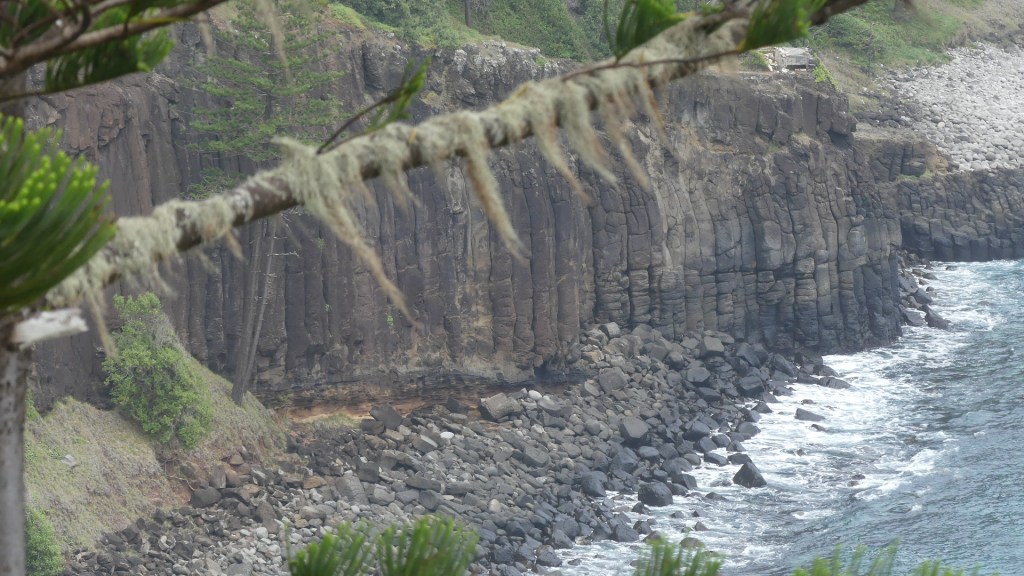
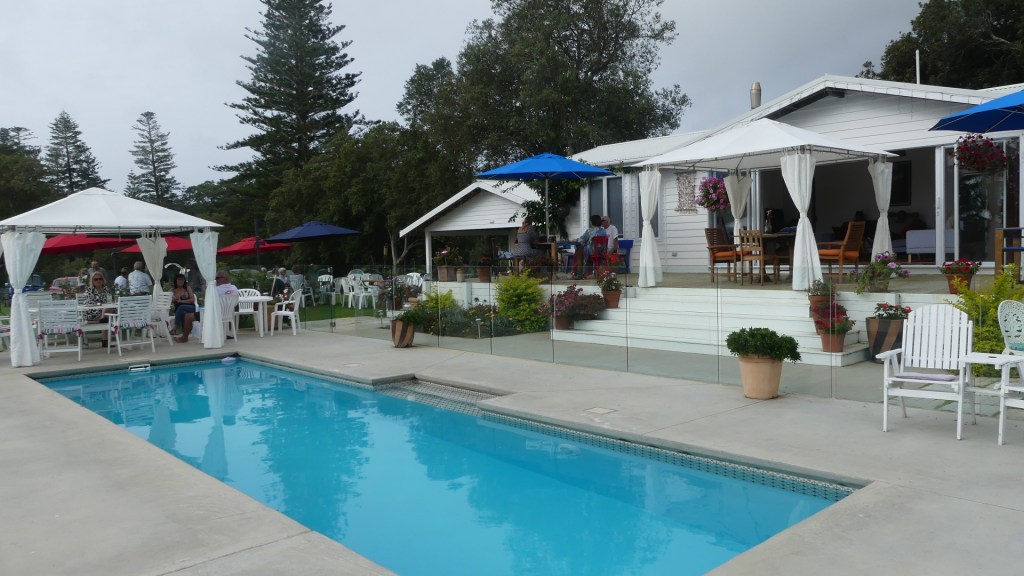
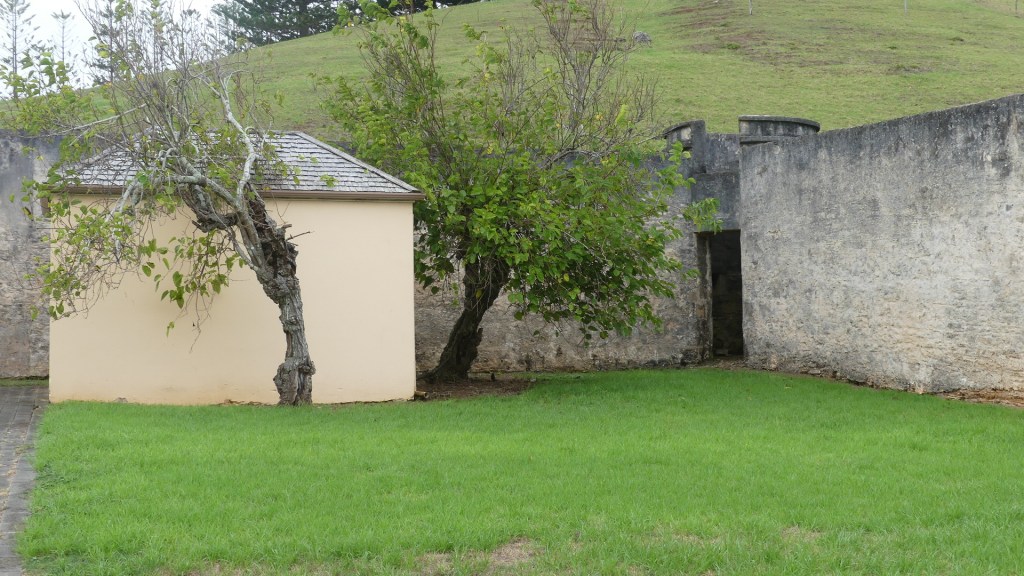
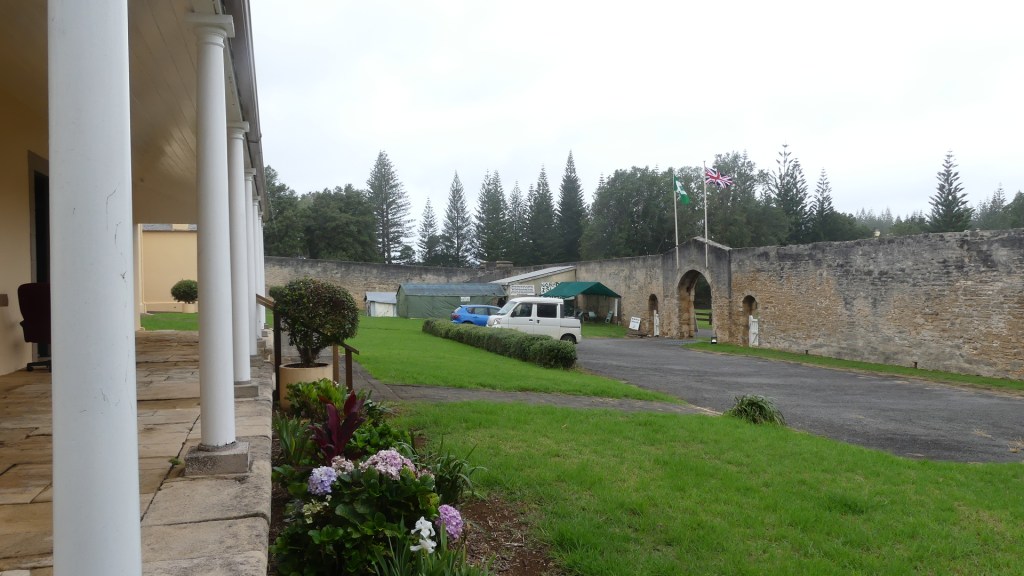
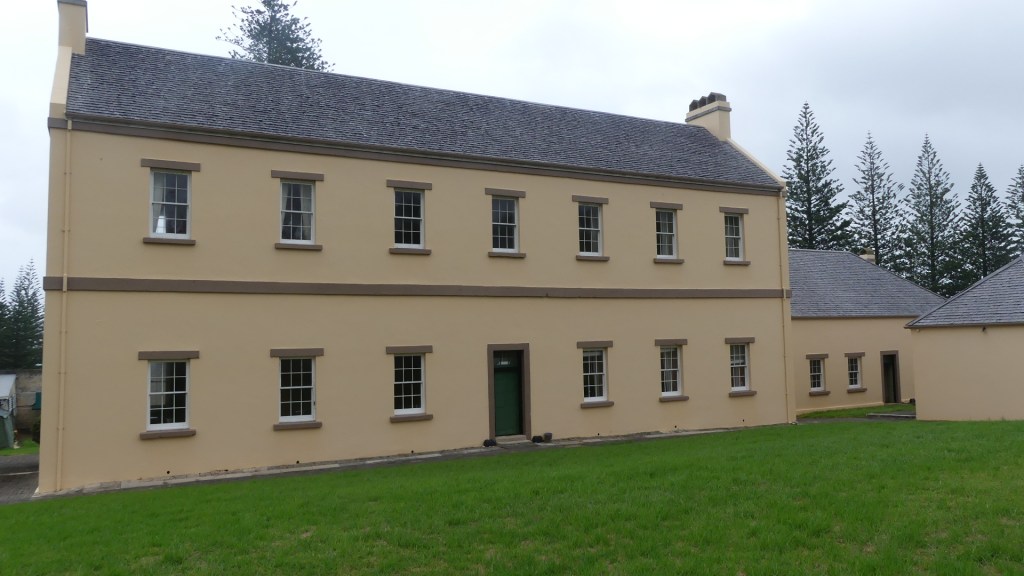
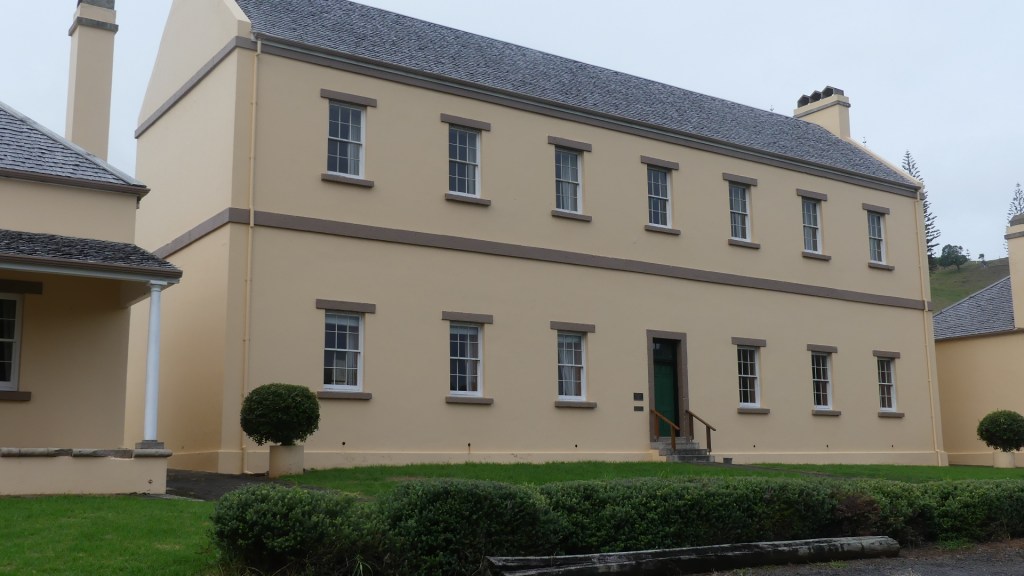
A Short Imprisonment on Norfolk Island

Day 2 Friday

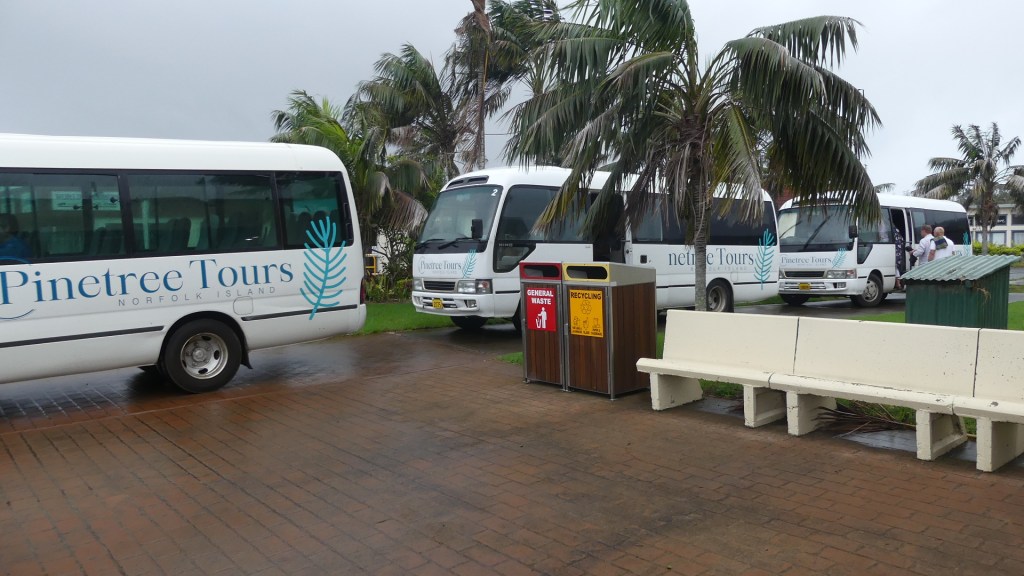
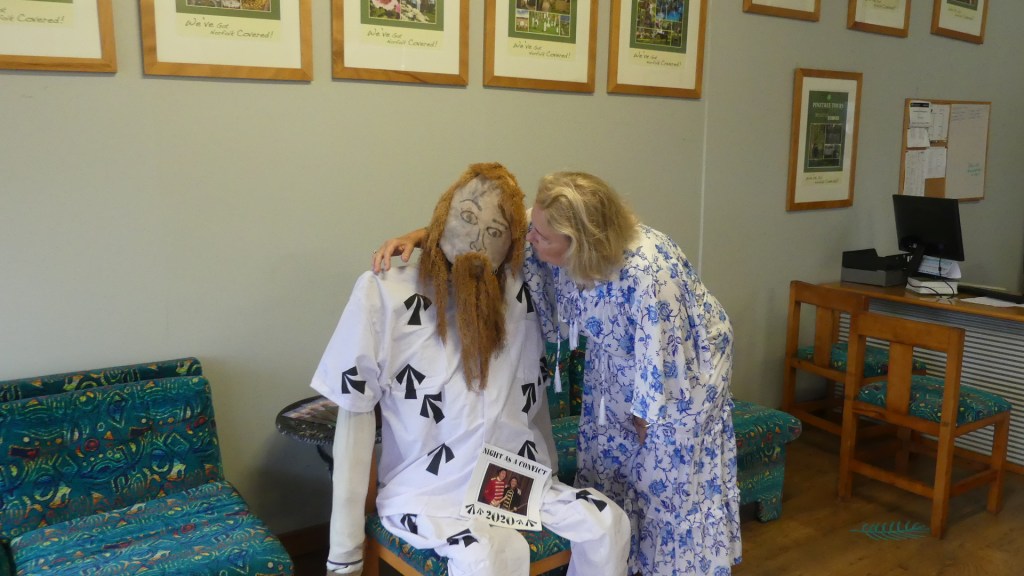
We are awoken by the local rooster crowing at the dawn and make our way to Pinetree tours office. The rooster is not domesticated. Like all of the open range chooks on Norfolk they are the current generation of the chooks released by Lieutenant Gidley King when he established the first English settlement in 1788. The first European known to have sighted and landed on the island was Captain James Cook, on 10 October 1774, on his second voyage to the South Pacific on HMS Resolution. He named it after Mary Howard, Duchess of Norfolk. After the outbreak of the American Revolutionary War in 1776 halted penal transportation to the Thirteen Colonies, British prisons started to overcrowd. In December 1785 Britain decided that it would send convicts to Australia. In 1786, it included Norfolk Island as an auxiliary settlement. Governor Arthur Phillip ordered Lieutenant Philip Gidley King to lead a party of 15 convicts and seven free men to take control of Norfolk Island, and prepare for its commercial development. They arrived on 6 March 1788. It was also called “Sydney” like its parent.

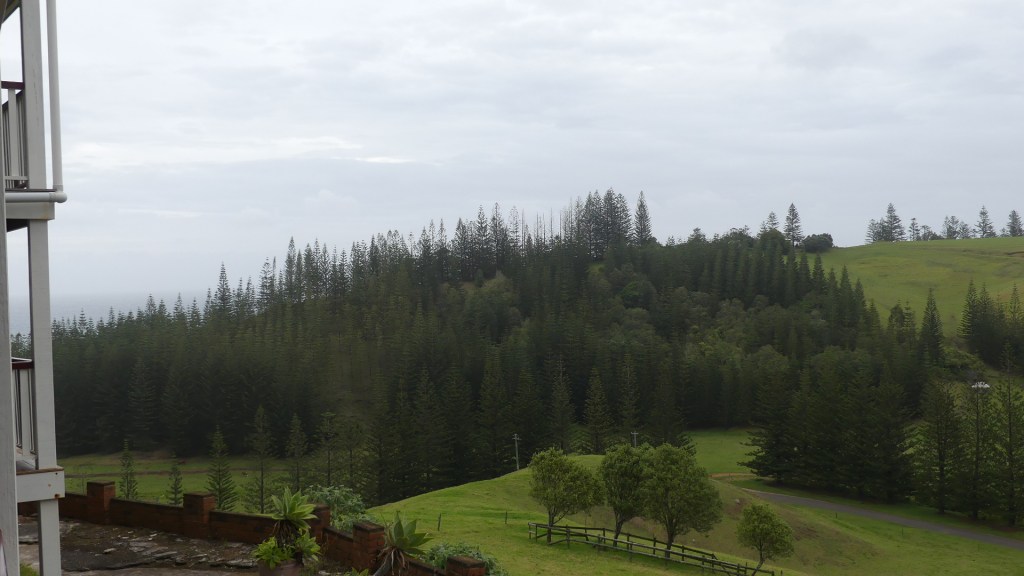
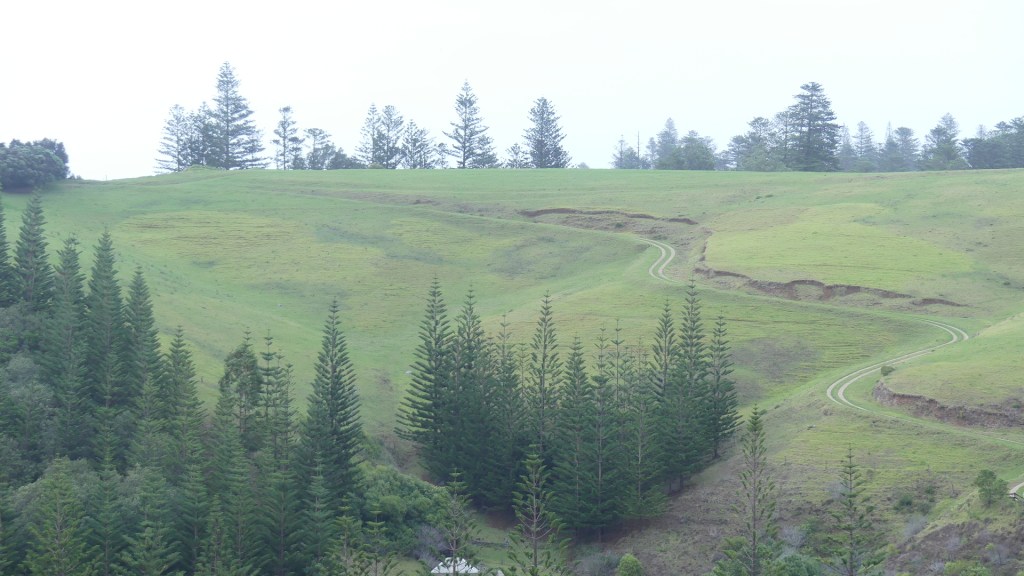
Lead rooster outside our Apartment and views from our deck

We are going to make this trip to Taylor’s Rd Burnt Pine many times as we have booked a few tours and if it is not Pinetree Tours, its Baunti (Bounty) Tours – the Pitcairn Islanders introduced this type of Pidgin English which is spoken by the “natives” today.

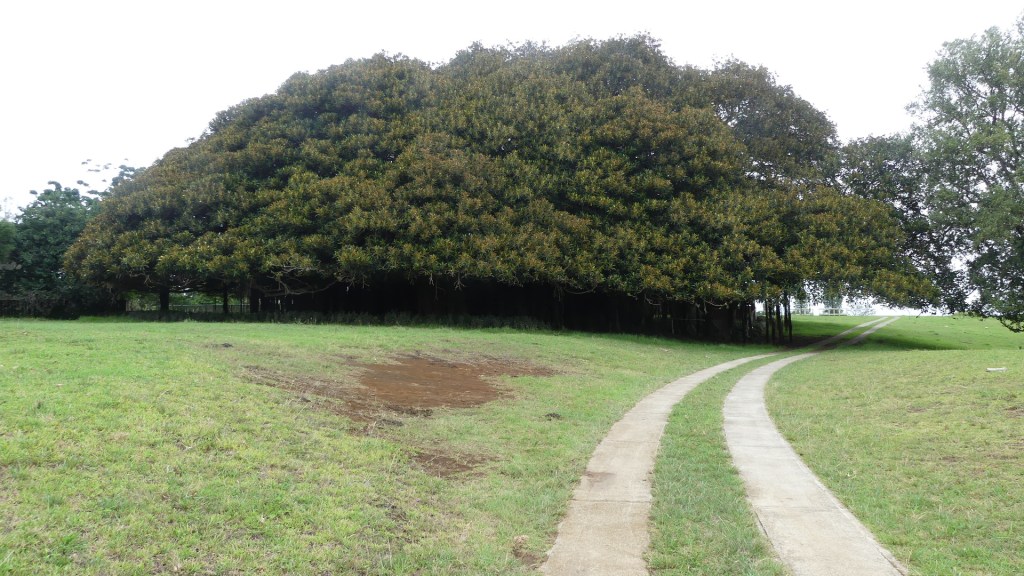
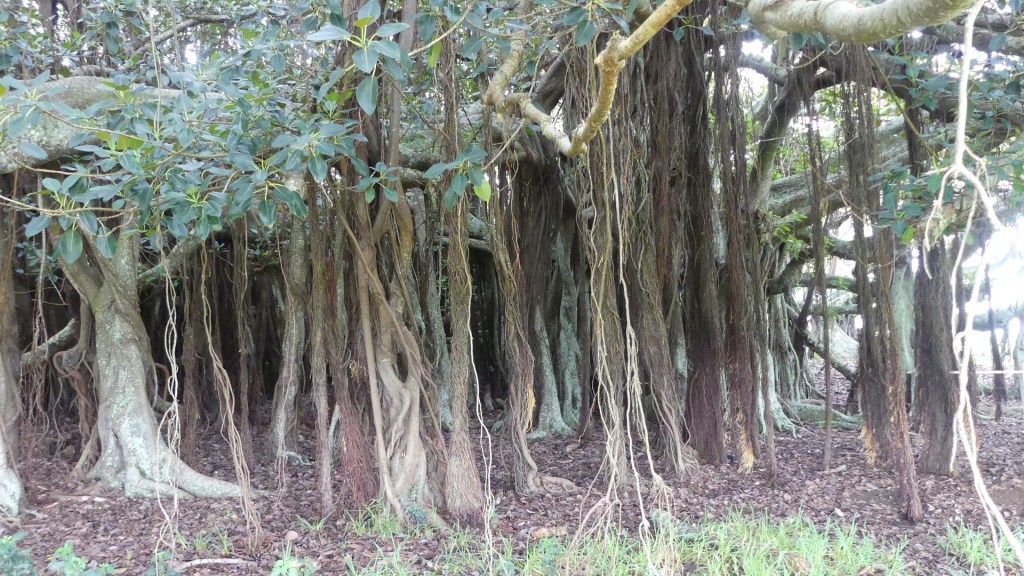
We join many of the other passengers from Brisbane and board our bus. Our driver is John Christian (of the Fletcher Christian line – I make him to be 10th generation) and he understandably has lots of knowledge about the island, its heritage and history. We drive out of the main street Taylor’s Rd and along to Queen Elisabeth Ave up to Rooty Hill Rd and south along that road until we see an Indian Banyan Tree. This thing covers approximately ½ an acre (one tree) with its extensive canopy and air rooting system. It’s on private land so the bus does not stop but we return for a closer look.

Further down the road is a lookout named after Queen Elizabeth (you would be surprised to learn she visited on a royal tour and left her name on a few things). Liz has her name on an Avenue, but poor old Phillip only gets his name “Prince Phillip Drive” on a dirt road to a dry waterfall at a place called “Cockpit” – does this reflect on Phillip?

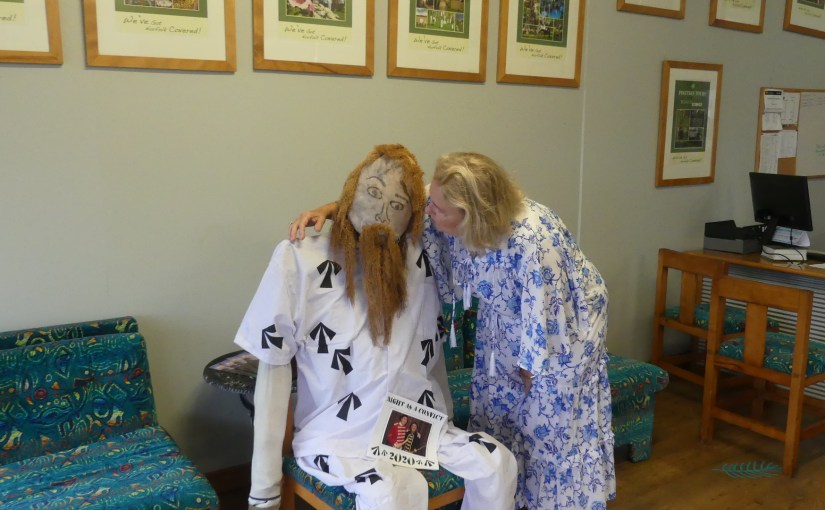
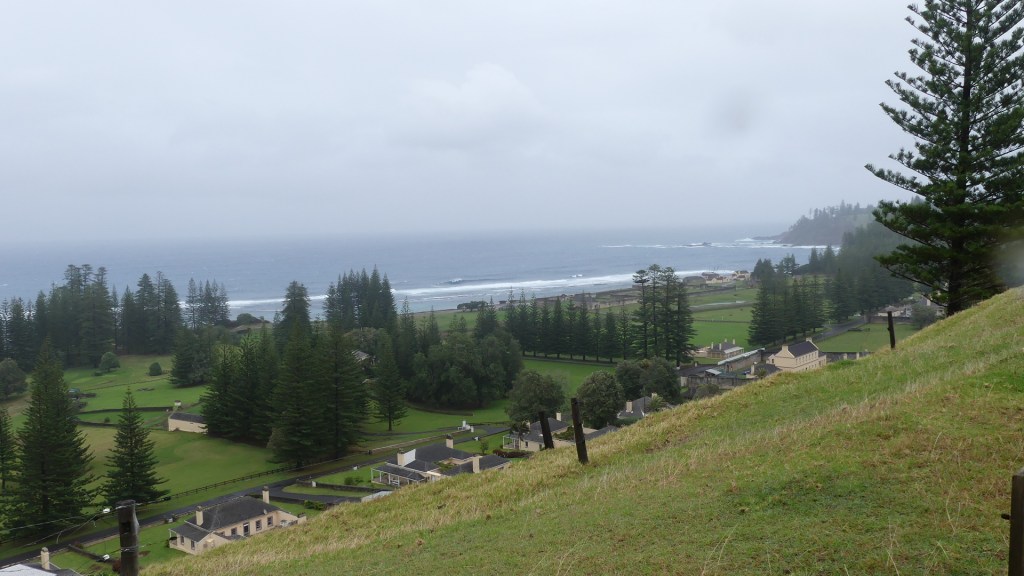
Photos with the convict at Pine Tree tour office, from the Q Liz Outlook and that Banyan Tree
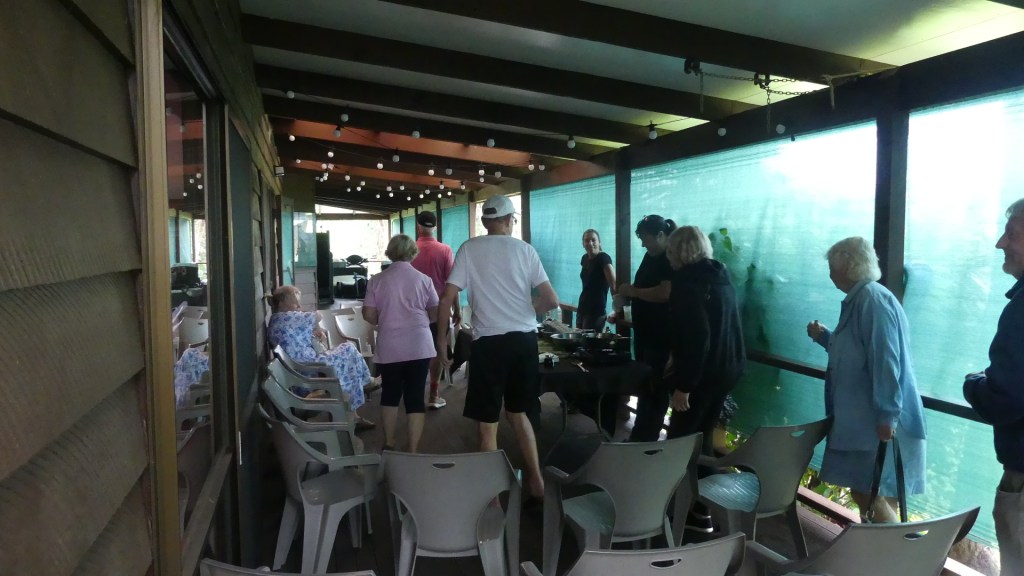
The first known settlers in Norfolk Island were East Polynesians but they had already departed when Great Britain settled the island as part of its 1788 settlement of Australia. Archaeological investigation suggests that, in the thirteenth or fourteenth century, the island was settled by East Polynesian seafarers, either from the Kermadec Islands north of New Zealand, or from the North Island of New Zealand. However, both Polynesian and Melanesian artefacts have been found, so it is possible that people from New Caledonia, relatively close to the north, also reached Norfolk Island. Human occupation must have ceased at least a few hundred years before Europeans arrived.

When they did arrive, it was to provide food for the settlement in New South Wales, so the settlement was called Sydney town. They brought with them domesticated animals that would become pests and cause environmental harm to the Islands. But the settlement did not last. As early as 1794, Lieutenant-Governor of New South Wales Francis Grose suggested its closure as it was too remote and difficult for shipping and too costly to maintain. All of the remaining inhabitants of the first settlement were removed in 1813. Everything that had been developed was destroyed in fear of another European power claiming and using the island.

From February 1814 until June 1825, the island was abandoned. The island served as a convict penal settlement from 6 March 1788 until 5 May 1855, except for an 11-year hiatus between 15 February 1814 and 6 June 1825, when it lay abandoned. On 8 June 1856, permanent civilian residence on the island began when descendants of the HMS Bounty mutineers were relocated from Pitcairn Island. In 1914 the UK handed Norfolk Island over to Australia to administer as an external territory, but as a distinct and separate settlement.

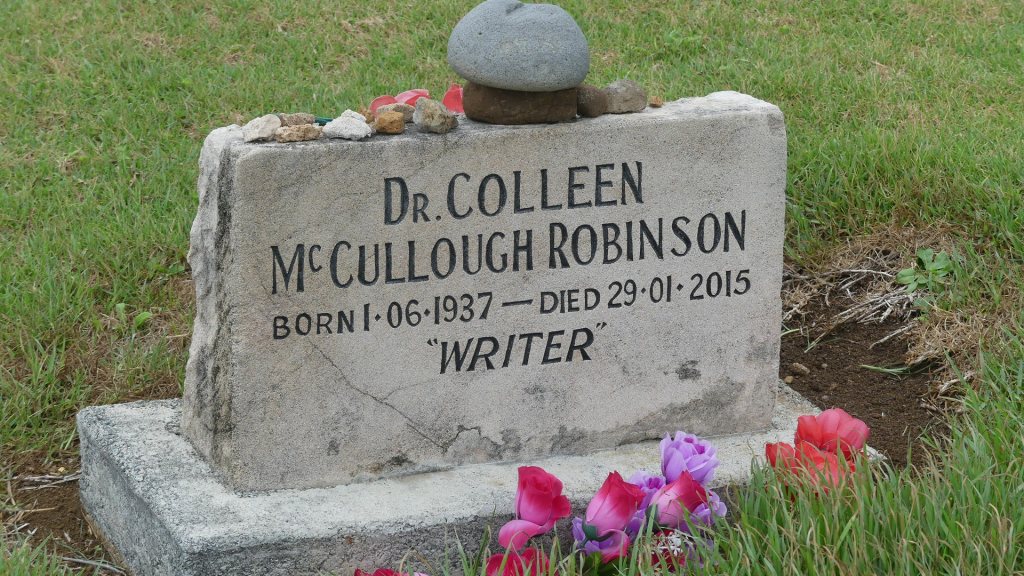
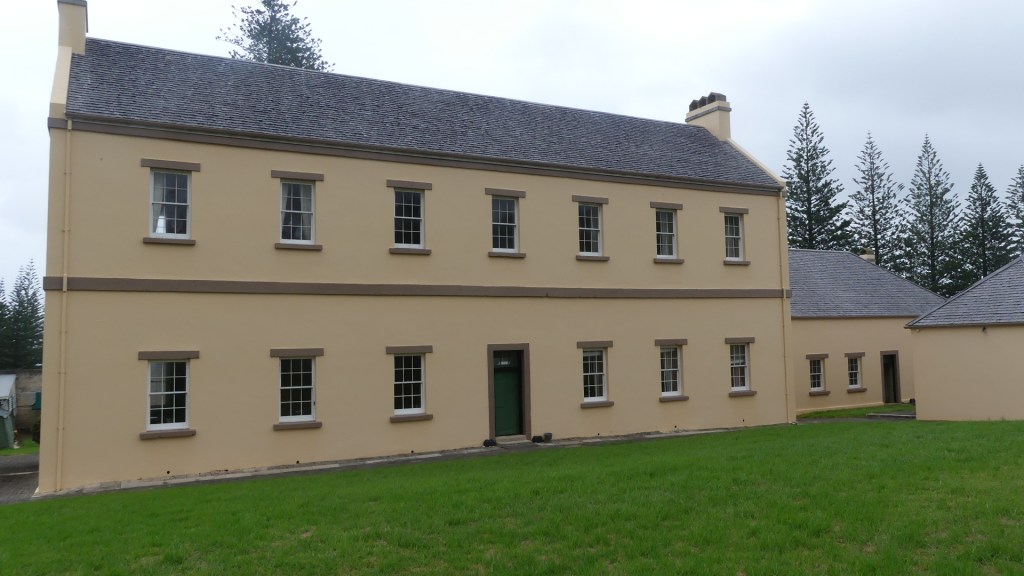
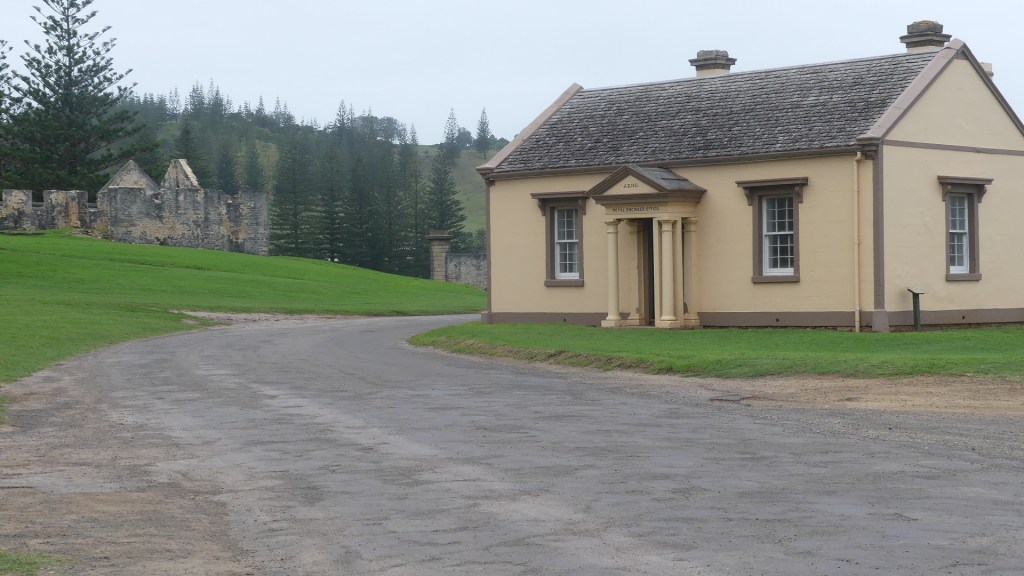
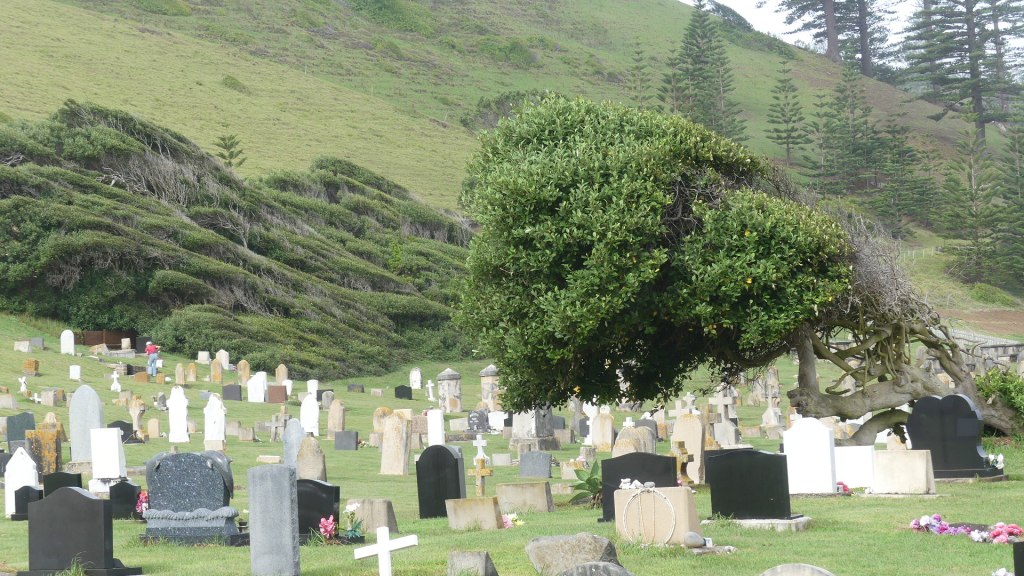
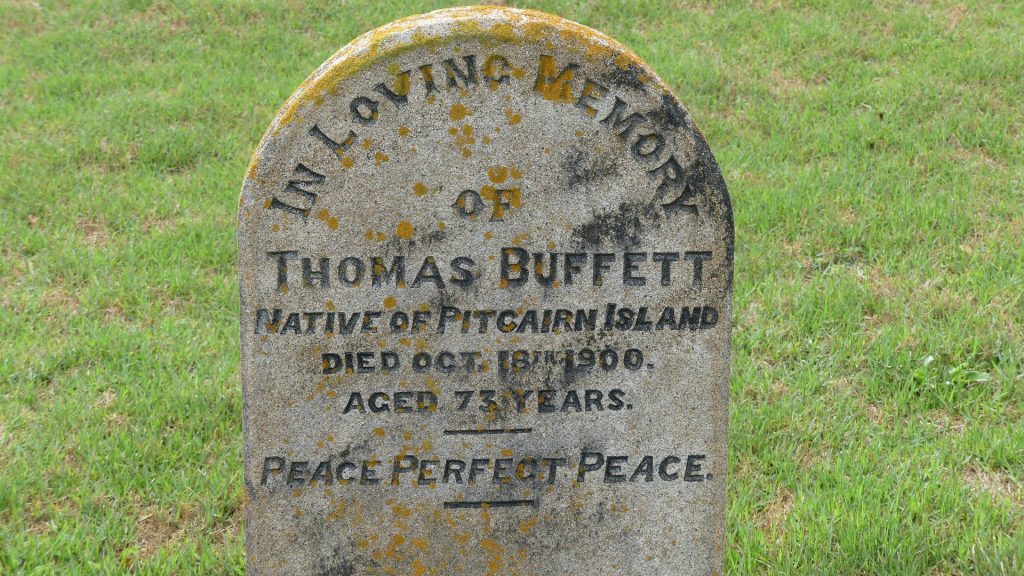
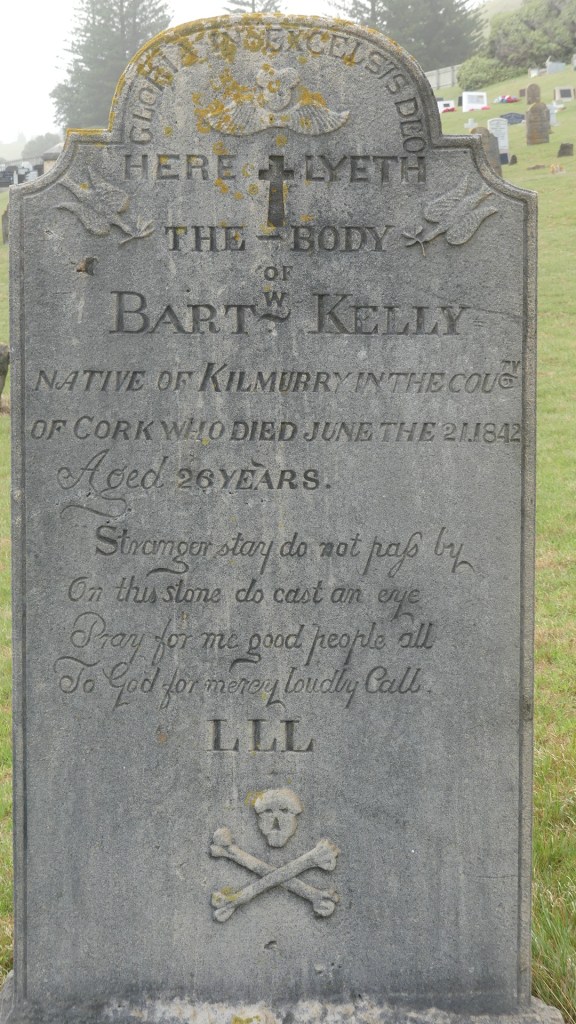
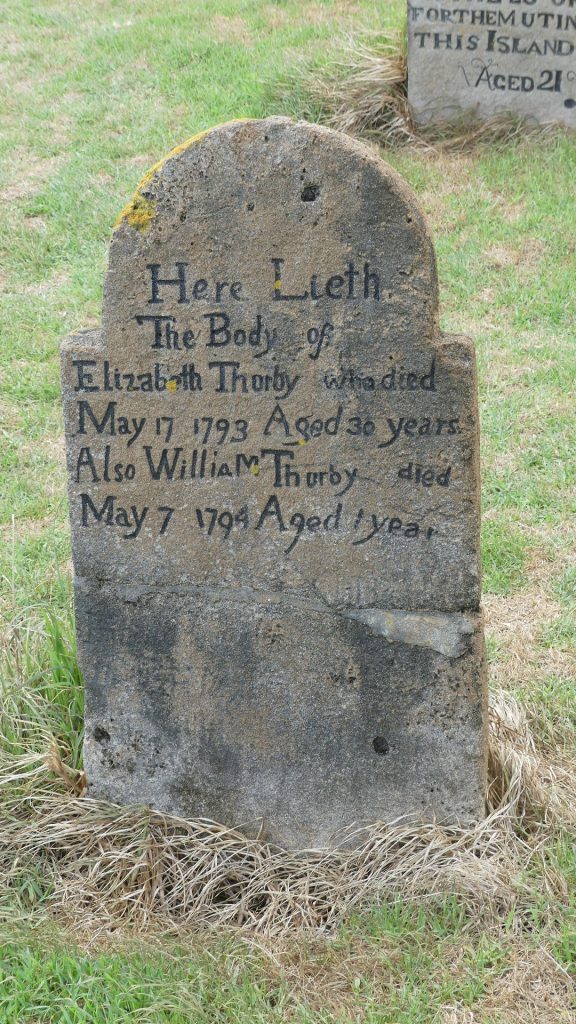
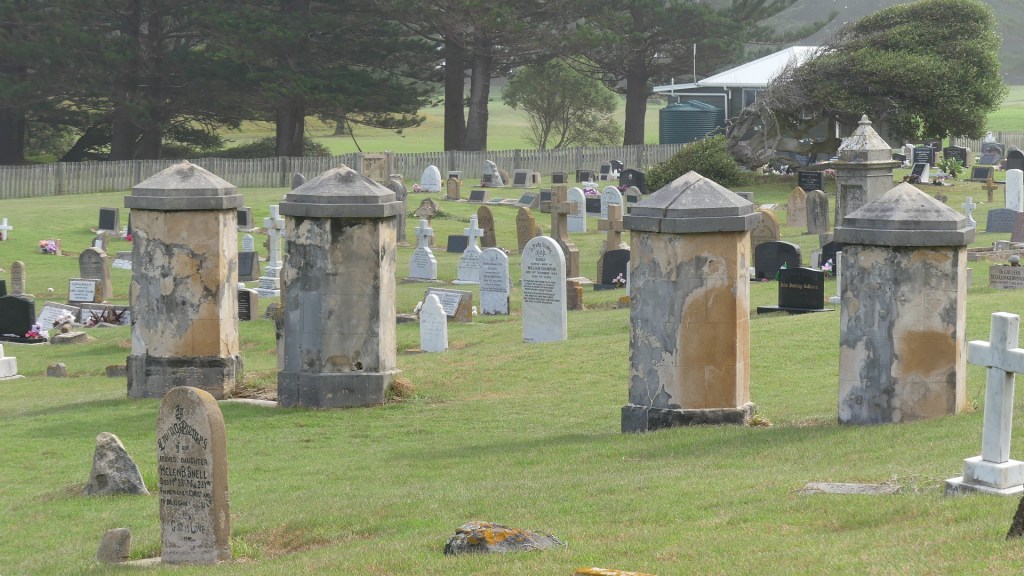
The buildings and development created by the 2nd settlement were centred around the settlement formerly known as Sydney town but renamed Kings Town (Kingston) by the 2nd settlement. Many of these buildings have survived and form the centre of the historic village. We can view these buildings and the cemetery from a top of Queen Elizabeth’s lookout. Our tour takes us down into the village and along Quality Row where there are garrison buildings which are now used as an Anglican Church (All Saints), the Council Chamber, the Supreme Court of Norfolk Island and the Magistrates Court and the Governor’s residence (now the Administrator’s residence). The officer’s houses are now private residences and one of the former military buildings is the Golf course clubhouse. Beyond the golf course and before reaching Bloody Bridge, is the cemetery. The cemetery was commenced with the first settlement and is still used today. Unlike other cemeteries around the world which do not accept criminals into the consecrated grounds, this cemetery welcomes all comers.

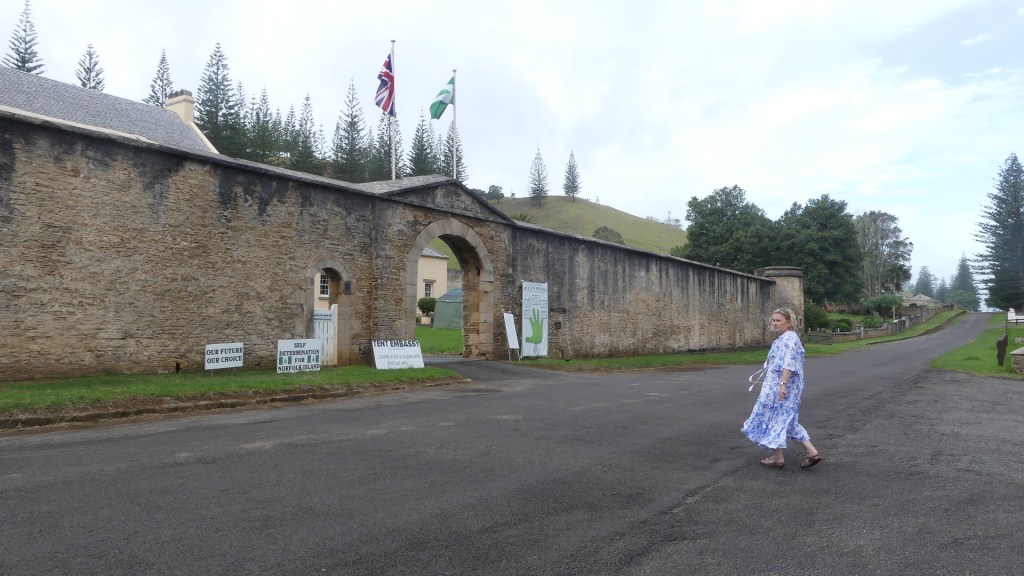
Former Governor’s residence now home to the Island Administrator and Kerry approaches the Supreme Court, Magistrates Court, and Island Council building (formerly a garrison building) in Quality Row

Our tour continued leaving the lookout and travelling down through Kingston around to Bloody Bridge. There exists a myth about how the bridge got its name, but recent research suggests that it was built by Irish Political prisoners who named it after a bridge Ireland.

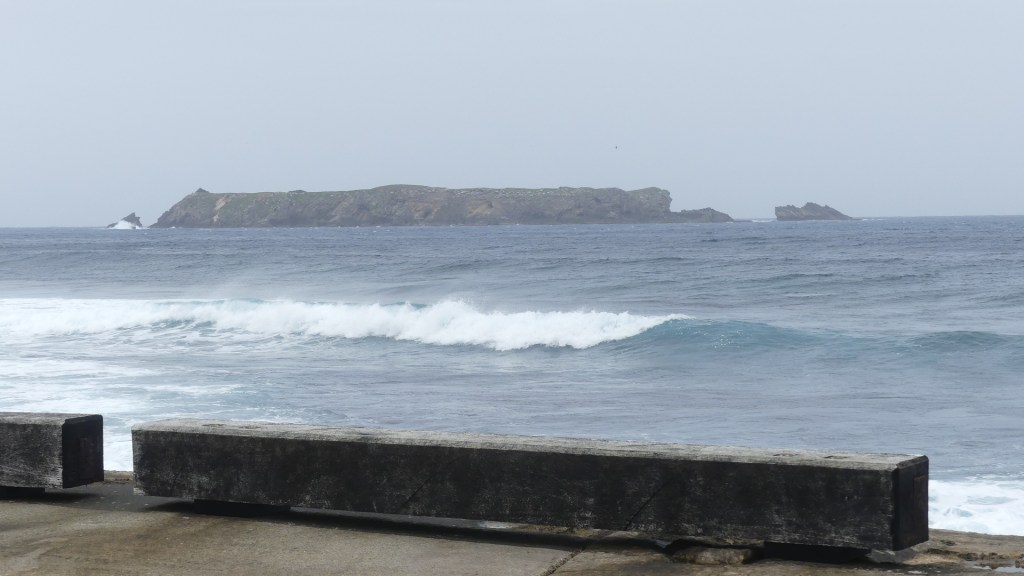
We then travel north to Cascade where the international ships come in (they have been waiting 5 months for a ship such is the difficulty to unload to the Island and the irregularity of availability). This is the old whaling station. The island was a regular resort for whaling vessels in the age of sail. The first such ship was the Britannia in November 1793. The last on record was the Whaling Bark Andrew Hicks in August–September 1907. Andrew Hicks of Westport Virginia had died in 1897 but his empire continued with this vessel lost when it dragged anchor in Havana. They came for water, wood and provisions and sometimes they recruited islanders to serve as crewmen on their vessels.

Whaling ceased in the 1960’s because they thought they had over fished the whales. Later evidence showed that Russian whalers had severely over fished sperm whales pushing that species of whale almost to extinction. With the cessation of whaling stocks have rebuilt and the station dismantled such that only one of the boilers is all that remains bar a few cement pads.

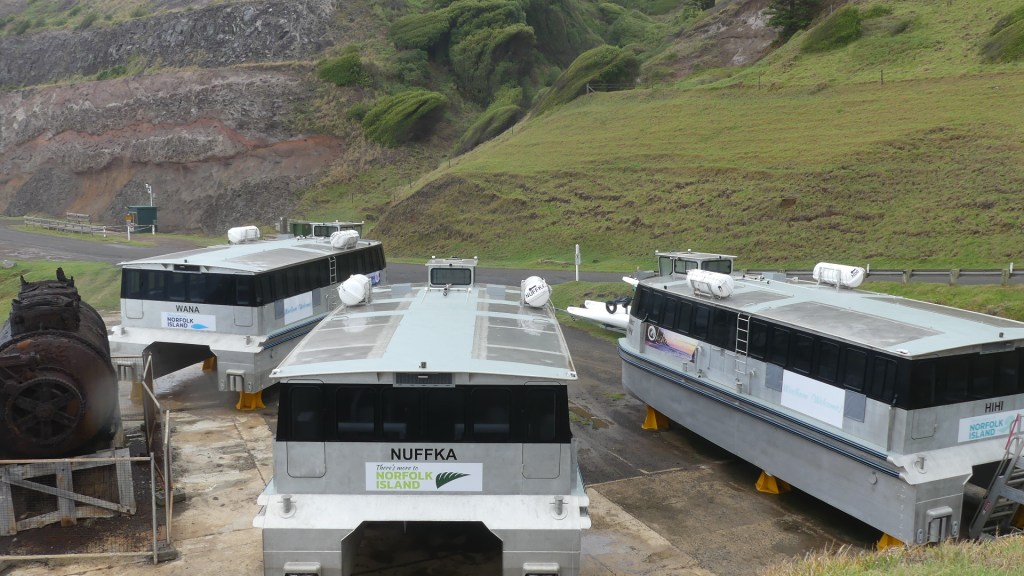
The jetty is inadequate for modern shipping which is now containerised. The wharf requires the ship to anchor off the island while Norfolk tenders ferry cargo to and froe – I don’t think the Norfolk Islanders want that to change just as they don’t want too many tourists as they like their little paradise just as it is with time and the world forgetting it is there. Violent winds raging seas and shallow water mean that any passenger ships can only unload passengers with the use of the 3 Australian donated ferries which sit dry docked waiting for the next ship never to come.

Our trip continued through Kingston and we headed to St Barnabas Chapel. In 1867, the headquarters of the Melanesian Mission of the Church of England was established on the island. We then back tracked going east to St Barnabas Chapel Anglican Church founded by the Mission and Ona dar Cliffe (some more pidgin – It literally means “on the cliff” which is precisely right). More about the church later when we visit the church on Sunday. In 1920 the Mission was relocated from Norfolk Island to the Solomon Islands to be closer to the focus of population

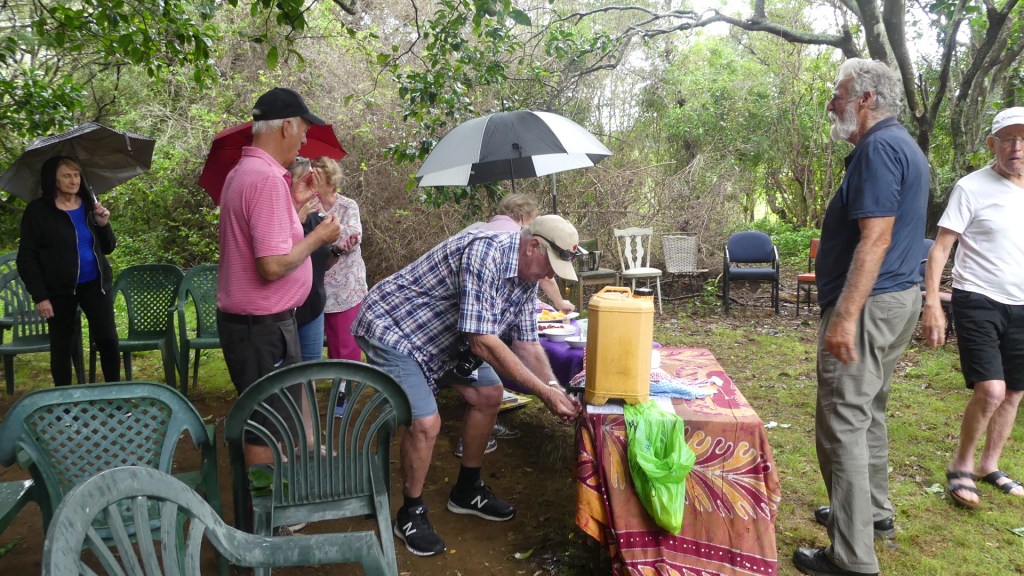
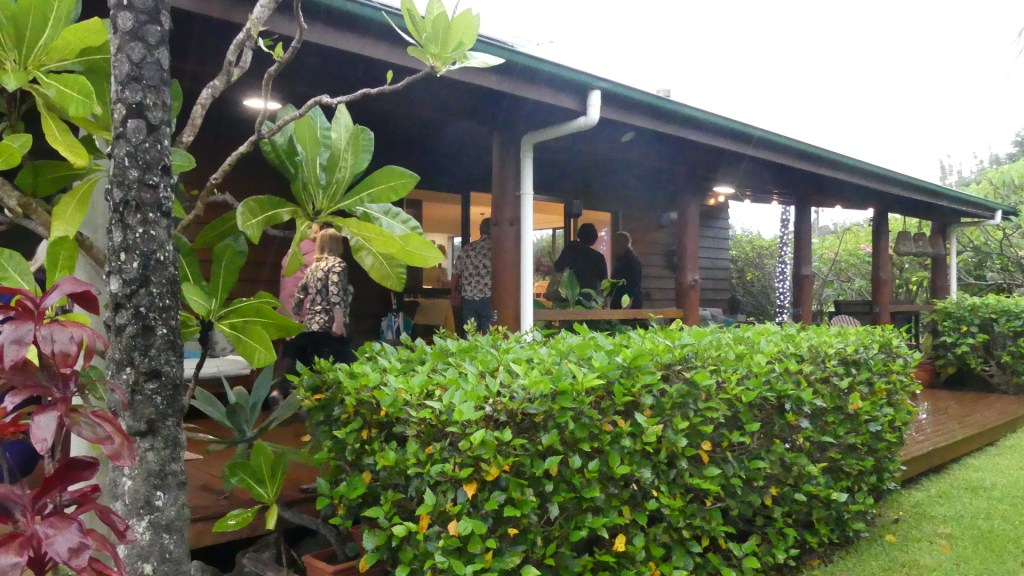
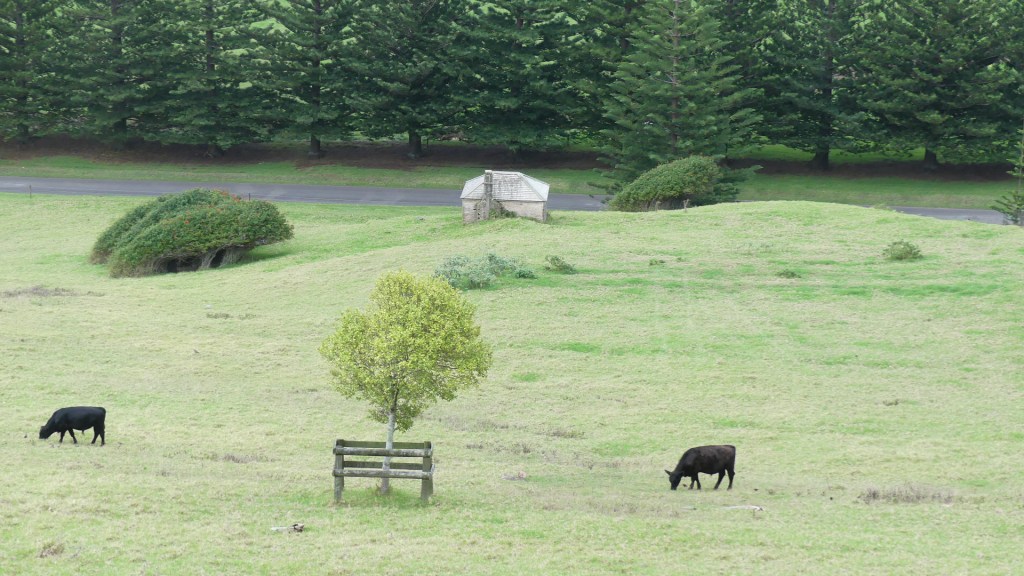
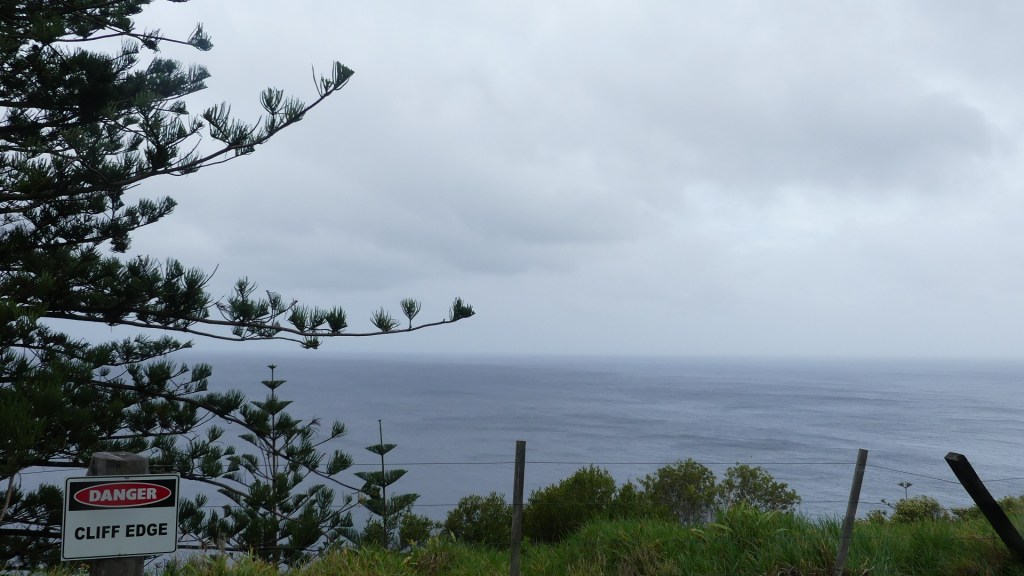
Ona dar Cliffe (Norfolk for “On the Cliff”), is a retreat like an oversize scout camp which the tour company controls and uses as a morning tea stop in this tour. It was sprinkling all day, so we were thankful for shelter. The grounds do end at a cliff, but the adjoining property and its two cattle and calf caught my eye. I am told that the cattle are a Canadian breed, but I could not find out anymore.

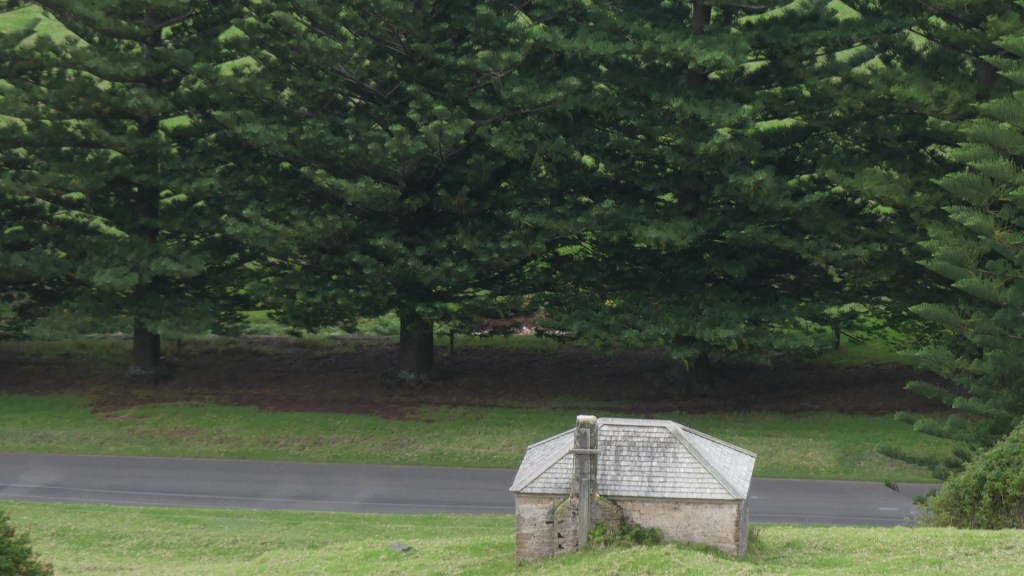
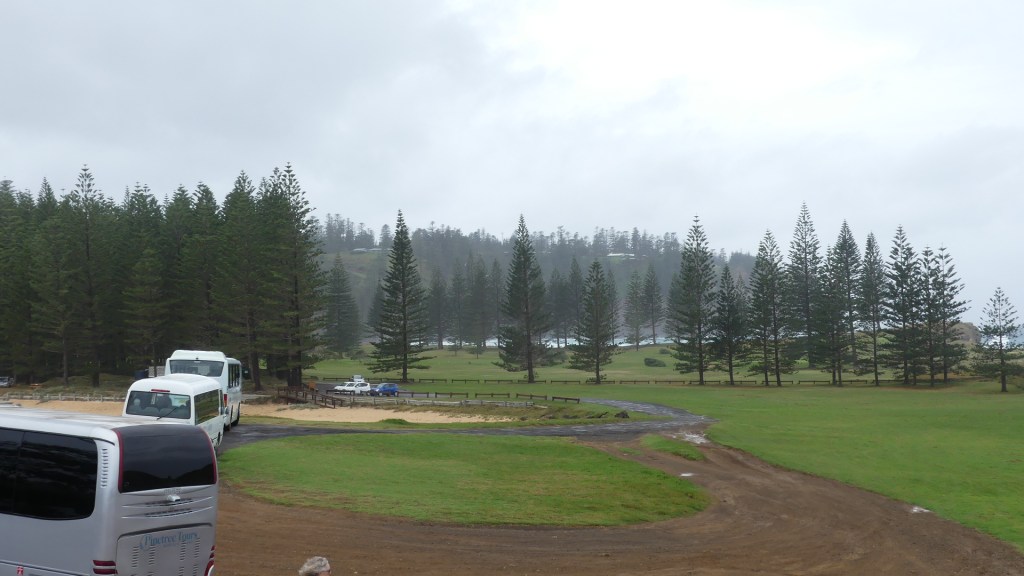
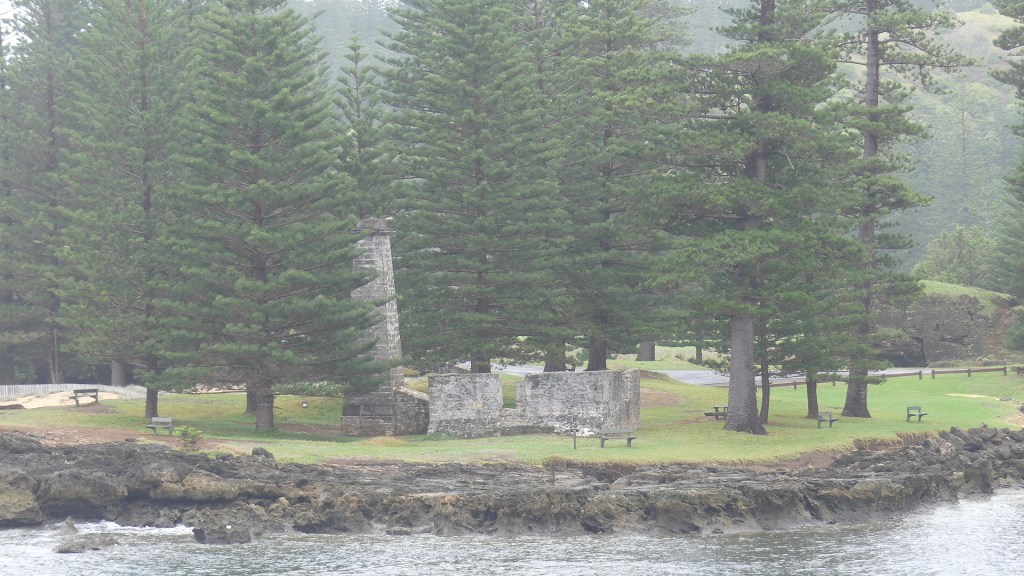
Lone Pine, the back of the golf course and the cemetery beyond, the old lime burner pit and salt mill, those cattle and looking off the cliff

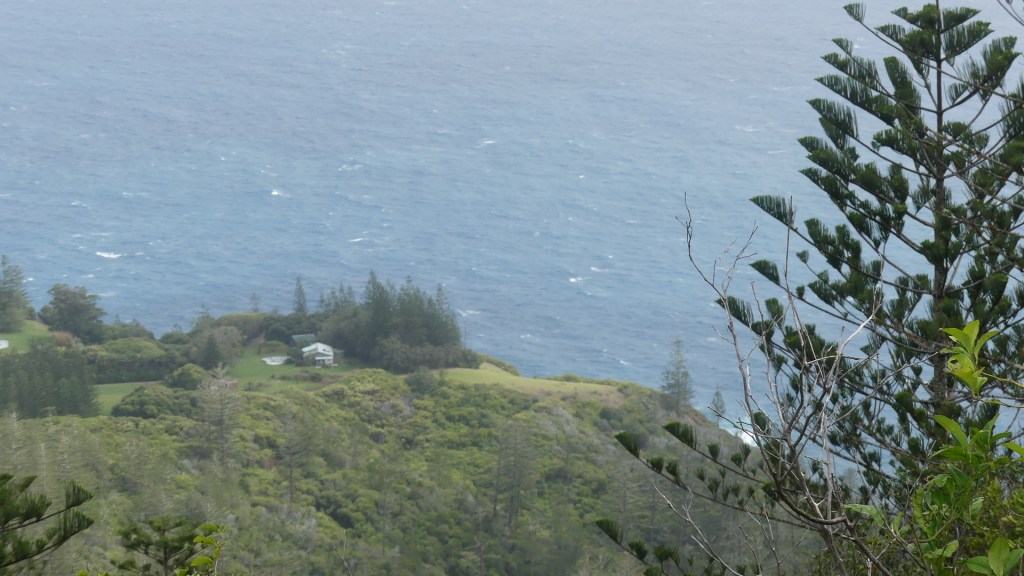
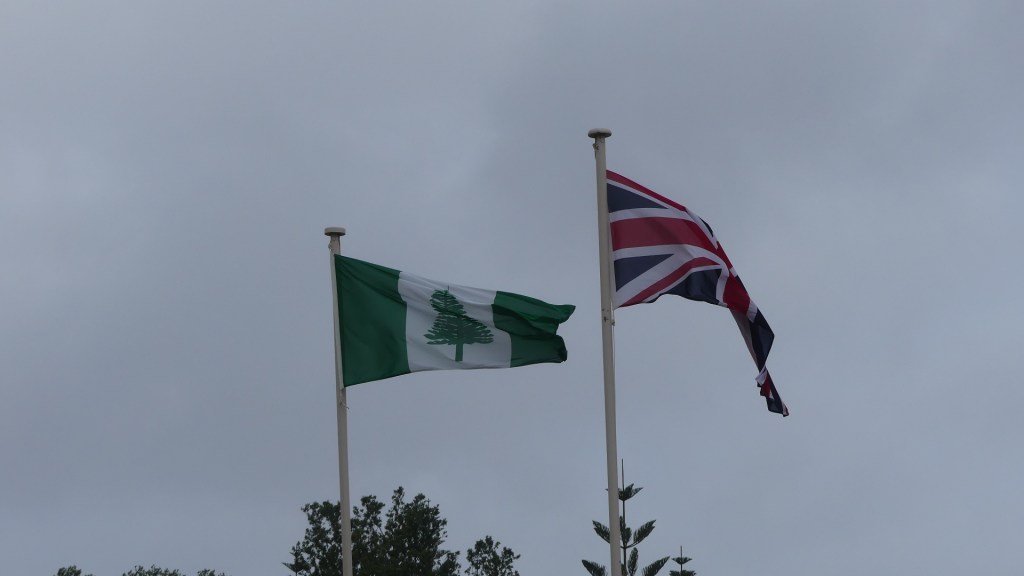
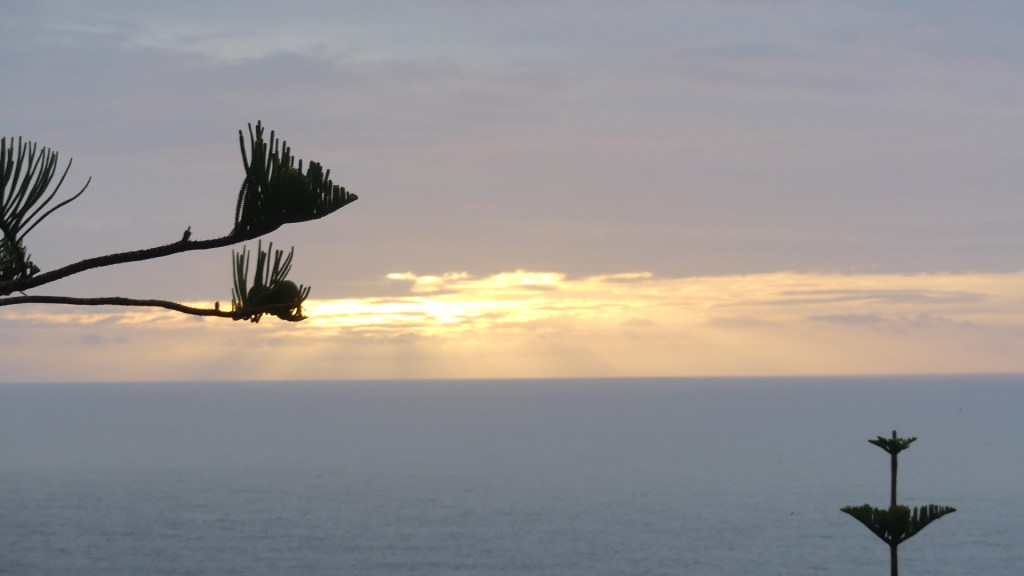
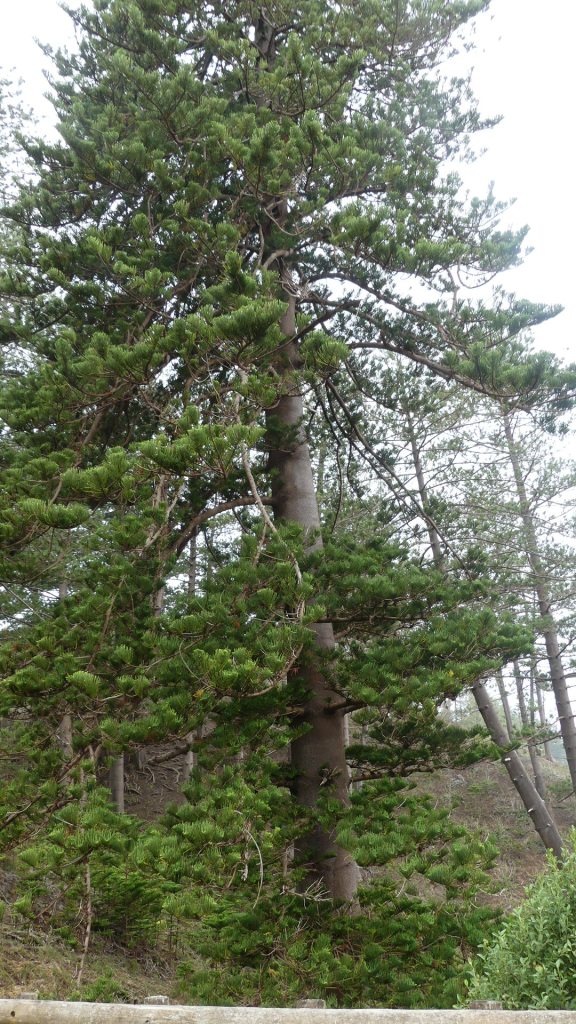
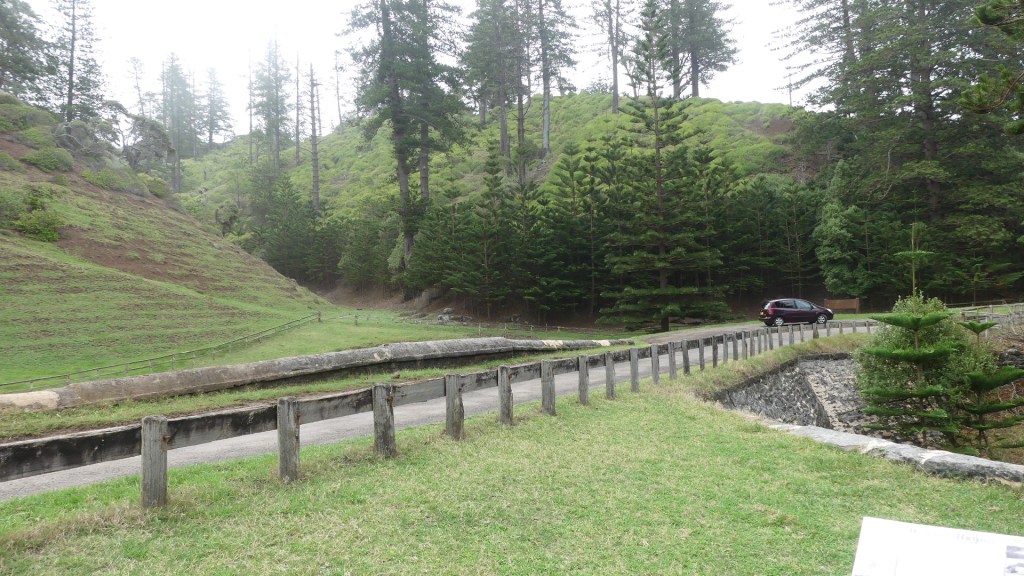
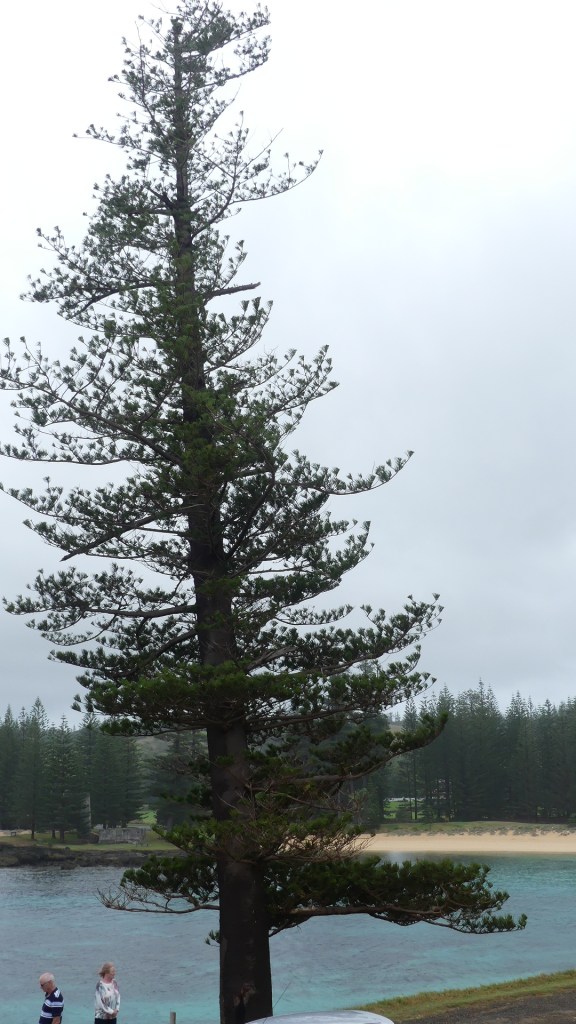
After morning tea, we went to the church and then south to “Lone Pine” on Hunter’s Point between Slaughter Bay and Emily Bay below our apartments the two most popular swimming spots – you don’t have to jump off a cliff to have a swim. There is a second settlement derelict salt mill on the Point and evidence of a smelter to obtain lime from a rocky reef and the evidence of the earliest settlement by Pacific Islanders which remains buried by sand for its protection. Native to the island, the evergreen Norfolk Island pine is a symbol of the island and is pictured on its flag.

The tour bus returned us to Taylor’s Road, and we returned to our apartment for a lazy afternoon. It continued to shower/rain and the wind was howling. After an afternoon nap it is off to the RSL for dinner. They are champions of the raffle. All night they were raffling something, and the same crowd seemed to be winning and it was not us. We left them as I was expecting they would start cockroach races shortly and I think they kept them in the kitchen.

Tomorrow we venture out on our own.

A Short Imprisonment on Norfolk Island

Day 1 Thursday

In these Covid times travel overseas is out of the question except for the overseas territories of Australia but even those can be subject to irrational shutdowns because of outbreaks of the contagion. In the case of Norfolk, it was the outbreak in Auckland that caused Air New Zealand to cancel our flights to Norfolk, but Qantas came to our rescue in the nick of time.

So, we departed Brisbane on 18th February 2021 for the short 1 hour 55-minute trip by air to Norfolk. I was interested to visit the former British penal colony and home of the Pitcairn Is families of mutiny on the HMS Bounty fame and one of Australia’s external territories.

Norfolk Island located in the Pacific Ocean between New Zealand and New Caledonia, 1,412 kilometres (877 mi) directly east of Brisbane and about 900 kilometres (560 mi) from Lord Howe Island. Together with the neighbouring Phillip Island and Nepean Island, the three islands collectively form the Territory of Norfolk Island. At the 2016 census, it had 1748 inhabitants living on a total area of about 35 km2 (14 sq mi). Phillip Island and Nepean Island are uninhabited. Its capital was Sydney but changed name to Kingston and since 1856 Burnt Pine is now the capital.

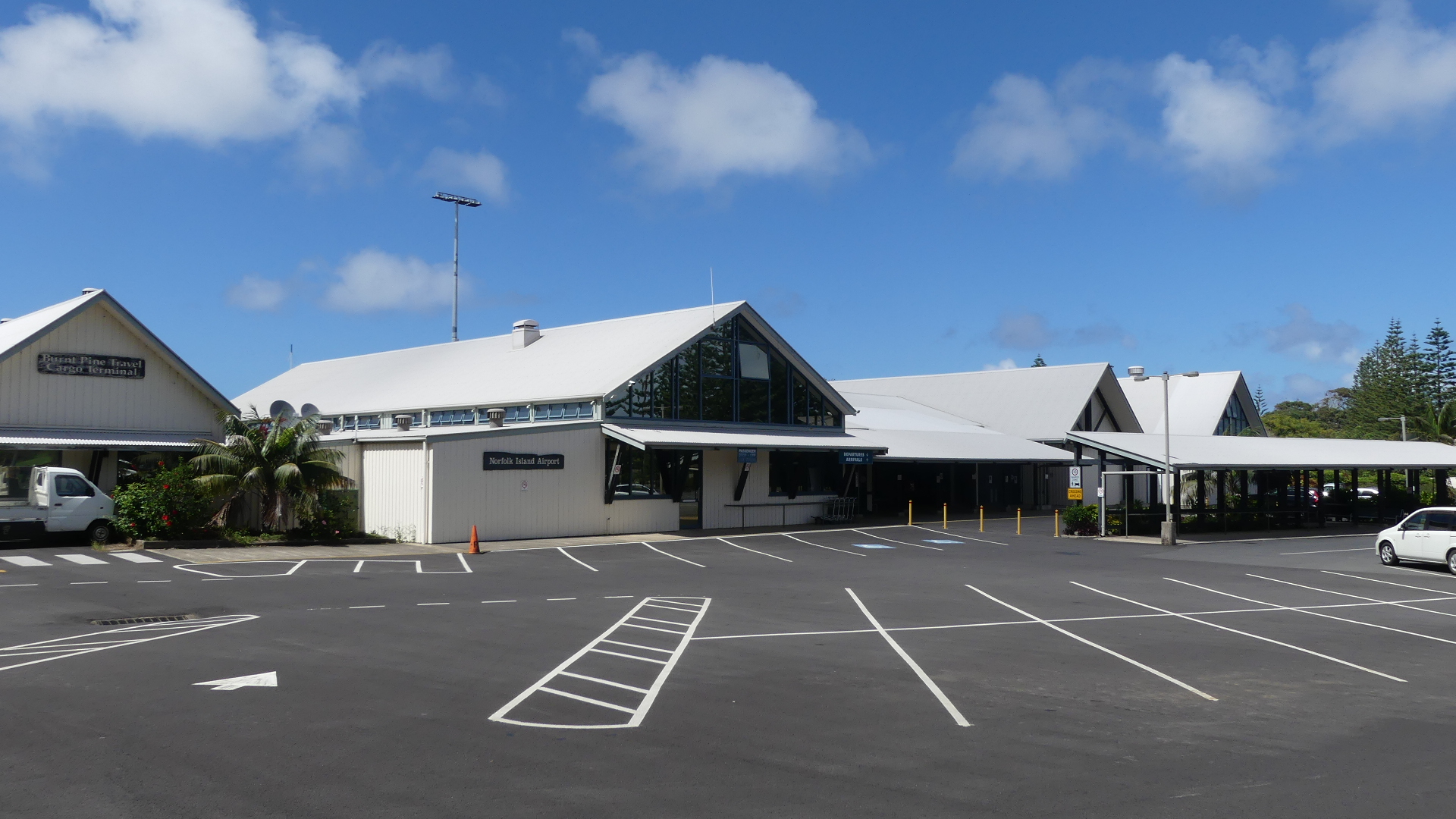
We landed at Norfolk Is/Burnt Pine international Airport. The airport was built by Australia and New Zealand during WWII as a base for the NZ “N” force but abandoned when they realised it was too far from the action. Fortuitous for Norfolk Island. After walking across the tarmac and collecting our luggage we boarded our ride to the apartment. It was at this time that we experienced the weather that would continue until the afternoon of Wednesday week – windy overcast and occasional drizzle. The Norfolkers were not unhappy as they have been through a dry spell.

Burnt Pine Airport

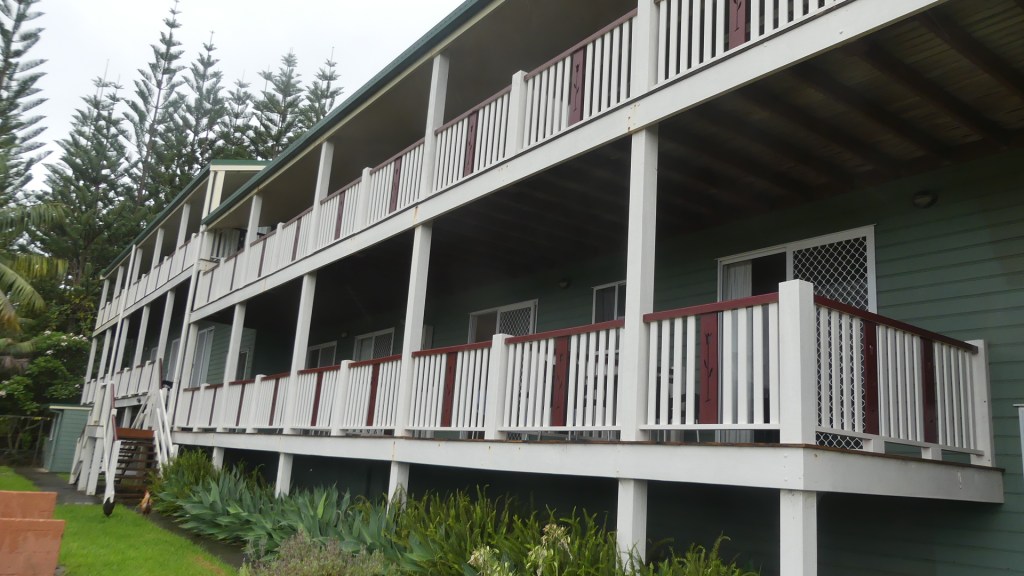
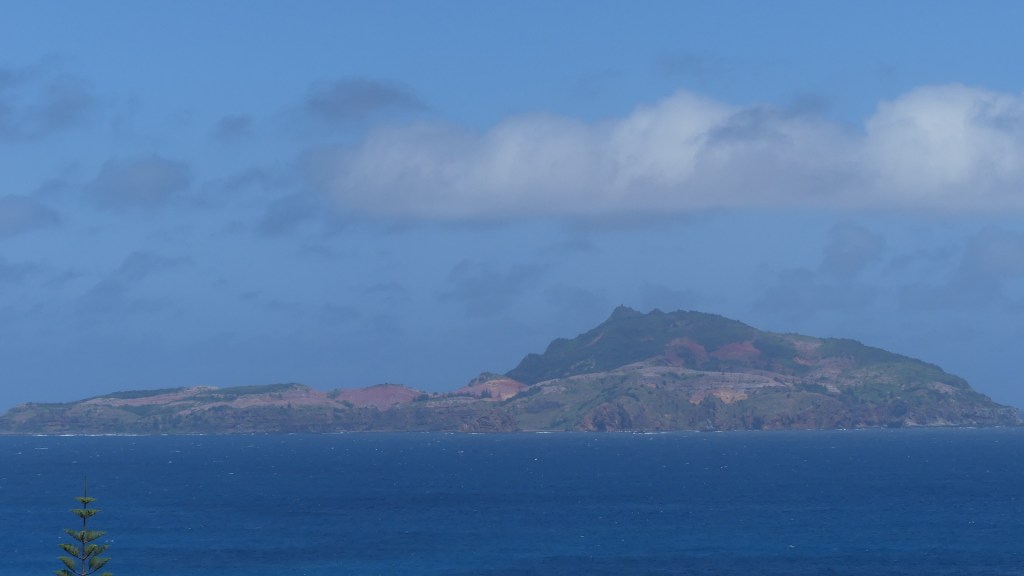
We travelled to Aloha Apartments 5 mins from the airport and dropped off the first six visitors leaving Kerry and me with Col and Gloria going to Panorama Oceanview Apartments another 5 minutes away but on the southern side of Norfolk Island. We drove south into the main street of Burnt Pine, Taylor’s Rd, and out again rather quickly onto Queen Elizabeth Avenue and down Middlegate Rd to the Apartments awkwardly placed on a bend in the road but with elevated views of Nepean and Phillip Islands, the old penal settlement of Kingston and the beaches.

the Apartments and the view

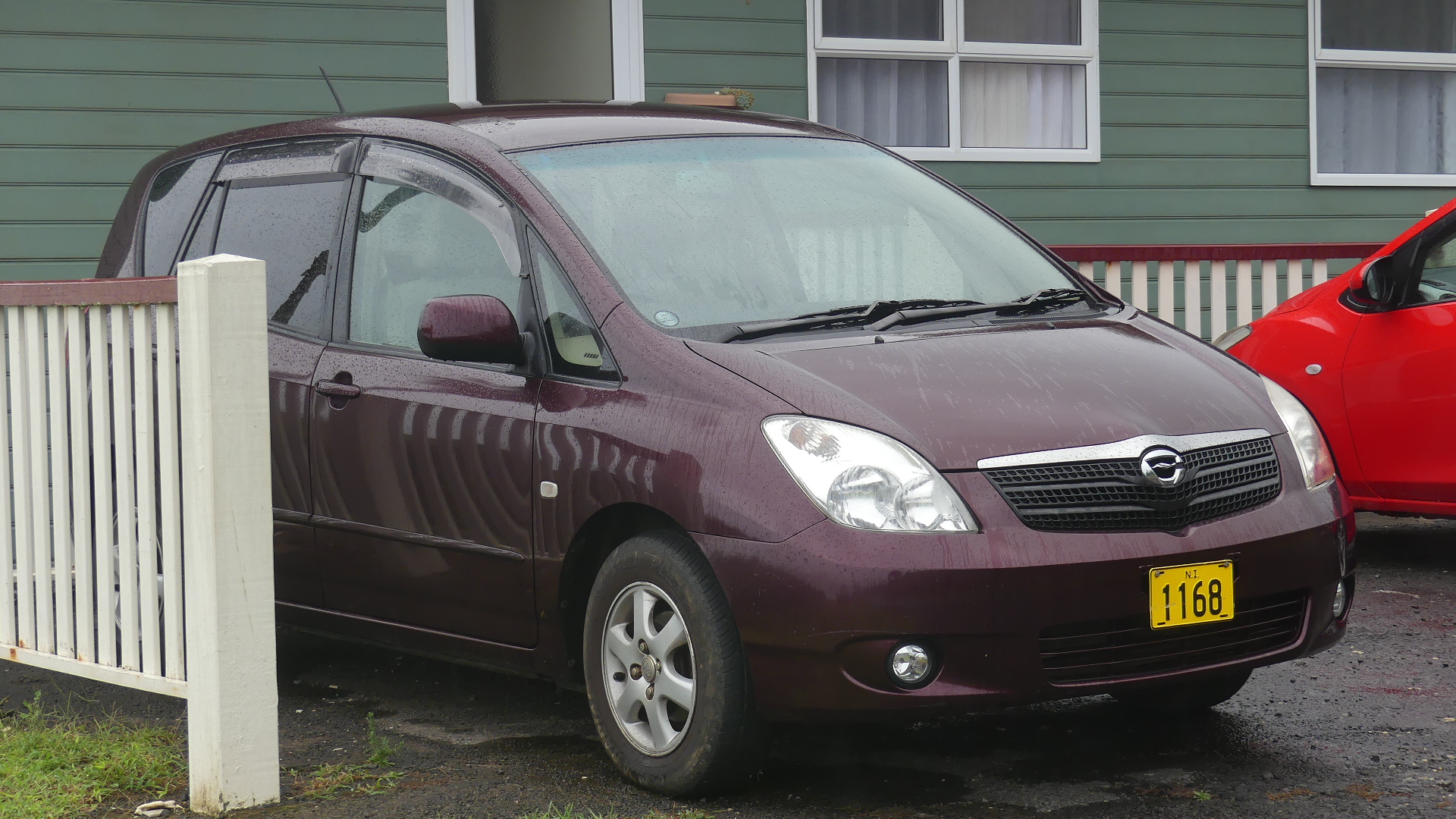
They have some great tourist innovations like delivering your hire car to your apartment in advance of your arrival with the keys in the ignition ready to go. You register at the apartments, put your luggage away and then you check in at the hire car office. So, we saw our mulberry coloured 7 seat corolla for the first time as we collected our room key.

Our Mulberry Toyota

The Apartments are very tired and musty smelling something you don’t expect or want but the views – wow! So, we settled in and then went to the Governor’s Residence (a resort between our apartment and the main street) to book in for the car. We decided to take the excess reducing insurance not aware that no one locks their cars and collisions are infrequent. Norfolk is 1 hour ahead of us in Brisbane and on daylight saving time so it’s now 4.00pm and apart from a light breakfast at 6.00am we have not had any lunch.

Hunger drives us to the Bowls Club in Taylor’s Rd – the kitchen opens at 5.30pm. Time for a drink. So we position ourselves for easy access to the kitchen/dining room and watch the world go by – at least the NI world. We meet Ray and Lorraine travellers like us and share a meal then wind our way back to the Apartments.

Very soon we are curled up in bed listening to the wind and rain hoping that tomorrow we are off to Pinetree tours for a half day sight-seeing of the Island.

The Retirees Reluctantly end up in Bali – the Wedding

Early in 2019 we learned that Kerry’s cousin Ken was soon to wed and we would be receiving an invitation to the wedding. Later it was revealed that Kerry would play a part in the ceremony. The invitation arrived and to our surprise it would be conducted in Bali Indonesia. Bali was the place of choice for the wedding as the bride Yena lives there.

Bali has never been on our bucketlist as a place to visit for too many reasons to explain here. You may say “you never know until you have been there”. Well you could not be further from the truth. We knew exactly what to expect. But duty and family overrode our choices.

We subsequently learned that friends Frank and Rosie Walsh were travelling to Bali on the same dates for a break so we decided that we would not just go for the wedding but spend sometime on the island (we could not justify spending the airfare for a weekend). So we did some planning booked our accomodation through the Accor Vacations Club and forgot about it until September 2019 when we boarded our flight.

Now Bali is good for Ken who lives in Perth to shoot straight up there but from Brisee it is a trek so we felt washed out on arrival. Our journey to the hotel was draining but the hotel (which was actually a resort) proved to be a surprise. Bali lies quite close to the equator and the weather is hot and humid so windows are not opened and rooms become musty – that is the tropics. so the first thing we did was to open the place up and then took a walk whilst the tropical air waffted through. The resort is at Nusa Dua. The pictures below are the reception one of the many ponds throughout the resort and one of the walks through the resort.

The resort is in an enclave of western hotels with Hindu shrines and decorations spotted throughout  in a tropical bushland so as to make you feel like you are somewhere different but familiar at the same time. The familiarity is somewhat destroyed by each hotel having a guardhouse where each incoming vehicle is checked and examined for possible bomb threats. These guard houses became familiar and reassuring. Below is the shrine in the front yard of the resort and one of the sculptures to be found throughout the area.

There are a number of resorts in this enclave along with clusters of shops and each bit of a shop has an offering at the front door, a shrine inside the shop with a major shrine in the square in the centre of the shops. Some of the local rats and mice could be seen helping themselves to the food offerings to the Gods.

After visiting the shops we travelled what seemed forever across the causeway to the place where the wedding rehearsals were being held to meet the bride Yena and the groom Ken plus Uncle Barry. Kerry also had to be briefed on her role in the Buddhist ceremony. After a quick rehearsal we returned to the resort as the wedding was planned for the following day.

Bright and early next morning we prepared for the ceremony which was late afternoon – one has to prepare fully for such a ceremony including loolling about in the swimming pool for hours to soften and cleanse the skin. After repeating the trip on the causeway and through the rabbit warren of tiny streets we arrived. The wedding was to be held in the court yard of a hotel and we were one the first to arrive with the setting still being prepared. When Ken and Yena arrived a very happy Yena greeted us. Uncle Barry was his usual laid back individual and Kerry was quick to cuddle up to him. The altar made up of a table with flowers candles and incense was a simple affair with a glorious ring of flowers behind it. the ceremony started when Ken and Yena made their way to the altar where they were met by the Buddhist priest who performed the ceremony. Kerry’s role involved lighting the candle of wisdom, one of 5 candles on the altar. Yena’s parents sat in the front row with us and they also lit a candle which represented love.

As soon as the ceremony was completed the festivities began and went well into the night. A banquet of Balinese dishes was offered but the heat and sweat made it hard to feel like eating. And it was still hot and sweaty by the close around 10.00pm.

The next day commenced with a swim in the pool the weather remain hot and steamy. We had planned that we would catch up with Frank and Rosie but the pool was essential start to the day.


The Retirees visit Normanville and Victor Harbour

We arrived at the resort and settled in. Now I have to confess that we stuffed up. We arranged a boat trip on the Torrens River in Adelaide after we had moved on to Normanville. Its just a short drive away we said. Well we did not know about the road works that would confuse us and lead to us missing the sailing of the boat and having to rendevouz at the second stop for the boat trip. The boat travelled up and down a stretch of the river either side of its base in a former boat shed.

The Torrens is called a river but it is no comparison with even the Yarra. Nevertheless the boat was full with people and it appears the promise of a gin tasting was the draw card. A local distillery manufactured and sells a product called”Prohibition Gin”. As we arrived late we we behind in the tasting and had to catch up. Now I am not an affectionardo of gin and the samples tasted we okay. Kerry was more impressed and found out where we could go to stock up. I was glad that we were staying at Normanville as this reduced the risk of having to attend and spend. Little did I know that 6 months into the future we would attend a gin tasting at Tattersalls Club in Brisbane hosted by Prohibition Gin and not only did I enjoy the neat gin nips but was relaxed sufficently that the purse strings loosened and we bought 2 bottles and won the door prize of a 3rd bottle of gin.

We returned to the resort for a nights rest and a relaxed few days. It started with a walk around the golf course. Although I did not play the course it was pleasantly laid out with plenty of sand traps and water but very few trees. At the end of the course is St Peters Catholic Church, a church of simple style seen through out Australia very different to the stone Cathedrals that litter Europe.

After the walk we drove to the beach and at the Normanville Surf Life Saving club we found a cosy cafe obviously enjoyed by locals. Our plan after a hot breakfast and coffee, we drove to Victor Harbour an hour and a bit away. Normanville is 77 km south of Adelaide, and it is the largest regional centre on the western side of the Fleurieu Peninsula. It is situated next to the mouth of the Bungala River. Robert Norman, in 1849 built first, followed by the general store, and the hotel. This was quickly followed by the local Government House, which housed the Police Officer, court house, and jail cells. Norman opened the Normanville Hotel in 1851 and a church soon after.

Victor Harbor is located on the south coast of the Fleurieu Peninsula, about 82 kilometres south of Adelaide. The town is a highly popular tourist destination. The town of Port Victor was laid out on the shores of Victor Harbor in 1863 when the horse-drawn tramway from Goolwa was extended to the harbour. After finding a place to park we walked past the old Customs House, the first public toilet in the town (the featured image at the commencement of this blog) around to the remenants of that horse drawn tramway across to Granite Island. Granite Island, also known by the Ramindjeri people as Nulcoowarra, is a small island next to Victor Harbor. In 1830s there was a shore-based bay whaling station operating at Granite Island. It is now a popular tourist attraction, particularly for people wishing to see little penguins which live there. The island is accessible across the causeway from the mainland, either on foot or the horse-drawn tram. From here you can also see the sea cages where blue fin tuna are farmed. Plenty of gulls as well.

The island appears wild with clear evidence of wind and water erosion. But amongst the natural are many man made things like sea groins, timber stair cases and some electic street art.

We walked around the island in about an hour and waited for our tram at the island cafe. The day was quite warm and a cool drink was very pleasant but those who chose to dine in the open dining area soon were battling crafty gulls intent on stealing your chips. The tram arrived and we boarded the tram for a very casual return trip. Next stop is the mouth of the Murray River.


The Retirees Babysitting in Adelaide

One of our daughters has recently returned from the USA with her husband and family to Adelaide. It is not as far to travel for baby sitting duties but not your average come over for a couple of hours while I….. So September 2019 we flew to Adelaide to babysit our grandsons.

They had moved into a comfortable home near the boys school so we were able to walk them to school and whilst at school see the sights of Adelaide. First was a visit to Rundle Mall and the city CBD via bus transport. Seniors ride free of paying a fare during certain hours which suited us nicely. We rode the buses passed City Hall to the end of the Mall where we decided to walk around and get a feel for the city. I have uploaded the various city sights. The city is surrounded by park which is lovely but makes the trip to the CBD longer than you would expect.


Amongst the collection of stone buildings we found the Art Gallery of South Australia. It was a bit eclectic. for example below is the stone ediface suggesting old traditional and conservative and inside is a spiders web of the things you would expect to be captured in the web;

We found the markets and I was particularly taken by this coffee shop (see below) which used a jumble of windows and doors to enclose the cafe space and then dotted tables chairs bars and stools around it to give it an el fresco atmosphere. The markets reminded me of the victoria markets in Melbourne with plenty of choice for fresh everything and an assortment of everything else. From the markets we made our way back toward the river and the casino passing the Parliament House a plaque commemorating the first federal convention where State leaders attempted to agree the constitution of a Commonwealth of Australia and the rampant Lion of Rex Britannica. We were making towards the road to cross the Torrens to North Adelaide and the Adelaide Oval. Set in a parkland surrounding the Oval is protected from view by a modern stadium building overshadowing everything around.


We picniced in the park under the shadow of the Oval building. It was a hot Adelaide day and sitting in the shade by the river was as pleasanrt as it was going to get. After lunch we strolled through the park and crossed a footbridge back into the CBD

We picked up a hire car  just across the road from the footbridge as we planned an excursion into the country after our babysitting was over. We booked accomodation at the Normanville Resort and Golf Club to the south of Adelaide – no point in flying to Adelaide and not using our time to look around.

We drove south to Myponga where we stopped for a coffee. The coffee was accompanied by a piece of fresh country baked cake and a couple of pies which would serve as lunch. We drove south through green pastures and herds of sheep grazing on the hills with the sea following us down the coast until finally finding the resort outside Normanville. You will notice in the photos below the traffic signs on the beach – clearly you can drive on the beach. Normanville is not a large centre but it has a lovely beach which we visited to eat our pies and then to the resort. The resort did seem a remote place for a resort but it was quite large and surrounded by a golf course and housing estate.

More on this adventure in my next blog.

← Back

Thank you for your response. ✨

The Retirees at Sea – Influenza

After a lovely day in Warnemunde and a session of cards and board games we went to dinner. I had been feeling light headed during the afternoon and had no apetite for dinner nor any wish for the after dinner show. We returned to our cabin. There was a full moon as we sailed from Warnemunde (I think it was Warnemunde) and I took my last photos for a couple of days. It was cloudy grey and despite the full moon darkening – just how I felt.

At sometime during the night I started vomiting and had tremendous stomach pain felt hot and the room was swimming. This went on till morning and throughout the next day. The ship was sailing for Oslo in Norway and I had no ability to do anything other than lie in bed. I was now hallucinating, feverish, vomiting and had diarrhea. Kerry nursed me as best she could with a damp washer to bring down my fever. For three days I hallucinated, ate chicken soup, drank water and fitfully slept while Kerry did what she could for me whilst staying sane with short trips from our cabin.

We had plans for Oslo, Copenhagen and Stockholm all of which were forsaken by Kerry to remain caring for me. After the 3rd day I was able to rise and visit the Infirmary where the doctor confirmed I had influenza and prescribed Tamiflu medication and a half dose for Kerry just to ensure she did not succomb. When in public (travelling to the infirmary each day for tests as to my fitness for my ongoing journey) I had to wear a mask, but otherwise I was confined to my cabin – in isolation. A biohazzard team would visit each day to disinfect the cabin.

So there I remained. Gradually the vomiting and diarrhea ceased but the hallucinations continued until my fever broke. I tried to rise for Copenhagen but there was no chance and Stockholm was the same although I did try and sat outside the cabin on our deck for a short time. Strangely they had an unusual wharf system (at least I think it was Stockholm) and I used my camera for the first time in 3 days.

Kerry was now becoming worried what might happen should my fever not break before Helsinki and our return flight home. She researched hotels in Helsinki and found one within the airport terminal. I was still unable to eat solid food or leave the cabin except for my morning and evening trip to the infirmary. As we sailed into the harbour I was feeling as though something had changed. The hallucinations had stopped and I had a reasonable night sleeping. So I opened the cabin door on our balcony to breath in some of the cool artic air and took these photos of the islands sheltering Helsinki, the multi coloured dressing cabins on one of the outer islands and at last the harbour.

On the morning we docked at Helsinki my fever broke and this was confirmed by the doctor who declared I was no longer infectious and free to go. We were last to leave the ship and Kerry and I travelled directly to the airport to locate the hotel, book a day bed and allow me to rest until our flight very late that night. My fever may have broken but I was weakened by the illness so much so that I slept from Helsinki to Singapore, and again from Singapore to Melbourne and finally home to Brisbane.

So despite the sour end we had a great time and the moral of the story is always have travel insurance!

← Back

Thank you for your response. ✨

The Retirees visit Warnemunde Germany

As we left a thick sea mist settled upon the water. Grey surrounded us and moisture hung in the air. the mist followed us for the two days sailing to Warnemunde and the joyous tune of the “Love Boat” blared into the fog. We killed time with cards and board games, feasting on the smorgasbord and other things which I have now forgotten. Little did I know that a sinsiter shadow was following me all that time.

Resting in our cabin I noticed we had a visitor in the form of a small land bird seeking refuge and probably lost in the fog.

The fog disappeared suddenly as we docked at Warnemunde. This is the port for Berlin 3 hours south. as we had spent 5 fantastic days in Berlin we were not considering sitting in a bus or train for 6 hours going to and from Berlin so we tumbled ashore to see what it had to offer. quite frankly I was pleasantly surprised.

From our cabin we could see a warm day rising. However I was now aware that I had a shadow. Warnemunde is a busy port as you might expect. Warnemünde  literally Mouth of the Warnow is a seaside resort and a district of the city of Rostock in Mecklenburg, Germany. It is one of the world’s busiest cruise ports. Founded in about 1200, Warnemünde was for centuries a small fishing village with minor importance for the economic and cultural development of the region. In 1323 Warnemünde lost its autonomous status as it was purchased by the city of Rostock in order to safeguard the city’s access to the Baltic Sea. It was not until the 19th century that Warnemünde began to develop into an important seaside resort.

We walked along the peir towards the railway station and the crossing into the township passing two other cruise ships of similar size to our SS Regal Princess before we encounter our first opportunity to purchase souvenirs. Out front of this establishment was a sand sculpture – why I don’t know exactly but it was very impressive in its artistry and detail.

A lefthand turn through a tunnel and we were out into the township with the rail station behind us. As we walked we encountered various buskers but this one caught my eye as very clever singing “Sitting on the dock of the bay”. the town’s fishing heritage can be seen with the fishing boats lining the canal whilst the new monarch of the seas stand large in the background.

The towns economy depended on fishing for centuries so you would expect some history around that. I found a well preserved fishermans house which had been enlarged with a modern extension to house a museum. The front entrance takes you back in time to when the last of the fishing families lived there. It is very much like someones home at the turn of the 19th and 20th centuries. as you walk through the home you are lead to the extension and the history of the community. I was impressed with the charm and the stories told by this museum. Like the story of Stephan Jantzen who went to sea at the age of 14. In 1856, he was granted a patent for skipper on a long journey. In the same year, he became captain of the 38-meter Bark “Johannes Keppler”; Jantzen personally commissioned this ship and had shares in this ship, with which he circumnavigated the earth twice in the period from December 1856 to 1866, mostly accompanied by his wife and his firstborn son Magnus. The second son Varelius was born on one of the trips aboard. Both sons of Jantzen later became sailors as well.Jantzen sold his vessel in 1863 and became commander of the local sea rescue stations of the German Society for the Rescue of Shipwrecked Persons and received numerous awards from Germany, Sweden and Portugal for his bravery and daring in rescuing shipwrecked persons.

I was the only one interested in the fisherman’s house so when I emerged I was all alone. I headed toward the town square and found my co-explorers who were oogling the markets in the square. As is the case in small towns and villages of Europe there was a collection of vendors selling everything from suasages to sauerkraut. We gathered a few items for a platter whilst playing cards on the ship. One item that abound in Germany is white asparagus and they are popular. What was unusal was a pub off the square called the “Captain Bligh” from mutiny on the Bounty fame (a bit of the south pacific in Wandemunde).

The town is on the Baltic Sea coast and has large sandy beaches and a unique beach chair. There is not a lot of wave action but the Germans are at the beach in great numbers. Nearby is the mouth of the river and great lines of ships can be seen sailing into the wharves in the river. We walked down the beach and over to an odd shaped building house an inviting cafe serving odd german beers – a Rostocker for Rod and a Duckstein for me. Having quenched our thirst and sampled the odd beach chairs we moved into the fishing wharves area and the major tourist strip. Still our ship was the largest thing in sight.

We returned to the ship ready to rest play cards and nibble on our market snacks. Relaxing in our cabin I realised how industrial the area around thei town has become. Later that afternoon just as we were readying to sail I saw a naval ship sail past. It was only then that I noticed the naval base behind the undergrowth on the island beyound our ship.

← Back

Thank you for your response. ✨


The Retirees visit Tallinn Estonia

We have sailed from St Petersburg to Tallinn and in doing so we have picked up another “n” for Tallinn.

Tallinn is the capital, and the most populous city of Estonia. Located in the northern part of the country, on the shore of the Gulf of Finland of the Baltic Sea, it has a population of 434,562. It is a major financial, industrial, cultural, educational and research centre of Estonia. Tallinn is located 80 kilometres (50 mi) south of Helsinki, Finland, 320 kilometres (200 mi) west of Saint Petersburg, Russia, and 380 kilometres (240 mi) east of Stockholm, Sweden. It has close historical ties with these three cities. From the 13th century until the first half of the 20th century Tallinn was known in most of the world by its historical German name Reval.

The earliest human settlements date back 5,000 years with the  first recorded claim over the land laid by Denmark in 1219, followed by a period of alternating Scandinavian and Teutonic rulers. Due to its strategic location, the city became a major trade hub, especially from the 14th to the 16th century, when it grew in importance as part of the Hanseatic League. Tallinn’s Old Town is one of the best preserved medieval cities in Europe and is listed as a UNESCO World Heritage Site.

So when we anchored we (this occassion Rod and Kerry Hayes joined us) headed for the old city. We caught the bus but the trip was so short that our return was on foot. The bus driver gave us a helpful tip to get to the old city “straight ahead and turn right”. It was that easy so we were glad we had not forked out for an excursion from the ship.

Not long after leaving the helpful bus driver we did exactly as instructed and encounter an Adventist Church with a cobbled road leading us right into the old city. We passed an exotic backpackers hotel with the hire scooter chained to the fence, a witches den then the city gates. We wandered through the back streets imagining we were visiting a different time period. Our trip through the residences ended at the grand Hotel Barons and the city square opening before us. We passed a building with the most interesting door carved with wood reliefs and just beyound was the Polish Embassy with its Teutonic metal door.

Arriving at the town square we were surprised at how few people were there forgetting that the typical tourist does finish breakfast at the buffet until 10.00am. The Town Hall dominated the square.It has interesting rain water heads and the shackles for public floggings remain in place.


We had read that there was a castle on the hill above the old city the Parliament House and a grand cathedral so we made our way to the hill of Toompea. Through the city walls and up the hill to The Alexander Nevsky Cathedral (Estonian: Aleksander Nevski katedraal). It was built  in a typical Russian Revival style between 1894 and 1900, during the period when the country was part of the Russian Empire. The Alexander Nevsky Cathedral is Tallinn’s largest and grandest orthodox cupola cathedral. The Cathedral crowns the hill of Toompea. As the USSR was officially non-religious, many churches including this cathedral were left to decline. The church has been meticulously restored since Estonia regained independence from the Soviet Union in 1991.

We tried to visit the Parliament but it was not open except for school trips. We also saw the remains of the castle (one tower) and some of its walls.

We walked on past the Parliament shop (yes a souvenir shop for Parliament), and found a pretty little park jammed in between the historical buildings atop Toomea Hill. The historical buildings have some interesting features the most surprising being a sculptural relief on the street frontage of the building commenorating an important person of history.

Leaving Toomea Hill we walked down to the town square once more looking for lunch. We found the Raeapteek.

The Raeapteek is opposite the Town Hall, at house number 11. It is one of the oldest continuously running pharmacies in Europe, having always been in business in the same house since the early 15th century. It is also the oldest commercial enterprise and the oldest medical establishment in Tallinn.

The first known image of the Town-Hall Pharmacy is an oil painting by Oldekop, showing Tallinn’s Town Hall Square in 1800. The first photos of the building date from 1889. Of course we had to have a look. It is a combination of pharmacy and museum.

Looking through the window of the Raeapteek we could see the crowds swelling with lunchtime tourists, so we sought a quite little cavern of a place for a bite to eat. It was dark and the floor made of rough stone with only one lavatory services a multitude. It turned out that this was the back of a restaurant facing onto the square and hungary tourists were flooding in from there. Nevertheless we enjoyed lunch followed by a visit to another town square eatery for a cold beer and the use of their bathrooms.
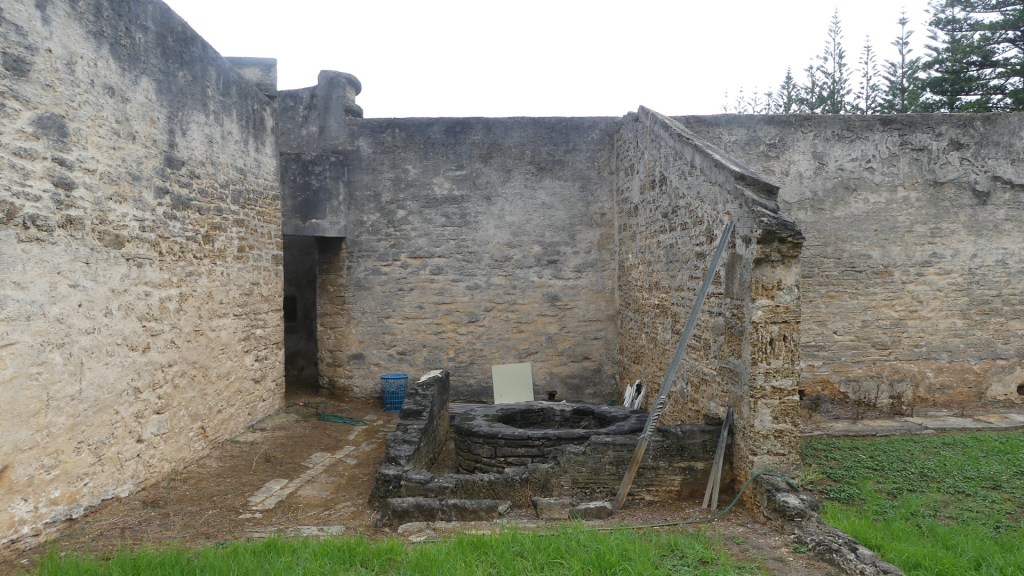
We then ventured down a lane and into an artisans lane one side of which held the head stones removed from an old cemetery.

We had passed some of the city walls with ticket offices charging for entry into the tower rooms and the city walk atop the walls. I could not resist. We entered and climbed through rooms to the walk and traversed the walls as far as they remained in tact. If you look closely at photo 5 you may mistake the well for a lavatory.

After walking the walls we decided to call it a day and walk back to the ship seeing more of modern Tallinn. A very relaxed walk backpast the exterior of the city walls and onto the ships. Each of these ships carries about 3500 passengers and this day there were 3 ships regurgitating tourists int the old town. Thats a bit of commerce right there. Soon after returning we set sail for Warnemunde Germany gaining some great views of the harbour and its visitors.

← Back

Thank you for your response. ✨


.


The Retirees sailing for Tallin – Farewell St Petersburg

After our canal cruise and the evening with the folk dancers of St Petersburg we spent some lesuirely time aboard our ship before sailing to our next destination – Tallin Estonia.

Whilst we waited for the ship to sail out of the harbour there was plenty to do on board the ship but it was just too cold for us subtropicals to think about a dip in the pool or the hottub. So we strolled around deck and noticed we had been joined in port by an MSC Line ship. Our ship has this curious gangway which took you out over the ocean with a glass floor so you could see what sixteen stories looked like. Or we could laze in the weak northern sun and watch TV. Or take in the views such as the new bridge or the tourist boat racing to Peterhoff. when we finally did saiwe were surprised how big the harbour is. We passed a navy base which has become more a museum than active. And like all good sailors you must have a church to protect you whilst at sea. Only this one is part gold.

And we sailed on. This old harbour remains in use as shown by the new Patrol boat moored amongst the exhibits of the museum. There also appeared a vest of the earliest use of the harbour – a fortress with gun ports pocked across it.  As we passed the last gates (the storm surge gates to protect against tidal surges) we knew we were leaving St Petersburg – sailing into a glorious sunset.

← Back

Thank you for your response. ✨

The Retirees aboard the “Love Boat” – SS Regent Princess – St Petersberg

St Petersburg is just around the corner from Helsinki at the head of the Gulf of Finland. Russia’s second-largest city after Moscow, with 5 million inhabitants in 2012, is an important Russian port on the Baltic Sea. It is situated on the Neva River, and was founded by Tsar Peter the Great in 1703. Saint Petersburg has been the capital of Imperial Russia until 1918, when the central government bodies moved to Moscow.

It is often considered Russia’s cultural capital. The Historic Centre of Saint Petersburg and Related Groups of Monuments constitute a UNESCO World Heritage Site. Saint Petersburg is home to the Hermitage, one of the largest art museums in the world. Many foreign consulates, international corporations, banks and businesses have offices in Saint Petersburg so it is an interesting place to visit.

We had been here in 2007 to undertake a canal tour to Moscow through Lake Ladoga and down the Volga. So we had done the Winter Palace, the Hermitage, Peterhoff and a few other things and wanted to do something a little more Russian rather than tourist.

We had previously arrived by plane but this time our arrival by cruise ship surprised us with the size of the new cruise terminal, the reclaimed land yet to be built on and the new monumental buildings on the skyline. Whilst we were taking in the vista we noticed a freighter along side and I guessed this was refuelling as it hung around all day. We also found these strange balls on tees on the highest deck on the ship. Remember I mentioned the medallions issued to us at boarding; well these are the tracking devices monitoring every medallion on ship and recording everything the medallion wearer does as well as identifying the medallion wearer to open his cabin charge his account etc.

We had selected a canal cruise for todays excursion. Peter the Great had lived in the Netherlands doing an apprenticeship in  ship building which gave him the knowledge when later as Tzar he built the port of St Petersburg. Hence he had copied the Dutch and their use of canals. We left the ship but found that the customs officers were on a break so we were unable to leave the ship and were left to wander aimlessly looking for a route to access our bus. When the officer returned he was somwaht indignant that we were concerned about missing our bus. As it turned out we had ample time to kick around in the Russian gift shops on the wharf – none today thanks!

Waiting for us outside were the tour buses looking like suckling pigs nussling the sow – that is a pretty big sow! All aboard the bus and off we go to find our canal boat. Round and round until we came to the Church of the Saviour of the Spilled Blood. One of the main sights of Saint Petersburg, it is erected on the site where political nihilists fatally wounded Emperor Alexander II in March 1881, the church was constructed between 1883 and 1907, funded by the imperial family. In the aftermath of the Russian Revolution, the church was ransacked and looted, badly damaging its interior. The Soviet government closed the church in 1932. During the Second World War when many people were starving due to the Siege of Leningrad, the church was used as a temporary morgue for those who died in combat and from starvation and illness. The church suffered significant damage. After the war, it was used as a warehouse for vegetables. In July 1970, management of the church passed to Saint Isaac’s Cathedral and it was used as a museum. The proceeds from the Cathedral funded the restoration of the church. It was reopened in August 1997, after 27 years of restoration, but has not been reconsecrated and does not function as a full-time place of worship. We stopped for 15minutes to get a picture of the “church” and 10 of those minutes were spent by the guide tracking down lost passengers.

Following our stop at the Church we took a much more direct route to the canal and boarded our boat. The canal boat was not  flash but basic and rudimentary in many ways.  We cruised out into the Neva to see St Petersburg from the water. The city has many historic buildings, universities, archane lighthouses ( for the traffic on the river), residences and decaying decadence. Not the best tour but looking back we were sheltered from the rain and able to sit down and take in the view. I took the following photos;

Our canal tour ended and we boarded our bus for the reutrn to the ship – oh no not before we visit the souvenir shop. Not just any shop but St Petersburg’s biggest! Our tour guide is paranoid about losing tourists so I check out with her about looking around outside rather than looking at the mind numbing tourist trinkets. She agreed and we bolt for the outdoors and find ourselves in the suburbs with a mall stretching away from us. At the commencement of the mall is a pink and grey cathedral with a maroon church beside it. These are the places of worship for the citizens of the suburbs and whilst plain when measured against the tourist sites, interesting in their own right.

After viewing the cathedral and the church we walked down the mall just looking at everyday people going about everyday business. Our tour guide had asked us to be back in 30 mins so we turned around and returned to the souvenir shop to board the bus with the rest of our group who were loaded up with crap from the shop. Back to the ship and rest up for the night activities. I noticed the daily paper for the ship announced a folk group was the special entertainment in the auditorium. Hey we going off ship to see the same thing – how does that happen? Free on the ship or pay for an excursion – not happy Jan!

← Back

Thank you for your response. ✨

.