The Retirees go Abroad – London in July – Buckingham Palace

Today we go to see the Queen. Well at least her London home. Our tour takes in the Queen’s Gallery, the Royal Mews where her coaches and coach horses are housed and the State Rooms of the Palace.

The Queen’s Gallery is a public art gallery at the west front of the Palace on the site of a chapel bombed during the Second World War. It exhibits works of art from the Royal Collection (those works owned by the King or Queen “in trust for the nation” rather than privately) on a rotating basis; about 450 works are on display at any one time.

We arrived early to beat the crowds but lined up for the State rooms instead of the gallery. Oh well we were not the only ones in the queue that day.

DSC07187

With directions we soon found the gallery but we were still early so we browsed the Royal gift shop. One thing about the Royal family is that they are good for tourism and they produce plenty of memorabilia to satisfy the tourist throngs.

This exhibition was entitled “Painting Paradise” and presented paintings of gardens down through the ages. The entry fee provided you with an audio guide which provided information on some of the more important paintings. As with all art there is the pretty picture that satisfies the eye and then there is the art with a story such as the picture of Henry VIII with Jane Seymour and their son or the Rembrandt portraying the resurrection of Christ as a gardener. To read about it in detail go to;

https://www.royalcollection.org.uk/exhibitions/qgbp/painting-paradise-the-art-of-the-garden/paradise

You will not be disappointed.

This slideshow requires JavaScript.

The Royal Mews is a combined stables, carriage house and in recent times motor garage of the Royal Family. In London the Royal Mews has occupied two main sites, formerly at Charing Cross, and since the 1820s at Buckingham Palace. I have always wondered where the word Mews comes from so after visiting the Royal Mews I consulted Wikipedia which says “The first set of stables to be referred to as a mews was at Charing Cross at the western end of The Strand. The royal hawks were kept at this site from 1377 and the name derives from the fact that they were confined there at moulting (or “mew”) time. The building was destroyed by fire in 1534 and rebuilt as a stables, keeping its former name when it acquired this new function.”

At the time of our visit there were half a dozen coaches including the Diamond Jubilee coach and the Gold State Coach, which was built for George III in 1762. Weighing almost four tonnes and requiring eight horses to pull it, it has carried every monarch to their coronation since 1821.

The Diamond Jubilee State Coach was built to celebrate The Queen’s Diamond Jubilee in 2012. The coach was conceived and designed by Mr J. Frecklington, who was also responsible for the construction of the Australian State Coach. The State Coach was on display outside of the State Rooms in the Palace.

Among the vehicles on display are the Irish State Coach, and the 1902 State Landau, used for recent royal weddings including that of Prince William and Catherine Middleton.

This slideshow requires JavaScript.

Buckingham Palace was originally known as Buckingham House. The building which forms the core of today’s palace was a large townhouse built for the Duke of Buckingham in 1703. It was subsequently acquired by King George III in 1761 as a private residence for Queen Charlotte and was known as “The Queen’s House”. During the 19th century it was enlarged, and became Buckingham Palace the official royal palace of the British monarch on the accession of Queen Victoria in 1837. The palace chapel was destroyed by a German bomb during World War II; and the Queen’s Gallery was built on the site.

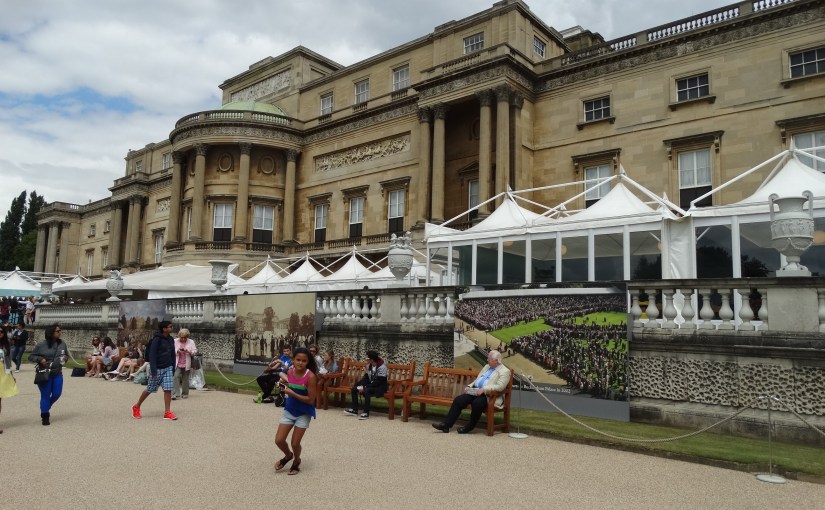
The original early 19th-century interior designs, many of which still survive, included widespread use of brightly coloured scagliola and blue and pink lapis, on the advice of Sir Charles Long. King Edward VII oversaw a partial redecoration in a Belle Époque cream and gold colour scheme. Many smaller reception rooms are furnished in the Chinese regency style with furniture and fittings brought from the Royal Pavilion at Brighton and from Carlton House. The Buckingham Palace Garden at approx. 37 acres is the largest private garden in London. The state rooms, used for official and state entertaining, are open to the public each year for most of August and September, as part of the Palace’s Summer Opening.

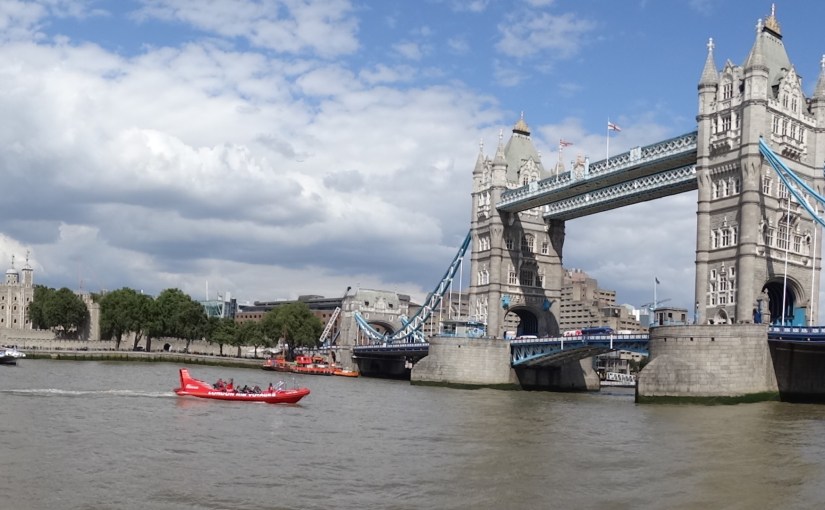
Again our entry fee included an audio tour with a considerable amount of information and sub directories on different aspects. You need every minute of 4 hours to complete this tour. We finished in the gardens where we had a light lunch along with hundreds of other visitors. We then exited through the garden which included another gift shop. On to Victoria Tube station and Tower Hill to visit Tower Bridge.

← Back

Thank you for your response. ✨

The Retirees go Abroad – London in July – Paddington Canal and Little Venice

Buckingham Palace only opens to the public two months of the year and we can hardly say we have been to London unless we have been to see the Queen. We have timed our visit so that it is after Greg’s visit and before we go to Edinburgh which means we are in the early period of the summer school holidays. Expecting that traffic will be hectic, we have planned to leave Thistle at Potters Bar Rail Station and travel into London by train.

The traffic on the M1 was as expected and we made Potters Bar within 3 hours instead of the two hours determined by Tommy. Fortunately we got a train to London almost immediately but where we thought we were going to Kings Cross St Pancras Station we ended up at Moorgate. No worries it is on the Circle Tube Line so we make our way over to Bayswater, but all this adds another hour to our travel. Next time we will look for parking at Cockfosters Tube Station and cut out one change.

Our hotel is “close to the Tube”. It is if you can walk through walls. Due to the road layout a two minute walk turns into a 7 minute walk. Oh well, that life!

DSC07186

All this “travel” and a very delayed lunch through our order being lost leads Kerry to want to rest before doing any exploring so I go off on my own. Up Inverness Tce to Porchester Sq to Westbourne Green across country to Delamere Tce and I find myself in Little Venice on the Paddington Arm of the Grand Union Canal. Here is evidence of London’s industrial past and the continued use of canals even in this big city for recreation. So I walk the canal through Paddinton to St. Mary’s Hospital where it ends in a new high rise development.

On the way I met a family of ducks so used to pedestrians that they pose for my photo.Then I meet a 2nd family followed by a coot family with its nest on the rudder of a canal boat.

Along the tow path I also encounter a variety of canal boats some obviously well used and some obviously abused. At Paddington rail station there is a new development incorporating the canal and around by St Mary’s there is that new high rise development I mentioned. By the way note the footbridge across the canal that is in segments raising up for water borne traffic.

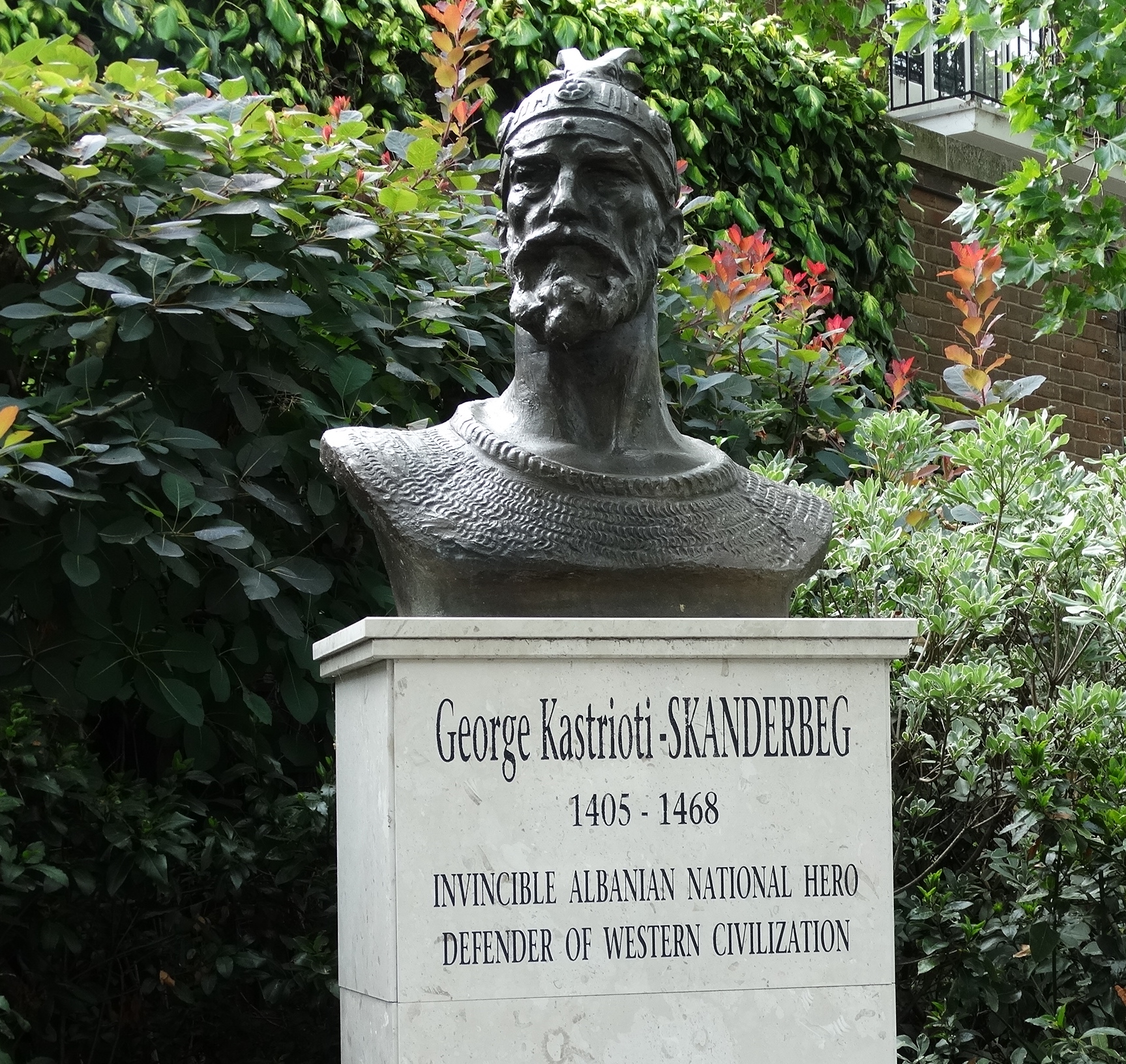
I then walk back along Praed St into Bishopsgate Bridge St and finally into Inverness Tce where I encounter a beehive in a backyard and a bust of George Kastriot Skanderbeg (1405 – 17 January 1468), a 15th-century Albanian nobleman on a street corner.

DSC07184 DSC07185


Very strange so I did some research as to why he is important and why his bust is here. My research discovered that because of Skanderbeg’s military skills he and his little Kingdom presented a major obstacle to Ottoman expansion, and he was considered by many in Western Europe to be a model of Christian resistance against the Ottoman Muslims.

He was admired for defending the region of Albania against the Ottoman Empire for 25 years, however he did not gain support in the Ottoman-controlled south of Albania or Venetian-controlled north of Albania

The London Evening Standard reported that “The bust (of Skanderbeg) was inaugurated at Inverness Terrace in Bayswater to mark the 100th anniversary of Albanian independence as police halted traffic and Albanians gathered to cheer.” There you go.

By the time I got back Kerry was rearing to go and I was weary from a long walk but off we went to see what I had found.

← Back

Thank you for your response. ✨

The Retirees go Abroad – Greg’s Visit to Nottingham – 18 holes at the Belfry Golf Club

Friday comes and the forecast is rain and gale force winds up and down the country. So Greg rings and is able to book Monday and cancel Friday. Monday comes and the forecast is not much better but maybe just maybe the weather is north of the midlands and as we are going to Warwickshire we should be safe.

Our hunch proves correct and we have a great day of golf at a premier resort with no rain. I surprised myself to find that I had not forgotten everything that I had learned of golf and that I had lost something – my high expectation of my ability.

The Belfry is a golf resort in Wishaw, Warwickshire, close to Birmingham. The resort has three golf courses. The Brabazon Course is the main tournament course, and the others are the PGA National and The Derby. The headquarters of The Professional Golfers’ Association are also located there, as are a hotel, tennis courts and a leisure spa. The Belfry has hosted the Ryder Cup on four occasions, three and has also staged numerous European Tour events.

We played the PGA National course. On arrival we determined that a cart would be needed. Greg thought that he did not play as well as at Sherwood Forest but he did some great shots in my view. He also caught my action on one hole – fair but my finish needs some work.

This slideshow requires JavaScript.

At the fifth hole the course crosses a road and returns on the fourteenth hole. As we returned we found the drinks cart having a siesta – not up to par.

DSC07158

No records were broken but it gave me interest to look at blowing the dust off my clubs when I get home.

After driving home it was time to prepare for Greg’s next leg – a train trip to Poitiers which would take him all day and require three changes of train starting with my driving him to Nottingham rail station the following morning. It is a good thing we left a half hour early as a major intersection was closed causing a diversion for about half an hour which meant Greg got to the station in time but later than expected.

You cannot trust the traffic over here – whether it is the M25 blocked at Heathrow or the M1 blocked because an air ambulance has had to land on the highway to evacuate injured drivers or Nottingham Rd closed off because of the bloody tram works

← Back

Thank you for your response. ✨

The Retirees go Abroad – Greg’s Visit to Nottingham – Wet and Cold in Chester and Llangollen

Sunday and Greg has put his washing on early. We will get away again today after hanging out the washing. Very domestic.

Kerry wants to show us the aqueduct over in Llangollen and to fill in the day plans we visit Chester. Chester is a city in Cheshire, lying on the River Dee, close to the border with Wales, Chester was founded as a Roman fort with the name Deva Victrix, during the reign of the Emperor Vespasian in AD79. One of the three main army camps in the Roman province of Britannia, Deva later became a major civilian settlement. In 689, King Æthelred of Mercia founded the Minster Church of West Mercia, which later became Chester’s first cathedral, and the Saxons extended and strengthened the walls, much of which remain, to protect the city against the Danes. Chester was one of the last cities in England to fall to the Normans. William the Conqueror ordered the construction of a castle, to dominate the town and the nearby Welsh border.

On arriving in Chester I again scored a hit with the parking. A short walk brought us to the Information office just as the rain started. A good day to take the hop on hop off bus, so we walked around to the bus terminus and waited for the bus. It finally showed – delayed by road closures because of a fun run through the city. We can pick them!

Boarding the bus we found we were the only passengers. The tour guide seemed to take a shine to us straight away and joined us under cover on the upper deck to give us a personalised presentation.

The more unusual landmarks in the city are the city walls, the Rows and the black-and-white architecture. The walls encircle the bounds of the medieval city and constitute the most complete city walls in Britain. A footpath runs along the top of the walls, crossing roads by bridges, and passing a series of structures, particularly Phoenix Tower (or King Charles’ Tower), so named because Charles was supposed to watch his army be defeated by the Parliamentary army in 1645. On Eastgate is Eastgate Clock which is said to be the most photographed clock in England after Big Ben. Unfortunately it was being repaired and we could not view it.

The Rows consist of buildings with shops or dwellings on the lowest two storeys. The shops or dwellings on the ground floor are often lower than the street and are entered by steps, which sometimes lead to a crypt-like vault. Those on the first floor are entered behind a continuous walkway, often with a sloping shelf between the walkway and the railings overlooking the street.

The most prominent buildings in the city centre are the town hall and the cathedral.

Another notable building is the preserved shot tower, the highest structure in Chester. This is where lead shot was made before cartridge shot replaced lead shot. The most important Roman feature is the amphitheatre just outside the walls which is undergoing archaeological investigation. To the south of the city runs the River Dee, with its 11th century weir. According to our guide the River Dee had a basin on which the Romans built a large inland port and that Chester retained its commercial importance as a port until the weir was built and caused the basin to silt up. This area between the river and the city walls is known as the Roodee, and contains Chester Racecourse

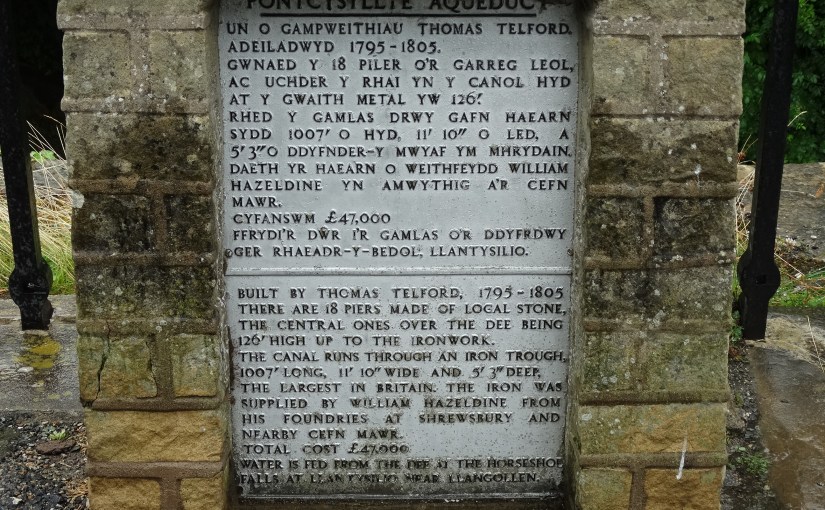
With the rain still falling we found a pub had lunch and hoped the rain would stop. As we farewelled Chester the rain did stop until we arrived at The Pontcysyllte Aqueduct. It is a navigable aqueduct that carries the Llangollen Canal over the valley of the River Dee in Wrexham County Borough in north east Wales. Completed in 1805, it is the longest and highest aqueduct in Britain, and a World Heritage Site.

Arriving at the aqueduct, it started to rain and the wind picked up to the point that it became miserable but still we walked the aqueduct clutching our umbrellas against the wind. Unbelievable views and scenic vistas only spoiled by wind, rain and close to freezing temperatures. It is summer you know.


← Back

Thank you for your response. ✨

The Retirees go Abroad – Greg’s Visit to Nottingham – Australia –v- Derby County

Somehow we learned that Australia was playing Derby in Derby and I managed to get tickets for the match. Unlike Friday the sun was shining but it was cold in the shade. Despite this I donned my shorts polo shirt and sandals and went to the cricket.

Arriving at 10.30am for an11.00am start we found that they started a half hour early because of rain yesterday. Derby was batting chasing a large total mounted by Australia and for a while it looked like they would be lucky to crack 100. A seventh wicket partnership gave Derby a respectable score.

This slideshow requires JavaScript.

After lunch, Australia batted again but it was clear that there would be no decision. It was a lazy day out but great that we got to see a match at the county ground.

This slideshow requires JavaScript.

← Back

Thank you for your response. ✨


The Retirees go Abroad – Greg’s Visit to Nottingham – Rainy Friday

The weather has prevented us from playing golf but Kerry does not need us sitting in front of the TV so I plan a trip for Greg and me.

We went west to Derby and the new Arena – the bike velodrome beside the Rams Stadium. Kerry and I could not get in in February but it is now open and Greg and I took a look.

Pretty slick.

We then visited Derby. Having been here a number of times I was able to give Greg a Cook’s tour and found that Speaker’s corner and its fountain had some changes. These little clay faces appeared on the wall and you could download an App to read or hear about who they were/are and why they are there. Too complex for me but I thought the clay faces looked great.

Then over to the museum at Wollarton Park in the refurbished Wollarton Hall. The museum also has a deer park and this time the deer were up near the hall because it is foaling season. Many were taking shelter under the trees from the wind and rain.

The hall is an interesting natural history museum. I learned here that ermine is the winter pelt of a stoat. Here is a bit more trivia about the stoat or the short-tailed weasel.

“The stoat (Mustela erminea), also known as the short-tailed weasel, is a species of Mustelidae native to Eurasia and North America, distinguished from the least weasel by its larger size and longer tail with a prominent black tip. The name ermine is often, but not always, used for the animal in its pure white winter coat, or the fur thereof. In the late 19th century, stoats were introduced into New Zealand to control rabbits. The stoats have had a devastating effect on native bird populations (see stoats in New Zealand).

Ermine luxury fur is often used by Catholic monarchs, pontiffs and cardinals, who sometimes use it as the mozetta cape. It is also used in capes on devotional images such as the Infant Jesus of Prague. The parliamentary and coronation robes of British peers of the realm are also made from ermine.” Wikipedia.

No stoats I am afraid but the Hall and its gardens were in full bloom and pretty as a picture.

← Back

Thank you for your response. ✨

The Retirees go Abroad – Greg’s Visit to Nottingham – Lincoln Castle and Steep Hill.

Here at Lincoln Castle we were afforded a guided tour also but unfortunately the weather was turning sour and quite windy and chill. Our guide did the best he could but found himself straying with all sorts of trivia. He said that Lincoln Castle is a major castle constructed during the late 11th century by William the Conqueror on the site of a pre-existing Roman fortress. The castle is unusual in that it has two mottes.

It is open to the public as a museum. Lincoln Castle remains one of the most impressive Norman castles in the United Kingdom. When William the Conqueror defeated Harold Godwinson and the English at The Battle of Hastings on 14 October 1066, he continued to face resistance to his rule in the north of England. After gaining control of York, the Conqueror turned southwards and arrived at the Roman and Viking city of Lincoln.

The castle was the focus of attention during the First Battle of Lincoln which occurred in 1141, during the struggle between King Stephen and Empress Matilda over who should be monarch in England. During the reign of King John in the course of the First Barons’ War the castle also came under siege.

Built in 1787 and extended in 1847, part of the castle became a prison. William Marwood, the 19th century hangman, carried out his first execution at Lincoln. He used the long drop, designed to break the victim’s neck rather than to strangle him. Until 1868, prisoners were publicly hanged on the mural tower (Cobb Hall) at the north-east corner of the curtain wall, overlooking the upper town.

Imprisoned debtors were allowed some social contact but the regime for criminals was designed to be one of isolation, according to the separate system. Consequently, the seating in the prison chapel is designed to enclose each prisoner individually so that the preacher could see everyone but each could see only him. Lincoln Castle remained in use as a prison and law court into modern times, and is one of the better preserved castles in England; the Crown Courts continue to this day.

This slideshow requires JavaScript.

The castle is now owned by Lincolnshire County Council. Parts of the prison are open as a museum, including the 19th–century chapel.

It is still possible to walk around the immense Norman walls which provide a magnificent view of the castle complex, together with panoramic views of the cathedral, the city, and the surrounding countryside.

This slideshow requires JavaScript.

A square tower, the Observatory Tower, stands on top of the first mound, standing above the outer walls to dominate the city of Lincoln. The story goes that this tower was used by the prison governor to perve on the women in the women’s prison. The second mound is crowned by the ‘Lucy Tower’, which was probably built in the 12th century and was named after Lucy of Bolingbroke, the Countess of Chester until 1138. Many of the prisoners were buried here and only their footstones remain to mark their grave. The western gate has a modern bridge entrance but earlier roman foundations have been found at this point under the castle.

In the castle grounds is part of one of the Eleanor Crosses. The Eleanor crosses were a series of twelve lavishly decorated stone monuments topped with tall crosses of which three survive nearly intact in a line down part of the east of England. King Edward I had the crosses erected between 1291 and 1294 in memory of his wife Eleanor of Castile, marking the nightly resting-places along the route taken when her body was transported to London.

Following a most entertaining visit to the castle we ventured down Steep Hill past Jews House and Jews Court (two buildings linked with L:incoln’s medieval Jewish community – the Jews were expelled because early Christian law did not allow money to be loaned with an interest charge but there was no such inhibition for the Jews who became wealthy and powerful until Edward 1 banished them and took all their loans and collected the money) through the Stonebow but before getting there we found the best coffee shop serving some exotic cakes and the sun came out to warm us as we sat in the courtyard at the top of the coffee shop.

After sunning ourselves we completed the walk to the commercial areas of Lincoln, the High Bridge, the Glory Hole and the renovated Brayford Pool. The Brayford Pool is a natural lake formed from a widening of the River Witham in the centre of the city. It was used as a port by the Romans – who connected it to the River Trent by constructing the Foss Dyke – and has a long industrial heritage. Today, the waterfront surrounding the pool is home to hotels, restaurants, bars, entertainment venues and a University. The High Bridge is the oldest bridge in the United Kingdom which still has buildings on it. The Glory Hole is the name given by generations of boaters to the High Bridge. It has a narrow and crooked arch which sets a limit on the size of boats using the Witham and going from Brayford Pool, at the start of Foss Dyke, to Boston and the sea.

← Back

Thank you for your response. ✨

The Retirees go Abroad – Greg’s Visit to Nottingham – Lincoln Castle and the Magna Carta.

We walked across Castle Square to the castle. I caught a conspiratorial conversation between Kerry and Greg in a photo. Plotting more shopping I thought. Not before we see the castle says I. Outside the eastern gate is another Baron.

2015 is the 800th anniversary of the sealing of the Magna Carta. Only four original copies of Magna Carta remain from when it was sealed by King John in 1215. Copies of the charter were spread to religious houses in England – Hugh of Wells, later canonised to become St Hugh, the then Bishop of Lincoln, was present at the sealing and made sure a copy was brought back to Lincoln Cathedral.

Lincoln is also the only place in the world where you can find an original copy of Magna Carta together with the Charter of the Forest, issued in 1217 to amplify the document and one of only two surviving copies. The two charters are housed in Lincoln Castle in a specially made vault.

– See more at: http://www.visitlincoln.com/magnacarta#sthash.J0ZtMrvi.dpuf

For those of you who have forgotten the importance of the Magna Carta here is a shortened extract from Wikipedia

“Magna Carta (Latin for “the Great Charter”), also called Magna Carta Libertatum (Latin for “the Great Charter of the Liberties”), is a charter agreed by King John of England at Runnymede, near Windsor, on 15 June 1215. It promised the protection of church rights, protection for the barons from illegal imprisonment, access to swift justice, and limitations on feudal payments to the Crown, to be implemented through a council of 25 barons. Neither side stood behind their commitments. At King John’s request, the charter was annulled by Pope Innocent III, leading to the First Barons’ War. After John’s death, the regency government of his young son, Henry III, reissued the document in 1216, stripped of some of its more radical content, in an unsuccessful bid to build political support for their cause. At the end of the war in 1217, it formed part of the peace treaty agreed at Lambeth, where the document acquired the name Magna Carta, to distinguish it from the smaller Charter of the Forest which was issued at the same time. Short of funds, Henry reissued the charter again in 1225 in exchange for a grant of new taxes; his son, Edward I, repeated the exercise in 1297, this time confirming it as part of England’s statute law.

The charter became part of English political life. At the end of the 16th century there was an upsurge in interest in Magna Carta. Lawyers and historians at the time believed that there was an ancient English constitution, going back to the days of the Anglo-Saxons, which protected individual English freedoms. They argued that the Norman invasion of 1066 had overthrown these rights, and that Magna Carta had been a popular attempt to restore them, making the charter an essential foundation for the contemporary powers of Parliament and legal principles such as habeas corpus. Although this historical account was badly flawed, jurists such as Sir Edward Coke used Magna Carta extensively in the early 17th century, arguing against the divine right of kings propounded by the Stuart monarchs. Both James I and his son Charles I attempted to suppress the discussion of Magna Carta, until the issue was curtailed by the English Civil War of the 1640s and the execution of Charles.

The political myth of Magna Carta and its protection of ancient personal liberties persisted well into the 19th century. It influenced the early American colonists in the Thirteen Colonies and the formation of the American Constitution in 1787.

Research by Victorian historians showed that the original 1215 charter had concerned the medieval relationship between the monarch and the barons, rather than the rights of ordinary people, but the charter remained a powerful, iconic document, even after almost all of its content was repealed from the statute books in the 19th and 20th centuries.

Magna Carta still forms an important symbol of liberty today, often cited by politicians and campaigners, and is held in great respect by the British and American legal communities. The four original 1215 charters were displayed together at the British Library for one day, 3 February 2015, to mark the 800th anniversary of Magna Carta.

← Back

Thank you for your response. ✨


The Retirees go Abroad – Greg’s Visit to Nottingham – Lincoln Cathedral

Firstly there is the obligatory picture in the gateway to the cathedral and then entry into the vast nave. The cathedral was once the highest building in the world until 1549 when its spire collapsed and was not rebuilt. A production of Jesus Christ Superstar is being performed in the cathedral so unfortunately we did not get a clear view of the nave. Whilst waiting for our guide Kerry and I inspected the wonderful “stations of the cross” and then I took Greg on my own version of the tour to show him the Dean’s Eye, the Bishop’s Eye, the chapter house and St Hugh’s choir in the chapel.

This slideshow requires JavaScript.


This slideshow requires JavaScript.

This slideshow requires JavaScript.

We met the guide for the tour and whilst he was most knowledgeable and informative he was also deaf so he did not hear our pleas for him to speak up. We saw the baptismal font carved from one stone in the 12th century, the Dutch pulpit saved from an Anglican Church in Holland, some hand carved pieces from an ancient set of carvings for a set of stations(the carvings were donated to the church by a parishioner)

This slideshow requires JavaScript.

Here is what I could hear of the history of the cathedral. Remigius de Fécamp, the first bishop of Lincoln, moved the Episcopal seat there “sometime between 1072 and 1092” from Dorchester. Bishop Remigius built the first Lincoln Cathedral on the present site, finishing it in 1092 and then dying on 9 May of that year two days before it was consecrated. It is a cathedral because it contains a “Cathra” or the bishop’s seat. The cathedral was mostly destroyed by an earthquake in 1185. The damage to the cathedral is thought to have been very extensive being described as having “split from top to bottom”. In the current building, only the lower part of the west end and of its two attached towers remain of the pre-earthquake cathedral. After the earthquake, a new bishop was appointed. He was Hugh de Burgundy of Avalon, France, who became known as St Hugh of Lincoln.

Hugh was consecrated Bishop of Lincoln on 1186 at Westminster. As a bishop, he was exemplary, constantly in residence or travelling within his diocese, generous with his charity, scrupulous in the appointments he made. He raised the quality of education at the cathedral school. Hugh was also prominent in trying to protect the Jews, great numbers of whom lived in Lincoln, in the persecution they suffered at the beginning of Richard I’s reign, and he put down popular violence against them—as later occurred following the death of Little Saint Hugh of Lincoln—in several places. Hugh was canonised by Pope Honorius III in 1220, and is the patron saint of sick children, sick people, shoemakers and swans. Hugh’s primary emblem is a white swan, in reference to the story of the swan of Stowe which had a deep and lasting friendship with the saint, even guarding him while he slept. The swan would follow him about, and was his constant companion while he was at Lincoln. Hugh loved all the animals in the monastery gardens, especially a wild swan that would eat from his hand and follow him about and yet the swan would attack anyone else who came near Hugh.

A new tower was soon started and in 1255 the Cathedral petitioned Henry III to allow them to take down part of the town wall to enlarge and expand the Cathedral, including the rebuilding of the central tower and spire. They replaced the small rounded chapels (built at the time of St Hugh) with a larger east end to the cathedral. This was to handle the increasing number of pilgrims to the Cathedral, who came to worship at the shrine of Hugh of Lincoln. The shrine has been moved a number of times and it appears in the moves they have lost St Hugh’s head.

DSC07004

The history of this cathedral goes on and on but as it is best known for the shrine of St Hugh, I have limited the history. From here we proceeded to the Castle and the Magna Carta vault.

← Back

Thank you for your response. ✨


The Retirees go Abroad – Greg’s Visit to Nottingham – Lincoln

The day starts with the BBC news for the weather and the score in the cricket and to pick up what has happened at St Andrews. Boy how the programming changes with two men in the house. The weather is okay for today – we can visit Lincoln but take a jumper. Not so certain about Friday though. A low has developed in the Atlantic and is moving toward the UK. We may have to reschedule golf for Friday.

The drive over to Lincoln is trouble free and my research on parking has proved very worthwhile as we are able to park between Lincoln Castle and Lincoln Cathedral (they face one another) at the top of Steep Hill (named because it is bloody steep). We arrive before tourist hour (10.00am) so we wander along Bailgate to Newport Arch. We start at the tourist information centre in Castle Square and walk past the Church of St Mary Magdalene which is the parish church and dates from the 13th century. It is overshadowed by the cathedral immediately behind it.

DSC06976DSC07005

Further down Bailgate is the Lion and Snake pub and set into the road outside the pub are stone circles marking the location of 19 columns which once formed the colonnade of a roman forum. The place is littered with roman relics. Further on we pass the County Assembly Rooms where the local Rotary Club meets. In front is one of the “Barons” celebrating the anniversary of the signing of the Magna Carta. There are 15 – the same number as opposed King John and forced his signature to the Magna Carta and they will be auctioned off for charity. We finish our walk at Newport Arch; a roman archway still used by traffic today (I’ll bet it is a nightmare at busy times). Built 1800 years ago as the north gate to the roman fortress on the site.

DSC06974DSC06975DSC06972

Don’t worry Kerry is keeping an eye on the shopping as we pass by the shops. I was taken by some bespoke ironwork in one – a replica penny farthing and a replica pushbike in the shape of a Harley Davison. She has even infected Greg who is shopping for scarves also.

DSC06970DSC06971

Enough of this. I drag them back to one of our goals – the Cathedral.

← Back

Thank you for your response. ✨