The Retirees go Abroad – Reims

After a tiring day yesterday we thought we would concentrate on Reims and planned visits to Reims Cathedral, Museum du Tau, and the Basilica of St Remi. It turns out that Reims is not such a big place and it was easy to walk to most places. It also turns out that the Kings of France came to Reims to be invested and crowned at the Cathedral and the banqueting hall beside it – now the Museum du Tau.

The cathedral is a towering grand church. Notre-Dame de Reims (Our Lady of Reims) is the seat of the Archdiocese of Reims and replaced an older church, destroyed by fire in 1211 that was built on the site of the basilica where Clovis was baptized by Saint Remi, bishop of Reims, in AD 496. That original structure had itself been erected on the site of some Roman baths.

Alongside the cathedral is the Palais Archi-Episcopal, now the Museum of Tau. The Palais was the palace of the Archbishop of Reims. It is associated with the kings of France, whose coronation was held in Notre-Dame de Reims. Most of the early building has disappeared: the oldest part remaining is the chapel, from 1207. The building was largely rebuilt between 1498 and 1509, and modified again between 1671 and 1710. It was damaged by a fire on 19 September 1914, and not repaired until after the Second World War.

The Palace was the residence of the kings of France before their coronation in Notre-Dame de Reims. The king was dressed for the coronation at the palace before proceeding to the cathedral; afterwards, a banquet was held at the palace. The first recorded coronation banquet was held at the palace in 990, and the most recent in 1825.

The palace now houses statuary and tapestries from the cathedral, together with reliquaries and other objects associated with the coronation of the French kings.

The Basilica of St Remi started life as the Abbey of Saint-Remi. Founded in the sixth century by the Bishop of Reims who converted Clovis, King of the Franks, to Christianity at Christmas in AD 496, after he defeated the Alamanni in the Battle of Tolbiac. Since 1099 it has conserved the relics of Saint Remi who died in 553AD. The present basilica was the abbey church; it was consecrated by Pope Leo IX in 1049. It houses many other “illustrious persons” in the crypt of St Remi. It was fabulous to stand in a building that had seen more than 1000 years of service and was still in use today.

We had a picnic lunch at a park near the Basilica and after the visit to the basilica we went to the hotel for a nanna nap. Upon arising David suggested we visit the War Rooms where the German nation surrendered and brought to an end the Second World War on May 8, 1945. The Museum of the Surrender of May 7, 1945 is a history museum founded by the city of Reims in 1985 to mark the 40th anniversary of the signing of the first part of the acts of capitulation of Nazi Germany. A second signing took place the following day in Berlin, which ended the Second World War in the European theatre. It is located in part of the premises of the Franklin-Roosevelt High School in Reims

On the way to the museum we passed a roman gate still standing where once gallo-roman citizens passed into the city. After the museum, there was still plenty of sunlight so we walked over to a large nearby park and the monuments of remembrance.

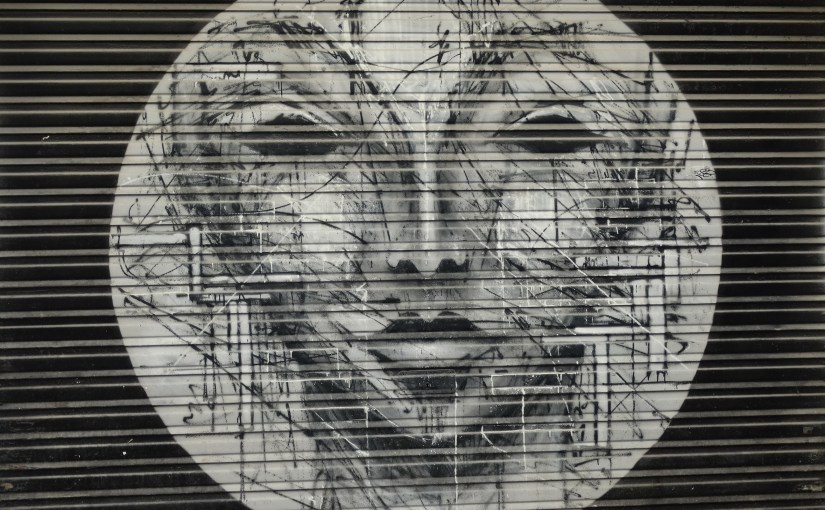
We passed through the park into the city centre and soon found a place to stop for refreshment. The Ernest Hemingway Café took our fancy and we stopped in to catch our breath. After reviving ourselves we walked on through the city past the golden angel atop o tower and past the Kings Cross look alike fountain, past some clever graffiti and then to the Palais of Justice (here David and I had a close encounter with a very angry cat – hissing a scratching at us – we may have been a little inebriated as we shrugged and moved on). Time had passed quickly and we decided we wanted a simple pizza dinner. Veronica spotted the Domino Pizza rider on his scooter and hailed him down so we could find our way there. The poor fellow was so surprised to be hailed that he actually stopped but could not speak a word of English. Never the less we completed the quest and enjoyed our repast under the arches of Rome.

With significant indigestion we retired to bed as we were on the road again tomorrow.

← Back

Thank you for your response. ✨

The Retirees go Abroad – Epernay and Hautvilliers

We had planned to visit a few champagne houses starting with Mercier. We did not know what to expect but I think this was a good place to start. Mercier Champagne prides itself on bringing champagne to the people and is big and bold and brassy. A visit to their cellars has a feeling of Disneyworld about it. It cost 16€ per person for the tour and I would have to say it was a good tour. Firstly we were given the history of the house. As best as I can recall, a young Mercier convinced 5 of the older houses to join forces and fund his grand plan of bringing champagne to the people. They built purpose built cellars, miles of them, 30 metres underground and to promote the house he had constructed a huge barrel which he ultimately dragged to Paris for the world’s Fare and but for the Eiffel Tower it was the biggest attraction. You can still see the barrel. He also introduce delivery by panel van boldly emblazoned with his brand.

After getting the history you travel 30 m down to the cellars board a train and take an escorted tour through the cellars. In addition to the champagne and the serious work of making the product he engaged master sculptors to engrave the walls with murals as he fully intended to exploit the tourist. He also developed luxury dining rooms for the well healed tourist but we did not get to see past the chandeliers. The tour ends with a tasting – yes that is right – a single tasting. He knew his stuff as the tours are full and run every 40 minutes. As we left another bus load arrived and judging by the driver’s demeanour it had been a busy day.

On our way to the next champagne house we were diverted by the sight of a large clock tower and ended up at Castellane. We ventured inside and the tour was about to start but having done Mercier we felt it could not be bettered so we just tasted the champagnes instead. We shared three coupes of champagne and did not see much more of interest so we pushed on.

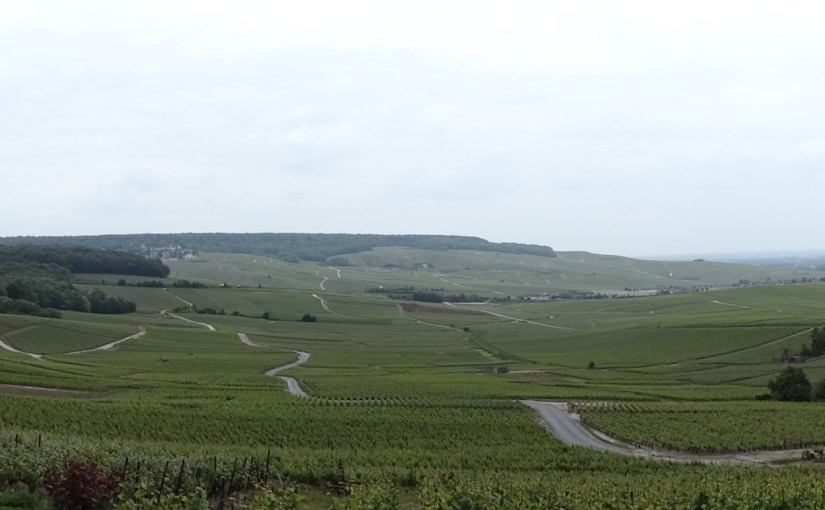
We pushed on to Hautvilliers looking for G. Tribuant. Hautvillers is a beautiful village on a hill surrounded by grape vines and home to quite a number of smaller producers. It also is small enough to park and walk the village which we did bumping into a few fellow tourists loaded down with cases of champagne and all vowing it was superb and cheap. The first cave we came across was the house of Locret Lauchaud. Unfortunately, or so we thought, he was closing his door as we arrived. We moved on to Joseph Desruets only to find that no one was home or so we thought. As we stood viewing the ancient equipment a young crowd of French came in and pointed out that we were in the work shop not the Cave and directed us up the hill. For reasons unexplained we went the other way and I am glad we did as we found our way to G Tribuant.

The Cave was superbly located atop a hill looking over the countryside. We tasted we bought and then we relaxed in the afternoon sun looking at the valley sipping champagne and eating cheese. I will let the pictures tell the story.


We were late into bed that day. With twilight and daylight saving the sun is present up to 10.00 o’clock.

← Back

Thank you for your response. ✨

The Retirees go Abroad – On the road to Avignon – La Grotte de St Marcel d’Ardeche

After having a great time at Beaune, we were eagerly looking forward to Avignon.

On the way we planned to visit La Grotte de St Marcel d’Ardeche; a system of limestone gorges just north of Avignon. Tommy guided us to the gorge by the most convoluted route. I am sure we passed through a forgotten village where they are still using a Roman bath house.

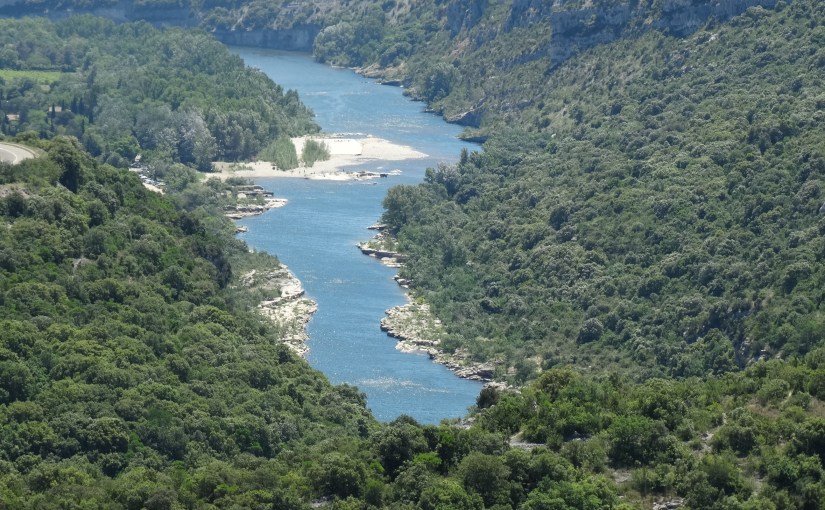
The wind was picking up as we arrived. The next tour was at 2.00pm and in French. The English narrated tour started at 4.00pm so we opted to take the French tour. Even though we could not understand much of what the guide told us the images will remain with me forever. First there was the views from the top of the mountain to the river valley below, then the trip down a man-made entrance along 416 steps to see the wonders of nature. The highlights were the illuminated pools and the immense chamber. Have a look at the photos.

When we returned along the 416 steps our pre-ordered lunch awaited us. Finishing lunch we drove down the mountain towards Avignon and stumbled upon a fabulous view point. The wind was howling but the view made it a necessary stop. Courtesy of David Colch I am able to share with you the world’s best selfie.

We followed the River Rhone to the bottom of the valley where the canoe hire companies were making a fortune hiring canoes to tourists and local wanting to explore the upper Rhone. We elected a cup of coffee at a local café and the girls wanted to wet their feet in the river. It did not go to plan for the girls – anyway have a look at the photos.

We arrived in Avignon at our apartment around 4.00pm the wind still blowing fiercely. Avignon is a commune in south-eastern France in the department of Vaucluse on the left bank of the Rhône River. Our apartment turned out to be on the fourth floor and there is no lift. Again a struggle to get the luggage to the apartment and daily exercise up and down 60 steps. Otherwise the apartment was fine. We settled in looking forward to the next day.

← Back

Thank you for your response. ✨


The Retirees go Abroad – Gordes and Rousillon

Our last day in Avignon and we are going into the country to visit two nearby villages – Gordes and Rousillon.

Gordes is a commune in the Vaucluse département in the Provence-Alpes-Côte d’Azur region in south-eastern France. It is very much as it was before the Second World War and therefore interesting and quaint. On the way we spotted some poppy fields and the tourists could not help themselves – out of the car camera in hand.

The village, like so many of the villages in southern France was built on top of a hill for defensive reasons which no longer exist today but give rise to the quaintness tourists find attractive. As with all these villages the church is a central element. In many cases the church came first and the village followed. Here in Gordes it has traditional church with some regional differences like the blue ceiling above the altar and the stairs up to the organ. Unfortunately the church is showing a bit of neglect. The village had a second church which has been de sanctified and is now a modern gallery. It also has a castle which now forms the Hotel de Ville and Tourist Information Centre.


Down the road (or should I say the footpath on which they drive) from the church we found a cave. When the town fell into decline after WW2 and premises were abandoned things like underground caves were lost and forgotten. When this particular house was remodelled by its new owner he rediscovered a series of caves going back to roman times. The caves most recent use was for pressing of olives. For a small fee we were able to visit the caves. The visit started with a film presentation and then an audio tour.

The charming mademoiselle at the caves gave us a tip as to a good place for coffee. On the way we saw more of the underground tunnels and caverns of the town. We also saw one of the residents sunning itself and of course we admired the view from the top of the hill. As we left Gordes to travel to Rousillon we were able to take some vistas of the village including the local vines and poppies.

Roussillon is a commune in the Vaucluse department in the Provence-Alpes-Côte d’Azur region in south-eastern France. It is famous for its ochre deposits found in the clay surrounding the village and ochre mines. Ochres are pigments ranging from yellow and orange to red. One of the former ochre quarries can be visited via the ‘Sentier des Ocres’ (Ochre Path). On arriving at the village we embarked on the walk to see the ochre in all its shades.

The village sits atop a hill and like Gordes has a fantastic view of the valleys surrounding it. The day turned out to be rather warm so ice creams all around as we investigated life in Rousillon. Interestingly the vineyards all seemed to have poppies growing between the vines.

During our investigation Kerry noted that some ancient stone dwellings could be visited just 4 klms outside Rousillon. These were called “Bories” and exist in many different places usually as temporary shelters for shepherds. However in this case there was a whole social and economic system built around and based on these dwellings. A small self-sufficient settlement. They were not easy to find and once found it was difficult to think of life in such a settlement.

A path through the scrub to a group of thirty dry stone huts, now restored following ten years of work gives an example of life in rural Provence in the past. The stones, without use of mortar, have been skilfully stacked into huts with corbelled vault ceilings. The huts give an austere and harsh appearance.

The Bories village is composed of seven groupings of huts, each having a very precise function. There are houses, stables, sheepfolds, barns, grain lofts, silkworm factories and bakehouses, vat houses and tanning mills, henhouses, pig sties and goat shelters. Preservation of the Bories

Attempts at dating the bories have been made and they may originate as far back as the Bronze Age. But it is more likely due to the remains found in and around the village that it would have been constructed around the 7th century. There are objects and money found on the site suggesting it could not have been built prior to the 15th century and other remains, such as the pottery, date from the 18th century.

One thing is for certain they could have used some outdoor shelters as the afternoon sun baked the ground and heated the rocky shelves on which the bories are built.

By late afternoon we were hot and dry. Retreating to the car we broke into the water bottles to quench our thirst and they remained with us on the drive home. A very satisfying if arduous day climbing hill top villages and negotiating the rubble around the bories.

← Back

Thank you for your response. ✨

The Retirees go Abroad – Farewell and Hello Calais and Beyond

A beautiful day greeted us for our trip to Gatwick. Our new hood rack and carrier had been fitted and we got underway on time. The weather blessed us and the traffic took a holiday. We travelled without incident to Gatwick where we rendezvoused with David and Veronica. We have known them for over 25 years and in my case 35 years but had only limited contact during that time. Now travelling together may raise some issues but we would have to wait and see.

We changed over the luggage had a bite to eat and farewelled Rod and Kerry who were off to Norway and the Hurtigruten trip up the Norwegian coast. No time to waste we had to be at Dover for the ferry at 4.40pm. Again the traffic was kind even on the dreaded M25 and we reached Dover with a half hour to spare. After lining up we went to the terminal kiosk for a nature break and over stayed our time returning to the car to find the traffic by passing us to board the ferry. A salutary reminder to me about timing.

All’s well though. We boarded and landed in Calais without problem and stayed at our favourite Hotel Meurice – an older hotel in a classic style and a great breakfast.

Calais looked very different from the windy and cold place we saw at Xmas. There were clear skies and late evening sunshine to entice us into the old city for dinner, a red beer for David and me (Grimbergen Kriek) and a walk around the square. We even got to see Notre Dame Calais before circling around back to our hotel.

The next day we were on the road early to drive to Reims or Rheims the pre WW2 spelling in the Champagne region. The day was misty rather than overcast and everything appeared grey and a little fuzzy. We caught up with gossip and shared some memories as we travelled along finally arriving in Reims right on 12 noon Saturday. I went to the hotel to book us in and to my dismay found that the reception closed at 12 noon on Saturdays. After calling the hotel number we gained entry and the keys to our rooms on the 2nd floor.

That afternoon we did a little exploring but the travel had been exhausting, so after dinner it was off to bed for a big day tomorrow.

The Retirees go Abroad – Sherwood Forest and a Bakewell Tart

One of the things on the bucket list for Rod was a visit to Sherwood Forest. There is not much of the original forest remaining but there is a section of the forest containing “Major Oak” a thousand year old oak tree rumoured to be one of Robin’s hiding places in the forest. Without thinking we prepared and took a BBQ for lunch in the forest.

On arriving at the car park we were met with a sign “NO BBQS IN THE FOREST”. Ah well we had come all this way so we walked to Major Oak and completed the circuit to the visitors centre. Having fulfilled the bucket list wish we set off for Clumber Park as we were told it was permitted to BBQ in that park. Clumber is near to Sherwood Forest is a National Trust property and does have a place for BBQs – an open field with no facilities. We had purchased a disposable BBQ from Tesco and some kebabs to cook. The wind was still gusting so we manoeuvred the car to form a wind break, lit the BBQ and waited to cook lunch. A memorable BBQ because of the laughs we had trying to cook in that wind with that BBQ.

A visit to Sherwood Forest is not complete without visiting Thoresby Abbey and Ingrid Pears Glass Works. Ingrid was still there working busy with curious tourists. But our goal was to visit the Abbey show Rod and Kerry the restoration performed by Warner Hotels and to enjoy a hot liquor coffee.

The next day was relax and pack day. But we managed to fit in a trip to Bakewell so that Rod could try a genuine Bakewell Tart and then over to Buxton to visit Poole’s Cavern and see the limestone cavern. To finish off the day we walked some part of the way along Erewash canal to Trent Lock then to the Bulls Head in Breaston for dinner. Early to been this night for tomorrow we drive to Gatwick Airport to farewell Rod and Kerry and collect David and Veronica.


← Back

Thank you for your response. ✨

The Retirees go Abroad – Happy Birthday Kerry Hayes

Although not her birthday, we will not be in Australia for the occasion so we celebrated with a wine trip in the UK.

First vineyard was at Halfpenny Green Vineyards close to Wolverhampton approximately 90 minutes south west of Long Eaton. A beautiful day greeted us with sun shining and cotton ball clouds in the sky. However on arriving we became a bit distressed as everything appeared closed bar the cafe. It was not like what we consider a traditional vineyard should be. There were numerous odd shops for plants furniture as well as the cafe, wine room. the bottling shed and assorted equipment all surrounded by the vines.

We discovered that there is a form of farm shop attached to the cafe and the building looked like a restored old barn. But we were there to try some English wines. Some 8 different varieties and styles were available for tasting. Most were whites with one Rose one red and one sparkling wine. And none of them were duds. All from different German and French varieties so it was quite a different experience. We selected a bottle of Rose for our picnic and as the weather had soured a little we were given the use of the wine room for our spread. As we munched on baguettes cheese olives pate and sausage we drank our wine and watched the staff in the bottling shed riddling the sparkling wine in the traditional method.

The day was still young so we went further south west into Gloucestershire to the Three Choirs Vineyard Britain’s second biggest vineyard and wine producer. This appeared to be more like an Australian vineyard. The wineshop was bedecked with wine paraphernalia and we booked our wine tour. From there we went into the court looking over the vines and across to the restaurant emitting fantastic aromas of lamb roast. The weather had turned decidedly nasty. The wind was whipping around the buildings and the air was much colder even though the sun seem to be winning against the clouds. Time for a hot chocolate and cup of tea.

Time passed quickly and we were soon called for our tour. Kerry Y was concerned that it would rain and dressed in her rain smock but most of us were just concerned about being blown away. The tour started with a glass of their sparkling wine and then the guide took us amongst the vines to explain the varieties of grape used. We sampled another wine then proceeded to the pressing fermentation and bottling plant to see the whole operation where we sampled another wine or two. The tour finished with a short video clip about the winery and our last tasting. No duds here either. I have experimented with some different styles of photography for the pictures of Three Choirs.

Kerry Y was feeling weary – no wonder with all the tastings so Rod, Kerry H and I thought we would try the nature trail through the vineyard. We were learning about the different sorts of trellises used and the reasons for it when Kerry noticed a much bruised cloud scudding across the sky towards us. There were pavilions along the trail and some cabins for overnight stays but unfortunately the wind and some missing panes of glass allowed the rain to reach us convincing us to return to the car.

But the day had not finished yet. Long Eaton is blessed with a fine dining Indian cuisine restaurant, so having planted gifts for Kerry H at the restaurant we casually suggested dinner at the Indian surprising the birthday girl with gifts and a good meal.

← Back

Thank you for your response. ✨

The Retirees go Abroad – Rod and Kerry come for a stay

It is Monday and we travel to Nottingham Bus station to pick up Rod and Kerry Hayes. They are on their way to Norway and are visiting for 4 days. As expected they step from the coach and we collect their luggage.

We have planned a tour of Nottingham and like most plans it gets changed. We walk to Upper Pavement into the Pitcher and Piano – a de sanctified church turned into a hotel.  Lunch and a beer is on the menu. The hotel is a great use of a grand building.

Nearby is the Galleries of Justice. This is a museum in the old Town Hall where court rooms and a prison were once housed. In fact hangings were done on the front steps of the building. Inside the first thing confronting you is a gibbet. Hanging from the ceiling is an iron cage in the shape of a person. Once hung the body was placed in the gibbet for public display. On entering the museum you are given a convict number. From there you proceed into the court room with the orderly who tells you about the proceedings in the court circa 1780 and then down the stairs in the dock to the cells.

Inside the cells you find your number which informs you as to the crime you have committed and the sentence that has been passed upon you. In the cells you meet the warder. She would live on the site and work in this airless cell extorting money from the prisoners for food water and other necessities.

We then went through various cells to the Sheriff’s cells and into the exercise yard where a warder barked commands about the exercise you were to take otherwise you met the gallows, solitary confinement in the dark or were thrown into the pit where you were forgotten about unless your family came and paid for your release. But hang on my sentence was transportation. Initially this may have been to the American colonies but after the American War of Independence many prisoners were transported to Australia. So I was shown through a different door from which I was transported to a hulk on the Thames and later to Australia.

I was glad when we found our way out of there. We then strolled through the streets of Nottingham back to our car and home to Long Eaton to prepare for tomorrow.

← Back

Thank you for your response. ✨

The Retirees go Abroad – Isle of White

It is an early start to catch a ten o’clock ferry to the island and the weather does not look inviting. We know it will take about one and half hours to drive to Lymington (the mainland port for the ferry) but we don’t know about the traffic. Hence the early departure.

As we near the New Forest the sun breaks through and the traffic remains light. We have made good time and we arrive at the terminal in sufficient time to have some breakfast before boarding. The ferry is much smaller than cross channel ferries but they have a trick. One floor in the ship is on an elevator and three lanes of cars disappear into the third floor of the ferry.

As we travel across to the island I keep an eye open for Castle Hurst and the pebble peninsular connecting it to the coast. When I spot it, it surprises me how long it is and to think we walked that peninsular. It also surprises me that the Needles on the western end of the island are so close to the castle and yet because of the heavy sea mist on the day of our visit we did not know they were there.

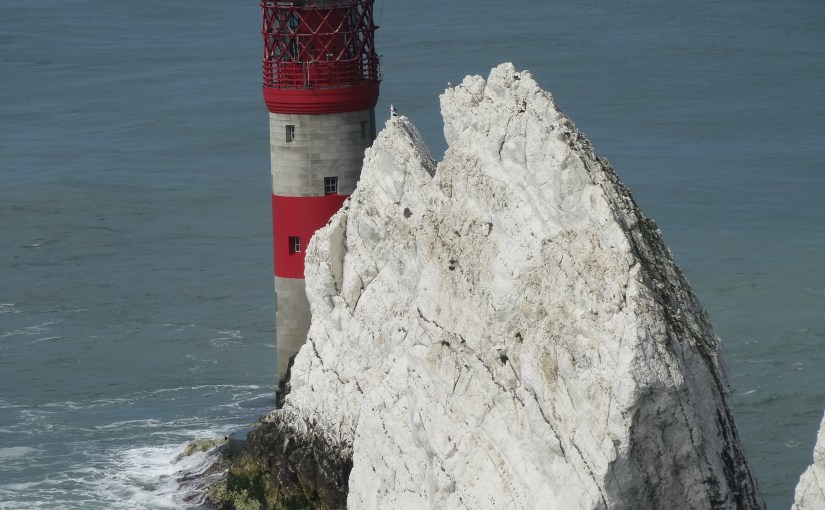
Our first place to visit was the Old Batteries and the Needles. Unfortunately the only place to park is a commercial car park at a cost of £4.50 which is fine if you are staying all day and visiting the amusement park. But for us it just left a bad taste and not a good way to start the day. To see the batteries and the Needles you must walk to the end of the island (at least a twenty minute walk) and when you get there apart from the spectacular view the other features were not that riveting. Perhaps the most exciting were the tunnel to the search light and the old rocket launch pads from Britain’s venture into the space race. The only British satellite launched on a British rocket remains in orbit and is functioning but is not used any longer.

When we visited the new batteries where the rocket launch pads are located we encountered two Brits who were waiting for a bus. Unknown to us there is a city tour hop on hop off bus available from Yarmouth for £5 per passenger. If considering a visit I suggest you consider this option.

Next we visited Mottistone Manor and Gardens but it is closed Fridays. My fault for not checking the opening days as well as the times. So we moved on to visit St Catherine’s Lighthouse. I was driving and I missed the turn. We did try to pick it up but the road was closed so on we went to our next stop the islands last windmill with all its working bits made in wood. Well not quite true as the grinding stone is made of stone and some of the mechanical bits are made of metal. A bit disappointing and it no longer works. However not all was lost as the scenery had been very enjoyable up til we stopped for lunch. We turned into a road which we thought would take us to a viewing point but instead we found the road closed due to subsidence – severe subsidence with the houses around it abandoned. It looked as though there had been a significant land slip. No photos of the land slip as people had turned it into a dump. Not very nice.


For our last visit I suggested Carisbrooke Castle but on the way we spotted a sign to a roman villa. After our experience with roman ruins at Weymouth I was suspicious that there would be little to see. Well I was wrong again. Brading Roman Villa is the ruins of three roman structures of different periods. Discovered in 1879 by the farmer working the land it was excavated in Victorian times and some magnificent mosaics.  By our standards they did more harm than good. Recently the excavation has been visited again and a new shelter to protect and display the third dwelling has been constructed. The building itself is impressive but the relics it protects are truly fascinating.

After visiting Brading we journeyed back to Yarmouth and caught the ferry back to the mainland and Kerry then took on the driving to return us safely home to Long Eaton.

← Back

Thank you for your response. ✨

The Retirees go Abroad – The Osminton White Horse, T. E Lawrence’s house Cloud Hill, Thomas Hardy’s birthplace and Max Gate, Durdle Door, the Jurassic Coast and Jordan Hill Roman Temple.

We started the day looking out the breakfast room window at the rain. As predicted by the BBC weatherman it was raining and quite heavily. Our plans had allowed for this development. In the morning we would visit T. E. Lawrence’s home Cloud Hill, and Thomas Hardy’s birthplace and home with a visit to Durdle Door in the afternoon when it stops raining.

Once behind the wheel of Thistle, Kerry drove east out of Weymouth with me in the co-pilot’s chair. We had been travelling for about 5 minutes when I noticed a large horse drawn on the hill opposite. Just last night Kerry had asked me to find the white horse on the hill and there it was. Well not the one she wanted but it is a horse drawn on a hill. The Osmington White Horse is a hill figure sculpted in 1808 into the hill just north of Weymouth. The figure is of King George III who regularly visited Weymouth and made it the first resort riding on his horse. It is 280 feet long and 323 feet.

We moved on. Kerry really wanted to follow the coast line and it appeared there just is not a coast road. I spotted a road running off toward the coast and Kerry wanted to follow it to see where it went. The road led us to a private road and a sign stating that there was a £5 charge to use the road. One irritating thing we have encountered down here is that you have to pay for parking everywhere. Now having to pay for the use of the road was just the end. So we proceeded in another direction to the top of the hill and a view to Portland and the bay in front of Weymouth.

The rain was once again falling consistently as we approached Cloud Hill. We were quite surprised that the car park was full and the cottage was next door to the Tank Museum and down the road from the Tank training grounds. It turned out that this was Lawrence week commemorating 80 years since his death. There was a special set of lectures on the man and we sat in on one before viewing the cottage. Of course we are talking about Lawrence of Arabia who ended up trying to find obscurity as a private in the tank corps hence he bought Cloud Hill just down the road from the tank training grounds. The cottage was quite eccentric. No toilet and one room lined in aluminium.

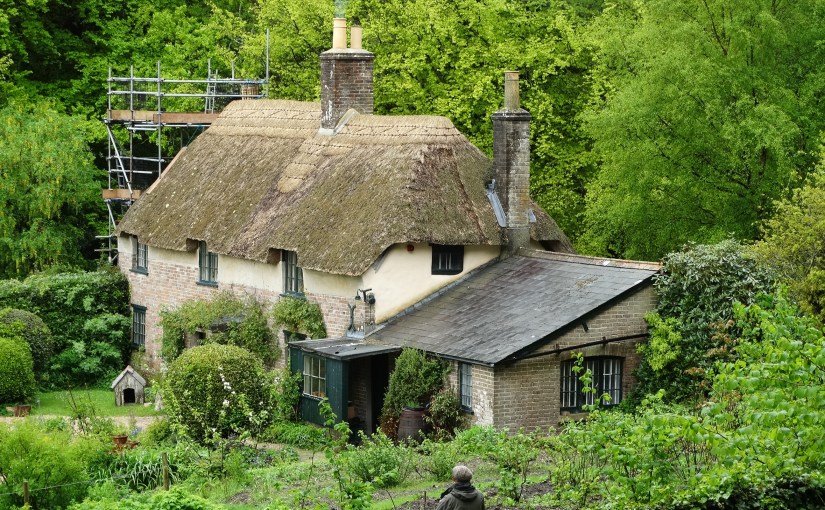
One of his mates was Thomas Hardy author of many books and poems notably “Far from the Madding Crowd”. Hardy was born in a cottage built by his great grandfather on land loaned to him by his master and there the family stayed until the Hardy’s were no more. It is a simple house and was acquired by his sister Kate who donated it and Max Gate to the National Trust. Recently the trust has incorporated a new visitors centre and woodland walk to the house.

Hardy qualified as an architect and worked in that profession until he could become a full time author. He designed Max Gate just outside Dorcester and also designed three extensions. Here he wrote most of his books and poems and his first wife Emma died. He then married his secretary Florence 39 years younger than him but he was preoccupied with the death of Emma for most of his second marriage until he died in 1928. When Florence died twelve years later Kate bought Max Gate at auction and along with the Hardy’s home gifted both to the trust.

The rain had largely stopped and the sun made a tentative appearance. So we headed for the coast and Durdle Door. On arriving it was quite cold with the wind off the English Channel. Kerry made the lunch whilst I made the tea and we sat in the car out of the cold to eat lunch. Following lunch we changed shoes to walk the trek to Durdle Door. Although only 15 minutes walk it is down a very steep and well trodden path which today was very muddy with the rain, covered in puddles and the churned up chalky soil from the traffic of human feet. Stunning coast line. Chalky cliffs lookout to the sea and the more solid stone of Durdle Door braces against the buffering sea. The stumps of a fallen coastline surface above the waves to remind us of the past. As we stood dreaming looking at this coast, I noticed a squall moving from Weymouth towards us so we hightailed it up the hill back to the car. The steepness of the hill meant that we were caught and not only did we drag mud back to the car but we had very damp jackets to dry out.

We then moved on to Lulworth Castle. I had noticed signs about this place and as it was nearby we decided to investigate. Unfortunately time was against us and the castle had closed by the time we drove in the gate. As though knowing that we were turning for home the rain stopped. So we had one more shot at visiting another site – Jordan Hill Roman Temple. We punched in the site into Tommy and headed in the direction of home. The site turned out to be within 5 minutes of our B&B at Weymouth. Not much to look at and as usual with Roman ruins in a curious spot between houses.

Another big day comes to an end.

← Back

Thank you for your response. ✨