The Retirees go Abroad – Dorchester, Piddlehinton, Puddletown, Corfe, Corfe Castle and Kingston Lacey

It’s Wednesday, another sparkling day and its market day in Dorchester. After breakfast we bundle into the car and travel the few miles to Dorchester and its markets. Disappointing in that it is more flea market and very little else. Not to worry we stroll the mall in Dorchester.  The author and poet Thomas Hardy based the fictional town of Casterbridge on Dorchester, and his novel The Mayor of Casterbridge is set there.  So is the book Far from the Madding Crowd.

Hardy’s childhood home is to the east of the town, and his town house, Max Gate, is owned by the National Trust and open to the public. Hardy is buried in Westminster Abbey, but his heart was removed and buried in Stinsford one mile east of Dorchester.

As we walked around the town we found in one alley a historic plaque claiming that Hardy was born in that very lane and another plaque claimed the building was the house on which Hardy based the Mayor’s house in Casterbridge. We also found the museum, Judge Jeffries coffee shop and an old arcade claiming by inscription on it facade to be built in 1661.

I was fascinated by some of the town names in the surrounding area and it was all because of a river – the River Piddle. Piddlehinton sits on the river and is a few minutes east of Dorchester. The village has one public house called The Thimble, but no shop or post office. It is quite picturesque. Like many of the surrounding villages it takes its name from the river running through it.

Then we went a few miles to the east and came to Puddletown also on the River Piddle but the wise folk of this village had the good sense to change the name from Piddle to Puddle. Many times larger than Piddlehinton, Puddletown was still very quaint and had many thatched roofed houses. We took a walk around the town, took a photo of the River Piddle flowing through it some of the thatched houses and notable buildings. Thomas hardy used Puddletown as the basis for Weatherby in his book Far from the Madding Crowd.

It was lunch time. We had purchased a small loaf of corn bread at the markets in Dorchester and we were looking for somewhere green and out of the wind to make a sandwich and have a cup of tea. Nothing offering in Puddletown we moved onto Corfe Castle, Dorset’s most recognised ruin. We found a spot off the main road between the visitors centre and the castle and beside a field of sheep with their new black lambs. No lamb chops for lunch – a little too close to the bone.

After lunch we walked the quarter mile to the visitors centre only to be told that we had to produce our pass at the castle village. So we walked back to the car then walked the quarter mile to the village and the National Trust office to be told that we had to produce our card at the castle gate. Fortunately the castle gate was only 50 metres away but the castle was atop a hill – a big hill. A little bit of the history of the castle.

Corfe Castle is a fortification standing above the village of the same name on the Isle of Purbeck in the English county of Dorset. Built by William the Conqueror, the castle dates back to the 11th century and commands a gap in the Purbeck Hills on the route between Wareham and Swanage. The first phase was one of the earliest castles in England to be built using stone when the majority were built with earth and timber. Corfe Castle underwent major structural changes in the 12th and 13th centuries.

In 1572, Corfe Castle left the Crown’s control when Elizabeth I sold it to Sir Christopher Hatton. Sir John Bankes bought the castle in 1635, and was the owner during the English Civil War. His wife, Lady Mary Bankes, led the defence of the castle when it was twice besieged by Parliamentarian forces. The first siege, in 1643, was unsuccessful, but by 1645 Corfe was one of the last remaining royalist strongholds in southern England. In March that year Corfe Castle was demolished on Parliament’s orders. Owned by the National Trust, the castle is open to the public. It is protected as a Grade I listed building and a Scheduled Ancient Monument.

What this short extract does not tell you is that the family built a home at Kingston Lacey when the castle was destroyed on a parcel of land that came with the 8,000 acres purchased from Hatton. Included on the land are villages the castle and farms. On the death of the last Bankes to live in the house, he bequeathed it (the whole 8,0000 acres, house, castle, villages and farms) to the National Trust – the single largest bequest received by the Trust. So after a short trip around the village of Corfe, we ventured off to Kingston Lacey.

Kingston Lacey is an ornate manor home set in wonderful gardens which we did not have time to visit. Inside the house is the original furnishings and art work – nothing sold all just given to the Trust. The artwork includes originals by the Venetian painter Tintoretto.

A snapshot of the history  is as follows. Kingston Lacy is a country house and estate near Wimborne Minster, Dorset, England, now owned by the National Trust. From the 17th to the late 20th centuries it was the family seat of the Bankes family, who had previously resided nearby at Corfe Castle until its destruction in the English Civil War after its incumbent owners, Sir John Bankes and Dame Mary joined the side of Charles I. They owned some 8,000 acres (3,200 ha) of the surrounding Dorset countryside and coastline.

We finished with a cup of coffee in the cafe and then after a tiring day made the trip back to Weymouth.

← Back

Thank you for your response. ✨

The Retirees go Abroad – the Swannery, Abbotsbury, Loughwood Meeting House, Lyme Regis and West Bay.

We awoke later this morning – it must have been the walk to Hurst Castle. The sky looked grey again and passers-by were wearing their jackets and scarves. Not a good looking day. But during breakfast the Swiss bloke at the table beside us points to the window of the breakfast room and says “look the sun”. From that point forward the day was beautiful – sunny and clear but the breeze was very fresh. A great day to see the Swannery.

In the 11th century the Swannery was established by Benedictine Monks who built St. Peters monastery at Abbotsbury. They farmed the swans for food until Henry VIII ordered the destruction of the monastery in the 1539. Everything apart from the Swannery, Great Tithe Barn, St Nicholas’s Church and St Catherine’s Chapel was destroyed. It was then purchased by the Strangways family and has remained in their ownership through fifteen generations up to the present day: an estate of some 61 square kilometres (15,000 acres) in Dorset covering Chesil Beach and Abbotsbury is still held by the Ilchester Estate owned by Mrs Charlotte Townshend, the daughter of Viscount Galway, a descendant of the first Countess of Ilchester.

Abbotsbury Swannery is the only managed colony of nesting mute swans in the world. It is situated near the village of Abbotsbury in Dorset, England, 14 kilometres (9 mi) west of Weymouth on a 1-hectare (2-acre) site around the Fleet lagoon protected from the weather of Lyme Bay by Chesil Beach. The colony can number over 600 swans with around 150 pairs.

On our visit the nesting had commenced and in some cases the goslings had hatched. We walked the entire park and the birds were nesting everywhere and allowing us very close in some cases to stand right beside the nest. As there are so many birds in close proximity they have modified their behaviour to allow for nesting. As you would expect there are other water fowl like ducks and moor hens but there are also some feral species like Australian black swans and Canadian geese. A fascinating park well worth the visit.

From there we moved onto Abbotsbury described to us as a quaint Dorset village and that it is. There are some remnants of the monastery but St Nicholas’s church and the Great Tithe Barn were the most obvious. High on a hill beside the village is St Catherine’s chapel but a considerable distance away and no car access. We had lunch at the tea house and chatted with a young English bike rider just returned from the Chapel. After lunch we moved onto Lougwood Meeting House outside of Exeter.

Loughwood Meeting House is a historic Baptist chapel, 1 mile (1.6 km) south of the village of Dalwood, Devon in England.[1] There was a meeting house on this site in 1653, although the current building may date from the late 17th century or early 18th century. It is one of the earliest surviving Baptist meeting houses. Since 1969 it has been owned by the National Trust. English Heritage have designated it a Grade II listed building.

The meeting house was founded by the Baptists of Kilmington, Devon, a village 1 mile (1.6 km) away to the southeast. Prior to the Act of Toleration 1689, the meeting house was illegal, but its location made it suitable as a refuge. It was built into a hillside, at that time surrounded by woodland and accessible only by narrow paths. Furthermore, it lay within a detached outlier of the county of Dorset, as the parish of Dalwood belonged to Dorset until 1842.

The building is of stone rubble with buttresses and a thatched roof. The interior dates from the mid 18th century to early 19th century, with a raised pulpit, box pews and a baptismal pool. There is also a musicians’ gallery, built over retiring rooms.

After Loughwood we went back toward Weymouth stopping in at Lyme Regis and West Bay where we had fish and chips by the boat harbour. Lyme Regis is a coastal town in West Dorset, England, situated 25 miles (40 km) west of Dorchester. The town lies in Lyme Bay, on the English Channel coast at the Dorset–Devon border. It is nicknamed “The Pearl of Dorset.” The town is noted for the fossils found in the cliffs and beaches, which are part of the Heritage Coast—known commercially as the Jurassic Coast—a World Heritage Site.

West Bay, also known as Bridport Harbour, is a small harbour settlement and resort on the English Channel coast in Dorset, England, sited at the mouth of the River Brit approximately 1.5 miles (2.4 km) south of Bridport. The area is also part of the Jurassic Coast.

← Back

Thank you for your response. ✨


The Retirees go Abroad – New Forest Hampshire

We have decided to go to the New Forest after seeing an episode of Location Location on TV. Created by William the Conquerer in the 11th century and called the New Forest it is not really that new. We were taken in by the fact that people are required to live in harmony with herds of undomesticated horses donkeys and cattle.

As usual the day is not looking to flash. Grey skies and cool breezes are the order of the day. It takes about one and a half hours to drive to Lyndhurst the largest settlement in the New Forest. We went to the information centre grabbed all the leaflets we could and went off to develop our plan. First of all we took a walk through the village and although it appeared charming when boiled down it was mostly coffee shops and a Ferrari and /Maserati dealership. Oh there is a notable grave in the church yard. Alice Liddel is buried there. Alice was the inspiration for Alice in Wonderland.

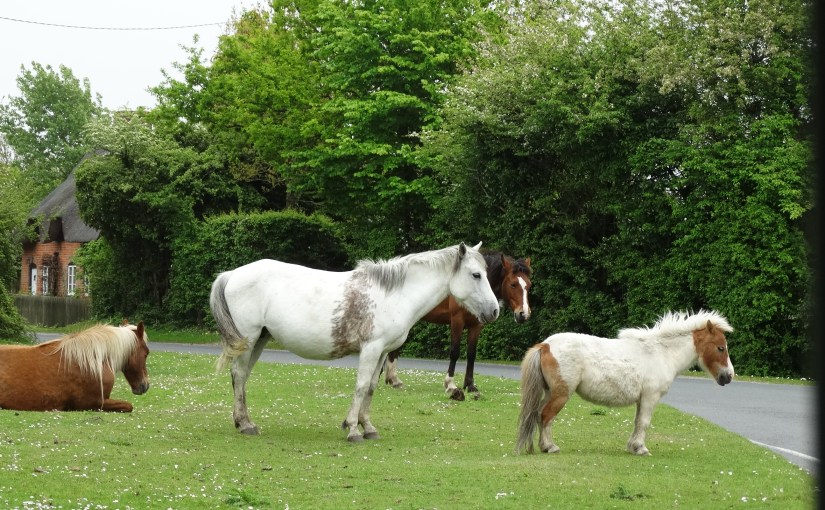
Our plan was to drive to Beaulieu then to another small village which was formerly a smugglers den then onto to Lymington and finish the day in Poole. We set off for Beaulieu hoping to catch a glimpse of the roaming horses, donkeys and cattle. We weren’t disappointed and Kerry even befriended one. Even in Beaulieu the animals had the run of the street. Again the village appeared old and quaint but was largely designed for tourism. Even worse still was Buckler’s Hard. If it was a village then it has been taken over by commercial interests as we could not enter the village without paying an entrance fee.

Next stop Lymington but somehow we got distracted and ended up in Keyhaven looking for Hurst Castle the last prison for Charles I. The castle was built by Henry VIII as part of his coastal defences in the late 16th century. Built for the age of gunpowder it is a low profile with a central keep and external walls in the shape of a clover with defensive towers on four sides. The castle was extended in both WW1 and WW2 and used in both conflicts.

It stands at the end of a remarkable peninsular of pebbles (another tombolo). It is one and a half miles from the carpark and if you miss the ferry (as we did) you can add another half a mile for the trip from the ferry terminal to the foot of the pebble sea wall. Well we walked the sea wall whilst the wind blew and the sky was blanked out by the sea mist. In fact we could not see the castle for most of our journey. The pebbles were hard work to walk on but we both enjoyed the exercise. We missed the ferry at 2.20pm and managed to walk to the castle in time to see the 3.00pm ferry departing.

Inside the castle there are two distinct parts – the Tudor castle and the modern extension. Large Georgian canon stand alongside modern Bofors guns. There is a display on the lighthouse nearby and wartime memorabilia. One of the most remarkable things is the memorial to all people who served in the castle between 1544 and 1955. We caught the boat back to the ferry terminal and picked up the car.

.

We then drove to Poole which did not excite us at all so we headed for home and dinner at Westers Bar.

← Back

Thank you for your response. ✨

The Retirees go Abroad – Holiday in Dorset

We have planned a quick trip to Dorset, a county on the southern coast of England overlooking the English Channel and the Isle of Wight. It is only 4 hours south of Nottingham but we were determined to get there early enough to make use of part of the day. So we packed the night before awoke at 6.00am, had breakfast made lunch packed the esky and out the door by 8.15am. The weather had been unpredictable and we were hoping the forecast rain would pass through before we arrived in Weymouth.

The day started out clear and cool but by the time we had travelled down the M1 to the M42 clouds had started to gather and our fine day was gone. By the time we got to Weymouth the rain was a fine mist and the wind off the channel was very chilly. As luck would have it we parked on the esplanade outside of a penny arcade. Now Kerry loves Penny Arcades and the tipping point games that are a part of the history of these arcades in the UK. So we spent 2 hours and £10 ( in 2p coins) playing the machines.

We stayed at Harlequin B&B. After unpacking and meeting our landlord, we took a drive to Portland. It is an island off Weymouth (now joined by a bridge) but it is so different to the mainland. The tombolo (an elongated stretch of land joining the island to the mainland) is made of pebbles washed into a steep hill formation and is quite surprising to see. The island must be predominantly made of Chalky rock. All of the shores have steep cliff formations except on the leeward side where a deep harbour has been formed.

As we drove onto the island the sun came out as though the rain had never been. We noticed what appeared to be ruins on the plateau behind the main residential and business settlement so we drove up to the viewing park – and what a view. We could look over the tombolo to the mainland view the residential settlements below us, see the mainland and the chalk cliffs that line part of the shore. At this look out there is a WW1 memorial and a 2012 Olympics memorial. In the photos you will see behind the WW1 memorial in the distance the thin line of rock wall is a former prison built into the hill.

We continued our drive on the island toward Portland Bill the lighthouse on the southern tip overlooking the English Channel. On the way there we stopped to admire some more of the cliffs that are so prominent on the island. In the distance we could always see merchant ships plying the channel. We moved on to Easton and down to the lighthouse which has appeared in Kerry’s facebook posts. Here I was able to capture the ruggedness of the coast and picture the Pulpit – an outcrop of rock looking like a pulpit surrounded by sea.

Day 1 ended with a walk along the esplanade looking for something open on a Sunday night to serve dinner. We got to walk the commercial district of Weymouth before settling for a Wetherspoon’s pub and some basic grub. The grey skies had returned so I was unable to get some photos.

← Back

Thank you for your response. ✨

The Retirees go Abroad – Newark and the Civil War Centre

Newark is north east of Nottingham and during the Civil War (1642 -1646) was a Royalist stronghold surrounded by Parliamentary strongholds in Nottingham, Lincoln, and Hull. The New Model Army besieged Newark on three occasions during the Civil War and it was ultimately captured because Charles I surrendered and ordered the garrison at Newark to surrender. Therefore Newark more than any other city can claim the right to be the National Civil War Centre.

The centre opened on May 2nd and we visited a few days later. It is in a very early stage of development and the displays do not cover the civil war period but rather Newark during that period and how Prince Rupert brought the plague to Newark when relieving the city from Parliaments siege. It also had displays on the effects of civil wars in the 20th century. In my opinion it is not yet the centre for civil war history but it has made a good start.

After visiting the centre we walked through the old town, visiting the cathedral and looking at some of the Tudor heritage preserved in the buildings in the city. One of the oldest buildings now houses a business called “Charles I Coffee Shop”

During a visit to the High St in Long Eaton we found a book on Canal and River Walks in Nottinghamshire and one of those walks was along the River Trent in Newark. We moved the car so that we could take that walk and visit the castle. As soon as we saw the ruins of the castle both of us recognised that we had been to that park some time ago in summer. So we had lunch and then walked along the banks up to the locks and along the heritage trail.

After our walk we decided we would go back to Nottingham through Southwell. As we drove through the villages we came upon Kelham. This is where the Scots held Charles after he approached them to change sides. Kelham House still exists today but it is now used as Council offices. After the family who built the house sold it to pay debts it became a monastery and then it was purchased by the Council. The monks added a domed extension for their prayers and now this chamber is the council chamber. The council also added an extension for all of its administration staff. When we visited the staff were counting votes in the recent election in which we voted. Now the council is selling the property to a hotel chain and the council will move into purpose built premises.

DSC03974

After Kelham we made it to Southwell and the Admiral Rodney Hotel. It had been threatening rain all day and now it was pouring so time to have an afternoon tipple and wait for the shower to finish before going home at the end of a long day.

← Back

Thank you for your response. ✨

The Retirees go Abroad – Derbyshire and Elvaston Castle Country Park

We have driven the A52 to Derby so many times now that I have lost count. Each time we would pass the turn off to Elvaston Castle Country Park and think nothing of it. Then one day whilst attending the church working bee, Michelle informed us that this country park was definitely worth a visit, that apart from the park there was a ruin of a castle and some pleasant walks, colourful gardens and surprising topiary.

Monday was a bank holiday (May Day apparently but it is just referred to as a bank holiday). The weather was a perfect English spring day. Sunshine filled the sky and a gentle breeze kept a coolness in the air. It smelt fresh and clean. A perfect day for a visit to a country park.

We took the familiar journey down the A52 and turned off into the village of Borrowwash down a country lane and arriving at the carpark for the park about 9.00am. There were quite a few vehicles there already but plenty of car spaces. We parked paid the ranger for our 4 hours parking and strolled off with the intention that we would come back to the car to collect our picnic. The park is a delightful mix of woodland with shady walks, gardens with a feast of colour and scents, and a surprising topiary garden of privet and holly.

Our visit included a walk through the English Garden with its beautiful blooms

The topiary garden with its wonderful shapes and hiding places for the kids

The Home and courtyard, the Church and the Water Wheel a bit of a mystery

The garden walk around the lake with some magnificent trees

We finished with a picnic overlooking one of the open grass areas. The carpark was now full with cars circling looking for a space and the grounds were alive with people all enjoying the sun and the fresh air.

A bit of history and the future about the Castle:

Wikipedia reports “Elvaston Castle is a stately home in Elvaston, Derbyshire, England. The Gothic Revival castle and surrounding parkland is run and owned by Derbyshire County Council as a country park known as, Elvaston Castle Country Park. The country park has 200 acres (0.81 km2) of woodlands, parkland and formal gardens.

The centrepiece of the estate is the Grade II* Listed Elvaston Castle. The castle has been neglected and has fallen into disrepair; due to its condition, the building is not open to the public, and since 2008 has been listed on the Buildings at Risk Register.”

However something is happening as when we visited there is scaffolding all around the stately home and limited access to the hall on particular days is now organised by the council. Highgate Sanctuary is a developer and its website tells us that “Working with English Heritage and the County and District planning and conservation officers, Highgate Sanctuary is preparing a planning application under which the Castle and its immediate buildings will be thoughtfully restored to their original grandeur, providing a hotel with spa and leisure facilities.”

Hopefully the open spaces and gardens will still be available for public use in the future.

The Retirees go Aboard – The Workhouse Southwell and Rufford Mill

It was a pleasant Friday morning and we planned to visit Rufford Mill for a high tea. There was a special advertised in Amazon Local and it sounded interesting but to travel to Rufford Abbey some 50 minutes’ drive away for no other purpose than to have afternoon tea seemed extravagant. I pulled out the National Trust Guide and settled upon “the Workhouse” at Southwell. Generally in the same direction, the Workhouse had been one of the closed sites that we had wanted to visit. So two birds, one stone.

The morning started with sunshine but as with so many days in the UK, this is deceiving. The breeze was lightly chilling our cheeks as we walked to the car. Both of us had decided that scarves were necessary to keep the chill off our chests. The drive up to Southwell took about 50 minutes and we arrived at opening time of 12 noon. Already the carpark was occupied by dozen or more cars and a bus. From the carpark there is a long walk to the Workhouse past a field then the gardens then some walled areas which we later learnt were the exercise yards for the residents an d finally into the reception shop and tea room.

We both had an idea that this was a place of brutality and Dickensian forced labour camps, with orphaned children being sacrificed to industry as in Oliver, but we were wrong. This was a social experiment that commenced in 1824 and surprisingly continued right up to 1989. In some sense it was a catalyst for the “welfare state” introduced in the ‘40s by the labour governments after WW2.

The building has under gone many changes in its short history and its fundamental purpose changed as society changed but for the purpose of presenting the building and its history the Trust has in some respects taken the building back to 1824. For instance they have stripped out the toilets that had been installed.

The history starts in 1601 with the Poor Act which made parishes responsible for the paupers, elderly, infirm and orphaned. Each parish handled the administration with a board of governors and raised funds for the poor through taxes. Rev J T Becher proposed a revolutionary idea of centralising those in need of help in the form of the Workhouse and banded together 60 parishes to fund the building of the first Workhouse at Southwell.

The building is three stories high, has a central administration and accommodation tower for the Master and Matron and three wings one on the left for abled bodied women, and old and infirm women, the one on the right for able bodied men and old and infirm men and the children’s wing which included orphans. Other facilities such as the wash house were in buildings surrounding the main building. In front of the adult wings were the walled exercise yards with a community latrine open to the sky and beyond that were the gardens and orchard. There was a classroom for the children but it is uncertain as to whether any play areas were provided for the children.

The Master and Matron were usually a married couple and their living quarters in the central tower had indoor flushing toilets and were quite comfortable. Also in the central administration block was the governors meeting room, the Masters office and the clerk’s office. This arrangement allowed the Master to access any area quickly and keep control.

The intent of the programme was to reduce the cost of aiding and caring for the poor, elderly, infirm, and orphaned on the parish, to encourage the able bodied, idle and indolent to return to work by working them at monotonous and physically demanding chores and to make them self – sufficient. The programme was a success on the financial level and by Act of Parliament the New Poor Law saw this model replicated 500 times across the UK.

The system was in the case of an able bodied family – they were stripped of their clothes which were washed and stored securely, they were washed and de-loused and issued the workhouse uniform, segregated into men, women and children and put to work. The aged and infirm were also segregated and often lived the rest of their lives in the institution and the children would be taught to read and write and then some vocation. The idea was that the abled bodied would want to return to the community because the life for them was uncomfortable and demanding and for the children to equip them to join the community. This workhouse had up to 160 inmates completely segregated with no contact whatsoever between the various groups. Often this lead to children being abandoned in the workhouse by their parents.

In relation to the aged and infirm the system continued up til 1989. One of the National Trust guides told us that as a 65 year old in the late ‘80s he could recall visiting “some of the old girls” at the work house and they tended to be gaga. I have posted some photos below. Unfortunately I did not think to photograph one of the third floor rooms which have been left as they found them in 1990. Seriously depressing. The presentation of the rooms as they were in 1824 is misleading in my view as I doubt they were painted in light colours and as clean as they are today.

To sum up, not the Dickensian workhouse that I had expected or been lead to believe was the norm by novels such as Oliver and Dark House but still a dark social experiment in many ways. Well I am pleased to say the high tea was a lot more comfortable than the workhouse. Starting with a glass of sparkling wine and finishing with the same, we stuffed ourselves on finger sandwiches, scones, and cakes before returning home. Rufford Mill was just that an old water powered mill, originally for grinding corn but finishing life as a timber mill. The lake which provides the water to drive the waterwheel is now a haven for bird life and one can walk around the lake to the old ruined Abbey and the Rufford Country Park and golf links.

← Back

Thank you for your response. ✨

The Retirees go Abroad – Rotary Club of Nottingham – Children of Courage Awards

.Whilst we have been visiting the UK we have attended Rotary club meetings where ever we can. Being based in Long Eaton we have been visiting the Rotary Club of Nottingham principally and this is one of their projects we attended.

The club has sought to recognise the courage of children (in many forms) in the community. Through schools and churches, the Club sought nominations to recognise these children. The nominations included disabled children and how they cope with their disability, children who have lost a sibling and how they coped with that loss, through to children with a disabled parent and how they cope bearing some of the burden of caring for that parent.

The awards were decided by the Club and presented at a lunch held at Nottingham Park Inn in Mansfield Rd last Thursday. We sat at a table with Edward Hardcastle aged 5 – 6. Edward was born with a genetic disorder which affects sight mainly but can also affect hearing. He now has only 10% vision but despite this he appears happy and communicative. One of the other persons at our table sought to engage with him and he readily responded without any concern that he can only see shadows images.

Most of the children receiving awards were similar to Edward in that they have a significant disability and yet do not make the disability an excuse. One young girl has the responsibility of caring for her disabled mother and wrote a most endearing poem about having to care for her which the club President read to the audience. The children seemed to appreciate the attention given to them as reward recipients and enjoyed their lunch. Photos of the awards, the Club President, the Mayor of Nottingham City and the children follow.


← Back

Thank you for your response. ✨

The Retirees go Abroad – Des Hortillonnages

We had learned for the Office de Tourisme that it is possible to visit the floating gardens called “Des Hortillonnages” in electric powered boats in the shape of the traditional “horn boat” of the “hortillons” which take visitors through the channels for about 45 minutes. You can also kayak or walk on some towpaths.

Known as Des Hortillonnages, the floating gardens of Amiens is a space of 300 hectares of former marshes located east of Amiens, drained and channelled (probably in the Gallo-Roman times) to create usable fields for cultivation vegetables. The floating gardens have been cultivated for about 2,000 years. Today, due to urban sprawl, there are only 300 hectares of the original 10,000 hectares. A thousand people lived on floating gardens of vegetable growing.

This activity has been in decline since the 1950s and was at risk of being lost when in 1974, the construction of a ring road through the site threatened the floating gardens. In 1975, the Association for the protection and preservation of the floating gardens (Association pour la Protection et la Sauvegarde du Site de L’Environnment des Hortillonnages – APSSEH) was created. The association now works for its preservation (clearing and bank stabilization). It also has maintained the “Water market” at Place Parmentier at the foot of the cathedral and has organized since 1982 boat tours of the site for the general public.

Most of the floating gardens have been transformed into ornamental gardens but in recent years, there has been a gardening revival with two organic farming market projects; the Garden Virtuous (ecological and educational landscape garden) and the Moon Hortillon (Jean Louis Christen, producer maraicher),and others are in the pipeline.

The channels are fed by the waters of the Somme and its tributary the Avre. The floating gardens are composed of a multitude of alluvial islands, surrounded by 65 kilometers of waterways called “rieux” in Picard and ditches that serve as drainage and the irrigation. The traditional horn boats once used by hortillons are on the decrease.

So we walked over to the office of APSSEH and tried to buy a ticket. “Non” said a rather rough looking chap behind the desk. We had to wait til 13.30 to buy tickets. We wandered off to get some lunch and return at 13.30. On returning there were people milling around uncertain of what to do with the office door locked – for lunch of course. These were French people who obviously could not read the sign in French which we had mistakenly read as Purchase tickets before 13.30. So we lingered at the gate until a pleasant plump French woman came to the gate and let us in and all the French followed.

Having purchased the ticket we waited at the quay until the horn boat was ready. We climbed in and the voyage commenced. For a moment we thought some part of the journey would include an English commentary. The “gondolier” asked if we spoke English. Then he said “keep your hands inside the boat”. That was it for the English commentary.

Even though we could not understand the commentary, it was a pleasant cruise which at sometimes was quite cool. We passed a fisherman trying his hand, sailed up shady canals passed “weekenders” and some ploughed fields, a boat which although out of service was still useful as a pot plant, a local doing a bit of gardening (note the radishes), some scarecrows and some recent residents of the channels.

After the tour we strolled back to the apartment via the Spa store and picked up some supplies to help us drink that bottle of Bordeaux. After catching up on our sleep we farewelled Amiens, Henri and Isobel early in the morning to catch the 12.30 ferry from Calais.

← Back

Thank you for your response. ✨

The Retirees go Abroad – ANZAC Day Dawn service and Villiers Bretonneux

We did not get back to Des Hortillonnges on Friday; I napped too long apparently. We did go back to the Mall but the promised rain seemed imminent as the weather closed in. Dark clouds and sprinkles of rain chased us all the way back to the apartment.

We set the alarm for 02.00am. I slept like a log and Kerry nervously awaited the alarm. At the appointed hour we dressed packed our backpack and headed for the train station. We were not alone. People were gathering from all directions and not just Australians. However the guides were not so anxious and they did not arrive til 03.00am and the buses (17 of them) until 03.15am. This caused many to wander aimlessly checking and double checking that they would not miss the bus.

Suddenly, Tour Perrett was illuminated with the Australian flag and then followed the guides and then the buses in no particular order. Our tickets allocated the bus we were to catch. Some were the “short tour” – just the dawn service and others like our bus number 5 were for the “long tour” – the dawn service and the French service at the memorial at Villiers Bretonneux. Boarding the bus we were issued with badges to identify our tour and bus number and lapel badges to commemorate the occasion.

DSC03797

The bus took about 20 minutes to travel to the Australian War Memorial and about 20 minutes to navigate the traffic to drop us at the memorial. There were thousands of people, some walking but most arriving by bus. As we alighted fine rain started to fall and a strong breeze blew it into our faces. We walked through the entry into the cemetery. Grave stones decorated with flags of the nationality of the soldier where known stood to attention to our left and right. Australian, New Zealand, British, French, Indian and South African flags identified the nations recognised at the memorial.

There is limited seating so we made our way quickly to get a good position from which to witness the ceremony. Darkness splintered by the camera lights for the broadcast and the official ceremony spread all around so everything seemed somewhat eerie with shadows crossing the graveyard and the monument continuously. We found suitable seats and then the rain started to fall in earnest. We had brought our “Bayeaux Tapestry” ponchos and umbrella. We were confident we would stay dry. Many were not prepared and someone made a lot of money selling clear plastic rain hoods. The military personnel carried on with protection and despite the rain.

We were seated by 04.00am. However the service could not start til the Gallipoli service had finished. In between there were songs, music, a photographic tribute projected onto the tower of the memorial and rain.

With the dawn members of the Federation Guard formed the Catafalque Party to commence the service. The Australian Ambassador to France welcomed everyone and the Chief of Navy Vice Admiral Tim Barrett presented the Call to Remembrance. Monsignor Stuart Hall Principal Chaplin for the RAN performed the Prayer for Remembrance and the Prayer for Peace. Kevin Andrews Minister for Defence delivered the Commemorative Address and Madame Pascale Boistard Secretary of State for Women’s Rights delivered the Commemorative Address for the French nation. This was followed by a reading then the official wreath laying, the Ode of Remembrance the piper, the Last Post, a Minutes Silence and Reveille. The service ended with the national anthems for Australia and France a final blessing from Monsignor Hall and the Catafalque Party dismounts. And still it rained.

DSC03825

The solemnity of the occasion was somewhat destroyed by the rush to the buses that followed. Our rain coats and umbrellas had been partly successful and everyone had the same paranoia about missing the bus back to Villiers Bretonneux, so everyone hurried past the graves to board their bus with some mayhem ensuing. And still it rained.

The drive to the village took less than 10 minutes. So by 07.30am we found ourselves dropped off in an unfamiliar place with vague directions as to where to find the village square and the French Memorial. But it had stopped raining and the glow of the morning illuminated our path to the village. A short stroll through a wooded park brought us to the Marie (the village town hall and Mayor’s office), the village square and the “commercial centre” of the village.

The rush was on for toilets and a warm beverage. We found a less popular café and comfortably fulfilled our requirements before strolling around to the village, the village church, the bakery, the museum and the school. The French service commenced at 09.00am followed by a concert. We attended the service along with the same dignitaries who had attended the Australian service but we were unable to attend the concert. The village hall was filled to overflowing. So we returned to the bakery and the courtyard at the rear until our bus returned at 10.30am.

We returned to Amiens by 11.00am. The stroll back to our apartment seemed a little harder now but after some lunch at the apartment and a rest we were off to Des Hortillonages.

← Back

Thank you for your response. ✨