The Retirees go Abroad – Exploring Amiens France

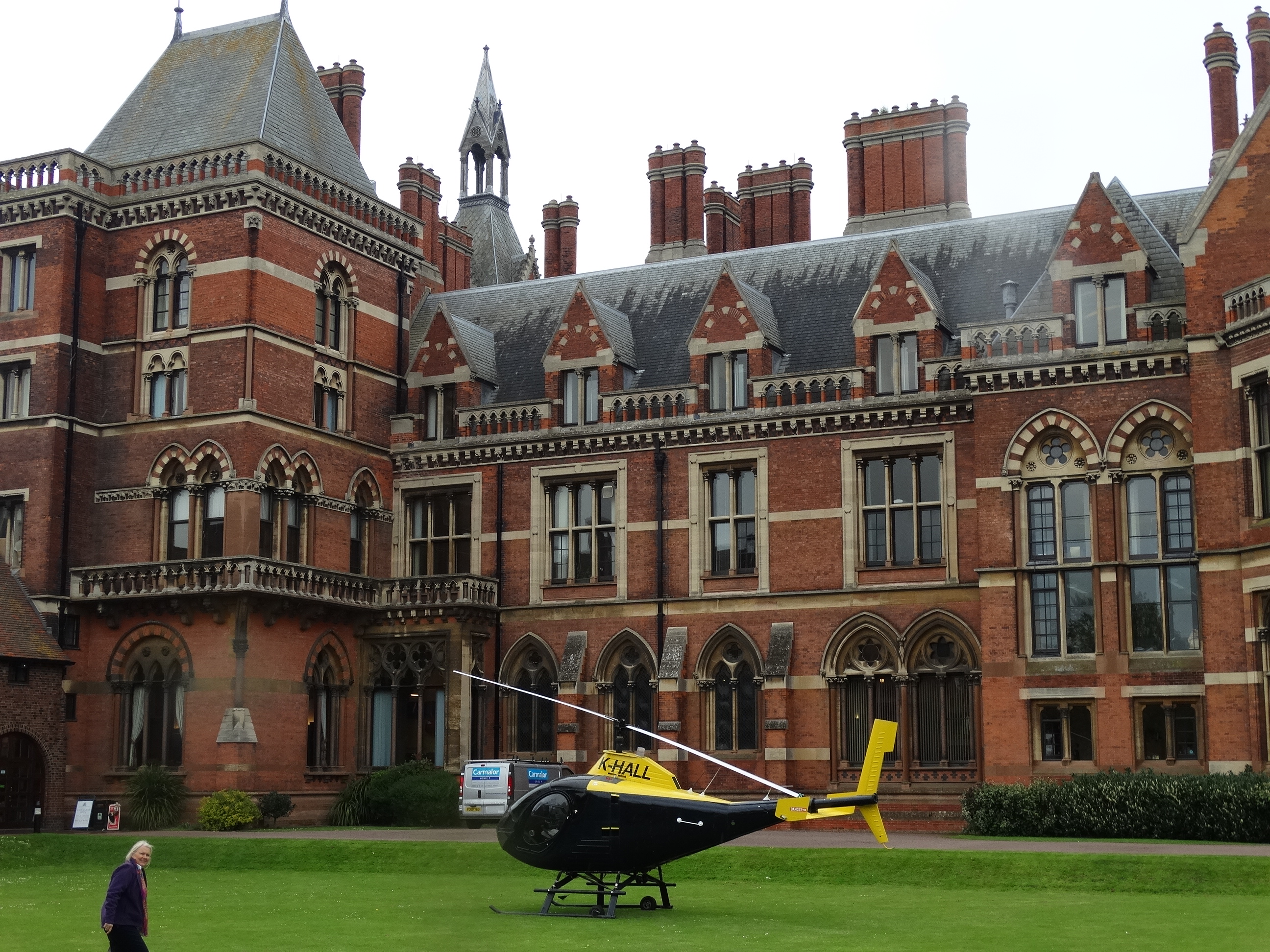
We had arrived in Amiens the previous day and now we are exploring the old city. It is always a good idea to check out the Tourism information available for the city and its surrounds. We had located the train station from which our bus to the Australian War Memorial would depart at 03.15am tomorrow so we did not plan to exert ourselves too much. After finding the train station we obtained a map of the city and located the Office de Tourisme near the Cathedral Notre Dame.

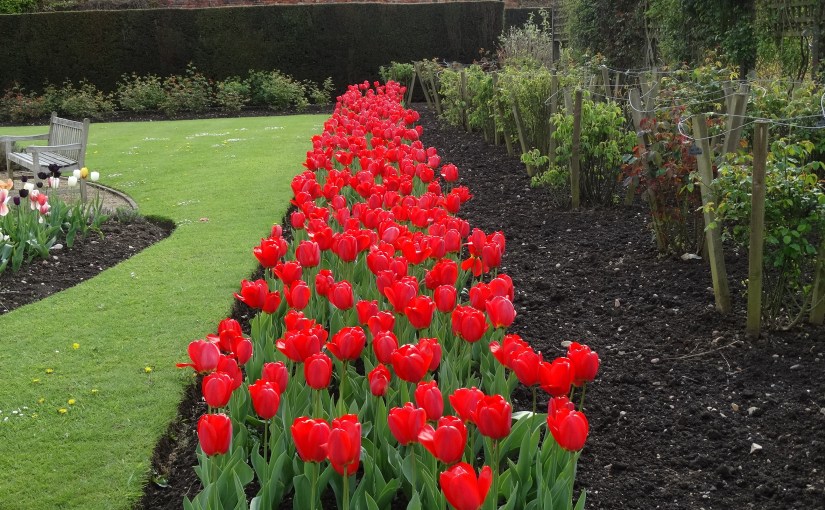
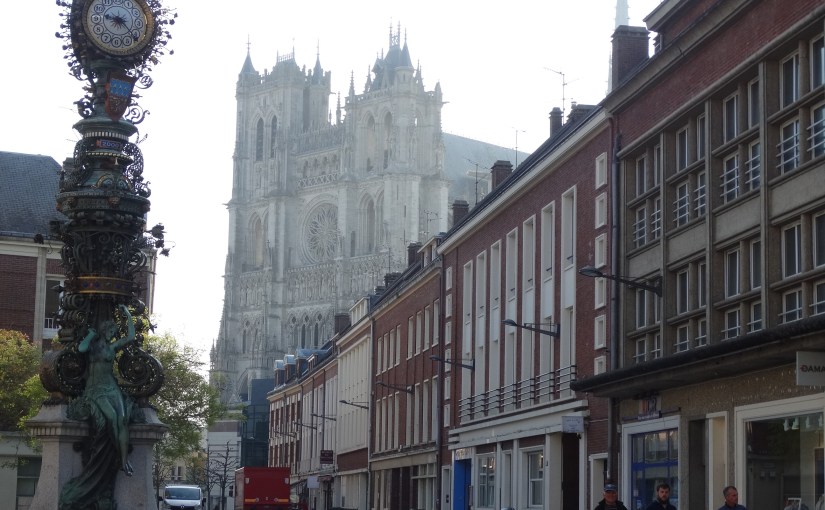
Once in the Office de Tourisme, we learned that we could take a self-guided walk through the old city. Armed with the map and brochure, we set off. The first stop was the Cathedral in the Notre Dame quarter. Behind the cathedral we found the Bishops gardens. Sedate, green and colourful it was a pleasant change to the noise of the city. From the garden we passed into the lower town and entering the Saint – Leu quarter and Rue du Hocquet. This is where one will find the oldest houses of Amiens sited on the bank of the canal. Originally they were designed with a shop or merchants stand on the road level with living quarters above. Many had been restored but others were not even fit or safe for the pigeons. Some even needed bridges across the canal to their front doors.

Our journey followed the canals past the Church of Saint Leu and the Universite de Picardie Jules Verne. Amiens reminded us of Venice in some ways. This had also been a centre of industry with 25 watermills operating grinding wheat and woad leaf and other industries. We passed a number of different building styles but one building caught our eyes – this building had no right to be standing. A little further along we came to the Place Aristide- Briand where the typical building style of weatherboard at the ground floor and a first story in cob (a mixture of straw and clay pasted over slated timber then plastered. We also saw some of the residents of the canal.

From there we entered Rue Motte and its myriad of smaller streets echoing the trades of the past – rue des Arches (archers), rue des Clarions (bugles), passage des coches (horse drawn carriages). We were now close to the finish of our tour and we found ourselves in Rue Belu and near our apartment. Rue Belu is also known as Quai Belu but its former name had far more charm – Rue de la Queue de Vache (Cow Tail St.) as it was here that animals were brought to drink from a public trough. The drinking trough for animals is gone and replaced with human troughs – Restaurants.

So we returned to the Apartment to rest as we would be arising at 02.00am the next morning to travel to the dawn service. On the way we passed Pont du Cange the oldest bridge in Amiens still showing signs of the old fortifications that once protected the city and the Water Market where the “hortillons” (marsh vegetable farmers) brought their goods via the canals to the market. A market continues to operate on the site every Saturday. We planned to visit des Hortillonnages but after our rest.


The Retirees go Abroad – Amiens Picardy France

We were met by our hosts Henri and Isobel who invited us to join them for a glass of wine after settling in. We made a quick trip to the ATM for some cash and the Spar for a bottle of wine. In less than 5 minutes we were in sight of the grand Notre Dame Cathedral of Amiens, the restaurants of Rue Belu, the statue in the middle of the canal which some one dressed in a different coloured shirt each day and the water markets.

Armed with some cash and a bottle of Bordeaux we joined Henri and Isobel for sparkling wine aperitifs. Very civilised. Henri had adequate English and tried very hard to hold a conversation with us. Kerry made a friend in their Jack Russell terrier “Toupee” which jumped from Isobel’s lap to Kerry’s lap with excitement. It had been a long day so we farewelled our hosts, ate our chicken salad and retired to bed to explore Amiens tomorrow.

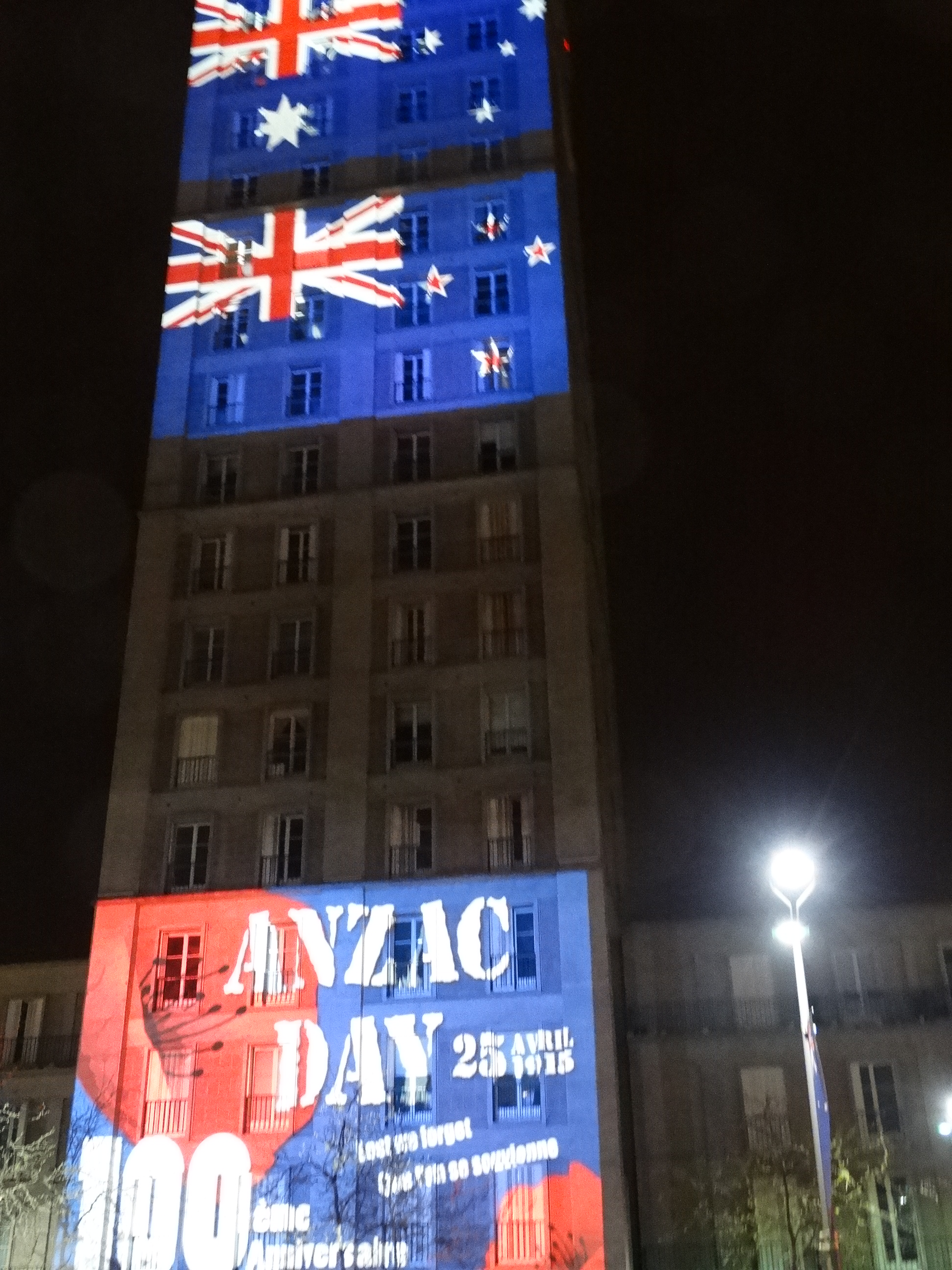
The next day good weather continued although Henri had informed us the forecast was for rain. After breakfast we set off early to see where we would catch our bus to the Australian War memorial for the dawn service. The bus departed at 03.15am so it was going to be an early start. Crossing the River Somme we made our way to Boulevard D’Alsace Lorraine which was lined with Australian flags all the way to the train station and the highest modern building in Amiens Tour Perrett. The rail station announced by a large display of WW1 scenes and posters that ANZAC Day was April 25th. We had selected a very centrally located apartment.

Satisfied that we could walk to catch our bus, we then walked down Rue de Noyen (now a Mall) making our way to the Office de Tourisme. In Square St Denis we found the memorial “Aux Picards Martyrs de la Resistance” reminding us that France had been an occupied country during WW2. The square was very pretty and relaxing with spring flowers blooming and the trees covered in new leaves. Someone had smashed a cake on the ground and the pigeons were enjoying morning tea. The Mall continued down Rue Rue des Trois Cailloux. We discovered a small lane through to Jules Verne’s House and Square J du Becquet with views to the Cathedral at one end and to the Palais de Justice on another side of the square.

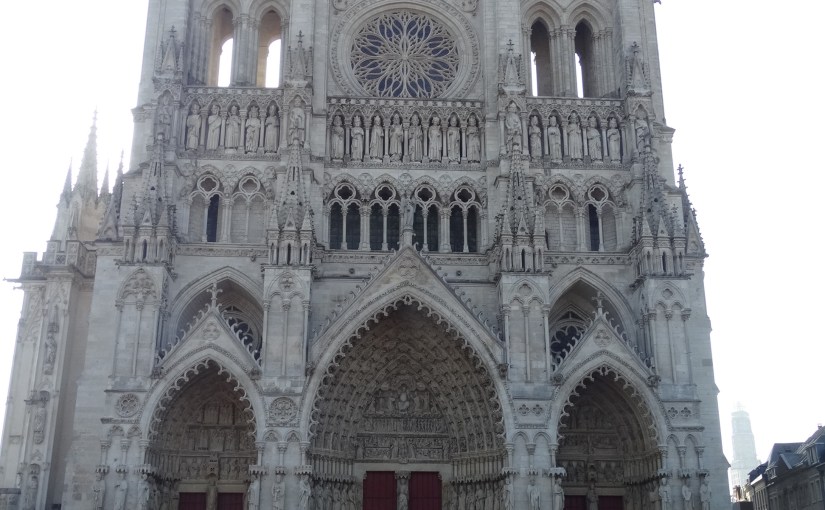
We returned to the Mall and continued the walk down to the Hotel de Ville (Town Hall). The Mall is decorated with fountains and small trees some of which are woven together such that they form a wall of foliage in summer. From Place Gambetta we could see the grand clock through to the Cathedral. We were looking for the Office de Tourisme and the Cathedral was the landmark to find it. We made our way to Place Notre Dame and stood before a gothic cathedral of gigantic proportion. It seemed taller than most we had seen (Henri claimed it to be the tallest in France) but its body seemed truncated. The exterior is being cleaned to remove the grime of the city and the interior was also receiving some attention.

The façade is a decorated with statuary of all kind and the door arches are emblazoned with carvings and grotesques. Inside I can believe that it may be the tallest interior in France. Here lie the graves of many important Amienites and the memorials to the soldiers and countries liberating Amiens. They cannot thank Australia enough for its sacrifices in two world wars.


← Back

Thank you for your response. ✨

The Retirees go Abroad – Travel to Amiens Picardy France

As April 25th approaches, we travel to Amiens as our base to attend the ANZAC Day service at Villiers Bretonneux. Amiens is in Picardy north of Paris and a short drive from the Belgian border. To the west and north of Picardy is the Somme. This was a killing field during W.W.1 and W.W.2 and the people of the region hold special affection for the Australian Imperial Force which held back the German advance in W.W.1.

It is an all day journey to Dover and the cross channel ferry and onto Amiens. We had allowed ourselves over five hours to reach the ferry terminal as we have learned that traffic bottlenecks occur with painful regularity around the Dartford Crossing. The weather blessed our journey. Fine and cool with patches of sea mist from time to time. Traffic was slow up to the turnoff to Birmingham where a majority of the trucks and cars turned off giving us an easy run to Dover.

On this occasion our planning was too conservative and we arrived in Dover ahead of time giving us a chance to look around the port. We drove along the sea front bounded by holiday flats and a new board walk reflecting the white cliffs that are famous in this area. With the sun shining and a gentle but cool breeze blowing we prepared our lunch on the foreshore and enjoyed a break from driving. Dover Castle looked on as we soaked up the vitamin E.

We finished lunch and joined the queue of cars and Lorries (trucks to us) awaiting boarding of the ferry. I had to call in to the kiosk to get our head light defuses as under French law we cannot travel in France without them. A right hand drive car has its headlights set to shine brightest to the left which is straight into the face of the driver of left hand drive cars. Understandable but at £7 a pop every time we go over to France it becomes expensive as you have to pull them off on returning to England.

I had just fitted them when the cars were called to board the ferry. These are very large boats with trucks on two decks and the cars scattered amongst the trucks on deck 5. The fittings are more like a cruise liner so the one and a half hours across the channel seems to fly.

The drive to Amiens was only one and a half hours but with the time change this meant we would arrive around 6.00pm. The weather continued to be fine and the fields of northern France were stunning. I could not reach my camera but I have included some shots I obtained on the return journey but unfortunately it was overcast and showering.

France is in a different time zone to the UK and has daylight saving as well so we had to set our watches an hour ahead. Fortunately this meant that we had the benefit of twilight even though it was past 6.00pm when we arrived in Amiens. It seemed like the middle of the day when we found our apartment. It was on the edge of the old city and a parking space opened up just nearby.

← Back

Thank you for your response. ✨

Retirees Go Abroad – Kedleston Hall Derbyshire

We have been back in the UK for 5 days now and recovered from jet lag but Kerry has caught a cold and is feeling miserable. However this Tuesday morning we awake to bright skies and warmish sun so it is time to break out of our flat and see more of the world.

We have a busy schedule coming up and we have to watch our pennies as pensioners so we pull out the 2015 edition of the National Trust Guide. We settle upon a visit to Kedleston Hall.

The guide says “Designed by the famous architect Robert Adam, the hall was built for Sir Nathaniel Curzon in 1765 as a house to rival Chatsworth. Intended as ‘a temple of the arts’ and as the location for grand entertainments, the main house was never meant to be a family home, but a canvas on which to showcase the finest paintings, sculpture and furniture.” This might be worth a look.

We load up our Thistle and 30 minutes later we arrive at the front gate with its two gatehouses either side of the road leading to the hall. Beside the entrance is the Kedelston Hall Golf Club. A sign inside the gatehouses warns that livestock will be on the road. We drive for almost a kilometre with the fairways of the golf course on our left before the house comes into view. In front of us is a magnificent bridge crossing a river, black angus cattle grazing casually on the banks of the river. To our right a strange building sits on the far bank of the river and we learn this is a ladies fishing lodge so that the fair ladies did not have to get their feet wet whilst fishing, Across the river we see sheep with their lambs skipping around dotting the grassy approach to the hall. And the back drop to this idyllic picture is the hall – you cannot miss it, it is large and grand.

Our guide book had promised “As soon as you arrive at Kedleston Hall you are invited to take a trip back in time to the 1760s, when wealth and power enabled the creation of this magnificent neo-classical mansion and beautiful landscaped park.” We were not disappointed.

On arrival we booked to join the introductory tour and the Conservation tour. The introductory tour was held in the grand hall and we learnt about the history of the family which still resides in the hall today even though the hall is now the property of the National Trust. Kedleston Hall is the seat of the Curzon family whose name originates in Notre-Dame-de-Courson in Normandy. The family helped finance William the Conqueror and received 10,000 acres in Derbyshire as their reward.

Whilst waiting for the tours to commence we visited the family church and the crypts within.

The Curzon family have owned the estate at Kedleston since at least 1297 and have lived in a succession of manor houses near to or on the site of the present Kedleston Hall. The present house was commissioned by Sir Nathaniel Curzon (later 1st Baron Scarsdale) in 1759. The family ended up with two titles, the family title of Viscount Scarsdale and the personal title of Lord Curzon (an Irish title given to by Queen Victoria to a second son of the Curzon family so he could be Viceroy of India in 1898). This is the Lord Curzon I speak about in my blog on Tattersall Castle. (Somewhere different – Lincolnshire)

Our second tour dealt with the difficulty for the National Trust to live up to its motto “Forever, For everyone”. Conservation is a knotty and costly problem full of decisions around conservation or restoration and what is important. For this part of the tour we were taken to some rooms in the top of the house (formerly the guest rooms) which had not been restored and now were used as storerooms via subsidiary stair cases which were never designed for frequent use and therefore are not structurally able to handle more than ten people at a time. The tour started in the hall beneath the grand hall where we witnessed some of the deterioration caused through use (they had five thousand visitors over Easter) and the fact that the hall does not have engineered foundations as would be done today.

Even the grand hall is deteriorating quickly because of the building technique employed. In the former guest rooms we were shown the tools of conservation and the bits and bobs which are stored there for conservation. We even found a doorway in a cupboard through which we reached another set of stairs so frail that only one person at a time could view the staircase.

The guides told us that “Soon after he inherited Kedleston in 1758, Sir Nathaniel Curzon met a young architect called Robert Adam, who had recently returned from three years study in Italy and who shared his enthusiasm for ancient Rome and the principles of classical design. Sir Nathaniel had already demolished his grandfather’s house and, while he was initially commissioned to redesign the parkland, by April 1760 Adam had sole responsibility for the design of the new Hall and its interiors.”

On the ground floor Lord Curzon created the Eastern Museum, displaying objects collected on his travels in Asia and while Viceroy of India (1899-1905).

The West Wing housed the servants’ quarters and kitchens (now the offices and restaurant), while the East Wing remains, as it always was, the private residence of the Curzon family. For further information here is the link to the National Trust site.

http://www.nationaltrust.org.uk/kedleston-hall/

The weather had been glorious so we strolled through the park (now only 4,000 acres) taking in the sunshine. We inspected that bridge more closely, interviewed some of the lambs frolicking in the pastures and inspected the Ladies Fishing Lodge although it was fenced off preventing a close up inspection.


It had been chill in the morning and in the hall but by 2.00 o’clock the day had reached its full potential. And so we bid farewell to Kedelston.

← Back

Thank you for your response. ✨

The Retirees take a holiday – in Australia – Maleny.

Dear Reader

At first I was going to tell you how hard it is to look after two boisterous boys on a farm stay holiday but I got over it so I won’t bore you with that but I can show you some of the pretty sights around Maleny and the farm which we all enjoyed.

I will tell you that the trip to Maleny was one of – “Are we there yet”, French songs sung by William and Matisse at the top of their voices, and constant chatter as each of the boys contested the right to be heard over the other. It was Kerry asking “Are we there yet”. The trip was uneventful for an Easter holiday with the weather a mixture of showers and grey skies.

We arrived at Solothurn Farm just in time for the 10.30 wagon ride. After travelling in the wagon towed by the tractor down the rough farm tracks we arrived at a corral – not for the cattle but for the people to stand inside and hand feed to the cows on the outside. Matisse would not leave the safety of the wagon but William was not afraid of the cattle and spent most of the time raking the fallen hay under the rails to the cows. He was not so sure of the farm dogs though. Feeding over, the tractor travelled oh so slowly back up the hill. Fortunately the scenery was outstanding. Our cabin was ready after the tractor ride and after settling in I strolled around to the Chapel. They do weddings  there also.

The next morning we made our way up to the cow shed for the milking of the cow. The weather was threatening rain so raincoats on, umbrellas raised off we went. Once we got to the milk shed, Lilly lined up to milk the cow – three or four times and Matisse clung to me saying “not the tractor ride no tractor ride”. So I hiked down the hill to the horses then the goats then the chooks then the pigs then the sheep and back up again to the emus and back to the milking shed. The rain stopped shortly after the feeding of the animals and the day warmed up. We took a drive to nearby Maleny, followed by swimming with the kids in the farm pool and then the kids ran around madly until dinner time when we had a BBQ and a glass of wine.


Over-night it rained incessantly so that the next morning all the puddles that had dried up the day before were now brimming with muddy water. We did the animal feeding again and William and Matisse were more familiar and more adventurous. We did the rounds then got ready for the tractor ride. But once again Matisse said “not the tractor ride” so I stayed behind whilst Kerry and the others went off on the tractor. After feeding the animals, Cassandra and I took the older ones on a walk to take some photos and Matisse napped.

After the walk we went to the pool. The water was not as cold as the previous day and I was able to do some swimming before becoming a surf board, a diving board, a punching bag and wrestling mat for Lilly and William. Kerry and Matisse arrived after his nap and of course he wanted to go in the pool. Exhausted I had just climbed from the pool and I had just dried off. But back into the pool I went to chaperone Matisse. Kerry lowered him into the pool and a tantrum erupted – he did not want Grandad in the pool. Indignantly this two year old swam to the ladder and climbed out of the pool. So we moved to the playground where the kids amused themselves in the playhouse with Mr Tantrum throwing a wobbly every now and then.

Monday morning and I took the boys off to the animals while Kerry packed the car. We departed around 09.00 and by the time we got to Mary Cairncross Park turn off the kids needed feeding and a break. So we went to the park, the kids went wild and we realised how exhausted we were. After returning from Maleny we moved from East Brisbane to Carina to baby sit Lilly Jazz whilst Cassandra visited Sydney.

I managed to sneak away for a day of fishing in the bay with my brother in law Ian in his boat. We left his house at Capalaba and arrived at Redland Bay launched the boat and we were at the yabbie bank at 7.15 am before the tide had turned. We got our bait then hopped in the boat and anchored off the bank to fish the incoming tide. It worked perfectly. We caught 24 bream (11 legal size and therefore keepers and 13 went back to grow some more). In addition Ian caught two sting rays one of which would have been 3 ft across its back and broke his line and his rod. I caught the only crab, a male sand crab with 1 claw which we also released back into the Bay. After returning to Ian’s home as I washed the boat and cleaned the gear Ian filleted and skinned the fish and we all enjoyed a feed of fresh fish that Friday.

We have now returned to Long Eaton. A busy calendar of travelling awaits us. We will travel to Villiers Bretonneux for ANZAC day, host a visit from Kerry and Rod, host a visit and trip through France, Italy, Austria and Switzerland with David and Veronica, host a visit from my brother Greg, visit Edinburgh for the Tattoo, visit Sue and Joe in the Lakes district and meet up with Ivor and Shanelle in Prague. I think that’s about it for now.

← Back

Thank you for your response. ✨

The Retirees take a holiday – in Australia – Brisbane

Our visit to Caloundra had come to an end so we returned to Brisbane. Carly had asked Kerry to manufacture some new ball gowns for Glitter Designs (now under the management of Carly) new fashion label Urban Prima, in time for the “Dancing with the CEOs” ball fund raising for the Women’s Legal Service. The ball was a success, lots of glitz and glamour and photo opportunities for Carly and her fashion label.

The weather which had been hot and humid improved changing to hot without the humidity. Whilst in Brisbane I  caught up with many of the people in my business network and friends as part of the adjustment to our ongoing travels.

I am back to walking in the morning. I have a really great circuit – from home I walk down to Mowbray Park on the river with views to the CBD, Kangaroo Point and the Storey Bridge (correct name is the Bradfield Highway but no one in Brisbane uses its correct road description). My circuit includes the Churchie Boat Shed, the avenue of large fig trees in the Park the Ferry Terminal where workers appear from 5.00am to take the trip to work, the sights and sounds of Brisbane. It takes about 1 hour but I walk through and see some of the best sights in Brisbane.

There are some great opportunities to take photos of some spectacular sunsets as our home overlooks Brisbane CBD and we a have a 280 degree vista of Brisbane from the east.

Doug and Nerida live on the opposite side of Brisbane and have spectacular views towards the city but from the north.

Whilst we are home, the Lorikeets (a small brightly coloured  and noisy parrot type bird) are feasting on the flowers on the trees in our driveway so it is easy to awake with the Lories for my walk. Even though Brisbane is a large city we still enjoy some of the native wild life – spiders, water dragons, white cockatoos, as well as the common butcher birds, currawongs, magpies, crows and mickey birds all joining the lories to make quite a symphony.

After the farm stay and before returning to the UK we had a gathering of friends at home and I took some photos before it got right out of hand.


← Back

Thank you for your response. ✨

The Retirees take a holiday – in Australia – Caloundra

For those of you who don’t visit the Sunshine Coast north of Brisbane, Caloundra is the first beach area north of Pumistone Passage and Bribie Island. It has been an institution for Brisbanites with young families to holiday at the beach and whilst probably not as trendy as its neighbours to the North (Mooloolaba and Noosa), it suits us down to the ground. Our holiday unit is 300 paces through a parkland to the foreshore, Kings Beach, the Surf Club, the sea pool, the restaurants. cafes and boardwalk. The Surf Club has been modernised in the last few months and has views of Kings Beach through to the northern tip of Bribie Island.

There is a very pleasant walk along the headlands around to Moffat Beach which takes a little over an hour return which I try to take every day I am at the beach. Apart from the vista of the beaches (Kings, Shelly, and Moffat), and the traffic in the boat channel to Moreton Bay, you can stumble upon some wild life like bush turkeys and sea eagles riding the air currents.

Our old neighbours Rod and Kerry came for an overnight visit later in the week. They have land at Peregian Beach about 1 hour north of Caloundra and are exploring building on the land. We spent one morning checking out building designs and having lunch at Peregian. This is an area well known to Kerry and me as this is where we tried our hand at being developers, entrepreneurs and publicans, developing the first non-accommodation hotel at Peregian.

Sunday it rained thus spoiling our planned get together with friends in the park. Instead it was canapes in the unit and lunch at the pub (Kings Beach Tavern) three doors down the road.

← Back

Thank you for your response. ✨

The Retirees take a holiday – in Australia – Canberra

The Retirees take a holiday – in Australia – Canberra.

The Retirees take a holiday – in Australia – Canberra

It’s early March and we have returned to Australia for a number of reasons. It was cold but fine as when we left Long Eaton but the unseasonably high temperatures, high humidity and lack of breeze made Brisbane just as unbearable.

My first Saturday back in Brisbane and I am off to Canberra (two hours by plane) to see our son Adam. He is loving living in Canberra. I have never been impressed by Canberra the few times I have travelled there but this time was very different and I can see why Adam has chosen this as his home. Adam introduced me to one of his neighbours by telling me to check out next door. So I poked my head above the fence and to my surprise his neighbours included a large male eastern grey kangaroo standing at least 5 feet tall. The neighbours don’t mow their grass and the roo hops down from Mt Ainslie park to graze on the grasses.

Sunday I forced Adam to take me on the grand tour of Canberra which included the following;

Mt Ainslie to view the city and surrounds and to photograph the War Memorial through to Parliament house.

Then onto the War Memorial. Despite visiting a few memorials around the world – Arlington in Washington, Les Invalides in Paris for example I still believe the War Memorial in Canberra is the best.

Then to Parliament house, the House of Reps and the Senate,

then to Kingston on the lake for lunch (new residential unit strip with cafes and bars)

then to Black Mountain and the Telstra Tower which is obvious on the Canberra skyline no matter where you are, and finally

to Mt Pleasant above Duntroon.

Monday I catch my taxi to the airport then pick up my car. I am at Caloundra by 11.30 am in time for our lunch engagement with Ivor and Shannelle . Only thing is I have picked up a gift – a cold.

← Back

Thank you for your response. ✨

The Retirees go Abroad – Living the Ordinary Life – Derby Arena, Pride Park and Derby Round House

It has finally arrived. Saturday and our guided tour of the Derby Roundhouse.

Tony Robinson (formerly Baldrick now Sir Tony), featured this bit of Derby’s history on one of his telly shows and we were intrigued. So the following day we set off in search of it and found it just beside the Derby Rail Station and in walking distance of the Rams Stadium (Pride Park) and the new Velodrome (Derby Arena).

Unfortunately the Roundhouse is only accessible by tour and you have to book. So we went over to the Velodrome (pictures below) and found that although complete it is not open to the public til March. Beside the velodrome is the Rams home ground (the Rams are Derby’s Division 2 team in the Champions League). It also can be visited but again by appointment only, unless attending a game of course. So perhaps a wasted trip.


On arriving home we booked our appointment for the Round House and here it is: Saturday. The weather is mixed. When leaving home it is overcast and blustery. On arriving it starts raining and when the tour starts the sun is out but the temperature is 4C with a strong breeze so it feels like -1C. Got to love this English weather! Our tour guide is Darren and we are joined by two other tourists, one from Derby and the other from Nottingham neither of whom has visited the Round House previously.

Darren explained that the Round House is one of many built in the early 19th century following the development of the steam engine by George Stephenson in Derby. This particular building was constructed in 1839 and ceased life as a steam engine repair shop in the twentieth century. Many of its contemporary buildings have been demolished but this one was spared not for preservation but through good luck. The University of Derby has acquired the site and created a unique campus. I have set out below what is said in the website for Roundhouse Events below.

“The Roundhouse at Derby is the world’s first and oldest surviving railway roundhouse. It was originally developed in 1839 by four rival rail companies, including North Midland Railway (NMR) for whom George Stephenson and his son Robert were engineers.

Robert was responsible for the engineering of the NMR buildings on the site, including the world’s first railway roundhouse, built for the princely sum of £62,000. The Stephensons are probably even more famous as the inventors of the Rocket steam engine which was designed and built by George and Robert for the 1829 Rainhill Trials.

In 2008, the Grade II* Listed building and other associated buildings on the site were sympathetically restored and repaired using the William Morris principle of ‘honest repair’. There are also two newly-constructed buildings which have been designed to blend in with the existing structures.

A number of innovations were incorporated into the new-build construction including a ‘chameleon glass’ which changes colour depending on the light and angle of view. Naturally, the short, 12-metre engine turntable can still be found in The Roundhouse today and is just one example of the rich manufacturing and railway heritage of the site.” http://roundhouse-events.co.uk/index.php

As we toured around Darren told us that George was also famous for the invention of a miners lamp used in the mines in Newcastle. The lamps became so famous that they took his name; George Lamps. Then the miners became known by the name of their lamps; Georges. Later the whole of the population of Newcastle on Tyne became known by that name, corrupted to “Geordie”. This is one of the explanations for both a regional nickname for a person from the larger Tyneside region and the name of the distinctive Northern English dialect spoken by its inhabitants – “Geordie”.

First we visited one of the new buildings to gain an overall view of the site and to catch glimpses of the workers houses, hotel, pub and other buildings on the other side of the rail line constructed to house and provide services for the 5,000 strong work force employed at the peak of its activity. Derby University teaches vocational activities so in this building was the hairdressing teaching school.

Then we went to the Engine Room which now accommodates the hospitality school and the training kitchens. Its original purpose was to maintain the locomotive engines and carriages. From there we went into the new glass panelled building and then into the Roundhouse itself. In this building 32 locomotives could be worked on at the one time. Whilst a marvel of efficiency it was a dangerous place to work with smoke, steam and close working quarters making it unsafe.

After the tour finished we went across the rail line to see the World’s first purpose built luxury hotel built for the first class passengers using the railway, the rail cottages and the rail worker’s pub. Its game day so plenty police officers in the streets and outside the pubs. We went into the New Brunswick (formerly The Railway Hotel) as it remains in the same internal layout as existed in the 19th century. Lunch was unique – the hamburger was an unbuttered bun with a meat patty – £2.60. We shared a table with a couple who are Sheffield Wednesday supporters (Derby –v- Sheffield Wednesday 3-2 Derby) and had an interesting chat – one of them had lived in Brisbane for two periods of 6 months and both thought they would like to emigrate (he had left a Sheffield Wednesday jersey at the Centenary Tavern Jindalee and wanted to go back to see it).

We popped into the former Midland Hotel to see what 19th century luxury looked like and then headed home before the footy crowd got too boisterous.

← Back

Thank you for your response. ✨