The retirees go Abroad – Living ordinary lives in the UK – Royal Crown Derby Porcelain

We have been coming to the UK now for over 6 years and each time we have agreed that we must visit the Royal Crown Derby Porcelain factory. Sounds a bit boring so we managed to skip it time and time again. At this time of the year when very little is open and the weather is cold, we could not escape so on a grey day we tripped over to Derby and the Royal Crown Derby Museum and factory for the tour. The factory is in the inner suburbs of Derby.

“The Royal Crown Derby Porcelain Company is an oldest or second oldest remaining English porcelain manufacturer, based in Derby, England (disputed by Royal Worcester 1751 year of establishment). The company, particularly known for its high-quality bone china, has produced tableware and ornamental items since approximately 1750. It was known as ‘Derby Porcelain’ until 1773, when it became ‘Crown Derby’, the ‘Royal’ being added in 1890. The factory closed down in the past under Royal Doulton ownership, but production was revived under the renewed ownership of Hugh Gibson and Pearson family.” (Wikipedia)

Upon arriving at a plain looking factory we entered into a reception/ Museum. Whilst waiting for the tour to begin we looked around the Museum and as I did not see the sign prohibiting photography I took these shots, so you are very lucky to see this lovely display of porcelain. First thing I spotted was the Zepplin marked service which is the contents of the furnace when the factory was hit by a bomb dropped by a Zepplin in WW1 (there are very few of the pieces still remaining and if you see a piece marked with the Zepplin then it is very rare) Then there is the settings for the SS Olympic and SS Titanic. RCD made the settings and of course had to replace the settings for the Titanic. There are also copies of specific orders for the Royal family, middle-eastern potentates and American millionaires.

In the centre of the museum is a very special piece which was the last photo I snapped before I was informed about the prohibition. We toured the factory and saw everything from the throwing of the clay to the hand painting of special pieces. We even learnt how to distinguish seconds from first pieces. Certainly interesting and worth doing. We then visited the visited the general museum with pieces from 1750 through to the present. It included a special exhibition from a private collector which basically filled a room 15m x 7m. Then as we left there was a special exhibition of vases. So I took some special photos of these very precious vases.

As usual we ended up in the gift shop and noticed that there was a special on certain firsts but just as we started selecting our pieces this other chap started taking the pieces off the table by the armful. It turned out that he is a retailer who grabs all these things for his shop. We got away with our few pieces before he swooped.


Retirees Go Abroad – Ordinary Lives living in the UK – Erewash Canal


Well it is now three weeks since we returned from our Xmas New year tour with the Bishops and apart from hosting a short visit by Svien Koningen, we have been conserving our resources. In this period we have walked our canal, visited Crown Derby Porcelain Factory, toured the peak District to see it in snow, a day tour commencing with a walking tour of Long Eaton, followed by visiting Attenborough Wildlife Reserve, University of Nottingham St Lawrence Centre, Ye Olde Trip to Jerusalem, Southwell Minster and Thoresby Hall. Then we tripped down to Thornton Reservoir, and Boswell Field Battle Visitors centre.

Walking the Erewash Canal

One of the only things flowering at this time is in the garden of our flats. Apparently it is a Himalayan bush hence the cold weather makes it flower. On this day I took a series of photos of our canal (Erewash Canal). Trent Lock (the canal junction with the River Trent) has two pubs, the Steamboat and Trent Lock. I have included some photos of places things and inhabitants of the canal.  I have been playing with the settings on the camera so you will see some different effects.

We have previously always walked toward Trent Locke in the east, but on a particularly nice day we walked in the opposite direction toward Langley Mill in the west. I did not take the camera because we were just going for a walk. Next time I will get some shots.

What started out as a bright cloudless day turned a bit sour when the wind lifted and with the ambient temperature hovering around 1*C the wind had a real bite.

Despite the cold, we walked for about an hour arriving in Sandiacre yet another nearby village. Kerry spotted the Red Lion Pub and wanted to warm up so we crossed the road to find it was permanently closed. There are a lot of abandoned hotels throughout these villages and this one presented an interesting building which appeared to have the old stables still in the back of the hotel. She spotted the White Lion Pub 100m up the road but I was not interested and so we turned around and walked home. There are two further locks in this section. In all the canal has 14 locks and is approximately 11 miles in length.


Bishops Visit – France and More – Gay Paris and New Years Eve

Some years ago, 1990 to be exact, we spent New Years eve in Paris in our hotel room. We had planned to be on Champs Elysees for all the excitement but when bus loads of Gendarmes turned up and all the shop keepers were boarding up as though a cyclone was about to hit the town we thought better of being there. This year we are older (much older) and wiser so we thought that we would position ourselves to take best advantage of the fireworks we expected for New Years Eve.

We had to visit American Express office to collect a new card. Amex had detected some use of Kerry’s card in the USA and cancelled it. So Kerry arranged that we would go to Rue Scribe in Paris and collect the card. So after breakfast we caught the metro to Place de l’Opera. As we surfaced we saw the wonderful building giving its name to this square and then called upon Kerry’s IPhone to direct us to this unknown street. After a false start we found that Rue Scribe is at the rear of the Opera (this makes sense as a “Scribe” is a writer). We walked in and were told that there was no card awaiting us. This led to Kerry calling Amex in Sydney and whilst waiting on the phone in walks a bloke form DHL and he asks the receptionist beside us to accept delivery of a letter to Madame Young. Of course it was Kerry’s new card.

Fate had intended to delay us at Amex. We then visited Galleries Lafayette Maison; a new 5 story addition providing the best in a food hall and homewares. After going around salivating we exited the shop for a breath of air and ran into Mike, Kate and their family.

After that chance meeting we headed to Galleries for a coffee (very nice and expensive) and view the extraordinary Xmas decorations and visit to the roof top patio to take in the views. There was an exhibition of Chinese artefacts which seemed a little strange so much so that we could not work out if a post in the store was part of the exhibition or not. Anyway I have included a picture of the sculptures or at least I think they were sculptures.


We then meet up with the Bishops had lunch at the cafeteria (more affordable and cheaper than our coffee) and went back to GLM to buy provisions and then to the hotel to prepare our picnic for that night – Bishops went via the bottle shop. Packed and ready for the new year celebrations, we had a nap.


← Back

Thank you for your response. ✨

Bishops Visit – France and More – Gay Paris and What happened to New Years Eve

December 31, 2014, five o’clock we walked out of our hotel with backpack, thermos, box of liquour chocolates, champagne (Verve Clicquot of course), AND most importantly two blankets kindly (but unknowingly) supplied by our hotel. These blankets were to prove essential.

We entered Monmarte from the north and came up through the village and its square. The place was alive with tourists and particularly walking tours. Our goal was to get a strategic positon on the steps of Sacre Coeur.

When we arrived there were still tours going through the church, so we took up a position on the western side of the steps near a sign board which every bloody tour wanted to view. We ducked and weaved many photo opportunities.

The crowd waxed and waned. Sometimes it appeared the forecourt was filling up and then the crowd would drift away. We had a group of musicians playing Spanish style music for a while – we even shared our liquor chocolates with them. There were the ever present Africans selling shit and scampering whenever the local police turned up but never afraid of the squad of armed Gendarmes that regularly patrolled/strolled through our area.

Bu 11.00pm more people started to arrive. Our blankets were proving invaluable to protect our bums from the cold of the stairs and to provide extra warmth as the thermometer dropped to -1C. The crowd became noisy and restless so that by 11.50pm someone decided to send up Chinese hot air balloons. At first they rose successfully and floated behind us to the north over Sacre Coeur then one got caught in a tree threatening to set on fire the tree and the street performer beside it doing the worst statue impressions ever.

11.55pm others below the forecourt got impatient and decided to launch their own fireworks and a few rockets went skywards and others went off course into the crowd. That heated things up a bit. Of course no Gendarmes nor any police appeared. Then the magic moment, 12.00 midnight NEW YEAR – NOTHING! NOT A BLOODY THING! No evidence of any celebrations in Paris not even at the Tour Eiffel. The pyromaniacs had a few rockets left but a miserable show of a water fall of coloured balls is all we got and that was probably courtesy of tourists who had bought up fireworks for the occasion. Ah well, we had an interesting night, met some new people, drank champagne after sitting 6 hours in the cold and all now had a desperate need to pee.

We set off the way we had come except that we had found a set of steps that appeared to offer a short cut (or so said Nerida). We headed down then around then down more stairs and Nerida appeared to be uncertain and now guessing as to the way home. Kerry in particular now needed to get back to the hotel so we set our own course and left the others. Kerry and I must have made it to the hotel in record time fortunately.

And so to bed, to dream of fireworks everywhere else in the world but Paris.

Thus ended our tour of Scotland, the Midlands and France. The next morning we headed for Calais and our ferry home to Long Eaton. Back at Long Eaton, over the next few days, Doug and Nerida caught up on their washing, repacked, regrouped said farewell and then we dropped them at Manchester for their return flight. It had been a very full tour as my many blogs attest.

Bishops Visit – France and More – Gay Paris

We arrive at the traffic chaos of Paris around 3.00pm. Thus far our joint effort of navigating and Kerry’s driving was working well. But the Parisiens have an annoying habit of creating lanes where there are none. One knot actually had six lanes of traffic (where there should have been two) trying to push through an intersection where the crossing traffic was trying to do the same but our lanes reduced to one lane on the other side of the intersection. This is not a time for politeness and courtesy apparently as every other driver asserted an apparent right to pass through the intersection ahead of the crowd. Meanwhile the traffic lights flicked from red to green to red ignored by every vehicle choking the intersection. As with passing trucks on the highway during heavy rain and fog – you hold your line and keeping moving. Kerry toughed this out and the traffic spat us out into the relative calm on the other side. We made it to the Hotel amid many sighs from the back seat.

The Hotel Mercure Montemarte is well located between the metro stations of Place de Clichy on the blue line and Lamarck-Cauliancourt on the chartreuse line. It also has “parking available” which means there is a parking station nearby – something we learnt after getting there. It has a modern reception (there is no desk between you and the receptionist who walks around with an IPad and distributes keys). After booking in while Kerry battled her way into the carpark we met (by accident) on the footpath collected the luggage and retired to our rooms. We had been on our bums nearly all day and Kerry and I were itching to get out and walk.

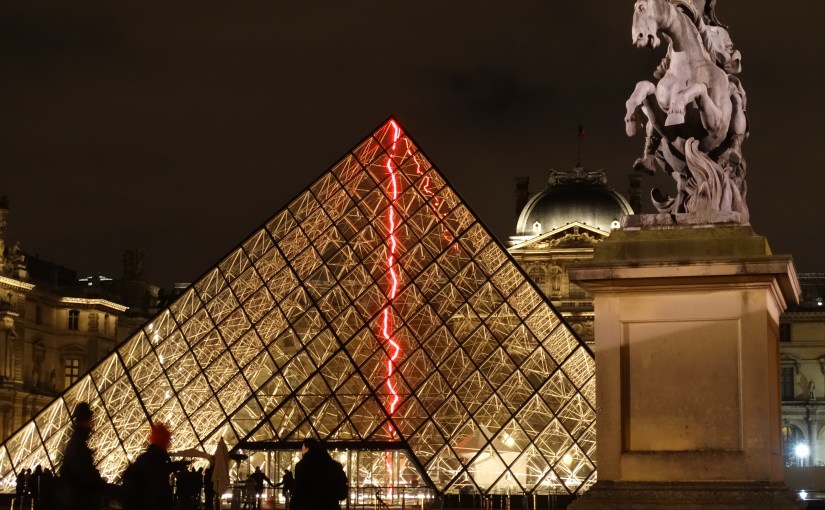
With no particular goal, we walked to Place de Clichy, bought a 2 day metro pass, and caught the metro to Saint Michel. On surfacing from the underground we headed across Pont Michel along Rue du Palais and Pont Change. We could see Notre Dame on the eastern end of Ile de Citie and off to the west Tour Eiffel and the dome of the Grand Palais. We decided to check out the Musee du Louvre. It was not open but still a vision by night. We then travelled west through the Jardin Tuileries onto Place de Concorde and the Obelisk. We sighted the Xmas lights of Champs Elysees and straight away Kerry wanted to walk through there.

Both sides of the Champs Elysees was alight and bubbling with Xmas stalls and food. We enjoyed a truly unusual French delight – Baked potato with various toppings – far more a Midlands/ Yorkshire dish.

Nevertheless on we strolled, passing children’s rides and umpteen shops until we reached the commercial end of Champs Elysees. We were starting to tire so we called it a night outside of the Lido and caught the Metro at George V metro station to Charles de Gaulle Etoile metro station which got us back on the blue line to Place de Clichy, our hotel and bed.

← Back

Thank you for your response. ✨

Bishops Visit – France and More – Orleans

Our tour was fast coming to an end. We intended to spend the last two days in Paris and see in the New Year in that gay city. To break up the journey from Limoges we decided to stop in Orleans. Orléans is a city in north-central France, about 111 kilometres southwest of Paris. It is located on the Loire River where the river curves south towards the Massif Central.

“In the Merovingian era, the city was capital of the kingdom of Orléans following Clovis I’s division of the kingdom, then under the Capetians it became the capital of a county then duchy held in appanage by the house of Valois-Orléans. The Valois-Orléans family later acceded to the throne of France via Louis XII then Francis I. In 1108, one of the few consecrations of a French monarch to occur outside of Reims occurred at Orléans, when Louis VI of France was consecrated in Orléans cathedral by Daimbert, archbishop of Sens.” (source Wkipedia)

We stopped for lunch and to see the magnificent Cathedral. We had an unexpectedly nice lunch (the soup was probably 3 parts cream 1 part pumpkin) and our stroll through the ancient streets led us to the cathedral. Now anyone who has been reading my blogs knows we have seen a few cathedrals, however I was not prepared for the enormous height of the nave and dome in this building. To emphasis the height clear glass windows ran all the way around the building just below the vaulted ceiling.

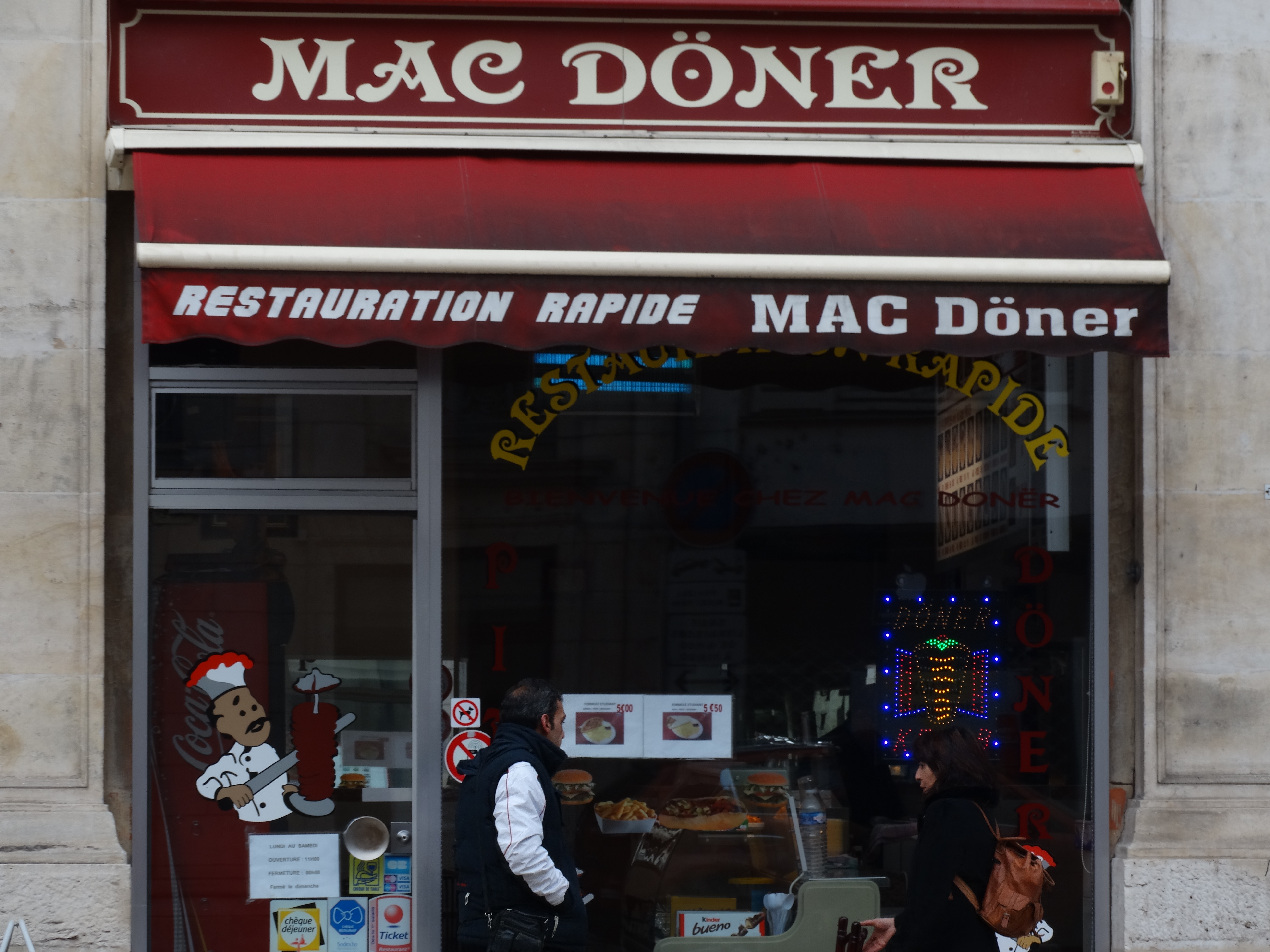
The city is service by trams. Around the cathedral something just did not seem correct. The trams were operating and passing the cathedral but no overhead power lines to despoil the view. Answer, there is a third rail between the tram tracks and the tram picks up the power by a foot under the vehicle. We also spotted the original Mc Donalds – see below.

DSC02728

We had very little time here as Kerry wanted to avoid rush hour in Paris to get to our hotel in Monmarte. In the words of that famous general MacArthur – we shall return – at some stage to further investigate Orleans.

← Back

Thank you for your response. ✨

Bishops Visit – France and More – Limoges and the Tradgedy of Oradour sur Glane

We left Dampierre on the morning of December 28 with much sadness that our time there had ended. With a fair wind we set sail to Limoges in the Central Massif. On the way however we called into Oradour sur Glane. It was a bitterly cold (below zero with some snow flecks) and misty day. The memorial was closed but the gate to the remains of the WW2 village lay open and beckoning. To me it looked like a village where a devastating fire had rushed through catching its inhabitants unprepared. In fact the fire was War and the result one of the all too familiar atrocities of War – the massacre of non-combatants. I have given the web link to the official site and the opening paragraph from the site. I have also added a few photos of what I saw.

http://www.oradour.info/

“This website describes the history, background and events leading up to the Nazi war-crime of the attack upon the martyr village of Oradour-sur-Glane. This atrocity was carried out on Saturday 10th June 1944 by soldiers of the Der Führer Regiment of the 2nd Waffen-SS Panzer Division Das Reich. On that day, without giving any explanation, they killed a total of 642 men, women and children, leaving only a few survivors. They then destroyed the entire village and to this day there is no universally accepted explanation for the massacre. The narrative, “In a Ruined State”, gives a full description of what happened on the 10th June 1944 and reviews all the current explanations offered by different authors for the attack on the village. In addition there are over 200 photographs in the Picture Gallery and much supporting information in the Appendices, including advice on how to get there and places to stay during a visit. If short of time, read the Summary and browse the Picture Gallery, but for a fuller understanding it is recommended to read all of, In a Ruined State and the Appendices, as they contain much relevant detail about the background to the affair and what happened afterwards to all those involved.”

I also recommend that you look at the Wikipedia history as a preliminary to reading more if you wish to do so.  Note the words from the official site “and to this day there is no universally accepted explanation for the massacre”

“http://en.wikipedia.org/wiki/Oradour-sur-Glane

← Back

Thank you for your response. ✨

Bishops Visit – France and More – Limoges and the Three Villages

Before going to bed we strolled through a very cold Limoges and viewed an old cathedral sized building which we believe has been transformed into a museum. The next morning in Limoges saw the weather changed to sunshine and light winds but the chill was still in the air. We took an early morning walk to the rail station waiting for the Bishops to arise. Warmer gear would be the order of the day.

Our plan was to visit three villages all part of Les Plus Beaux Villages de France (The Most Beautiful Villages of France)- Collonge la Rouge, Curemonte and Turenne.

Collonges-la-Rouge is entirely built with red sandstone. Its existence is proven since the 8th century thanks to the donation of the count of Limoges of the parish to the monastery of Charroux. The village is actually where this association Les Plus Beaux Villages de France was created.

The Saint-Pierre church, dating from the 11th, 12th and 15th centuries, is one of the oldest of the Limousin region, and was fortified during the 16th-century French wars of religion. The whole church has been a historical monument since 4 April 1905.

The fortified wall of the village dates back to the 14th century. The doors of the ancient priory are listed as historical monuments.

Curemonte is a medieval village characterised by its three castles. In a fortified position on a ridge overlooking a valley on both its eastern and western flanks, the village has historically had a strategic importance in the area. When we drove into the village we were forced to park on a ridge opposite the village where we enjoyed a picnic lunch despite the chill wind. The day was glorious – mellow sunshine and clear blue skies illuminating this ancient stronghold. Walking through the village felt like a ghost town. I guess many of the residents are holiday visitors. The three towers are in private ownership and no visitors allowed. In the warmer months I suspect the place would be alive with tourists. I think we got to see the village at its best without the maddening throng.


Turenne is a medieval village and castle characterised by its height and unique position on top of a cliff. The first lords of Turenne appeared in the 9th century. The town became a veritable feudal state after the Crusades and one of the great fiefs of France in the 14th century.

Turenne has seen a succession of four families of Viscounts. On 8 June 1738, Turenne was sold to Louis XV to pay the gambling debts of Charles Godfrey, the last of the Viscounts of La Tour d’Auvergne family. Thus ended the quasi-independence of this last French stronghold. The Viscounty’s subjects became subjects of Louis XV and were forced to pay taxes. The king also ordered the dismantling of the fortress of Turenne. As of the Revolution, Turenne was more like a seat of a royal provost.

We had some difficulty working out how best to gain access as the village sprawls up the side of a steep slope. I eventually just drove up risking the wrath of the locals but there was no objections until I wanted to come down when the no entry signs just had to be ignored if I was ever going to get Thistle out of there. Half way up was an interesting church – another Notre Dame.

DSC02717 DSC02718 DSC02719

The remains of the castle and there was not much was closed. However it was still magical wandering through the village and viewing the valleys below. I even found evidence of an abandoned archaeological dig in the basement of one of the houses.

After navigating our way out of Turenne, we happened upon an old 11th century church under repair. It is apparently built on Roman foundations and therefore of historic interest. But it was not open which did not foil one intrepid member of our group.

Throughout this trip Kerry was doing 90% of the driving with me navigating. The lovely sunshine was so out of the ordinary that the result was a severe headache for Kerry and an early night with take away lamb sandwiches.

← Back

Thank you for your response. ✨

Bishops Visit – France and More – Limoges and St Leonards de Noblat

Limoges is the capital of the Haute-Vienne department and the administrative capital of the Limousin région in west-central France. To reach this regional centre we had to drive through some of the prettiest of French countryside. After the wide green fields, scattered forests and freshly ploughed paddocks of Dampierre it was vastly different to be climbing through the Central Massif, its small villages and woodlands. We arrived in the middle of the day and our apartments are located in the centre of the city but no one told us that our neighbour was the Benedictine Rail Station (Gare de Limoges Bénédictins). This huge station had innumerable lines running through it and numerous passenger trains of up to 30 cars in length going all night.

The apartment was not immediately identifiable but when I did find it there was no reception just the number 13 and a key pad. Reviewing the email booking we found that we collected the keys from 13 A – down an alley between buildings in a shoe shop. Then we found that our host was not adept with English more so than we were not adept with French. After a lot of hand signals and repetition we worked out that our apartments were at the top of two flights of stairs and that we had been given bigger apartments at the same price.

The apartments were newly renovated and very large and stylish. However the timber floor had not been laid properly and it squeaked with every footstep. Apart from this annoying issue the apartments appeared luxurious. Settled in we took a trip to St. Leonards de Noblat. Saint-Léonard church is a UNESCO World Heritage Site part of the World Heritage Sites of the Routes of Santiago de Compostela in France. The day continued to be bitterly cold with gusting wind and barely noticeable snow flurries – Nerida and her prayers for snow.

The village itself was interesting with its many narrow streets and ancient buildings but it was too cold to continue exploring on foot. So I charted a return journey through the area north of Limoges and Tommy found every goat track known to man for this journey. It was pretty country side and pretty hair raising at times.

Kerry had sought assistance with directions to our apartment from the owner of a kebab shop a few doors from our apartment. He did not speak English – he is a Turkish Kurd so he spoke Turk, Kurd, and French but no English. A customer translated and although it did not help we decided to try his Lamb Sandwich for dinner. Well it was simple tasty wholesome food at very little cost. We returned again the following night.

After dinner Kerry and I took a walk through the city centre for so long as we could withstand the cold before retiring for the night.

← Back

Thank you for your response. ✨

Bishops Visit – France and More – Dampierre and Ancient Aulnay -de-Saintonge

However we had an important stop to make. We had to visit Aulnay and the Church of St Pierre d’ Aulnay and view the ancient tower.


Aulnay, commonly referred to as Aulnay-de-Saintonge, is a French commune in the Charente-Maritime department in the Poitou-Charentes region of south-western France. The Church of Saint-Pierre d’Aulnay (12th century) is reported by Wikipedia to be “One of the finest surviving Romanesque churches. It is also classified as a UNESCO World Heritage Site. It is unknown why the church was built so far from the town but it may be related to the site of an old cemetery along the Roman road. At the end of the 11th century the building that preceded it belonged to the Abbey of Saint-Cyprien in Poitiers who, around 1045, received part of the burial rights and wax offerings from the church as evidenced by a donation by Ranulfe Rabiole. Pierre II, Bishop of Poitiers, around 1100 confirmed the ownership of the church by the monastery and Pope Calixtus II followed his example in 1119. In 1135 however, the parish belonged to the Chapter of Poitiers Cathedral which retained its rights until the French Revolution. Papal bulls dated 1149 and 1157 list the Aulnay church in the list of properties of Canons who were calculating their costs. Numerous oriental influences can be seen in its designs. For example the first arc of the gate is inspired from Oriental designs. Designs of elephants also originate from Oriental designs. The Church contains several items that are registered as historical objects….”. For further information see http://en.wikipedia.org/wiki/Aulnay,_Charente-Maritime.
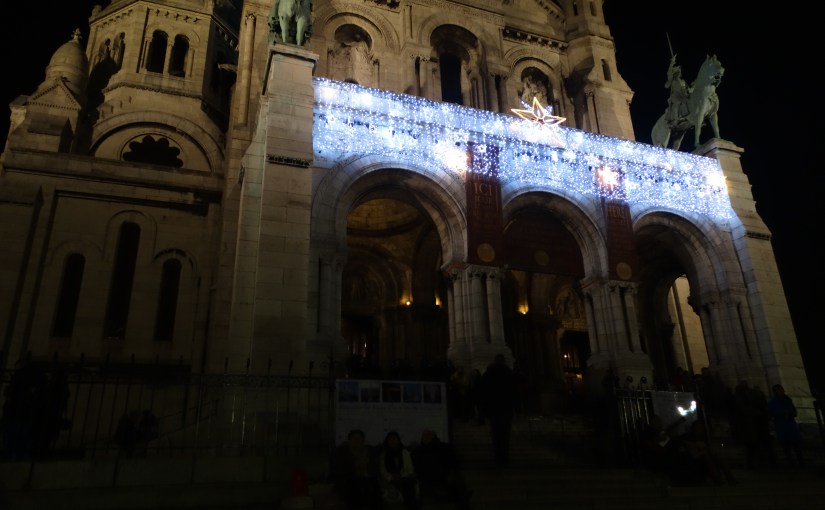
 

We were told this church is on the pilgrimage to Santiago de Compostella, but apart from its obvious history we could not see evidence of the walk. So I went to Wikipedia and this is what it says ” They follow many routes (any path to Santiago is a pilgrim’s path) but the most popular route is Via Regia and its last part, the French Way (Camino Francés).” So I guess some pilgrims’ include it on their trip from Limoges (on the French Way see map at the follow link)

http://en.wikipedia.org/wiki/Camino_de_Santiago_(route_descriptions)

The Viscounts of Aulnay (or Viscounts of Aunay) were descendants of other noble families in Poitou and Saintonge and lived in a castle which was demolished in 1818 but whose tower still remains. It is this tower near the town hall (Hotel de Ville) and its unusual coloured memorial to the soldiers of WW1 that we went to visit.

Part of the old Abbey remains but it now forms part of the centre of the village and a restaurant precinct where we had a slap up dinner as a thank you to our hosts that evening.

← Back

Thank you for your response. ✨